














Summary:
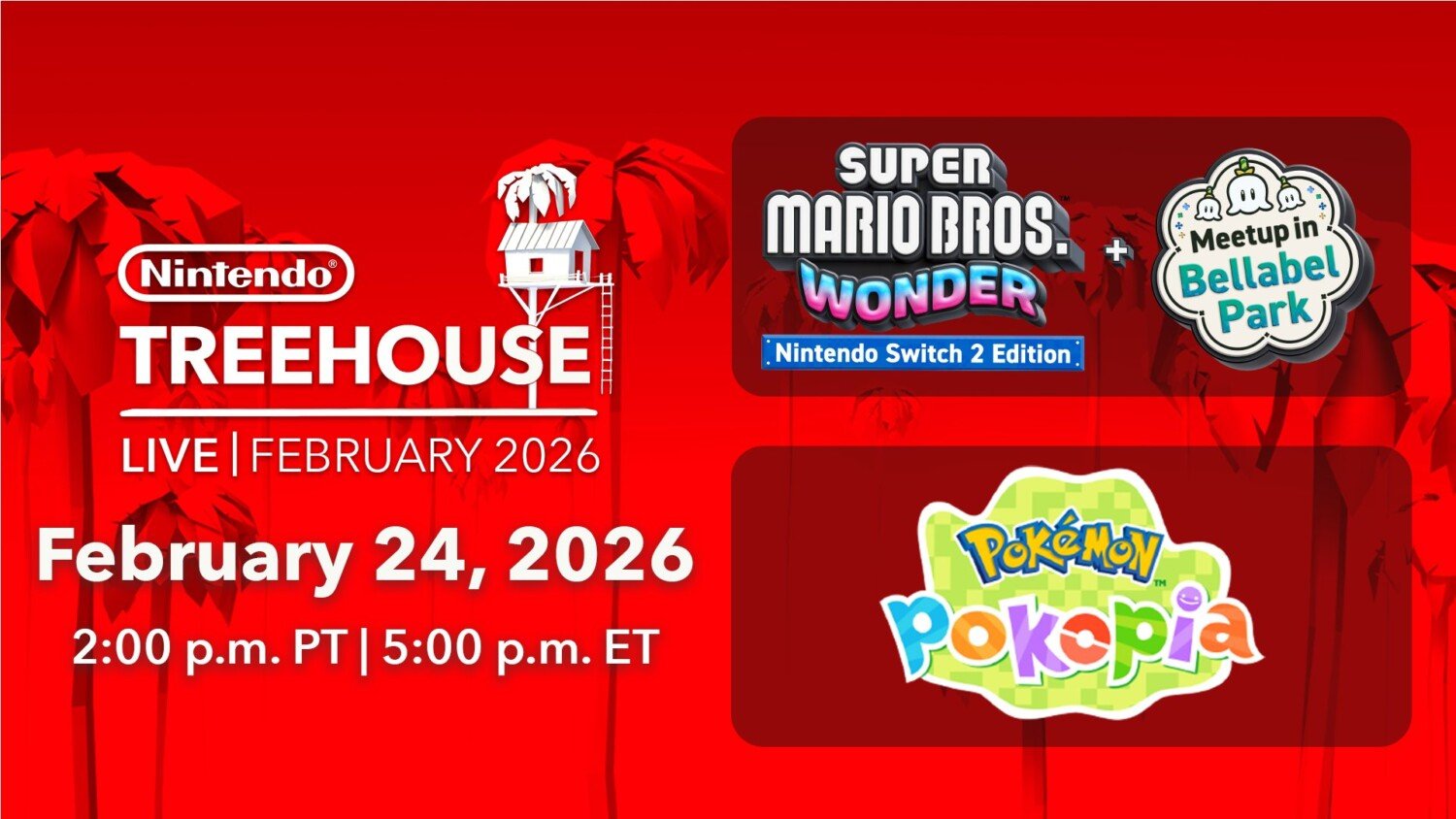
Nintendo has locked in a Nintendo Treehouse: Live for February 24, and the setup is refreshingly straightforward: hands-on gameplay for two Switch 2 games, shown in a format that usually prioritizes real play over polished trailers. The livestream begins at 2:00 p.m. PT – which lands at 11:00 p.m. in Amsterdam (CET) on the same date – and it will be hosted on Nintendo’s YouTube channel, with Nintendo also promoting it through its official events page. If you have ever watched a Treehouse segment before, you know the vibe: developers or Nintendo staff talk through what is happening on screen while the game is actually being played, which tends to expose the tiny details that trailers skip. That is why this one matters, even if you already know the headlines.
On the menu are Super Mario Bros. Wonder – Nintendo Switch 2 Edition + Meetup in Bellabel Park and Pokémon Pokopia. Nintendo’s own description frames Bellabel Park as a new area with multiplayer attractions, which instantly raises practical questions: how the new area is accessed, how quickly you can get into the fun part with friends, and what the flow looks like when the action shifts from classic side-scrolling stages into a social-style hub. Pokémon Pokopia is pitched as a cozy life experience with Pokémon friends and other players, so the hands-on angle should be perfect for answering the stuff that actually affects your day-to-day play: pacing, menus, online prompts, and what you are doing minute to minute when you are not watching a trailer cut. By the end of the show, we should have a much clearer feel for both games – not just what they are, but how they move, how they sound, and whether they look like something you want to jump into on day one.
What Nintendo Treehouse: Live is and why it matters this week
Nintendo Treehouse: Live is one of those formats that tends to age well because it is built around real gameplay. Instead of a fast-cut montage that makes everything look flawless for six seconds at a time, we usually get longer stretches where the camera just stays put and the game has to carry the moment. That is useful when you care about the little things that shape your actual play sessions, like how quickly menus respond, how readable the UI is from the couch, or whether a feature sounds fun in a bullet point but feels clunky when someone actually uses it. This week’s show is also a nice pulse check for Switch 2 support, because Nintendo is positioning it as “hands-on” for two specific games rather than a wide buffet of quick clips. If you are the type who likes to know what you are buying before you commit, this is the kind of livestream that can save you from guessing. And if you just want a fun hour of Nintendo energy while you wind down at night in Europe, this is basically a scheduled excuse to make a snack and watch Mario chaos unfold.
Date, start time, and where to watch the stream
The broadcast is set for February 24, 2026, starting at 2:00 p.m. PT and 5:00 p.m. ET. For Amsterdam and most of Central Europe, that lines up with 11:00 p.m. CET on February 24, which makes it a classic late-night Nintendo appointment – the kind where you tell yourself you will watch “just the first few minutes,” and suddenly it is past midnight and you are debating whether you can squeeze in one more replayed segment. Nintendo is pointing viewers to watch on YouTube, and it also has the event listed on its official site. If you want the cleanest experience, YouTube is usually the simplest route because you can pause, rewind, and jump back to specific moments when a mechanic flashes on screen for half a second. Another bonus is that if Nintendo keeps the recording up after the live broadcast, you can revisit sections later without hunting through third-party uploads. In other words, the easiest plan is: open the YouTube link a few minutes early, set the quality to something stable, and you are ready.
How the showcase is structured and how long it runs
Nintendo is presenting this as a focused Treehouse: Live featuring hands-on gameplay from two games, which usually means longer uninterrupted play segments rather than rapid-fire announcements. Nintendo’s official event listing describes the livestream as lasting roughly 60 minutes, so it is designed to be long enough to show real systems in action without turning into an all-night marathon. That runtime matters because it sets expectations: we are probably getting meaningful gameplay slices, but not every question under the sun is guaranteed to be answered. The best way to approach a one-hour Treehouse is to listen for the practical commentary. When someone casually says, “Now we are going to hop into this mode,” or “Here is how you join a friend,” those offhand lines often reveal more than any marketing blurb. If there is a split between games, keep an eye on the pacing – if the first segment runs long, the second might move faster, and you will want to be ready to rewind later. Think of it like a tasting menu: not everything in the kitchen, but enough bites to know what the meal is going to be like.
Super Mario Bros. Wonder – Nintendo Switch 2 Edition + Meetup in Bellabel Park
Super Mario Bros. Wonder is already known as a lively 2D Mario experience, and the Switch 2 Edition branding is paired here with “Meetup in Bellabel Park,” which Nintendo describes as an addition that expands the Flower Kingdom with a new area featuring multiplayer attractions. That one sentence is doing a lot of work, because it suggests a shift from purely level-based play into something that feels more like a shared space – a place you go when you want quick bursts of multiplayer fun, a change of pace, or a more social way to interact with the game’s systems. The Treehouse format is ideal for showing how that actually works, because it can reveal whether Bellabel Park is something you dip into for five minutes or a place you end up revisiting again and again. We should also get a better sense of how the Switch 2 Edition label shows up in moment-to-moment play. Does it feel like a simple upgrade, or does it change how you approach sessions with friends? The most interesting part is usually not the big headline feature, but how smoothly it fits into the flow of play.
What “Meetup in Bellabel Park” adds in plain terms
Nintendo’s description is short but clear: Bellabel Park is a new area with multiplayer attractions, and it expands the Flower Kingdom. The key word there is “area,” because it implies a place with its own structure rather than a single minigame tacked onto a menu. In practical terms, that means we should be watching for how you enter it, what it looks like when you arrive, and how quickly you can start doing something fun with other players. If it takes three menus, two confirmations, and a loading screen, it might be something you only use occasionally. If it is quick and inviting, it could become the default hangout when friends come over. The Treehouse segment can also reveal the social rhythm – do you walk around and pick attractions, do you queue up, or do you trigger activities from NPCs or signposts? The difference between “multiplayer exists” and “multiplayer feels effortless” is huge, and Bellabel Park is the kind of feature that lives or dies on convenience. If Nintendo shows multiple players interacting smoothly, that is the strongest signal that this is more than a cute name.
What we should look for during the hands-on segment
When the gameplay starts, the best details are often the ones that nobody pauses to explain. Watch how quickly the player can swap between activities, how readable the interface is during multiplayer moments, and whether there are clear prompts that help you join or invite others. If Bellabel Park is built around attractions, pay attention to whether those attractions look like quick party-style bursts or longer structured challenges. Also keep an eye on how the camera behaves with multiple players, because 2D Mario can get chaotic fast when everyone is sprinting in different directions like toddlers escaping a birthday party. Another useful clue is how Nintendo staff talk about it. If the commentary focuses on “jump in with friends” and “here is how you meet up,” that suggests the feature is meant to be frictionless. If it is mostly describing what the park is rather than showing how it works, that can be a sign that the flow is harder to demonstrate. And, because this is tied to a Switch 2 Edition label, we should look for any explicit mentions of what is new beyond the park itself. If it is there, Nintendo usually finds a way to call it out while the game is on screen.
Pokémon Pokopia
Pokémon Pokopia is positioned by Nintendo as a cozy life experience where you build a comfortable routine with help from Pokémon friends and other players, and Nintendo’s event listing also notes a March 5 launch for Nintendo Switch 2. That combination – cozy life plus Pokémon plus multiplayer framing – is exactly the kind of pitch that can sound great in a sentence but needs hands-on footage to truly land. The Treehouse setting is perfect for this because it can show what “cozy” means in practice. Are you decorating, farming, crafting, or managing a town-like space? How often are Pokémon actively involved, and do they feel like partners or like mascots standing nearby? The stream can also reveal the rhythm of play: the loop you repeat, the tasks you do daily, and how quickly you get from “start the game” to “I am doing the fun thing.” If you have ever bounced off a life sim because the opening hour felt slow, you know why this matters. The goal here is not hype – it is clarity.
The core idea and what hands-on footage can confirm
The core pitch Nintendo is putting forward is simple: you build a cozy life with Pokémon friends and other players. The livestream can confirm what that looks like without guessing. We should see the player moving through real environments, interacting with objects, and doing routine activities that define the game’s identity. Hands-on footage also tends to show whether the game is menu-heavy or action-forward, and whether the world feels alive or staged. Another key point is how Pokémon participate. Are they assigned tasks, do they accompany you, do they assist with building or gathering, or are they mainly there for vibe? The footage can also reveal pacing, like how quickly new options unlock and whether the early minutes feel welcoming. If the Treehouse presenters spend time showing the daily loop – even briefly – that is a strong sign Nintendo wants you to understand what you will actually do when you pick up the controller. And if they show multiplayer interactions in a natural way, that will do more to sell the concept than any line of text ever could.
Multiplayer notes and the kind of details that matter
Nintendo’s listing includes a multiplayer asterisk note, which is typical language that reminds players additional games, systems, or accessories may be required for multiplayer modes, and that games and accessories are sold separately. In practice, what matters most is how multiplayer is integrated into the cozy loop. Is it drop-in, where a friend can join your space quickly, or is it session-based, where you meet in a separate area? The hands-on footage may show the entry point – an invite prompt, a menu option, or a visible hub-like feature. Pay attention to whether multiplayer looks like “we are building together” or “we are visiting each other,” because those are very different flavors of social play. Also watch for signs of how communication is encouraged, even if Nintendo does not explicitly talk about it. If characters are gathering, trading, or collaborating, that suggests the game wants social interaction to be central. If multiplayer appears more like light co-presence, it might be a chill add-on rather than the main draw. The stream does not need to answer every technical question to be useful – it just needs to show the vibe honestly.
What “hands-on gameplay” usually signals in a Treehouse format
When Nintendo says “hands-on gameplay” in a Treehouse context, it usually means longer uninterrupted stretches that show the game behaving like a real product rather than a cinematic pitch. That is important because it can reveal the natural pace of play. You see how quickly characters move, how readable the world is, and whether actions feel snappy or slow. It also tends to surface small quirks: a camera angle that gets awkward in multiplayer, a menu that takes an extra click, or a feature that looks fun but requires more setup than you expected. Another benefit is that Treehouse commentary often includes casual clarifications. Someone might mention how a mode is accessed, what the goal of an activity is, or how a feature is meant to be used, and those lines can clear up confusion better than a press release. If you watch with a practical mindset, this kind of show can help you decide whether you want to play day one, wait for impressions, or simply keep it on your wishlist. It is less like a fireworks show and more like watching someone test-drive a car on normal roads.
Smart ways to watch, rewind, and capture the details you care about
If you want to get the most out of the livestream, treat it like a short detective session. Start by watching live to catch the excitement, but do not stress if you miss something – YouTube’s rewind is your best friend. When you see a menu flash by or a feature name pop up, pause and take a quick note. Even a simple timestamp like “Mario park hub menu” or “Pokopia multiplayer join screen” can save you time later. Another useful habit is to listen for phrasing like “this is new” or “here is how you…” because those lines are often followed by a demonstration. If you care about visual quality, switch the stream to a stable resolution that matches your connection, because buffering ruins momentum and makes you miss the tiny UI moments. And if you are in Europe, the late start time can be a blessing: you can watch with fewer distractions, then rewatch key parts the next day with a clear head. It is like watching a magic trick twice – the first time for fun, the second time to see how the rabbit got into the hat.
Questions the stream can realistically answer – and what it probably won’t
A one-hour Treehouse can answer a lot, but it has limits. It can show how Bellabel Park is entered, what it looks like when you are there, and how the multiplayer attractions are presented in the interface. It can also show the moment-to-moment loop of Pokémon Pokopia and how the “cozy life” pitch translates into actions you actually take. What it might not do is cover every edge case: every multiplayer restriction, every online requirement detail, or every late-game system. Treehouse segments are usually curated to show features clearly, which means they may focus on friendly scenarios that demonstrate the intended experience. That does not make it misleading, but it does mean you should watch for what is shown and what is not. If multiplayer is a core selling point, we should see it functioning plainly on screen. If it is only mentioned in passing without a demonstration, that is a signal to wait for follow-up details. The best mindset is to look for solid confirmations rather than reading tea leaves. If you leave the stream with a clearer picture of what playing feels like, it has done its job.
What to do right after the stream ends
Once the livestream wraps, the smartest move is to do a quick rewind pass on the sections that matter most to you. If you care about Super Mario Bros. Wonder – Nintendo Switch 2 Edition + Meetup in Bellabel Park, rewatch the first moments where the new area is introduced, because that is where Nintendo is most likely to show the entry point and the basic structure. If Pokémon Pokopia is your priority, rewatch any moments where the player interacts with Pokémon in everyday tasks, because that is where the game’s identity will be most obvious. After that, check Nintendo’s official event page for any updated wording or links, since Nintendo sometimes adjusts pages after a broadcast. Finally, if you are planning to watch with friends or talk about it online, grab a couple of clean timestamps so you can point people to the exact moments that answer real questions. That way the conversation stays grounded in what was actually shown, not what someone “heard might be in the game.” In the end, the livestream is the source of truth for feel and flow. Everything else is just noise on top.
Conclusion
Nintendo Treehouse: Live on February 24 is shaping up to be the kind of livestream that rewards practical curiosity. We are getting hands-on gameplay for Super Mario Bros. Wonder – Nintendo Switch 2 Edition + Meetup in Bellabel Park and Pokémon Pokopia, shown in a format that tends to expose how games really behave when the controller is in someone’s hands. The start time is locked, the viewing options are simple, and Nintendo’s own event listing sets expectations for a roughly one-hour show. If you want real answers about what Bellabel Park looks like as a multiplayer space, or what “cozy life” actually means in Pokémon Pokopia, this is a great chance to watch those questions get answered on screen. The best part is that we do not need to guess. We can watch, pause, rewind, and see it for ourselves.
FAQs
- When does Nintendo Treehouse: Live start on February 24, 2026?
- It starts at 2:00 p.m. PT / 5:00 p.m. ET, which is 11:00 p.m. CET in Amsterdam on February 24, 2026.
- Where can we watch the livestream?
- Nintendo is directing viewers to watch on YouTube, and it is also listed on Nintendo’s official events page.
- Which games are featured in this Treehouse: Live?
- The featured games are Super Mario Bros. Wonder – Nintendo Switch 2 Edition + Meetup in Bellabel Park and Pokémon Pokopia.
- How long is the Nintendo Treehouse: Live expected to run?
- Nintendo’s official event listing says the livestream will last roughly 60 minutes.
- What is Bellabel Park in the Mario Wonder Switch 2 Edition listing?
- Nintendo describes Bellabel Park as a new area that expands the Flower Kingdom and includes multiplayer attractions.
Sources
- Nintendo Treehouse: Live | February 2026, Nintendo, February 2026
- Nintendo Treehouse: Live | February 2026 (YouTube livestream), Nintendo, February 2026
- Nintendo Treehouse: Live set for February 24 featuring Super Mario Bros. Wonder – Nintendo Switch 2 Edition + Meetup in Bellabel Park and Pokemon Pokopia, Gematsu, February 23, 2026
- Nintendo Treehouse Returns This Week With A Pair Of Gameplay Showcases, Nintendo Life, February 23, 2026
- Nintendo Treehouse Live to showcase Pokemon Pokopia and Super Mario Bros. Wonder – Switch 2 Edition, Shacknews, February 23, 2026