














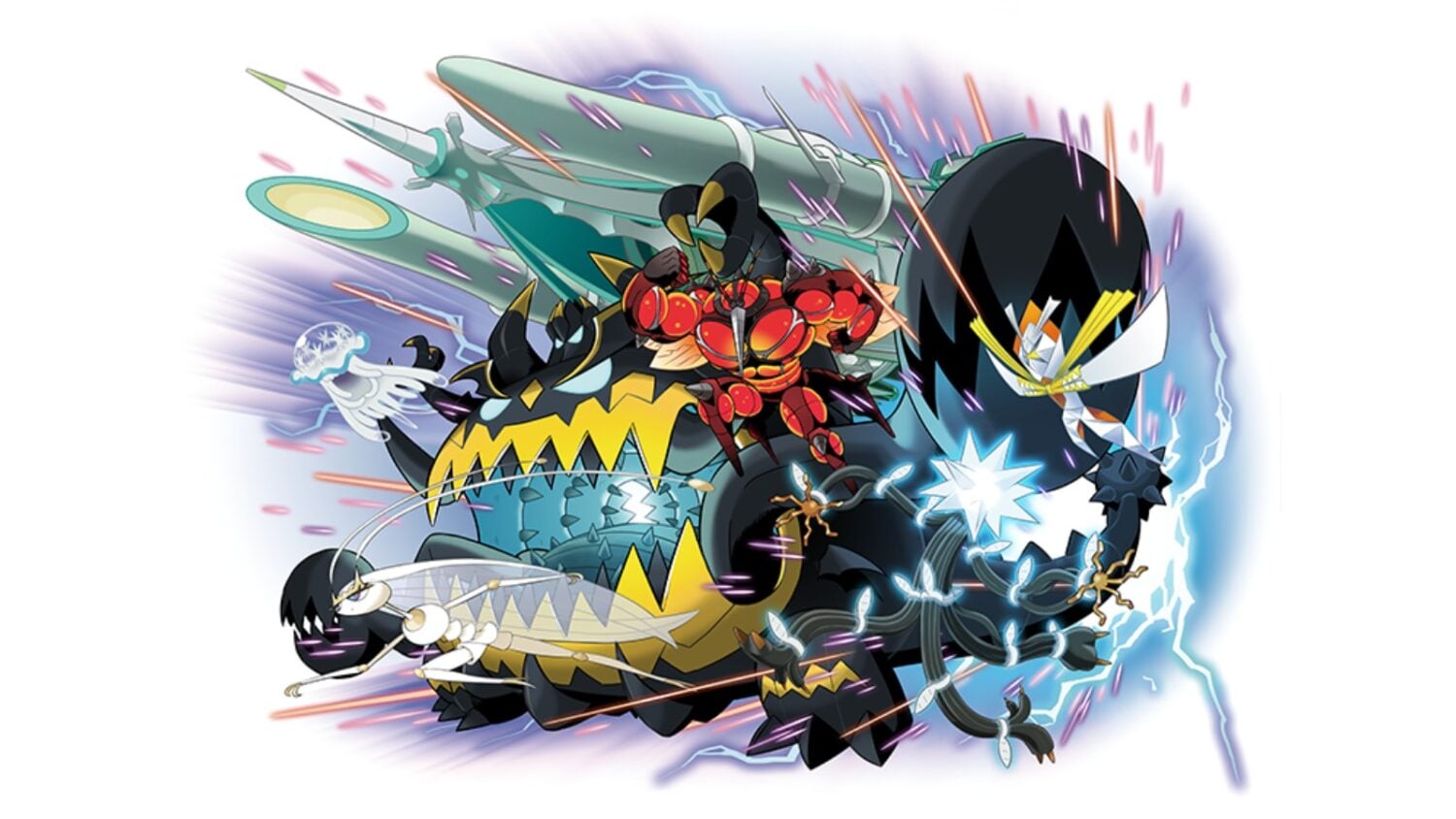
Summary:
Ultra Beasts hit Pokemon Sun and Moon like a sudden weather change. One minute we were in familiar territory, and the next we were staring at creatures that looked like they had wandered in from a different franchise. That reaction was never an accident, and Yusuke Omura’s recent explanation helps us understand why the Ultra Beasts don’t “blend in” the way most new species usually do. Omura, who worked as a lead designer on Sun and Moon, shared that the Ultra Beasts were shaped by earlier Pokemon design ideas of his that had been rejected by Ken Sugimori. Instead of tossing those ideas into a digital drawer forever, he deliberately leaned into the exact traits that got them rejected and used those reasons as a guiding style for the Ultra Beasts.
That single choice explains a lot. If a normal Pokemon is meant to feel like it belongs in the same ecosystem as Pikachu and Eevee, an Ultra Beast is meant to feel like it doesn’t. Their silhouettes can be awkward, their proportions can feel unsettling, and their “faces” can read more like masks or signals than cute expressions. Omura even joked that the result was like a “manifestation” of resentment, while making it clear there was no personal hostility toward Sugimori. The key takeaway is not drama. The key takeaway is craft. Ultra Beasts were built with a design philosophy that weaponized “wrongness” into identity, which fits their lore as visitors from Ultra Space. And once we see that, the whole concept becomes easier to appreciate, whether we love Ultra Beasts or still find them a little creepy in the dark.
Pokemon Sun/Moon Ultra Beasts and the moment Pokemon got weird on purpose
When Ultra Beasts arrived in Pokemon Sun and Moon, they didn’t feel like “the next batch” of familiar creatures. They felt like an intrusion, like someone left a door open and something unfamiliar slipped into the room. That feeling matters because Pokemon usually aims for instant recognition. Even brand-new species often carry a kind of visual comfort: readable faces, friendly shapes, and a vibe that says, “Yes, we belong here.” Ultra Beasts do the opposite. They look like living warnings, like biology that took a left turn and never corrected itself. And that is exactly why fans still talk about them years later. We can argue about favorites, we can argue about whether they count as Pokemon in spirit, but we can’t pretend they were forgettable. They were designed to create friction, and friction creates memory. Like a song with one strange chord that keeps ringing in your head, Ultra Beasts stick because they don’t resolve the way we expect.
Yusuke Omura’s reveal and why it instantly clicked with fans
Yusuke Omura’s explanation landed with the satisfying thud of a puzzle piece snapping into place. He shared that he designed the Ultra Beasts by recalling designs he had made in the past that were rejected by Ken Sugimori, then deliberately using the reasons for rejection as the artistic direction. That line is doing a lot of work, because it tells us the “alien” vibe wasn’t just a random style experiment. It was a method. If a typical design gets rejected for being too sharp, too abstract, too odd, or too far from the series’ usual shape language, then those exact qualities become the foundation once the goal shifts to “make something that feels outside the normal world.” Omura’s joke about resentment reads less like bitterness and more like gallows humor from someone who remembers the sting of hearing “no” repeatedly. Most people can relate to that. We’ve all had a moment where we wanted to prove a point, even if we did it with a wink. The important part is that he also clarified there were no hard feelings, which keeps the focus where it belongs: on the creative process, not on personal conflict.
What the “manifestation” joke really tells us about the design mood
Calling the Ultra Beasts a “manifestation” of resentment is funny, but it is also revealing. It points to an emotional engine behind the work, and emotion can sharpen design decisions. When we design with a clean, neutral goal, we tend to sand off the edges. When we design with a strong feeling in the driver’s seat, we commit harder. Ultra Beasts feel committed. They don’t apologize for being strange, and they don’t beg to be liked at first glance. They stand there like, “Yes, we look like this. Deal with it.” That’s powerful branding for creatures meant to feel unnatural. It also helps explain why Ultra Beasts can trigger such split reactions. If something is built to be unsettling, some people will bounce off immediately, while others will get obsessed and start collecting favorites like trophies. The joke is a sign that the discomfort was part of the recipe, not an accident that slipped past quality control.
Ken Sugimori’s role and what “rejected” really means in a studio
Ken Sugimori’s name carries weight in Pokemon for a reason. He helped define the series’ visual identity, and that identity is not just “cute monsters.” It’s a specific balance of shapes, readability, and charm that still leaves room for tough or scary designs without losing the Pokemon flavor. In a studio environment, rejection is not automatically a judgment of talent. Often it is a judgment of fit. A design can be strong on its own and still be wrong for the slot it needs to fill. It can clash with the rest of the lineup, confuse the silhouette language, or push the style too far away from what the brand needs that generation. So when Omura says his designs were rejected, we should read that as part of a normal pipeline where ideas are filtered and refined. Then the clever twist happens: Ultra Beasts create a category where “wrong fit” becomes “perfect fit.” If the job is to design something that looks like it does not belong in Alola’s natural world, then the designs that once failed the “belongs here” test suddenly become golden.
Rejection as a tool, not a dead end
One of the most interesting parts of this story is that it frames rejection as storage, not disposal. Think about it like a kitchen. If an ingredient doesn’t work in one dish, you don’t throw it out if it’s still good. You save it for the recipe where it shines. Game studios do the same thing. Concepts get shelved, reused, remixed, and re-contextualized all the time, especially when they are strong but don’t match the current project’s needs. What Omura described is a very intentional version of that. He didn’t just recycle old sketches. He used the reasons those sketches failed as the guiding principle. That’s like turning critique into a design checklist: “Make it stranger. Make it less conventional. Make it feel uncomfortable.” In a franchise built on familiarity, that kind of deliberate contrast becomes a feature.
Turning rejection into a design rulebook
The core of Omura’s approach is almost mischievously smart. If a senior art director rejects something for being too far outside the series’ normal shape language, then those “too far” traits can become the official rules for a new category that needs to feel outside the norm. That is how we get Ultra Beasts that look like they were engineered rather than evolved. It’s also how we get designs that can feel more like symbols than animals, more like living geometry than wildlife. This method does something else, too: it makes the category coherent. Ultra Beasts may all be different, but many of them share that “off-world” reading. That consistency suggests a clear guiding philosophy rather than random experimentation. It also makes the narrative stronger, because the visual language supports the story. We don’t just get told these are from another dimension. We can see it. The designs whisper it before any character explains it.
Why “using the reasons” matters more than the old sketches themselves
It would be easy to reduce this to “Ultra Beasts are recycled designs,” but that misses the point. The important detail is that Omura used the reasons for rejection as the artistic direction. That means the process is less about nostalgia and more about constraint. Constraints shape creativity. If the constraint is “feel like Pokemon,” we get one type of design. If the constraint is “feel like a rejection of Pokemon norms,” we get Ultra Beasts. This also helps explain why some Ultra Beasts look like they have minimal facial expression or unusual anatomy. In standard Pokemon design, readability and character often flow through the face. In Ultra Beasts, the face can be withheld, abstracted, or presented in a way that feels like a mask. That choice creates distance, and distance creates alienness. So even if we never see the original rejected sketches, we still understand the method, and the method is what makes the category work.
Why the Ultra Beast silhouette language feels “off” in the best way
Silhouette is one of the quiet superpowers of character design. If we can recognize a Pokemon by its outline alone, it usually means the design is doing its job. Ultra Beasts play with silhouette in a way that can feel confrontational. Some are spindly where we expect sturdiness. Some are bulky in ways that read like armor or machinery. Some look like they have too many limbs, or the “wrong” kind of symmetry, or body parts that feel like they were attached with a strange logic. That “off” feeling is the point. Ultra Beasts are not supposed to read as natural animals of the region. They are supposed to read as visitors, invaders, anomalies. The alien look becomes a visual shortcut that tells the player, “Treat this differently.” And because Pokemon is so visually consistent most of the time, the contrast hits harder. It’s like seeing a single glitch in an otherwise smooth video – your eyes snap to it immediately.
Alien design without losing readability
Here’s the impressive part: even when Ultra Beasts look bizarre, they are still readable enough to be memorable. That balance is tricky. Go too abstract and the design becomes noise. Go too normal and it stops feeling like an Ultra Beast. The Ultra Beasts often land in a sweet spot where we can identify them instantly but still feel uneasy. That’s like a clown mask. We can recognize it as a face, but it triggers discomfort because the proportions and emotion cues are wrong. Ultra Beasts can create that same tension. Their shapes are clear. Their vibes are not comforting. That tension is what keeps people debating them years later. Some fans collect Ultra Beast favorites the way others collect rare cards, because the designs feel like a bold statement that Pokemon rarely makes this loudly.
How Ultra Space and the story justify the look
Ultra Beasts don’t exist in a vacuum. Sun and Moon frame them as creatures from Ultra Space, and that framing gives the designers permission to break rules. If a Pokemon is from the local environment, we subconsciously expect it to “make sense” within that ecosystem, even in a cartoonish way. Ultra Beasts are framed as outsiders, and outsiders are allowed to look wrong. The lore and the look work together like two hands clapping. The story says they are not from here, and the designs prove it. That synergy is why the category feels cohesive rather than random. It also lets the games play with tension. Encounters with Ultra Beasts can feel less like meeting a new animal and more like encountering a phenomenon. That mood supports the idea that the world is bigger and stranger than the usual gym-and-routes rhythm, and it gives the Alola setting a distinct identity among generations.
Why “charm” can include discomfort
When people say Ultra Beasts have charm, they often mean something different than “cute.” Charm can be curiosity, intrigue, or that feeling where you can’t look away. Ultra Beasts can be charming the way a weird piece of modern art is charming. You might not want it in your living room, but you respect the commitment and you keep thinking about it afterward. In Pokemon terms, that creates a different kind of attachment. Some players love Ultra Beasts precisely because they break the mold. They feel like the franchise letting its hair down and doing something risky. And if you’ve ever felt like the series sometimes plays it safe, Ultra Beasts feel like a reminder that it can still surprise us.
Fan reactions: love, dislike, and the point of discomfort
Ultra Beasts are the kind of designs that act like a personality test. Some fans look at them and feel immediate excitement, because the designs are bold and the lore is spicy. Others feel immediate rejection, because the designs don’t match what they want Pokemon to feel like. Both reactions make sense. If you grew up loving the cozy, creature-collecting vibe, Ultra Beasts can feel like someone changed the recipe. If you love when Pokemon experiments, Ultra Beasts can feel like a rare treat. Omura’s explanation helps us understand that this split was not accidental. If the guiding rule is to lean into the reasons a design was rejected, we should expect sharp edges. We should expect discomfort. We should expect debate. In a way, the arguments prove the concept worked, because the category refuses to fade into the background.
Why polarizing designs can strengthen a generation’s identity
Every generation wants a signature. Sometimes it’s the region, sometimes it’s a mechanic, sometimes it’s a specific set of monsters. Ultra Beasts gave Sun and Moon a visual identity that is hard to confuse with any other era. Even if we only remember a few names, we remember the feeling: “Those alien ones.” That identity can keep a generation alive in fan memory long after launch. It also creates a strong hook for conversations, remakes, spin-offs, and future references. People still ask about Ultra Beasts because they feel like a door that could be opened again. And once a franchise introduces “other dimensions” in a big way, fans never fully stop wondering what else might be out there.
What this says about collaboration inside Game Freak
Omura’s comments also hint at how collaboration and leadership can shape a franchise’s look. A long-running series needs consistency, and consistency often comes from strong creative direction. At the same time, freshness often comes from letting different artists push boundaries. The Ultra Beasts feel like the result of that tension being used productively. Sugimori’s role helps maintain the core identity, while Omura’s willingness to use “rejected” traits created a controlled space for experimentation. That is a healthy pattern for a franchise this big. It suggests the studio can create categories where rule-breaking is not only allowed but required. And when a team can do that, it keeps the series from becoming a photocopy of itself. It also gives newer artists room to leave fingerprints on the franchise without breaking the main template.
Creative constraints as a shared language
The interesting thing about this story is that it shows how critique can become a shared language. If an art director says, “This doesn’t fit because of X,” that feedback can become a design tool later. The team learns what “fit” means, and they also learn how to intentionally not fit when the story demands it. That’s like learning music theory so you can break the rules on purpose. Ultra Beasts feel like rule-breaking that still understands the rules, which is why they don’t feel like random fan designs pasted into the game. They feel official, but unsettling. That’s a very specific vibe to land, and it usually comes from a team that knows exactly what it is aiming for.
Could we ever get new Ultra Beasts, and how that might work
The big question fans keep circling is whether Ultra Beasts could return with new additions. Omura’s reveal makes that idea more interesting, because it suggests a repeatable philosophy. If the studio wanted new Ultra Beasts, it could create them by identifying designs that were previously rejected for being too strange, too abstract, or too far from the expected Pokemon language, then leaning into those traits again. That would keep the category’s DNA consistent. The story would also need the right doorway – a reason for Ultra Space to matter again, or a new narrative hook that involves dimensional travel, anomalies, or invasive species from elsewhere. Pokemon has already shown it can revisit big concepts, so it’s not impossible. The real challenge would be keeping the return meaningful rather than feeling like a nostalgia button.
What a modern Ultra Beast rollout might look like
If Ultra Beasts return, we might expect them to show up as rare, event-like encounters, because they work best when they feel unusual. A normal route full of Ultra Beasts would dull the effect, like telling the same scary story every night until it stops being scary. The category thrives on contrast. So a modern approach could emphasize mystery again, perhaps with limited sightings, research missions, or story beats that treat them like anomalies rather than regular wildlife. Design-wise, the team could push even harder now, because players are already familiar with the concept. The first wave shocked people. A second wave would need a new angle while still feeling like it belongs to the same strange family. That’s a fun challenge, and Pokemon tends to enjoy those when it decides to commit.
What to watch for if the idea returns in a future game
If we ever see Ultra Beasts again, we should watch for a few signals. One is narrative framing: are they treated as wildlife, as invaders, or as something closer to a phenomenon? Another is design cohesion: do the new designs share that deliberate “rejected on purpose” feeling, where the oddness feels intentional rather than messy? We should also watch how the games present them mechanically. Do they feel like special battles, special catches, special research targets? Or do they get normalized into the broader ecosystem? Ultra Beasts are most powerful when they are not normalized. They are the weird radio station you stumble upon at night – it’s fascinating because it feels like it wasn’t meant for you. Omura’s reveal helps us see that the category’s identity is built from deliberate contrast, and that contrast is the thing worth protecting if the concept ever comes back.
Conclusion
Ultra Beasts stand out because they were built to stand out. Yusuke Omura’s explanation that they drew on designs rejected by Ken Sugimori, and that he deliberately used the reasons for rejection as a design direction, gives us a clean lens for why they feel so alien. It’s not just that they look different. It’s that their “different” is structured, intentional, and tied to the story of Ultra Space. The joke about resentment works because it points to a real creative truth: strong feelings can produce strong design decisions, and Ultra Beasts feel like decisions made with conviction. Whether we love them, dislike them, or still feel mildly unsettled when one appears on screen, we can appreciate the craft behind the discomfort. And if new Ultra Beasts ever appear, the most exciting part is that the philosophy is already there, ready to be used again.
FAQs
- Did Yusuke Omura say Ultra Beasts were based on rejected Pokemon designs?
- Yes. He explained on social media that he recalled designs rejected by Ken Sugimori and used the reasons for rejection as the artistic direction for Ultra Beasts.
- Does this mean there was personal conflict between Omura and Sugimori?
- No. Omura clarified there were no hard feelings, even while joking about resentment as a creative spark.
- Why do Ultra Beasts look so different from other Pokemon?
- The designs intentionally lean into traits that would not fit normal Pokemon, which matches their lore as beings from Ultra Space.
- Are Ultra Beasts meant to feel unsettling on purpose?
- Yes. The design approach focuses on “not fitting in,” using unusual proportions, silhouettes, and readability choices to emphasize otherness.
- Could new Ultra Beasts be added in future games?
- It’s possible in concept. The design philosophy is repeatable, but the story would need a good reason to bring Ultra Space or similar anomalies back in a meaningful way.
Sources
- Pokémon’s Ultra Beasts were based on past Pokemon designs rejected by Game Freak art director Ken Sugimori, artist reveals, AUTOMATON, February 4, 2026
- Sun & Moon’s Ultra Beasts were “a manifestation of my own resentment”, explains Pokemon artist, Nintendo Life, February 4, 2026
- Pokemon’s Ultra Beasts origins, Nintendo Everything, February 4, 2026
- Pokemon artist says Ultra Beasts were based on previously scrapped Pokemon designs, Video Games Chronicle, February 4, 2026
- Genki_JPN shares Omura statement translation on X, X (Genki_JPN), February 4, 2026