














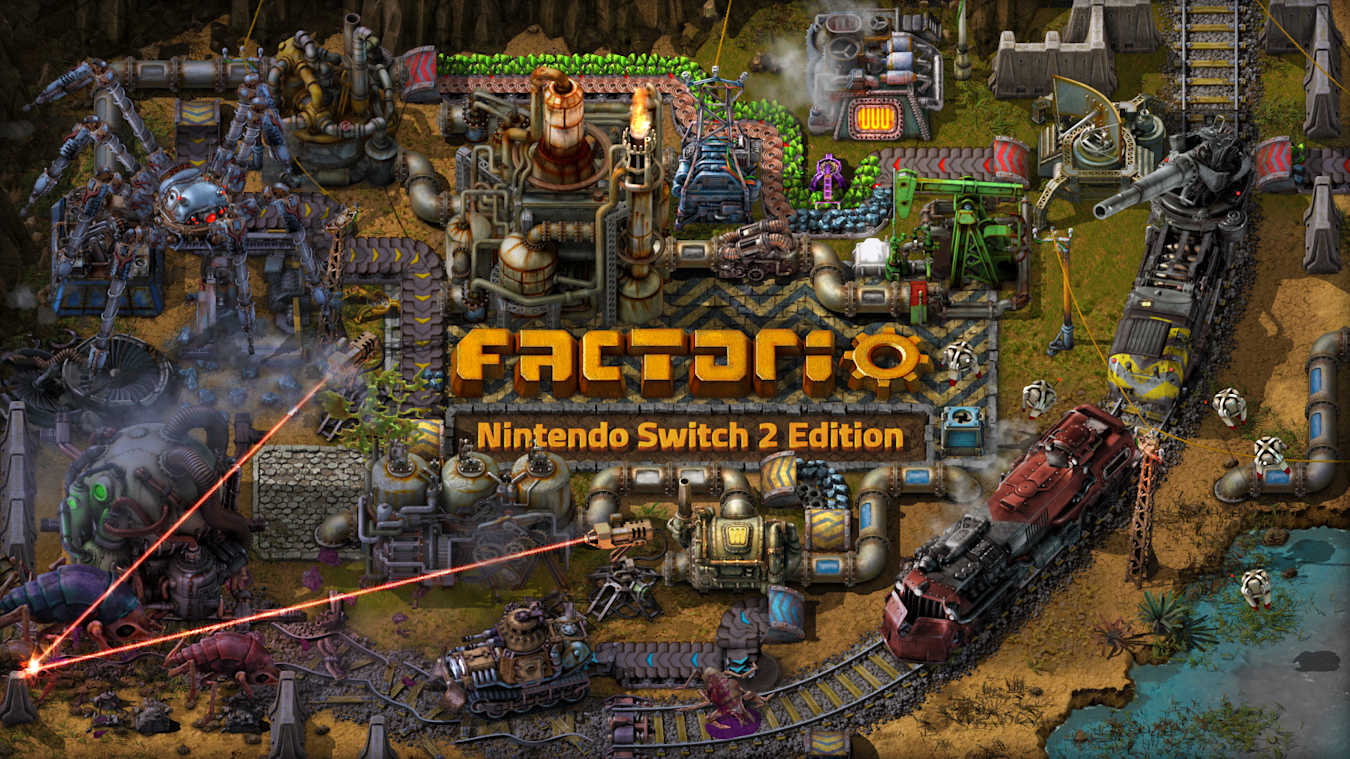
Summary:
Factorio is basically the “one more tweak” game, except the tweak turns into a conveyor belt, the belt turns into a production line, and the production line turns into a planet-sized machine that you swear you totally meant to build. On Nintendo Switch 2, Factorio is set to launch on December 22, 2025, with the Space Age add-on also lined up for the same date and priced at $35. If you’ve ever loved the idea of taking raw ore and turning it into a neatly timed symphony of gears, science packs, and power grids, this is your kind of problem to have. We start small with manual chopping and mining, then ramp up into automation that feels like snapping LEGO bricks together, only the bricks are running at full speed and you’re the one responsible for the traffic jams.
Along the way, we deal with the not-so-friendly locals who don’t appreciate their backyard turning into an industrial wonderland. That means defenses, walls, and the satisfying click of a plan coming together right before a wave of enemies hits. We also lean into the social side: co-op can turn Factorio into a team project where everyone has a role, as long as nobody decides to “improve” the main bus without telling anyone. Add scenarios for focused challenges, a map editor for creative control, and a relatively modest 2.5GB download size on Switch 2, and you’ve got a setup that’s easy to install but hard to put down. Whether you’re brand new or returning with big factory dreams, the goal stays the same: keep building, keep learning, and keep the machines humming.
Factorio arrives on Nintendo Switch 2 on December 22, 2025
Mark the calendar and clear a little space on your system, because Factorio is scheduled to land on Nintendo Switch 2 on December 22, 2025. That date matters because Factorio is the kind of game that doesn’t politely wait for a weekend – it happily eats one. If you like games where your decisions pile up into a living, breathing system, this is your moment. You start with almost nothing, then build up a factory that feels like it has its own heartbeat: drills thumping, furnaces blazing, belts flowing like busy city streets. The big charm is that you’re never “done.” There’s always one bottleneck to fix, one ratio to improve, one layout to tidy up. And if you’re thinking, “That sounds like work,” Factorio’s secret is that it makes work feel like play, because every fix is a small victory you can actually see.
What Factorio actually feels like on a console
Factorio on a console feels like having a massive workbench in your living room, then realizing you can keep expanding the workbench until it pushes the walls outward. The core experience is still about planning and building, but the vibe is surprisingly cozy once you get comfortable. You’re constantly placing machines, connecting them with belts, and watching the factory come alive like a complicated marble run. The real fun comes from the balance between intention and improvisation. You might plan a clean layout, then an ore patch runs dry, power dips, and suddenly you’re doing factory triage. On Switch 2, the best approach is to lean into steady progress instead of trying to build the “perfect” base immediately. Factorio rewards learning-by-doing. You’ll make a mess, you’ll fix the mess, and then you’ll look back and laugh at the tiny starter base that once felt huge.
The loop: mine, research, automate, repeat
The gameplay loop is simple on paper and dangerously addictive in practice. First you gather resources – think iron, copper, coal, stone – then you turn those into parts, then into machines, then into science that unlocks even better machines. It’s like cooking, except your kitchen keeps growing and you’re also building the oven, the fridge, and the electricity grid while dinner is already burning. Research is the engine that pushes everything forward, because each unlock removes friction. Early on, you’re crafting by hand, which is fine for a minute, but it quickly feels like trying to move house with a backpack. Automation is the “ah-ha” moment: once your factory produces its own building parts, the whole game opens up. From there, you’re not just making items – you’re designing a system that makes items, and that mindset shift is where Factorio gets its hooks in.
Belts, inserters, and the joy of tidy layouts
Belts and inserters are the two best friends you didn’t know you needed. Belts move items around like rivers of parts, while inserters are the little mechanical arms that grab and place items with dependable rhythm. When things are working, it’s weirdly satisfying, like watching a well-rehearsed dance where every step lands on beat. When things aren’t working, it’s also satisfying, because you get to play detective. Why is that assembler starving? Why is the belt full of the wrong item? Why does everything stop the second you walk away, like the factory is being dramatic? The layout side is where personal style shows up. Some people love neat grids. Others embrace “spaghetti,” where belts twist everywhere and somehow it still works. The fun is that Factorio doesn’t judge – it just asks one question: does it run?
Enemies and defenses: keeping the locals at bay
Factorio isn’t only about building, it’s also about surviving the consequences of building. The locals don’t love pollution, and they definitely don’t love watching their planet turn into a sprawling industrial zone. That’s where defenses come in. Walls, turrets, ammo lines, and smart positioning matter, especially as your factory grows and attracts more attention. The best defense usually starts before you think you “need” it. A simple perimeter and a few turrets can save you from the awkward moment where you’re busy celebrating a new production line and then notice half your power network is on fire. Defense planning is another puzzle layer. You can feed ammo to turrets with belts, keep repair materials ready, and design choke points that make attacks manageable. The key is to treat defense as part of your factory, not a separate chore. If your factory is the heart, defense is the immune system.
Multiplayer and co-op: building together without chaos
Co-op can turn Factorio into a brilliant teamwork game, where everyone tackles a piece of the puzzle and the whole factory benefits. It’s also a fast track to hilarious misunderstandings. One person is carefully optimizing smelting, another is expanding power, and a third quietly reroutes belts “just to make it cleaner,” which is how arguments start in polite society. The trick is to agree on a shared approach early. Are you building a main bus? Are you going modular? Who’s handling research priorities? Once you’ve got those basics, co-op becomes a joy because the factory grows faster and problems get solved from multiple angles. Delegating is the secret sauce. Let one player focus on defense, another on production scaling, another on exploration and resource outposts. The result feels like running a tiny, chaotic company – except the quarterly report is a rocket launch or a fully automated supply chain.
Scenarios and challenges: bite-sized factory puzzles
Freeplay is the big sandbox where you can sink countless hours, but scenarios and challenges offer something different: focused problems with clear goals. Think of them like factory-themed escape rooms. Instead of building endlessly, you’re solving a specific task under specific constraints. That’s perfect if you want a session that feels contained, or if you’re learning and want to practice one skill at a time. Challenges can highlight parts of the game you might ignore in freeplay, like tight resource management, efficient production chains, or quick defense setups. They also make great “warm-ups” before you jump back into a long-running save. If freeplay is a long novel, scenarios are short stories that still leave you with that same “I can do better next time” itch. And that itch is basically Factorio’s love language.
Map editor and custom worlds: when you want to play architect
The map editor is where Factorio stops being only a factory game and starts feeling like a creative toolkit. If you’ve ever wanted to build a perfectly shaped testing area, design a custom challenge for friends, or prototype a layout before committing it to your main save, this is your playground. You can place terrain, entities, and enemies to create the exact kind of world you want to tackle. It’s a great way to learn, too. Want to understand how trains work, or how a particular production chain behaves at scale? Build a small controlled setup in the editor and experiment without risking your main factory. The editor also encourages playful creativity. You can create puzzles, build showcase factories, or just mess around and see what happens when you drop a fully powered production line into a blank world. It’s the difference between “playing” and “building something to play.”
Space Age on Switch 2: what the $35 expansion adds
Space Age is also confirmed for Nintendo Switch 2, priced at $35, and it’s arriving alongside the base game on December 22, 2025. If the base experience is about turning one planet into a finely tuned machine, Space Age is about stretching that ambition further. The big appeal of an expansion like this is how it refreshes your priorities. New goals push you to rethink your layouts, your logistics, and your scaling strategy. It’s the kind of add-on that makes you look at your old factory and think, “Okay, that was good practice, now let’s really do this.” If you’re new, you can start with the base experience and learn the fundamentals first. If you’re returning, Space Age gives you a fresh reason to rebuild smarter, expand cleaner, and chase bigger milestones. Either way, it’s built for players who love the planning, the pacing, and the satisfaction of systems clicking into place.
Storage, downloads, and smart setup planning
Factorio’s estimated file size on Nintendo Switch 2 is listed as 2.5GB, which is refreshingly reasonable in a world where some downloads feel like adopting a small hard drive. That smaller footprint makes it easier to jump in quickly, but smart setup still helps. A stable internet connection matters, especially if you’re downloading close to launch day when traffic can spike. It’s also worth thinking about where you want your save data and how you like to play. Handheld sessions might be shorter and more tactical, while docked sessions might be when you tackle big layout changes or major expansions. If you’re planning to play online, having your Nintendo Switch Online setup ready avoids last-second friction. And since Factorio is a game that rewards long-term saves, it’s a good idea to treat your first session like setting up a workshop: get comfortable, learn the tools, and don’t worry if the first draft is a little messy. You can always rebuild.
Tips for a smooth start on Switch 2
If you want your first hours to feel satisfying instead of overwhelming, start with small, repeatable wins. Automate basics early: plates, gears, and science packs are the foundation for everything else. Keep your factory readable. Leave space between sections so you can expand without ripping everything up like you’re renovating a house with the plumbing still running. Power is another early trap – it’s easy to build faster than your energy supply can handle, so keep an eye on production and add capacity before your factory starts stalling. Don’t ignore defense just because things seem calm. Calm is temporary. Also, embrace imperfect layouts. A working “good enough” setup beats a perfect plan you never finish. If you’re playing with friends, agree on roles and don’t silently redesign shared areas unless you want friendly chaos. Most importantly, let yourself enjoy the rhythm. Factorio is at its best when you’re solving one problem at a time, watching the factory improve, and realizing you’ve been smiling at conveyor belts for twenty minutes like that’s a totally normal thing to do.
Conclusion
Factorio on Nintendo Switch 2 is shaping up to be a great fit for anyone who loves building systems that grow from small beginnings into something impressive. With a release date set for December 22, 2025, you can plan a proper start, whether you want a solo factory that you fine-tune like a hobby project or a co-op setup where everyone contributes to the machine. Space Age launching the same day at $35 adds an extra layer for players who want more goals and bigger ambitions right away, while the 2.5GB estimated file size keeps the barrier to entry pleasantly low. The real magic is how Factorio turns problem-solving into momentum. Every time you fix a bottleneck, the factory feels more alive. Every time you automate one more step, you get time back to plan the next improvement. Before you know it, you’ll be thinking in production lines in the middle of the day, and honestly, that’s part of the charm.
FAQs
- When does Factorio release on Nintendo Switch 2?
- Factorio is listed to release on Nintendo Switch 2 on December 22, 2025.
- How much does the Space Age DLC cost on Nintendo Switch 2?
- Space Age is priced at $35 for Nintendo Switch 2.
- How big is the download for Factorio on Nintendo Switch 2?
- The estimated file size shown for Nintendo Switch 2 is 2.5GB.
- Is Factorio only about building, or is there combat too?
- It’s mainly about building and automation, but you also have to defend your factory from enemies that react to your expansion.
- What should beginners focus on first in Factorio?
- Start by automating core materials and early science, keep power stable, leave room to expand, and add basic defenses before attacks become a problem.
Sources
- Factorio – Nintendo Switch™ 2 Edition for Nintendo Switch 2 – Nintendo Official Site, Nintendo, n.d.
- Friday Facts #439 – Factorio and Space Age on Nintendo Switch 2™, Factorio.com, October 24, 2025
- Factorio Nintendo Switch 2 Edition announced [update: release date], Nintendo Everything, December 16, 2025
- Factorio Nintendo Switch 2 page reveals December launch and Space Age DLC $35, My Nintendo News, December 16, 2025
- Factorio – Nintendo Switch 2 Edition Announced, Free Upgrade For Existing Owners, Nintendo Life, October 24, 2025