














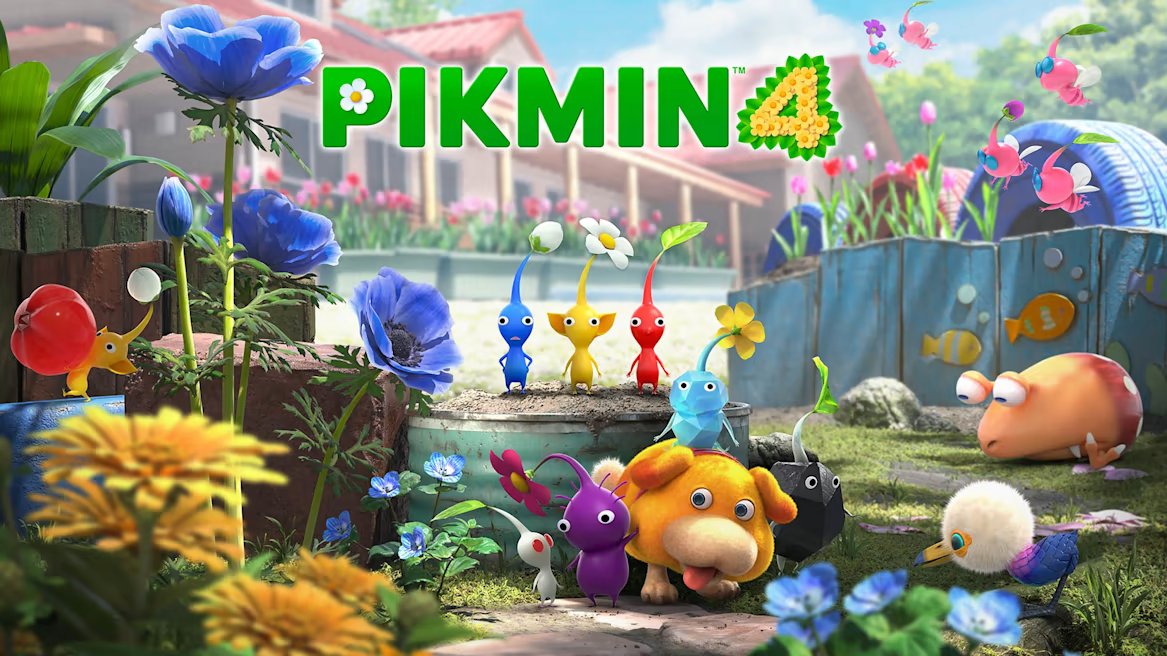
Summary:
Pikmin 4 Version 1.1.1 is one of those updates that doesn’t show up with a flashy new mode, but quietly makes the whole adventure feel smoother. We’re talking about small friction points that can mess with your rhythm – the kind you notice most when you’re in a time-sensitive scramble, juggling Pikmin, issuing orders, and trying to keep everything moving like a well-oiled rescue machine. The headline changes revolve around reliability and control: Oatchi’s commands behave more predictably, Roll Over progression is more consistent, creature behavior better matches the activity level you choose, and the game gives you clearer cues in Photo Mode.
The quality-of-life highlight is the Auto Target Lock related adjustment. If you’ve ever turned Auto Target Lock off because you want full control, only to feel the cursor still “stick” when you mash A during throws, Version 1.1.1 addresses that exact annoyance. On top of that, there are practical bug fixes that matter over the long haul, like Treasure Catalog completion reflecting your actual progress, and Decor Pikmin handling becoming more dependable – including smoother syncing behavior when sending discovered Decor Pikmin data to Pikmin Bloom in the full version. Add in tweaks to Relaxed and Fierce creature behavior, plus a clearer on-screen reminder for camera movement in Photo Mode, and the update lands as a tidy cleanup that respects your time. If you want to know what changed, where to find the key setting, and how to confirm the patch is installed, we’ll walk through it all in plain language.
Pikmin 4 Version 1.1.1 at a glance
Version 1.1.1 for Pikmin 4 (released December 16, 2025) is built around one goal: making moment-to-moment play feel less fussy. No new headline features are introduced here, but a stack of fixes land right where players tend to build muscle memory. That’s why this update matters more than it first appears. When a command doesn’t register at the right time, or a setting behaves inconsistently, it’s not just a “minor bug” – it interrupts your flow, like hitting a pothole at full speed. Version 1.1.1 focuses on that flow: smoother command timing for Oatchi, more consistent carryover behavior in Roll Over, and better alignment between the selected Creature Activity Level and what enemies actually do. It also improves how Decor Pikmin behave in specific situations and includes a practical tweak for Auto Target Lock behavior when it’s switched off. Think of it as tightening screws across the whole experience so your choices and inputs feel respected.
Oatchi commands feel more reliable
Oatchi is the kind of partner you lean on constantly, so even a small hiccup in command behavior can feel huge. This update directly targets a scenario many players stumble into without meaning to: throwing every Pikmin in your squad in quick succession, then continuing to press A out of habit while trying to queue up the next action. Before Version 1.1.1, that rapid input could lead to awkward timing where Oatchi’s “Go to Work” didn’t behave the way you expected in the moment. And when you’re juggling a task that needs momentum – hauling, building, or multitasking while you keep scouting – the last thing you want is a command that feels like it arrived late to the party. With 1.1.1, the intent is clearer: if you want Oatchi working immediately, the game is better at understanding you. It’s a small change that makes Oatchi feel less like a separate unit you babysit and more like a teammate who keeps up.
“Go to Work” triggers correctly after rapid throws
The specific fix is simple to describe, and that’s a good sign – it means Nintendo identified a clean, reproducible edge case. If you throw all the Pikmin in your squad and keep pressing A, you can now give the “Go to Work” command to Oatchi in your squad right away. In practice, this reduces that split-second confusion where you’re certain you issued the order, but Oatchi behaves like he didn’t hear you. There’s an important guardrail still in place, too: if there aren’t enough Pikmin for the task, or if Oatchi can’t do the task, the command can still be stopped temporarily. That’s not the game being stubborn – it’s the game preventing a false promise. The useful part is that the input is recognized cleanly when the task is valid, and when it isn’t, the reason is about feasibility, not timing weirdness. If you play quickly and rely on repeated button presses to keep momentum, this is the kind of fix you feel immediately.
Roll Over saves behave more consistently
Roll Over is all about replaying without feeling like you’re starting from absolute zero. It’s meant to let you carry forward certain progress and enjoy a fresh run while keeping some sense of earned momentum. That only works if the carryover rules are predictable. Version 1.1.1 tightens that predictability by addressing Oatchi’s skill progression across Roll Over starts. If you’ve invested time into training Oatchi and shaping him into your ideal helper – faster work, better movement options, whatever fits your style – losing that progress in a repeat playthrough can feel like being told to rebuild your toolbox from scratch. This update aims to prevent that frustration. It also includes a reminder-like instruction that points you to where the carried-over skills become visible again, which matters because sometimes the game is doing the right thing, but you just haven’t looked in the right spot yet. The result is a Roll Over experience that feels closer to what players expect when they pick a mode designed around continuity.
Oatchi skill carryover and where to confirm it
With Version 1.1.1, when you start a new game with Roll Over, you can carry over all of Oatchi’s previously learned skills. The “all” part is the key word – it signals a clear rule instead of a fuzzy one. The update also explains how to confirm it in-game: speak to the captain and go into the training screen after Oatchi grows and you are able to do training. That matters because early moments in a new run can be deceptive, especially if the UI doesn’t immediately throw confetti for carryover progress. There’s also a hard limitation to keep straight: you cannot perform Roll Over starts in the Pikmin 4 demo. So if someone tests Roll Over on the demo and thinks something is “missing,” it’s not a bug – it’s simply not supported there. Once you’re in the full version and you’ve reached the point where training is available again, the carryover should present itself cleanly, making Roll Over feel like a true second lap, not a full reset.
Treasure Catalog completion is more accurate
Completion tracking is one of those systems you don’t notice until it goes wrong. When you’re building toward 100 percent goals, the Treasure Catalog becomes a scoreboard, a checklist, and a motivational poster all at once. Version 1.1.1 fixes a bug where some treasures were not reflected in the completion of the Treasure Catalog. That sounds small, but it can be disproportionately annoying: you did the work, you found the treasure, yet the game acts like it never happened. That kind of mismatch can send you on a wild goose chase, re-checking caves and areas you already cleared, convinced you missed something. The fix helps restore trust in the catalog so you can use it the way it’s intended – as a reliable map of what’s left, not a source of doubt. If you’ve been holding off on finishing everything because the tracking felt off, this update is the quiet green light that says, “Yeah, now it should line up.”
Creature Activity Levels match the selected mood
Creature Activity Levels are a great idea because they let you shape the feel of the world without changing what Pikmin is at its core. If you want a calmer exploration vibe, Relaxed should behave like Relaxed. If you want chaos, Fierce should be challenging for the right reasons, not because of odd bugs. Version 1.1.1 is largely about keeping that promise. It tweaks how certain creatures behave in Relaxed, reduces some of the most frustrating “gotcha” moments around inhaling or tongue grabs, and fixes Fierce mode issues that could lead to strange behavior like enemies freezing in place. In other words, the update polishes the rules so the game feels less like it’s occasionally improvising and more like it’s consistently playing by the settings you chose. That’s important because settings are a form of agreement between you and the game. You pick a mode, the game should honor it, and Version 1.1.1 leans into that principle.
Relaxed mode: fewer surprise attacks and fewer swallowed Pikmin
Relaxed mode is designed for players who want space to experiment, take photos, or simply enjoy exploration without constant aggression. Version 1.1.1 reinforces that identity. While the activity level is set to “Relaxed,” certain creatures will no longer attack unless you attack them first. That’s the clearest possible rule: you decide when the fight starts. On top of that, the update notes that creatures are less likely to inhale Pikmin or catch them with their tongues in Relaxed. That’s a big quality-of-life improvement because those attacks can feel especially punishing when you’re in a mode that’s supposed to be forgiving. It’s the difference between a casual stroll and a casual stroll where a bird keeps trying to steal your snacks. If you’re using Relaxed as a learning space, these changes make it a better training ground that still respects the world’s danger, just with fewer sudden “oops, there goes half your squad” moments.
Which creatures stop attacking first in Relaxed
Version 1.1.1 calls out a specific list, which is helpful because it removes ambiguity. While set to “Relaxed,” the following creatures will no longer attack unless you attack them first: Moss, Waterwraith, and Dweevils carrying Bomb Rocks. That’s a meaningful set because each one can create high-pressure situations in different ways. This change doesn’t magically make them harmless – it changes the opening move. You get to approach on your terms, position your squad, and decide whether you’re engaging or passing by. That’s especially useful if you’re trying to focus on collecting, mapping, or snapping photos, and you don’t want the world to constantly shove you into combat. It also makes Relaxed feel more coherent: if the mode says “chill,” then enemies that used to jump you on sight now respect that vibe until you throw the first punch.
Fierce mode: fixes for Grubchucker and Bomb Rock edge cases
Fierce mode is supposed to be the “hands sweaty” setting, where you plan better, react faster, and accept that mistakes cost more. That challenge only feels fair if the enemies behave properly. Version 1.1.1 fixes a bug where the Grubchucker was unable to prey on Pikmin while the activity level is set to “Fierce.” That kind of issue can accidentally undercut the intended difficulty, which is the opposite problem of a frustrating bug, but still a problem because it makes the mode inconsistent. The update also fixes a bug where some creatures would freeze in place when fed multiple Bomb Rocks in Fierce. A frozen enemy is not “harder,” it’s just broken, and it can make battles feel awkward or anticlimactic. With these fixes, Fierce mode becomes tougher in the correct way: by keeping creature behavior functional and dangerous, not by introducing odd glitches that pull you out of the moment.
Decor Pikmin and Pikmin Bloom syncing improvements
Decor Pikmin are a fun crossover concept because they blend the charm of Pikmin Bloom with the mainline world of Pikmin 4. But once you connect two experiences, you introduce extra places where things can get finicky: photo recognition, attack interactions, and data syncing. Version 1.1.1 includes multiple improvements here. It’s now easier to “Say Cheese” when taking pictures of some Decor Pikmin, which matters because Photo Mode should feel playful, not picky. Decor Pikmin are also now unaffected when a creature performs an attack where they suck in Pikmin, reducing the chance of strange interactions that don’t feel intended. Finally, there’s a fix for a bug where there was sometimes a delay in reflecting what Decor Pikmin you have found when sending that data to the Pikmin Bloom smart device application. That last one is the practical headache-solver. When you send data, you want it to show up, not linger in limbo like a package that’s “out for delivery” forever.
Auto Target Lock: off means off, even when tapping A
Auto Target Lock is one of those settings players have strong opinions about because it directly affects how aiming feels. Some people love the assist, others want total manual control. The key is consistency: if you switch it off, the game shouldn’t sneak bits of “sticky” targeting back in through side effects. Version 1.1.1 specifically addresses a frustrating behavior: repeatedly pressing the A button could cause the cursor to lock in place even when Auto Target Lock was set to “Off.” The update adds a setting so the cursor is not locked in place from repeatedly pressing A while Auto Target Lock is off. That might sound technical, but the feeling is simple – your cursor should stay free. If your throwing rhythm includes quick taps, or you play with a fast cadence, this makes the controls feel more honest. It’s like turning off cruise control and finally getting the steering wheel back exactly the way you expect.
Where to find “Tap A Repeatedly to Lock”
The setting is easy to miss if you don’t know the exact menu path, so it’s worth spelling out clearly. You can switch between “On” and “Off” by opening the Pause menu (the – button), selecting “Settings,” and going to “Tap A Repeatedly to Lock.” In Version 1.1.1, it’s set to “Off” by default, which is a strong hint that Nintendo recognized how many players found the behavior annoying. If you’re trying to confirm the change, do a quick test: set Auto Target Lock off, then throw Pikmin while tapping A more rapidly than usual. The cursor should no longer feel like it’s being pinned in place by your own button rhythm. If you prefer the old behavior, the toggle is still there, which is the best outcome – you get control either way, and the game stops making assumptions about how you want to aim.
Photo Mode: clearer camera controls on-screen
Photo Mode is meant to be fun, and fun falls apart when controls are unclear. Version 1.1.1 adds an additional button guide so an explanation appears on-screen in Photo Mode when using the Field Camera. Specifically, it indicates that you can move the camera up or down using the up and down direction buttons on the Joy-Con (L), or the up and down buttons on the +Control Pad of the Nintendo Switch Pro Controller. That kind of on-screen reminder is small, but it prevents the classic “why won’t the camera do what I want” moment. It also helps newer players discover movement options they might not try naturally. If you’ve ever fumbled around, accidentally taking five photos of the ground while trying to frame Oatchi like a heroic movie poster, this update is basically the game tapping you on the shoulder and pointing at the right buttons.
Demo parity and limitations to know
Version 1.1.1 isn’t just for the full version. A patch with the same changes has also been distributed for the Pikmin 4 demo, which is good because it keeps the experience consistent across both. However, the demo still has important limits that can confuse players if they don’t know them upfront. You cannot perform Roll Over starts in the demo, so any Roll Over related improvements won’t be something you can test there. Also, Decor Pikmin data cannot be sent to Pikmin Bloom from the demo, even with the update installed. That means if someone plays the demo and wonders why their discovered Decor Pikmin are not appearing in Pikmin Bloom, it’s not a connection issue or a missing step – it’s simply not supported in that version. The demo is useful for getting a feel for the game and the updated controls, but some of the most “connected” features remain full-version only.
How to update, verify, and troubleshoot Version 1.1.1
Updating is straightforward, but it’s worth doing it carefully so you can trust what you’re seeing afterward. The safest approach is to highlight Pikmin 4 on the HOME Menu without launching it, press the + or – button to open the options menu, and check the displayed version number. If you’re not on Version 1.1.1 yet, run Software Update via the internet and let it complete before starting the game. Once updated, test one or two changes you care about most, like the Auto Target Lock behavior or the “Tap A Repeatedly to Lock” setting path, so you know the patch is active. If something still feels off after the update, don’t panic. Many issues come down to settings not matching your preferences, or to expectations based on the pre-update behavior. Treat it like tuning an instrument: the update gives you the improved baseline, and then you adjust the knobs so it plays the way you want.
Quick checks that solve most “still feels weird” moments
Start with the simplest checks, because they’re often the winners. First, confirm the version number is actually 1.1.1 in the game’s options panel from the HOME Menu. Second, open the Pause menu in-game and look directly at Settings, because Version 1.1.1’s most noticeable control-related change lives there under “Tap A Repeatedly to Lock.” Third, if you’re testing Roll Over carryover, make sure you’re doing it in the full version and that you’ve reached the point where Oatchi can train again, since the game’s own note points you to the training screen after he grows. Fourth, if you’re focused on Decor Pikmin and Pikmin Bloom, remember the demo cannot send Decor Pikmin data – you need the full version for that feature to work. Finally, if you’re checking creature behavior, confirm the Creature Activity Level is actually set to Relaxed or Fierce at the time you’re testing, because the fix is tied to that setting. With those quick checks, most confusion clears up fast, and the improvements in 1.1.1 become much easier to spot.
Conclusion
Pikmin 4 Version 1.1.1 is the kind of update that earns its value through feel, not flash. Oatchi responds more reliably in a common rapid-input scenario, Roll Over treats your training time with more respect by carrying over skills, and the Treasure Catalog is less likely to gaslight your completion progress. Creature Activity Levels now better match their intent, whether you want a calmer world that waits for you to strike first or a Fierce setting that’s challenging because enemies work correctly, not because they glitch out. Decor Pikmin handling and syncing behavior get practical refinements, Photo Mode becomes a little clearer, and the Auto Target Lock adjustment finally makes “off” behave like you meant it. If you’ve been playing regularly, you will notice the difference, and if you haven’t, Version 1.1.1 is a great moment to jump back in with a smoother foundation.
FAQs
- When did Pikmin 4 Version 1.1.1 release?
- Version 1.1.1 became available on December 16, 2025, and focuses on bug fixes and quality-of-life improvements rather than new gameplay additions.
- How do we stop the cursor from locking when Auto Target Lock is off?
- Open the Pause menu with the – button, go to Settings, and find “Tap A Repeatedly to Lock.” Version 1.1.1 sets it to Off by default and prevents cursor locking from repeated A presses when Auto Target Lock is off.
- Do Oatchi’s skills carry over in Roll Over now?
- Yes. Version 1.1.1 allows all previously learned Oatchi skills to carry over when starting a new game with Roll Over in the full version. The demo does not support Roll Over starts.
- Which creatures stop attacking first in Relaxed mode after the update?
- With the activity level set to Relaxed, Moss, Waterwraith, and Dweevils carrying Bomb Rocks will no longer attack unless you attack them first.
- Can the demo send Decor Pikmin data to Pikmin Bloom after Version 1.1.1?
- No. The demo can receive the same gameplay fixes, but it still cannot send Decor Pikmin information to the Pikmin Bloom smart device application.
Sources
- How to Update Pikmin 4, Nintendo Support, December 16, 2025
- Pikmin 4 1.1.1 update out now, patch notes, Nintendo Everything, December 16, 2025
- Er komen nieuwe functies naar Pikmin 4!, Nintendo (NL) News, October 27, 2025
- Nintendo announces a string of free updates for Pikmin 4 and Pikmin Bloom, The Verge, October 22, 2025