














Summary:
Pokémon Pokopia has opened with the kind of momentum most publishers dream about. Nintendo and The Pokémon Company confirmed that the Nintendo Switch 2 exclusive sold 2.2 million copies worldwide in its first four days, with 1 million of those sales coming from Japan alone. That is a huge result on its own, but it becomes even more striking when you place it next to the reported supply issues affecting physical copies in several regions. In other words, Pokopia did not simply launch well. It launched well while dealing with conditions that could have held it back.
The early numbers tell a story that is bigger than raw sales. They point to strong anticipation before release, fast word of mouth once players got their hands on it, and a concept that clearly clicked with a broad audience. Pokopia arrived as a Pokémon spin-off, but not one that felt small or disposable. It came in with a distinct identity, a clear hook, and enough critical praise to push undecided players toward a purchase. That matters, because successful spin-offs usually need more than brand recognition. They need a reason to feel essential.
There is also something notable about where the sales strength came from. Japan delivering 1 million copies so quickly shows immediate domestic enthusiasm, while the global figure shows that interest did not stop there. The result suggests Pokopia found a sweet spot between familiarity and freshness. It still feels rooted in Pokémon, but it also offers something different enough to stand out in a crowded release calendar. That is a tricky balance to pull off. Pokopia seems to have managed it with surprising confidence.
Pokémon Pokopia gets off to a remarkable start
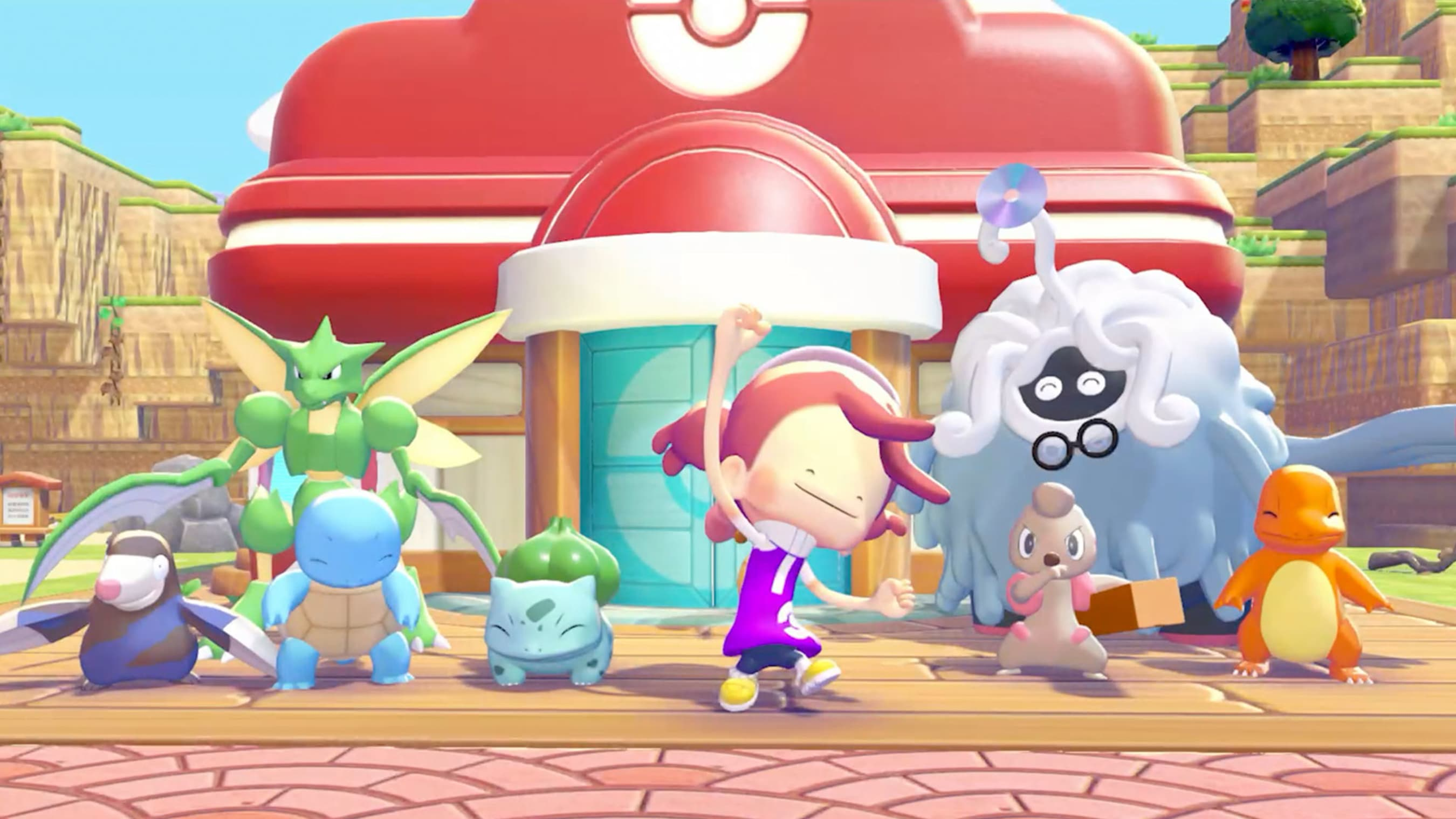
Pokémon Pokopia did not creep quietly onto the scene. It kicked the door open, waved to the neighbors, and then ran up a sales total that instantly made people pay attention. Nintendo and The Pokémon Company announced that the game sold 2.2 million copies worldwide in its first four days, a result that places it among the strongest early performers for a Pokémon spin-off. That kind of opening is not just nice to have. It changes the whole tone of the conversation around a release. Instead of asking whether the game can find an audience, people are suddenly asking how far it can go. For a Nintendo Switch 2 exclusive, that is a powerful headline. It gives the platform another clear win, it gives the Pokémon brand a fresh success story outside the mainline formula, and it gives Pokopia the kind of early credibility that many new ideas spend months trying to earn.
Why 2.2 million copies in four days matters
Big launch numbers always look impressive, but this one has extra weight because it reflects more than a familiar brand doing what familiar brands do. Four days is barely enough time for a release to settle into the market, yet Pokopia already posted a figure that signals genuine demand across regions. That suggests strong pre-launch interest, a healthy digital showing, and fast-moving word of mouth once the game became available. It also suggests that players were not treating this as a side curiosity. They were treating it as something worth showing up for right away. When a spin-off posts this sort of start, it tells us the idea landed cleanly. The pitch made sense, the messaging worked, and the audience understood what made the game special. There is no need to squint and search for signs of life here. The pulse is obvious, loud, and impossible to ignore.
Japan’s one million sales show immediate domestic strength
Japan accounting for 1 million of the 2.2 million copies in such a short window says a lot about how quickly Pokopia connected with its home market. Pokémon has always had deep roots in Japan, of course, but that does not mean every release hits with the same force. Pokopia clearly did. That early domestic surge suggests strong excitement before launch and a concept that resonated immediately with players who know the brand inside out. It also shows that the game was not relying only on overseas curiosity to build momentum. Japan turned up in a major way, and that matters because a big local response often helps stabilize the broader narrative around a release. It gives the game a sturdy foundation, like building a house on solid stone instead of soggy cardboard. Nobody wants the cardboard version, especially not at Nintendo prices.
Physical copy shortages could not slow momentum
One of the more interesting parts of Pokopia’s early success is that it arrived despite reported supply issues for physical copies in several regions. Usually, when stock becomes harder to find, there is at least some concern that sales potential is being capped in the short term. That is what makes the 2.2 million total stand out even more. Pokopia was not cruising downhill with perfect road conditions. It was picking up speed while a few lanes were already blocked. That points to very strong digital demand, yes, but it also points to a level of urgency among players. When people want a game badly enough, they do not always wait around for the shelf to refill. They grab the available option and jump in. Supply issues became part of the story, but they did not become the story. The real headline remained the appetite for the game itself.
A Nintendo Switch 2 exclusive with clear pull
Being exclusive can be a blessing, a burden, or a bit of both. In Pokopia’s case, exclusivity seems to have sharpened its impact. As a Nintendo Switch 2 only release, the game arrived with a clear sense of identity and purpose. It was not floating across every platform at once, trying to be all things to all people. It was tied directly to Nintendo’s newer system, and that helped frame it as one of the platform’s meaningful early draws. That matters for Nintendo, because exclusives help shape how a console feels in its opening period. They give people a reason to stop watching from the sidelines and actually buy in. For Pokopia, exclusivity also made the game feel more event-like. There is a difference between a release and a moment. This one felt like a moment, and that kind of momentum is hard to fake.
Game Freak and Omega Force gave the project a distinct identity
Pokopia’s strong start also reflects the appeal of its development partnership. Game Freak co-developing the project with Koei Tecmo’s Omega Force gave the game an extra layer of intrigue before launch, because it suggested a blend of familiar Pokémon sensibilities and a different kind of design energy. Collaborations like this can sometimes feel like odd experiments assembled in a hurry, the gaming equivalent of throwing random ingredients into a pan and hoping dinner survives. Pokopia seems to have avoided that trap. Instead, the pairing helped the game feel fresh without cutting it loose from the brand’s core appeal. That matters because spin-offs live or die by identity. If they are too close to the mainline formula, they feel redundant. If they drift too far, they feel disconnected. Pokopia appears to have landed in the sweet spot where the game feels recognizably Pokémon while still bringing its own flavor to the table.
Critical response helped turn curiosity into demand
Launch sales can be driven by hype alone for a day or two, but strong critical reception helps that excitement hold its shape. Pokopia benefited from that. The game launched to a very warm reception, and that kind of response can make a huge difference in the first week. It reassures hesitant buyers, validates the energy around the release, and keeps the conversation moving in a positive direction. In practical terms, it helps transform “maybe later” into “fine, I’m buying it tonight.” That shift matters more than people sometimes admit. A game does not need universal praise to succeed, but it does need enough confidence around it to make people feel like they are stepping into something worth their time. Pokopia seems to have crossed that line comfortably, and once that happened, the early commercial result started to make a lot more sense.
Social media buzz kept the launch conversation moving
Pokémon releases have always had a way of spreading through online spaces quickly, but Pokopia’s launch chatter seems to have hit a particularly lively note. That kind of social buzz matters because it turns a release from a store listing into an ongoing shared experience. Players post reactions, screenshots, clips, impressions, jokes, and small discoveries. Suddenly the game is everywhere, and even people who had not planned to think about it are now seeing it pop up while scrolling. It is a bit like smelling fresh bread from across the street. You were minding your own business, and now you are interested whether you meant to be or not. When that online attention arrives alongside strong reviews and a trusted brand, it creates a feedback loop. More conversation leads to more curiosity, more curiosity leads to more purchases, and more purchases keep the conversation alive.
What this success says about Pokémon spin-offs
Pokopia’s opening suggests that the Pokémon brand still has plenty of room to grow outside its traditional structure. That may sound obvious on paper, but it is harder to prove in practice. Spin-offs often fight against the idea that they are side dishes rather than the main meal. Some do well, some build loyal fan bases, and some vanish into the attic like old toys people swear they still care about. Pokopia feels different because its launch performance makes it harder to treat as a novelty. This looks more like a game that found a real lane for itself. That matters for Pokémon as a whole. It shows that players are willing to embrace new formats when the concept is strong enough and the execution backs it up. Familiar characters alone are not enough. Pokopia appears to have paired brand power with a clear idea of what kind of experience it wanted to be.
What the strong launch could mean going forward
The obvious next question is whether Pokopia can sustain this pace, and that is where the story becomes even more interesting. Early sales are a signal, not the full verdict, but this is a very encouraging signal. If momentum holds, Pokopia could become one of the defining spin-off success stories in the franchise. It could also strengthen the case for more projects that take creative risks within the Pokémon universe instead of playing everything safe. For Nintendo, the result is useful in another way too. A strong exclusive with broad appeal helps reinforce the Nintendo Switch 2 lineup and gives the platform a release people can point to as proof of current momentum. That is valuable. Hardware thrives on software that feels alive, talked about, and wanted. Pokopia has provided exactly that. Sometimes a release arrives and politely joins the party. Pokopia walked in, grabbed the aux cord, and somehow played the perfect song.
Conclusion
Pokémon Pokopia’s first four days have been hard to ignore. Selling 2.2 million copies worldwide, including 1 million in Japan, would already be a headline worth talking about. Doing it while physical supply issues were part of the picture makes the result feel even stronger. The launch points to real demand, strong word of mouth, and a concept that clicked quickly with players on Nintendo Switch 2. It also suggests that Pokémon spin-offs still have room to surprise people when they arrive with confidence, identity, and genuine momentum. Pokopia did not feel like a side project trying to borrow attention from a famous name. It felt like a release people actively wanted, and the early numbers reflect that with striking clarity.
FAQs
- How many copies did Pokémon Pokopia sell in its first four days?
- Nintendo and The Pokémon Company said Pokémon Pokopia sold 2.2 million copies worldwide in its first four days on the market.
- How many of those sales came from Japan?
- According to the announced figures, 1 million of the 2.2 million copies were sold in Japan alone.
- When did Pokémon Pokopia launch?
- Pokémon Pokopia launched worldwide on March 5, 2026 for Nintendo Switch 2.
- Was Pokémon Pokopia affected by physical stock shortages?
- Yes. Reports indicated supply issues for physical copies in several regions, but the game still posted a very strong early sales result.
- Why has Pokémon Pokopia’s launch been seen as such a big success?
- The game combined strong early sales, heavy player interest, positive critical reception, and broad online buzz, which together gave it a very strong start.
Sources
- Global Sales of Pokémon Pokopia for Nintendo Switch 2 Surpass 2.2 Million in First Four Days, Nintendo, March 12, 2026
- Join the Developers of Pokémon Pokopia for an Island Tour, Pokémon.com, March 3, 2026
- Pokémon Pokopia Releasing on Nintendo Switch 2 on 5 March 2026, Pokémon, accessed March 14, 2026
- ‘Stealth’ Pokemon hit boosts Nintendo Switch 2 momentum sentiment, Reuters, March 12, 2026
- Pokémon Pokopia Reviews, Metacritic, accessed March 14, 2026
- Pokémon Pokopia is sold out at many major retailers, but it’s really not difficult to see why, TechRadar, March 11, 2026