














Summary:
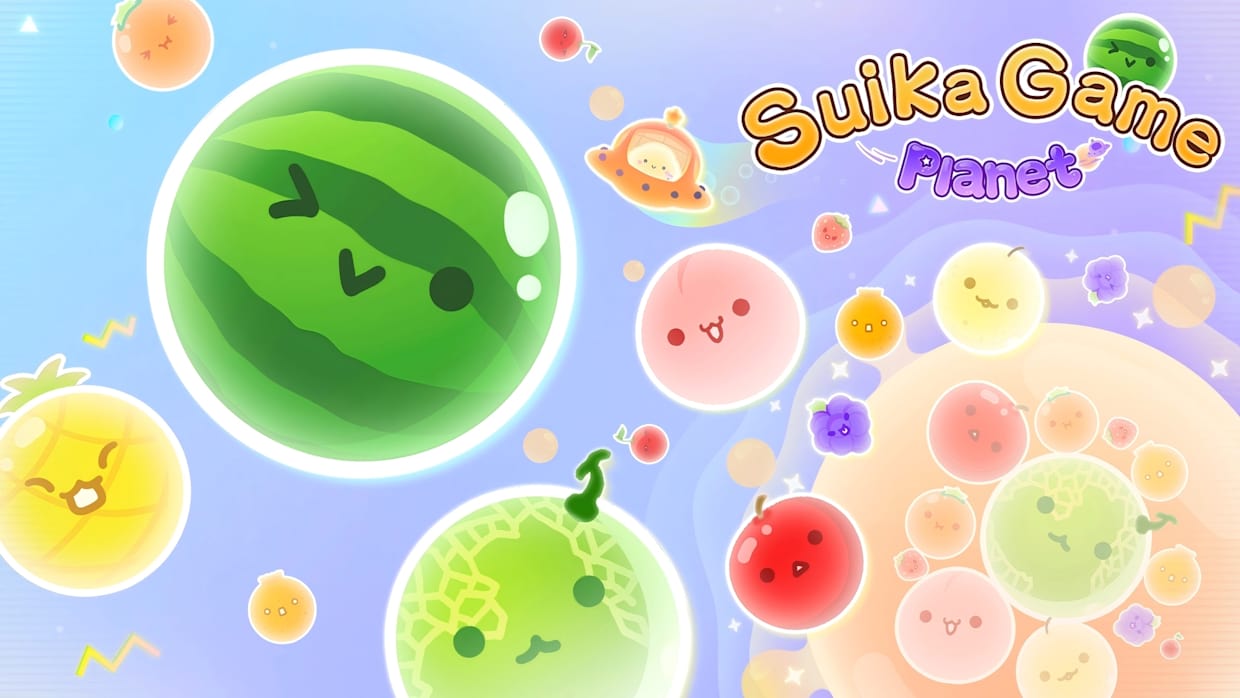
Suika Game Planet takes the familiar “merge fruit until you reach a watermelon” idea and drops it onto a tiny planet floating in space, which immediately changes how the whole thing feels in your hands. Instead of always dropping fruit from a single top edge, we’re aiming while “Poppy” flies around the planet in a full 360-degree orbit, meaning the direction you drop from is part of the strategy, not just a detail. The goal stays satisfyingly simple: collide matching fruit so they evolve into bigger fruit, then keep climbing that chain until you finally land those precious watermelons for a high score. The twist is that the board’s geometry and the shifting drop angle can turn one calm placement into a chaotic bounce, and that’s where the fun lives.
Suika Game Planet also leans into spectacle in a way that fits the space theme, with special background music and dramatic effects tied to big moments, including a feature called Super Evolution Time. When we trigger it by evolving lots of fruit, it’s not just visual flair – the game throws in bonus scoring that rewards keeping momentum. On Nintendo Switch 2, there’s also a practical party-friendly hook: GameShare (local communication) lets up to four players work together in co-op, so the “please don’t topple the stack” pressure becomes a shared problem, like four people trying to carry one wobbly cake through a hallway. Add in online ranking for score-chasers, and the result is a small-priced puzzle game that’s easy to start, hard to put down, and built for both solo obsession and couch teamwork.
Suika Game Planet arrives on the US eShop
Suika Game Planet is now available on the Nintendo eShop in the United States, and it’s positioned as a straightforward follow-up for anyone who enjoyed the original Suika-style “merge and climb” loop. The headline details are refreshingly simple: we’re looking at a puzzle game with a space setting, a clear score chase, and a price point that’s closer to “impulse buy” than “budget planning.” That matters because this kind of game thrives on curiosity. You see the premise, you try a round, and suddenly you’re bargaining with yourself: “One more run, then I’ll stop.” Spoiler: we both know how that goes. The best part is that the eShop description spells out exactly what we’re doing – turning, targeting, and aiming for the watermelon – so we’re not guessing what the game wants from us. It’s a pure mechanics-first setup, and the space twist is the new hook that makes familiar merging feel freshly awkward in the best way.
What makes “Planet” different right away
The immediate change is the setting and the shape of the play space. Instead of feeling like we’re dropping fruit into a simple container from a single direction, Suika Game Planet frames the action around a planet, with “Poppy” moving around it. That framing is not just cosmetic, because it changes how we think about placement. When the board feels like it has a “top,” we naturally build habits: place small fruit here, save room there, avoid the edge, and so on. On a planet, those instincts get challenged, because we’re dealing with angles and rotation. The game leans into that by telling us we can drop fruit freely from any direction while Poppy flies 360 degrees around the planet. It’s the same kind of puzzle pressure, but now it feels like we’re trying to stack groceries while walking around the cart. The rules didn’t change, but our hands and eyes have to adapt, and that’s where the new flavor comes from.
The 360-degree drop angle and why it changes everything
Being able to drop fruit from any direction sounds like a small upgrade until we actually play a few rounds and realize how much it alters decision-making. In a typical drop-from-the-top setup, the main question is “Where does this land?” Here, we’re also asking “From which side should this land?” because the entry angle affects how fruit rolls, collides, and settles. Physics-based puzzle games are basically polite until they aren’t, and Suika Game Planet gives physics more opportunities to act up. A fruit that would have calmly nestled into a gap from one angle might bounce and roll into trouble from another. That doesn’t make the game unfair – it makes it expressive. We can choose safer drops when the planet is crowded, and more aggressive drops when we want a collision right now. It’s like pool, but the table is round and the balls are fruit, which is exactly as dignified as it sounds.
The core loop – turn, target, aim for the watermelon
At its heart, Suika Game Planet is brutally simple in a way that makes it easy to explain to anyone within earshot. We drop fruit, we collide matching fruit, they evolve into larger fruit, and we keep climbing the chain until we create watermelons for a high score. That loop works because it’s instantly readable. Even when things get messy, we can still point at the screen and say, “If those two touch, they become the next one.” The space setting and rotation add complexity, but they don’t muddy the goal. In fact, the game’s own description puts the objective front and center, which is exactly what a score-chasing puzzle game needs. The fun comes from the tension between intention and chaos: we have a plan, gravity has a plan, and only one of them is getting paid.
Poppy’s role and how the orbit affects control
Poppy isn’t just a cute name in the description – Poppy is the framing device that explains why the drop direction keeps changing. When Poppy flies around the planet, we effectively get a rotating perspective on where we can place the next fruit. That matters because it encourages active aiming instead of passive dropping. We’re not waiting for fruit to fall straight down and hoping for the best, we’re turning and targeting, trying to line up collisions or avoid creating unstable towers. If we treat the orbit like a “camera trick” and ignore it, we’ll still get some merges, but we’ll also get more accidental roll-offs and awkward bounces. If we embrace it, the orbit becomes a tool: we can approach a gap from the side that makes a fruit settle into it, or we can approach a cluster from the angle that causes an immediate collision. It’s a small control twist that turns placement into a more deliberate act.
Fruit evolution – how merges actually build your score
Everything in Suika Game Planet revolves around evolution. The game tells us to make fruit of the same type collide so they “evolve,” and the score chase is built on how efficiently we can keep that evolution chain moving. This is where people either fall in love or bounce off. If we play casually, we’ll get a few satisfying merges and a handful of bigger fruit, but the planet will gradually fill up and the run ends when we can’t manage the pile anymore. If we play with intent, we start thinking in sequences: “If I merge these now, it creates that fruit, which can later merge with the one I’m saving on the other side.” The trick is to stay patient without being timid. The game rewards momentum, but reckless momentum is how we create a fruit avalanche that wipes out our careful setup. So the real skill is managing the tempo of evolution, keeping the board stable while still pushing toward watermelons.
Planning your merges instead of reacting
Planning in a physics-based merge game is like trying to plan a picnic when you live in a windy country – you can do it, but you should bring clips for the napkins. In Suika Game Planet, we can still plan, but we plan in flexible chunks rather than rigid scripts. A useful habit is to build “merge zones,” where we try to keep certain fruit types grouped so future matches are easier. Another habit is to avoid scattering mid-tier fruit everywhere, because that creates a board full of “almost merges” that never quite connect. The orbit mechanic also helps planning because we can choose safer entry angles, nudging fruit into a zone instead of dropping it straight into chaos. The more we treat each drop as a decision with consequences, the more often we’ll see merges cascade in a controlled way. And when controlled cascades happen, the game feels like it’s clapping for us. When they don’t, it feels like the planet is laughing.
Keeping the pile stable when physics gets loud
Stability is the hidden boss fight. The fruit are cute, but they are also round, bouncy, and eager to roll into the exact spot you did not want them to roll into. The planet setting can amplify that because collisions can send fruit along curved surfaces, and a small nudge can become a slow-motion disaster that ruins a tidy stack. The best way to stay stable is to respect the center of mass. If we build high piles on one side while leaving another side sparse, the board becomes unpredictable, because new drops can trigger rolling and shifting. A steadier approach is to spread weight more evenly, even if it means delaying a merge for a moment. We also want to avoid “pinball gaps,” where fruit can fall into a narrow space and bounce out in weird directions. When the pile is stable, we can chase bigger merges with confidence. When it’s unstable, every drop becomes a prayer with fruit-shaped punctuation.
Super Evolution Time – what triggers it and what it rewards
Super Evolution Time is the game’s way of saying, “Nice streak, let’s make it feel even better.” According to the description, we enter this mode by making a lot of fruit evolve, and the payoff is a surge of excitement through special background music, dramatic effects, and a bonus score. The important part is that it’s tied to volume and momentum. This isn’t a random slot-machine bonus, it’s a reward for keeping evolution moving. That encourages a style of play where we look for merge chains and avoid stalling out. Practically, it means we should aim for sequences where one merge creates a fruit that immediately matches something nearby, or where a drop is likely to cause multiple collisions in quick succession. The mode is also a pacing tool. It punctuates the run with a peak moment, which is exactly what makes people say, “Okay, one more,” right after they swore they were done. It’s emotional design wearing a space helmet.
Space vibes that are more than just a background
The space setting could have been a wallpaper change, but Suika Game Planet leans into it as a mood setter. When we’re playing a puzzle game that’s all about tiny decisions, atmosphere matters more than we think. Space is quiet, vast, and a little dramatic, and that contrast makes the clacks and thuds of fruit collisions feel even funnier. The game’s description explicitly calls out special background music and dramatic effects tied to Super Evolution Time, which suggests the audio-visual layer is meant to heighten big moments rather than just fill silence. That’s smart. In score-chasing games, feedback is the reward. A satisfying sound, a flash of effects, a little “yes!” moment – these things make a run memorable even if we don’t break our record. And when the setting is space, the game has permission to be bold with spectacle, because space is basically the universe’s stage lighting.
Music, dramatic effects, and the “one more run” feeling
There’s a reason puzzle games with simple rules can become so sticky. They create tiny emotional arcs in a short time: calm setup, rising tension, a clutch merge, a near disaster, and then either triumph or a messy end. Suika Game Planet reinforces those arcs with music and effects, especially when Super Evolution Time kicks in with bonus scoring. That moment is a built-in highlight reel. Even if we’re not streaming, our brain treats it like a “best moment” clip. The key is that it’s tied to our actions, not a timer, so it feels earned. That’s also why the game can keep pulling us back. When we lose a run, we often know exactly what went wrong, and the space setting makes the reset feel playful rather than punishing. It’s like the planet shrugs, hands us a fresh batch of fruit, and says, “Go on then, show me what you’ve got.”
Nintendo Switch 2 GameShare co-op
One of the standout practical features is that the Nintendo Switch 2 version supports GameShare (local communication) and allows up to four players to enjoy cooperative play. That’s a big deal for a game built on precision and restraint, because co-op changes the vibe instantly. Solo play is a quiet duel between our plan and the pile. Co-op turns it into a group project where everyone has opinions, and somehow the fruit still end up in the wrong place. The Nintendo listing even clarifies how the player count works, noting that up to three other players can join per device, so up to four players can play together. The important thing here is “cooperative.” This is not about dunking on your friends’ mistakes. It’s about working together to aim for the watermelon, which is both wholesome and dangerous, because teamwork is great until someone drops the wrong fruit and pretends it was “strategy.”
Local communication and up to four players
GameShare being local means this co-op setup is designed for people in the same room or nearby, not for anonymous matchmaking. That fits Suika Game Planet’s style, because the funniest moments happen when everyone reacts at once to a wobble that’s clearly about to become a disaster. Local co-op also makes the game easier to introduce to new players. We can hand someone a controller, explain “match same fruit to evolve,” and they’ll understand within seconds. The new player doesn’t need to learn a long ruleset, they just need to feel the physics and see the evolution chain. With up to four players, we can rotate responsibilities or talk through decisions together, which turns the game into a social puzzle. The best part is that the objective stays clean. We’re still aiming for watermelons and high scores, we’re just doing it with more voices, more laughter, and more opportunities for someone to say, “That wasn’t my fault.”
Simple teamwork roles that keep co-op from becoming chaos
If four people all try to “drive” every decision, co-op can become a committee meeting, and nobody wants a committee meeting with fruit. A smoother way to play is to assign light roles, even if we don’t say them out loud. One person can focus on immediate merges, calling out when two fruit types are close to matching. Another person can watch overall stability, basically acting as the “please don’t build a tower of doom” guardian. A third can think two steps ahead, setting up future merges by keeping certain fruit grouped. The fourth can keep an eye on risk, suggesting safer drop angles when the board is crowded. These roles aren’t strict jobs, they’re just mental guardrails that help the group stay coordinated. And when Super Evolution Time is within reach, teamwork gets even more fun, because everyone starts hunting for chains like they’re trying to start a wave in a stadium. The key is talking, staying calm, and accepting that physics will still betray us sometimes.
Practical details you actually care about
Beyond the fun pitch, Suika Game Planet comes with a set of practical details that help set expectations before we hit “purchase.” Nintendo’s store pages list the publisher as Aladdin X and include basics like supported play modes (TV, tabletop, handheld), file size, and the fact that an internet connection is required for the online ranking function. That last detail is important because it draws a clear line between local play and score competition. We can play offline for the core puzzle experience, but if we want to chase leaderboards, we’ll need connectivity. The listings also show a release date of January 5, 2026, which is useful for anyone trying to track what just dropped and when. And if you’re the type who likes knowing exactly what you’re getting, these pages also call out GameShare support on Switch 2, while the Nintendo Switch version notes that GameShare sharing isn’t available there. No drama, just clarity, which is always welcome.
Price, release date, file size, modes, and online ranking
In the US eShop, Suika Game Planet is listed at $3.75 for Nintendo Switch 2, and Nintendo’s official store listing shows the release date as January 5, 2026. File size is listed at 795 MB on the Switch 2 page, which is small enough that it won’t bully your storage into submission. Supported play modes are the usual trio – TV, tabletop, and handheld – so we can play wherever we feel like obsessing over fruit physics. For competitive score-chasers, the store page also notes online ranking, with the reminder that internet access is required to use that function. On the Nintendo Switch side, the listing includes a few extra feature notes in the publisher description, such as customization that lets us decorate the game screen (skin) and a collection feature tied to stickers and missions for creating an original name tag. Those details help paint the picture of a game that isn’t just “merge fruit forever,” but also gives us little goals and personalization hooks to keep things feeling fresh between score attempts.
Tips for your first hour
The first hour with Suika Game Planet is usually where we build habits that either help us or haunt us. Because the game is easy to understand, it’s tempting to play on autopilot, dropping fruit quickly and chasing merges without thinking about stability. That works until it doesn’t, and then the board becomes a bouncy fruit traffic jam. A better approach is to slow down slightly and treat the orbit as a tool. Before each drop, ask one simple question: “What is this drop supposed to do?” If the answer is “I don’t know, but it’s fruit,” that’s a sign to pause for half a second. Use safer angles when the board is tight, and only take risky drops when the payoff is obvious, like a guaranteed merge or a chain setup. Also, don’t underestimate how helpful it is to keep similar fruit near each other. The game rewards evolution streaks, and your future self will thank you for not scattering everything like confetti.
Common mistakes, quick fixes, and how to chase watermelons faster
A classic mistake is building tall stacks too early, especially on one side of the planet. It feels productive because the pile looks “organized,” but it often creates a precarious tower that collapses the moment a round fruit bumps it the wrong way. The quick fix is to spread weight and keep the board flatter, which reduces surprise rolls and makes future placement easier. Another mistake is saving “almost merges” everywhere, which clutters the planet with mid-tier fruit that never meet their match. The fix is to commit: either set up a clear meeting spot for a fruit type or merge it sooner so it stops taking up space. A third mistake is ignoring the 360-degree drop choice and always dropping from the same comfortable angle. The fix is to experiment intentionally. If a fruit keeps rolling away from the spot you want, change your entry angle and let gravity help you instead of fighting it. Watermelons come faster when we’re building toward them with purpose, not just hoping two big fruit bump into each other by accident.
Conclusion
Suika Game Planet is a neat example of how a small mechanical twist can make a familiar idea feel new again. The core loop stays simple – collide matching fruit to evolve them and chase watermelons for high scores – but the planet setup and 360-degree drops add a layer of choice that changes how we think about every placement. Super Evolution Time gives the run a satisfying peak by rewarding big evolution streaks with bonus score, music, and dramatic effects, which makes those “clean” sequences feel like the game is cheering along with us. On Nintendo Switch 2, GameShare co-op adds a social hook that fits perfectly, because planning placements together is both strategic and hilarious when physics decides to misbehave. With a small file size, clear support for TV, tabletop, and handheld play, and online ranking for score-chasers, the package is straightforward and easy to jump into. If you liked Suika’s addictive rhythm before, Planet is basically that feeling in a space suit – familiar, a little weirder, and ready to steal far more of your time than you meant to give it.
FAQs
- How much does Suika Game Planet cost on the US eShop?
- The Nintendo Switch 2 listing in the US eShop is priced at $3.75, based on current US store tracking and recent US availability reporting.
- What’s the main objective in Suika Game Planet?
- We drop fruit, collide matching fruit to make them evolve, and aim to create watermelons for a high score.
- What is Super Evolution Time?
- It’s a mode triggered by evolving lots of fruit, adding special music, dramatic effects, and bonus score to highlight big streaks.
- Does the Nintendo Switch 2 version support co-op?
- Yes. The Nintendo Switch 2 version supports GameShare (local communication) and allows up to four players to play cooperatively.
- Do we need internet to play?
- No for the core puzzle play, but internet access is required if we want to use the online ranking function listed on the store pages.
Sources
- Suika Game Planet for Nintendo Switch 2, Nintendo, January 5, 2026
- Suika Game Planet for Nintendo Switch, Nintendo, January 5, 2026
- US: Suika Game Planet now available in Nintendo eShop, My Nintendo News, January 6, 2026
- Suika Game Planet Available Today on Switch and Switch 2, Final Weapon, January 5, 2026
- Suika Game Planet Nintendo Switch 2 – buy online and track price history, NT Deals, January 5, 2026