














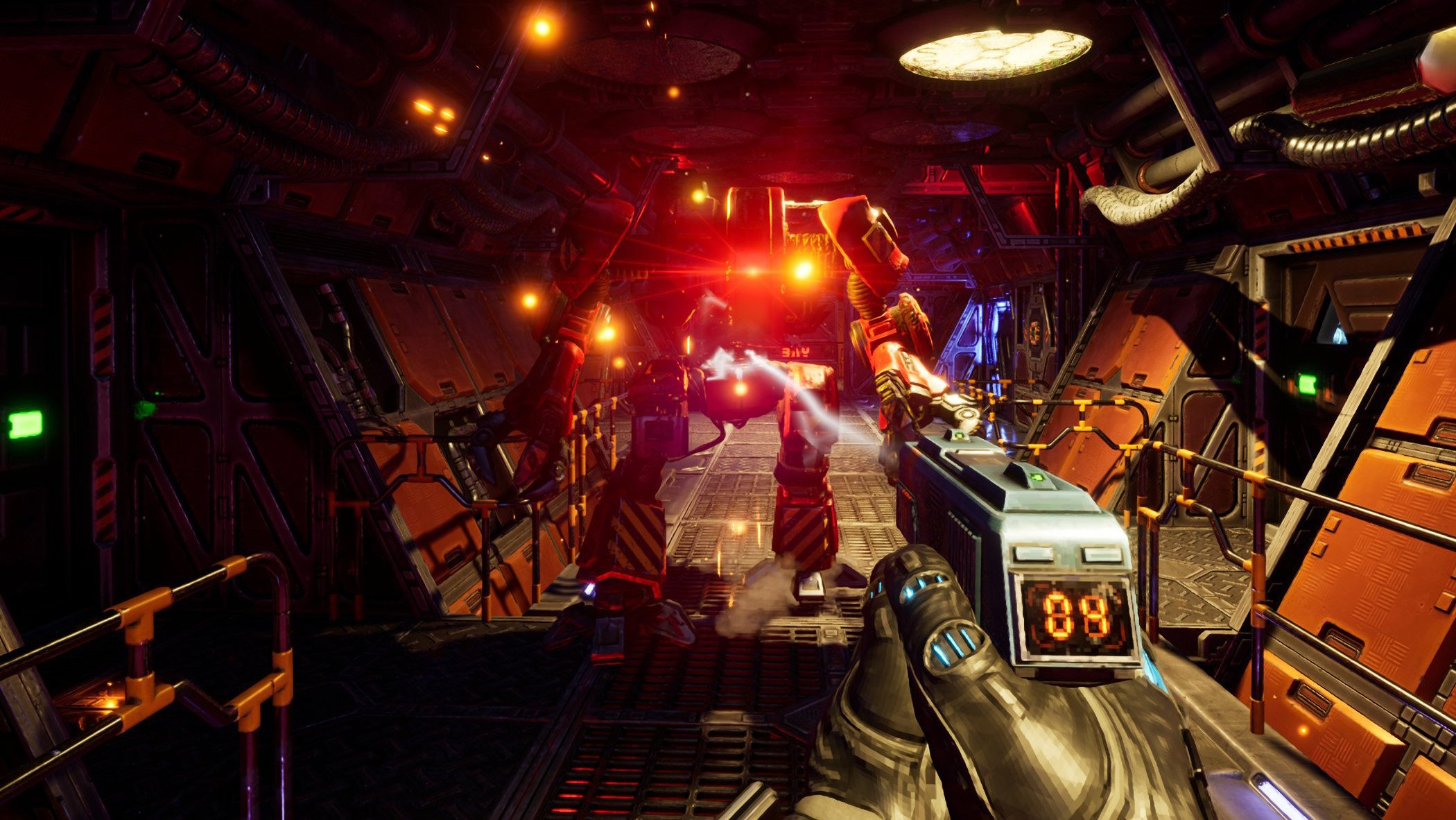
Summary:
System Shock Remake arriving on Nintendo Switch 2 should’ve been the victory lap. The hardware is stronger, the game already proved it could be squeezed onto the original Switch, and Nightdive’s reputation is built on polished throwbacks that feel lovingly modern. Instead, the Switch 2 version became the awkward party guest: it looks sharp, it has the muscle for higher targets, but it doesn’t always move smoothly. If you’ve felt the frame rate bounce around, you’re not imagining it. Nightdive has acknowledged the experience isn’t where they want it, and technical producer Justin Khan has been direct about what they’re chasing and why.
The key idea is simple: Nightdive believes Switch 2 is capable of a very smooth 60 frames-per-second, locked basically all the time, and they have fixes queued up to stabilize the experience. The more interesting part is the “how did this happen” angle. Khan points to the team working in an engine that wasn’t theirs, and that matters because an immersive sim like System Shock is full of systems that can stress the CPU, not just the GPU. That’s why a port can look great while still feeling uneven in motion. While we wait for the next patch, we can still play smarter by managing expectations between handheld and docked, adjusting how we approach heavy combat moments, and focusing on what makes System Shock sing: exploration, tension, and problem solving. When updates land, we’ll know what to look for, and it won’t just be a single number on a frame counter.
System Shock Remake on Switch 2: a rough start that surprised everyone
When a game launches on new hardware, we usually expect the “bigger machine” to be the easy win. That’s why the Switch 2 situation with System Shock Remake feels so backwards. The original Switch version earned real respect simply for existing, because pulling an Unreal Engine powered immersive sim onto 2017-era handheld hardware is like stuffing a spaceship into a single-car garage. Then the Switch 2 release landed with a problem that’s harder to ignore than a blurry texture: the motion doesn’t always feel stable. Even if the image looks crisp, an inconsistent rhythm to movement can make aiming, turning corners, and reacting to threats feel oddly slippery. The result is a version that can look like the “best” one in screenshots, while still feeling less comfortable in your hands during actual play.
Why the Switch version feels steadier than the Switch 2 version
It’s tempting to assume “more power” automatically means “more stable,” but ports don’t work like a simple math equation. A version built earlier, tested longer, and tuned around strict limits can end up feeling more consistent because everyone involved learns exactly where the cliff edges are. On the original Switch, the target and constraints are brutally clear, so teams tend to make firm decisions early: cap the frame rate, reduce certain effects, and keep the experience predictable. On Switch 2, the temptation is to stretch for more, because the hardware invites it. That extra ambition is exciting, but it can also expose weak points in how the game behaves under stress, especially in scenes where many systems wake up at the same time. In other words, the Switch version can feel calm and disciplined, while the Switch 2 version can feel like it’s trying to sprint before its shoelaces are tied.
Frame rate versus frame pacing: the difference you actually feel
We love talking about “60fps” because it’s an easy headline, but your hands care about something more basic: consistency. Frame rate is the count, frame pacing is the rhythm. If the game flips between 30 and 60, you might still see “high” numbers, but you feel the wobble like a shopping cart with one squeaky wheel. In a first-person game where you’re constantly scanning corners and tracking movement, that rhythm matters more than almost anything else. It influences how your aim settles, how smooth your camera turns feel, and how confident you are when you commit to a fight. That’s why a steady 30 can sometimes feel nicer than a shaky “sometimes 60,” even if the second option looks better on a bullet point list. For System Shock, where tension and precision are part of the flavor, that rhythmic stability is the foundation we want the update to reinforce.
What Nightdive says is coming next
Nightdive’s response hasn’t been “deal with it,” and that matters. The studio has talked about fixes already pending, with the goal of making the experience more stable in the next patch. The framing here is important: stability first. Not fancy new extras. Not a marketing spin. Stability. That’s the right priority because once motion feels dependable, everything else in System Shock gets to breathe again, from combat to exploration to the quiet dread of hearing something skitter in a vent when you’re low on ammo. Technical producer Justin Khan has also laid out the reasoning behind the original target, and it helps explain why the Switch 2 version is being treated like a performance project rather than a “good enough” port.
Why Nightdive aimed for 60fps instead of locking to 30fps
Khan’s explanation comes down to capability: Nightdive believed Switch 2 hardware could handle the higher target, so they chased it. On paper, that’s a logical call. If the system can deliver smooth 60, the game feels more immediate: input response is snappier, camera motion is cleaner, and the whole experience feels more modern without changing the design. The problem is that hitting 60 “most of the time” isn’t the same as locking it “basically all of the time,” and players feel that gap instantly. Still, the intent tells us something useful: the goal isn’t to accept a compromised baseline, it’s to push the version into a state where its best-case performance becomes its normal-case performance. That’s also why the next patch matters so much. It’s not just bug fixing, it’s the moment where the version either earns its ambition or admits it needs a different approach.
When a 30fps option still makes sense
Even if the dream is locked 60, we shouldn’t treat 30fps like a dirty word. Think of it like driving modes in a car. Sometimes you want sport mode, sometimes you want comfort mode, and both can be valid depending on the road. A locked 30 option can be a safety net that prioritizes predictability, especially for handheld play where power and thermal constraints can shift the feel over longer sessions. It can also help players who’d rather have consistent camera motion than chase higher peaks. The key is choice. If the game offers stable modes, we can pick the one that matches our tolerance for dips and our preference for responsiveness. If Nightdive truly lands a locked 60, great. If not, a stable 30 option can still be a win because it addresses the real enemy here: instability, not a specific number.
The “engine that isn’t ours” problem
One of the most telling parts of Khan’s comments is that this was the first time the team attempted something like this using an engine that wasn’t theirs. That’s not an excuse, it’s a clue. Nightdive has a long history with its own technology and workflows, and swapping that foundation changes how quickly you can diagnose issues, how you optimize, and how confident you are in edge cases. An engine is not just a renderer, it’s a whole ecosystem of assumptions about memory, streaming, threading, and how game logic behaves under pressure. When a studio is working in tools it didn’t build, the job becomes part engineering, part archaeology. You’re not only fixing what’s broken, you’re learning how the house is wired while the lights are already flickering.
What changes when a studio ships on tools it didn’t build
When a team owns its engine, it knows where the “weird” corners are because it built them. When a team uses a third-party engine, you inherit both power and complexity. You get mature tooling and broad support, but you also get layers of abstraction that can hide the real bottleneck until you profile the right thing. On a new platform, those mysteries multiply because platform-specific quirks show up in the exact places you don’t want surprises: streaming, CPU scheduling, memory bandwidth, and the way effects stack in busy scenes. For System Shock, the challenge isn’t only drawing Citadel Station. It’s simulating the station: AI, physics interactions, audio, lighting behavior, and all the systems that make the world feel alive and reactive. If one layer of that stack misbehaves under Switch 2 constraints, you can get a version that looks fine but stutters when the game’s brain gets busy.
Why CPU limits can matter as much as GPU power
It’s easy to blame visuals for performance problems, but many modern bottlenecks are about what the CPU is asked to do every frame. Even if the GPU has headroom, the CPU can be overwhelmed by simulation, AI, streaming logic, and game thread workload. That’s especially true in games with lots of interactable elements and systemic behavior, which is basically System Shock’s whole personality. You can think of it like a restaurant: the kitchen might be capable of cooking faster, but if the waitstaff can’t deliver the plates efficiently, the whole experience slows down anyway. Optimization often means reducing spikes, smoothing workloads, and making sure the “worst moments” don’t drag the average feel down. That’s also why a patch can make a dramatic difference without changing the game’s art style at all. If Nightdive reduces CPU spikes and improves scheduling, the frame rate stops wobbling, and suddenly the entire game feels more confident.
What we can do right now on Switch 2
Waiting for updates doesn’t mean we have to sit in frustration. There are practical ways to make the current experience feel less irritating, even if we can’t patch the code ourselves. The trick is to avoid the moments that trigger the biggest performance swings and to play in a way that reduces “everything happening at once.” That might sound like telling you to tiptoe around a haunted house while holding a tray of glasses, but it’s honestly the right metaphor for System Shock anyway. We’re already playing a survival-minded game where patience is power. Until the next patch lands, we can lean into that identity: slow down, control engagement distance, and give the game fewer reasons to spike its workload in short bursts.
Practical habits that make performance dips less annoying
First, treat big fights like planned events, not spontaneous chaos. If you sprint into a room, trigger enemies, fire wildly, and spin the camera like you’re trying to unscrew your own neck, you’re asking the game to do a lot at once. A calmer approach often feels better: peek, pull enemies into a simpler space, and keep your camera movement deliberate. Second, save smart. If you notice a specific area consistently feels rough, make a save before entering so you can test different approaches without losing progress. Third, take breaks between intense sections. It sounds silly, but long sessions can make any minor annoyance feel louder, like a dripping faucet at 2 a.m. Finally, remember that System Shock rewards methodical play. If we lean into that rhythm, the performance swings become less central to the experience.
Handheld and docked expectations we should set honestly
Handheld and docked play can feel like two different personalities, even on the same system, because the conditions around performance change. Docked play often gives a more stable environment for sustained performance, while handheld play can be more sensitive to how the system is running at that moment. The honest expectation to set right now is this: if you’re chasing the smoothest feel, docked may be the safer choice until the next patch improves stability. Handheld can still be enjoyable, especially for slower exploration, but fast combat and rapid turning are where inconsistencies stand out most. The point isn’t to scare anyone away from handheld, it’s to make sure you’re not blaming yourself for what you’re feeling. If motion feels uneven, it’s not your imagination, and it’s also not a skill issue.
How we should judge the next update
When the next patch lands, it’ll be tempting to load in, spin the camera for five seconds, and declare victory or defeat. We can do better than that. If the goal is “more stable” and “locked basically all of the time,” we need to test the exact moments that used to wobble, and we need to judge more than raw frame rate. The best updates don’t just raise peaks, they flatten spikes. They make the worst moments less dramatic and the average feel more dependable. For System Shock, that’s especially important because atmosphere depends on immersion. If the game feels stable, you stop thinking about performance and start thinking about the station again, which is exactly where this experience is supposed to live.
The stability checklist: three things to test first
First, test a repeatable combat scenario where you previously noticed dips, ideally in the same location with similar behavior. If it feels smoother there, that’s a meaningful sign. Second, test traversal through a busy area where streaming and effects stack, like moving quickly between rooms and turning corners fast. This is where frame pacing issues often reveal themselves. Third, test a longer session. A patch that looks great for five minutes but feels uneven after an hour still hasn’t solved the real problem. If those three checks feel improved, we can trust that the update is doing what Nightdive says it’s trying to do. And if they aren’t improved, we’ll know exactly where the version still needs work.
Small fixes that change how the whole game feels
Even beyond frame rate, small improvements can make System Shock feel dramatically better on Switch 2. More responsive input, steadier camera movement, fewer hitchy moments when effects trigger, and cleaner transitions between areas can make the station feel less like a machine that’s struggling and more like a machine that’s threatening you on purpose. That distinction matters. In an immersive sim, friction should feel designed, not accidental. If the patch reduces the accidental friction, the intentional friction becomes sharper, and the game’s tone improves automatically. We should also pay attention to quality-of-life elements tied to playing on a handheld, because the best portable versions respect how people actually play: shorter sessions, quick resumes, and comfort-focused controls. A patch that improves stability and polish together is the one that finally makes the Switch 2 version feel like the place we want to spend time.
Conclusion
System Shock Remake on Switch 2 is a strange story right now: a version with big ambitions that launched with motion that doesn’t always match those ambitions. Nightdive’s message, especially from Justin Khan, is clear on the goal: fixes are pending, stability is the priority, and the team believes a smooth locked 60 frames-per-second is achievable on Switch 2. The “engine that isn’t ours” detail explains why the road to that goal can be bumpier than players expected, because optimization is as much about understanding the toolchain as it is about squeezing hardware. Until the next patch lands, we can still enjoy the experience by leaning into System Shock’s slower, tenser rhythm and setting realistic expectations between docked and handheld play. When the update arrives, we’ll know what to look for: not just higher numbers, but steadier pacing and fewer spikes that break immersion. If Nightdive delivers the stability they’re describing, the Switch 2 version can move from awkward to essential, and Citadel Station can go back to being the scary part, not the frame rate.
FAQs
- Why does System Shock Remake feel uneven on Switch 2 if the hardware is stronger?
- Stronger hardware helps, but stability depends on how the port is tuned. If the game is targeting 60fps and fluctuates between 30 and 60, you can feel the inconsistency even when visuals look sharp. Optimization is about smoothing the worst moments, not just raising peak performance.
- What has Nightdive said about fixing the Switch 2 performance?
- Nightdive has said fixes are pending and the next patch is aimed at making the experience more stable. Justin Khan has also expressed confidence that the game can hit a very smooth 60fps with the frame rate locked on Switch 2 basically all of the time.
- Why didn’t they just lock the game to 30fps from the start?
- The stated reasoning is that the team believed Switch 2 hardware was capable of the higher target, so they aimed for 60fps. A stable 30fps option can still be valuable, but the initial choice focused on delivering a smoother, more responsive feel when the target is met.
- What does “working on an engine that isn’t ours” mean for performance fixes?
- It means the team is optimizing within a toolset they didn’t build, which can slow down diagnosis and tuning on new platforms. Engines have complex systems for streaming, threading, and simulation, and learning their quirks on Switch 2 can take time even for experienced developers.
- What can we do right now to make the Switch 2 version feel better?
- Play more methodically, avoid chaotic camera whipping during heavy fights, and consider docked play if you’re sensitive to performance swings. Treat intense areas as planned encounters, save before trouble spots, and test different approaches to reduce “everything happening at once.”
Sources
- Nightdive is “confident” System Shock Remake patches on Switch 2 will give players a locked 60fps as the team has “learned a lot” about Nintendo’s new handheld, FRVR, January 12, 2026
- Nightdive says System Shock Remake update on Switch 2 will be locked 60fps, My Nintendo News, January 12, 2026
- System Shock Remake Coming To Switch 2 And Original Switch This Month, GameSpot, December 8, 2025
- Nightdive Studios on finally bringing System Shock remake to Switch 2 and Switch, mouse controls, optimization, and more, RPG Site, December 15, 2025
- Patches in the works for System Shock on Switch 2 to improve performance, visuals & more, GoNintendo, January 12, 2026