














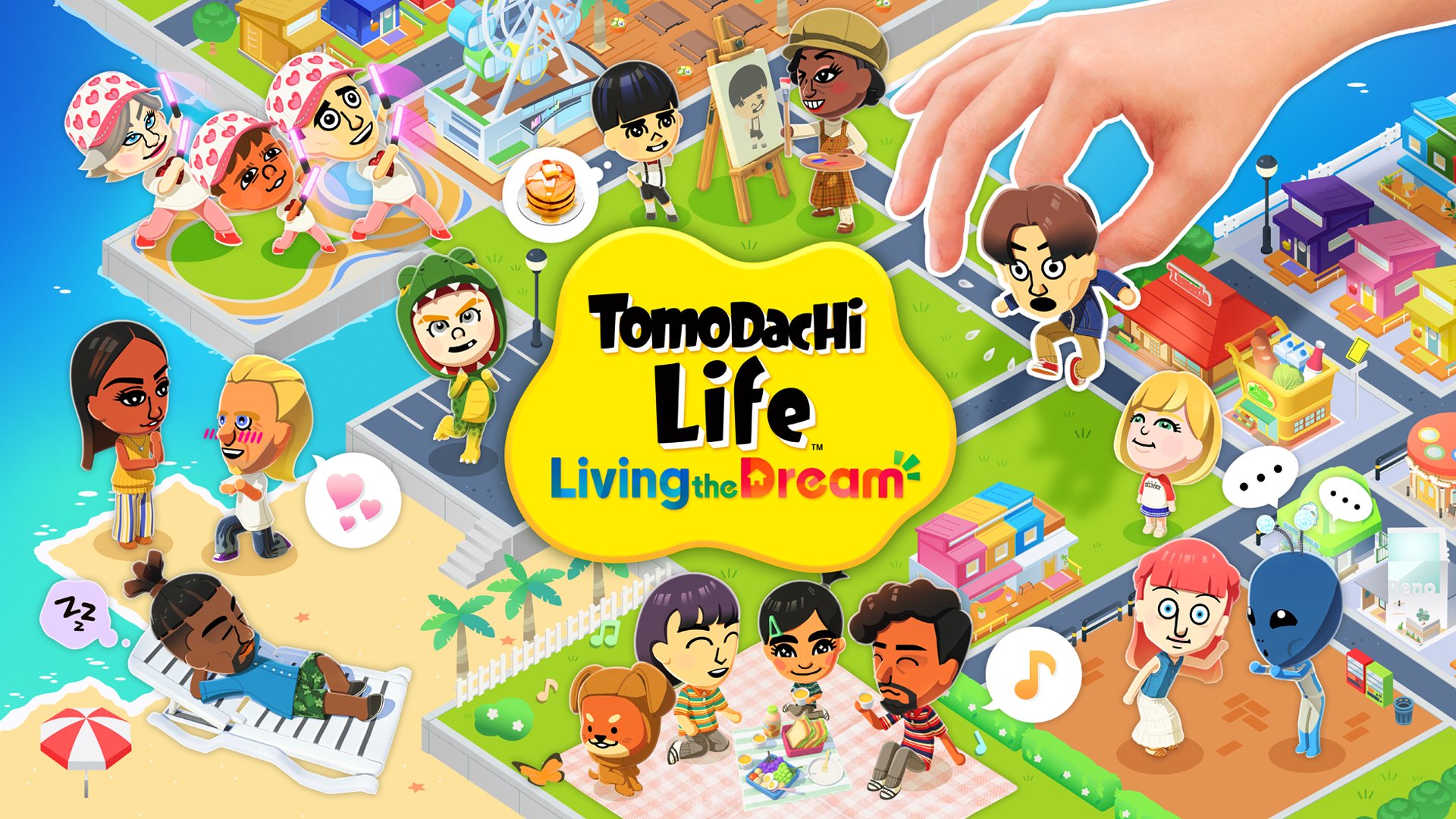
Summary:
Tomodachi Life: Living the Dream is the kind of life sim that doesn’t just let us “decorate an island” and call it a day. It hands us a tiny society of Miis, gives them personalities, habits, and relationships, then watches what happens when we nudge the pieces around. We start by creating residents in a surprisingly flexible way, either by answering guided questions or by building every facial detail from the ground up. After that, the real fun begins: we bring people together, drop Miis near each other, and suddenly we’re watching them bond over favorite foods, argue over something petty, or develop friendships that feel oddly specific. The island itself becomes a playground of routines and surprises, thanks to facilities like food and clothing shops, home renovation options, rotating marketplace items, and little “community” spaces that make the place feel lived-in. The Palette House Workshop pushes creativity further by letting us design all sorts of custom elements, from pets to visual touches that make the island feel like ours rather than a template. On top of that, we can shape the landscape, move buildings, expand areas, and layer in quirky behaviors and catchphrases so each resident stops feeling like a generic Mii and starts feeling like that one friend who always does that one thing. The result is a cheerful, unpredictable island where we’re not chasing perfection, we’re chasing stories.
Welcome to Tomodachi Life: Living the Dream and the island vibe
We’re stepping into a life sim that treats our island like a stage, and our Miis like the cast that refuses to follow a script. Tomodachi Life: Living the Dream launches on Nintendo Switch on April 16, 2026, and the core idea is simple: we build an island community, then we watch it develop a personality of its own. The Animal Crossing comparison makes sense on the surface because we place buildings, decorate outdoors, and shape the vibe, but the heart of this one is the people. Miis aren’t just cute avatars standing around to admire our landscaping. They talk, react, form opinions, and create little stories that feel like sitcom scenes we didn’t write, but somehow still caused. If we want a calm island, we can try, but the moment we move two very different Miis into the same orbit, the island can turn into a comedy club. That’s the charm. We’re not aiming for a museum. We’re building a living place, and “living” means messy, funny, and occasionally dramatic in the smallest, pettiest ways.
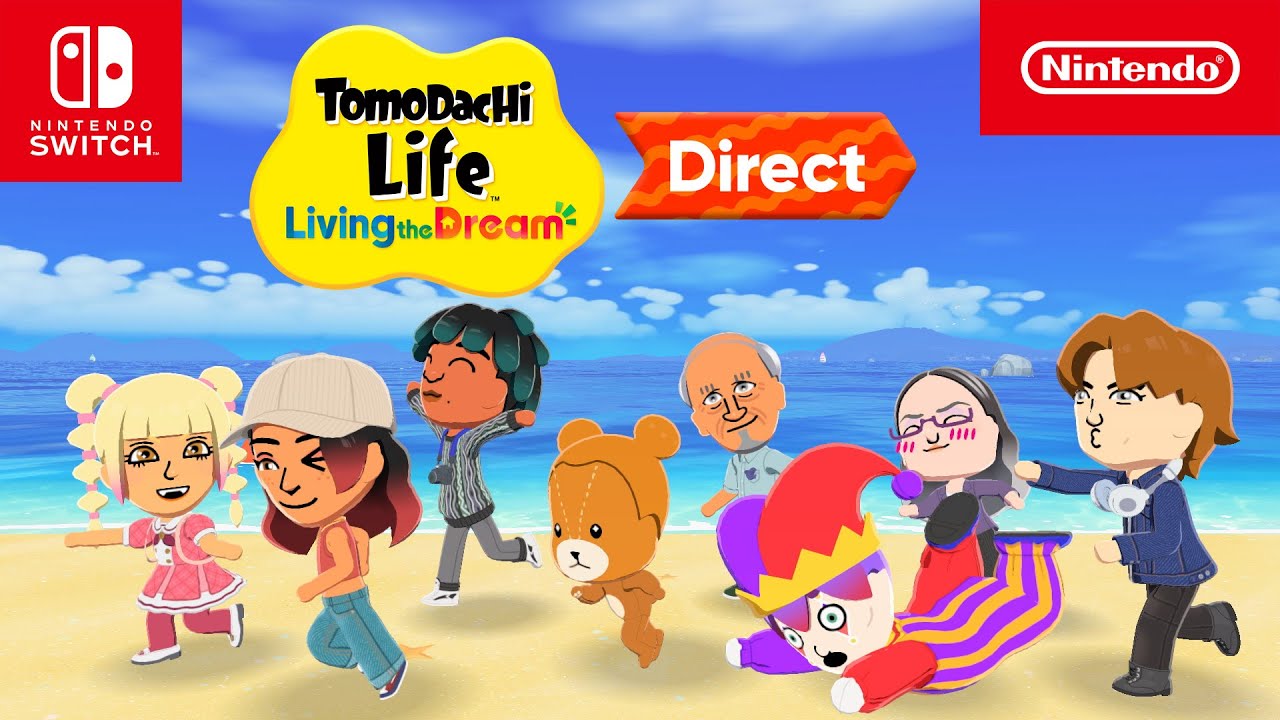
Mii characters with character
Everything starts with the residents, because the island is only as interesting as the personalities we drop onto it. Living the Dream leans hard into the idea that the Miis we create shape the stories we’ll see, which means our choices matter more than we might expect. Make a bunch of near-identical residents and the island can feel like a mirrored hallway. Mix friends, family, original characters, and a few wildcard inventions and suddenly every interaction has the potential to surprise us. The game also encourages experimentation, and that’s a big deal because it’s easy to fall into “safe” choices in character creators. Here, safe can be boring. A shy Mii paired with an energetic chaos gremlin is basically a spark near fireworks. We get to decide the ingredients, and the island handles the cooking. The fun part is that we don’t need to micromanage every moment. We set the stage, give them room to move, and the island starts producing those “no way they just said that” moments that make us call someone over to see the screen.
Two ways to create Miis: Get Help and From Scratch
Creating Miis comes in two flavors, and both matter depending on how we like to play. “Get Help” works like a friendly shortcut, asking questions about facial features so we can land on a look quickly without spending an hour tweaking eyelids like we’re painting the Sistine Chapel. “From Scratch” is the full toolbox option, letting us pick face types, hairstyles, eyes, and more. This split is smart because it respects different moods. Sometimes we want precision because we’re recreating someone we know, and sometimes we just want to toss a new resident into the mix so the island feels busier. The important thing is that neither path locks us out of personality later, so even a fast-created Mii can become a star once we start shaping how they behave. And when we’re building a whole island population, speed matters. We can craft a few “main characters” carefully, then fill out the neighborhood with quick creations that still have enough individuality to keep interactions fresh.
Face parts, hair, and the new-style polish
The face-building side is where we start seeing how Living the Dream tries to make Miis feel more expressive without losing that iconic Mii identity. With a wide range of parts to choose from, including options that are new to this game, we can push beyond the familiar “default Mii look” and get more variety across the island. That variety matters because it helps us read the island at a glance in a natural way: we recognize residents by silhouette, hairstyle, and the overall vibe before we even read a name. Face paint options also open the door for more imaginative designs, which is basically an invitation to create at least one resident who looks like they walked out of a fever dream. And that’s not a problem. That’s a feature. A handful of grounded, realistic Miis mixed with a couple of wild designs makes the island feel like a real community where not everyone shops in the same aisle of life.
Personality, voice, and the little choices that change everything
Once the look is set, the game pushes us into the choices that actually drive island stories: name, height, body type, gender, voice, and personality traits. This is where the island starts to feel like a social experiment we pretend we’re not running. How quirky is a resident? How much energy do they bring into a room? These sliders and settings sound simple, but they’re the difference between a resident who quietly enjoys snacks in the corner and a resident who barges into the spotlight like they own the place. Voice choices are especially fun because they can completely change the vibe of a character we thought we understood. And because we’re building multiple residents, we can create contrast on purpose. A calm, low-energy Mii living next door to an ultra-quirky, high-energy neighbor is basically a recipe for moments we’ll remember. We’re not just creating faces. We’re creating sparks, and the island is the tinder.
Creating many Miis without making clones
Building a full island population is exciting until we realize we accidentally made five residents who feel like the same person wearing different hats. Living the Dream gives us enough customization to avoid that, but we still have to make intentional choices. The trick is to think like a casting director. We want a mix of archetypes: the laid-back one, the overachiever, the sweet troublemaker, the one who takes everything too seriously, and the one who’s somehow friends with everyone. If we’re recreating real people, we can still mix in originals to keep the island unpredictable. The island thrives on contrast, and contrast comes from variety in personality, not just hairstyles. We can also experiment with “theme clusters” without turning the whole place into a gimmick. Maybe one corner of the island is a group of sporty types who bond over loud hobbies, while another corner is a set of calm residents who care about food and comfy homes. When those clusters cross paths, that’s where the magic happens, because the island suddenly feels like a real town where different worlds bump into each other.
Building a balanced island cast
A balanced cast isn’t about being fair, it’s about keeping the island entertaining. If everyone is high-energy and quirky, the island can feel like a nonstop circus where nothing stands out. If everyone is calm and polite, the island can feel like a waiting room. The sweet spot is a mix where we always have a few residents likely to start conversations, a few who react more cautiously, and at least one wildcard who seems to live purely to cause hilarious confusion. This is also where naming and small identity choices matter more than we expect. A resident with a bold name and a bold voice can become memorable fast, even if their face is simple. And because we can keep adding residents over time, we’re not locked into a first draft. We can watch how the island feels, then adjust by bringing in someone who fills a missing role. If the island lacks humor, we add a goofball. If the island lacks warmth, we add a friendly connector. The island is a recipe, and we get to keep seasoning it.
Helping residents connect and stirring up stories
Once residents exist, the island stops being a build project and becomes a social playground. The game makes it clear that Miis need help getting on their feet, and that “help” often means placing them in situations where they’ll interact. This is where Living the Dream starts feeling like we’re gently pushing dominoes and pretending we didn’t do anything. We can bring residents together, and different situations can play out based on who they are. Sometimes it’s wholesome, like bonding over favorite foods. Sometimes it’s hilariously specific, like connecting over something random that shouldn’t be relatable, yet somehow is. The key is that once residents are acquainted, they can interact on their own, which means the island starts producing stories without constant input. That’s the payoff. We’re not manually writing dialogue. We’re creating conditions where dialogue happens. And because we have a whole island worth of combinations, the “what happens if these two meet” question never really runs out.
Dropping Miis together and letting moments happen
The simplest way to kick-start relationships is almost comically direct: drop Miis near each other and see what happens. It’s like introducing two strangers at a party and then hovering nearby pretending we’re checking our phone. The game leans into that playful meddling, because it knows the best moments come from unexpected pairings. A resident who seems serious might suddenly reveal a ridiculous passion, and the other resident might respond in a way that makes the whole exchange feel like a punchline. These moments matter because they become the foundation for future interactions. Once residents know each other, they’re more likely to cross paths naturally and keep the relationship moving. That means we can do a little “social gardening” early on, then let the island grow relationships in its own weird direction. And if we ever feel the island is getting too quiet, we can stir the pot again by introducing new residents or nudging unlikely pairs together.
Roommates, shared spaces, and surprise drama
Roommates add another layer because living together forces interactions that wouldn’t happen otherwise. We can have up to eight residents live together as roommates, and the game promises they’ll react differently when sharing a home. That’s where the island’s “sitcom energy” can really show up, because shared spaces create friction and friendship in equal measure. One resident’s quirks become another resident’s daily reality, and that’s a perfect setup for those small dramas that feel silly but memorable. It’s also a practical tool for shaping the island’s social map. If we want a tight friend group, roommates are a shortcut. If we want chaos, we mix personalities that absolutely should not share a fridge. The best part is that these living arrangements don’t just sit in a menu. They show up in reactions and moments, making the island feel like it remembers who shares a roof. And that’s exactly the kind of detail that turns a collection of avatars into a community.
Island shops and facilities we actually use
Shops and facilities aren’t just there for decoration, they’re the island’s daily rhythm. They give us reasons to check in, try new looks, change a room, or just see what’s available right now. Living the Dream lays out a lineup of locations with distinct roles, and that variety matters because it makes the island feel like a real place with routines. Food, clothing, home renovation, rotating deals, decorations, news, and photo ops all feed into the same loop: residents grow, we respond, and the island shifts. These places also become storytelling tools. A new outfit can change how we see a resident. A favorite food can become a running joke. A ridiculous room theme can turn into a character trait all on its own. It’s the difference between “we placed a building” and “we created a habit.” When the island has habits, it feels alive, and we keep coming back because we want to see what changed while we were gone.
Fresh Kingdom food mart and the power of favorite foods
Fresh Kingdom food mart is where we lean into the fact that food is emotional, even in a goofy island sim. Helping Miis discover favorite eats and culinary curiosities sounds light, but it’s a strong way to make residents feel individual. When one resident is obsessed with a specific snack and another can’t stand it, we suddenly have personality in the simplest possible form. Food also becomes a social glue, because conversations about favorites and reactions to meals can create those small, relatable moments that make us laugh. And let’s be honest, half the joy in games like this is watching characters react to things with dramatic sincerity. Fresh Kingdom is basically a factory for that kind of humor. It also gives us an easy “daily check” habit. We pop in, see what’s going on, grab something for a resident, and watch how it changes their mood or interactions. Tiny action, big personality payoff.
Where & Wear clothing and visual identity
Where & Wear clothing is the island’s style engine, and it matters because outfits are storytelling. A resident who dresses in neat everyday attire feels different from a resident who shows up in an out-there outfit like they lost a bet and decided to commit to it. Clothing also helps us read residents quickly in busy scenes, especially as the island population grows. It’s not just “dress up” for its own sake. It’s identity, mood, and sometimes comedy. We can also use clothing to reinforce relationships. Matching outfits for roommates can make them feel like a little team. A deliberate mismatch can make a pairing feel like an odd couple. And because style changes are visible instantly, this shop becomes one of the easiest ways to refresh the island without rebuilding anything. Swap a few outfits, and suddenly the island feels like a new season of the same show.
T&C Reno home supply and rooms that get weird in a good way
T&C Reno home supply is where we reshape interiors, and the game clearly wants us to have fun with it. Revamping rooms and living spaces isn’t limited to “nice furniture in nice places.” The examples point to rooms built around dreams that are delightfully specific, like sleeping in a supermarket or a library. That’s the tone in a nutshell. Homes become extensions of personality, and when homes are expressive, we get more stories. A resident who lives in a perfectly tidy space feels different from one who lives in a themed room that looks like a joke someone took seriously. Interior changes can also affect how we think about roommates. Shared homes can become cohesive, or they can become a visual tug-of-war. Either way, it adds texture to island life. And because rooms are where residents spend a lot of time, it’s not just decoration. It’s atmosphere, and atmosphere is half the reason we remember places, even fictional ones.
Marketplace deals that change by time of day
The Marketplace brings that “check back later” energy by offering reasonably priced items that change depending on the time of day. That rotating stock matters because it creates natural momentum. Instead of buying everything at once and being done, we’re encouraged to revisit and see what’s new. It also adds a light sense of timing, like the island has its own schedule and we’re stepping into it. This kind of system is sneaky in the best way because it makes the island feel like it exists even when we’re not looking. And when we do find an item that feels perfect for a resident, it’s more satisfying because it feels discovered rather than handed to us. The Marketplace is also a great place for impulse decisions, and in Tomodachi Life, impulse decisions are usually the ones that lead to the funniest outcomes.
Quik Build amenities and decorating the shared world
Quik Build amenities is where we gather island decorations and start shaping the public spaces, not just private rooms. That’s important because a community isn’t only the people, it’s the places they bump into each other. Benches, vending machines, playground rides, and other landscape items turn empty stretches into hangout zones. Once we start placing these, the island stops feeling like a map and starts feeling like a neighborhood. We can design cozy corners for calm residents, lively spaces that feel like social magnets, or silly areas that exist purely because we wanted a bouncy ride next to a vending machine. These choices also influence how we experience the island. A well-decorated path makes us want to stroll around and check on residents, even when we don’t have a specific goal. That’s a sign the island is working. It’s pulling us in, not pushing tasks at us.
MNN news and Foto-Tomo for memories and chaos
MNN, the island’s news station, and Foto-Tomo photography add flavor in two different ways: one helps us keep up with island happenings, and the other helps us capture moments worth remembering. News framing is funny by default because it treats everyday island life like it’s headline-worthy, which fits Tomodachi Life’s sense of humor perfectly. Foto-Tomo, meanwhile, is a reminder that these games are basically memory machines. We don’t remember every item we placed, but we remember the moment two residents did something absurd at exactly the right time. A photo op becomes a way to bookmark those moments. Together, these facilities make the island feel like it has its own culture. There’s a sense that things happen here, get talked about, and get remembered. That’s what turns a sandbox into a place with identity.
Palette House Workshop and the joy of making things
The Palette House Workshop is where Living the Dream leans into creativity beyond furniture placement. Instead of only choosing from existing items, we can create a wide range of elements that further enliven island life. That matters because personalization isn’t just about where a building sits, it’s about the little details that make the island feel like it belongs to us. When we can design something custom and then see it exist in the island’s day-to-day rhythm, it hits differently. It’s like handwriting a note instead of picking a greeting card. Both communicate, but one feels personal. The workshop also broadens what “customization” means. We’re not stuck in a single lane like outfits or furniture. We can create across categories, which encourages experimentation and gives us more ways to express each resident’s vibe. If a resident feels bland, we can give them something made just for them, and suddenly they have a hook.
Pets, drinks, shows, clothing touches, house exteriors, and ground tiles
The workshop’s range is the point. We can design pets for Mii characters, draft custom drinks, sketch a resident’s favorite TV show, decorate a special item of clothing, draw the exterior of a house, and even create ground tiles. That’s a lot of creative surface area, and it means the island can reflect our sense of humor, our aesthetic, or our inside jokes. Give a resident a custom pet and they feel more like a person with a life. Create a ridiculous drink and suddenly we have a running gag. Design a house exterior and the neighborhood starts looking like a place with stories on every street. Ground tiles are especially powerful because they influence how the whole island reads visually, and that’s the kind of customization that makes us feel like we built something unique rather than “decorated a preset.” The workshop is basically a permission slip to be weird, and Tomodachi Life is always at its best when we embrace the weird.
Making the island yours with layout and landscape
Customization isn’t only about objects, it’s about space. Living the Dream lets us change the island’s aesthetic with landscape items like trees, plants, benches, vending machines, and playground rides, and that’s where the island starts to feel authored. We can build a cozy park area, a bustling little shopping zone, or a scenic stretch that feels like the “main street” of our community. The island also isn’t locked in place. We can move shops and houses around, which is huge because it lets us redesign the flow as the population grows. Early on, we might keep things clustered for convenience. Later, we might spread out to create distinct neighborhoods. That kind of evolving layout mirrors how real places change as more people move in. And because residents can influence suggestions, the island can feel collaborative rather than purely top-down. We’re still in control, but it feels like we’re responding to a living place, not just arranging props.
Moving buildings, expanding land, and following resident suggestions
The ability to expand areas of land and rearrange buildings means the island can grow with our ideas rather than boxing us in. If we realize a certain area isn’t getting used, we can redesign it into something more inviting. If we want a “friendship hub,” we can place amenities and shops in a way that encourages residents to cross paths. Resident suggestions add a fun psychological twist because they can nudge us toward changes we wouldn’t have considered, which keeps the island from becoming too predictable. Sometimes a suggestion will feel perfect, like the island itself is helping us. Sometimes it’ll feel like a resident is making a weird request purely to test our patience, and honestly, that’s also part of the charm. Either way, the island becomes a conversation. We propose a layout, the residents react, and we adjust. That loop keeps the place feeling fresh over time.
More ways to customize with quirks and phrases
Once we’ve handled the big stuff like looks, homes, and island layout, Living the Dream zooms in on the tiny details that make residents feel human. We can add flourishes to Miis by gifting them little quirks that give them more individuality. These are the kinds of details that make us grin because they show up when we least expect it. A pose a resident strikes, the way they enjoy their food, or even how they toss and turn while they sleep can turn a generic moment into a character moment. This is where the island starts feeling like it’s full of people with habits rather than avatars waiting for input. Favorite phrases are another great tool because they let us spice up conversations with a touch of personality or inside jokes. The danger, of course, is that we’ll give someone a phrase that’s funny once and then hear it a thousand times. But that’s also kind of realistic, isn’t it? We all know someone who found one joke and never let it go.
Animations, habits, and the “that’s so them” factor
Quirks work best when we match them to the resident’s vibe, because that’s how we get the “that’s so them” feeling. A dramatic resident might get a theatrical pose. A relaxed resident might get a sleepy habit that makes them look perpetually cozy. A chaotic resident might get something that turns normal activities into mini-performances. These details also help relationships feel more believable. When we see how two residents react differently in the same situation, we start thinking about them as distinct people. That’s the secret sauce of Tomodachi Life. It makes us care about tiny differences and laugh at tiny behaviors. And because phrases and quirks can be gifted, we can keep evolving residents over time. If someone feels stale, we freshen them up. If someone is already hilarious, we lean into it. The island becomes a comedy ensemble, and we’re the casting director with a bag of props.
Playing on Nintendo Switch and Nintendo Switch 2
Living the Dream is a Nintendo Switch release, and it’s playable on Nintendo Switch 2 as well. The practical takeaway is that we don’t need to wait for a separate version to enjoy it on the newer system, but we also shouldn’t invent features that haven’t been spelled out. Nintendo has been clear about the Switch launch date, and coverage around the Direct points to Switch 2 playability, but specific changes on Switch 2 were not detailed in the information we’re working from here. That means we can talk about what we know without turning this into a guessing game. What we can say confidently is that the game’s core loop is built around social interactions, customization, and creative tools, and those strengths don’t depend on hypothetical enhancements. Whether we’re on Switch or playing via Switch 2, the experience hinges on the residents we create and the island we shape. The magic lives in the people and the moments, not in a checklist of technical tweaks.
What we can say without guessing
We can anchor ourselves in the parts that are concrete: the release date on Switch, the revealed features like multiple creation routes for Miis, the ability to help residents connect through proximity and shared living, the named facilities, and the Palette House Workshop’s creative options. Those are the building blocks of the experience, and they’re plenty. If we’re choosing where to play, the decision can be as simple as “where do we like to spend our time?” If Switch 2 is our main system, great, we’ll play there. If Switch is what we’ve got in our hands, also great, the island will still be full of unpredictable interactions. The best approach is to focus on the part we control: making a fun cast, setting up spaces that encourage interactions, and using shops and the workshop to keep the island evolving. That’s where this game lives, and that’s where we’ll get the stories we came for.
A fun first week plan that avoids decision paralysis
Starting a life sim can feel like being handed a box of LEGO with no picture on the front. Exciting, but also a little intimidating. The trick with Living the Dream is to aim for momentum, not perfection. In the first week, we can focus on building a small but varied set of residents, learning the daily rhythm of shops and facilities, and setting up a few public spaces that naturally pull residents together. We don’t need to place every tree or design every tile right away. If we try to “finish” the island on day one, we’ll miss the point, because this island is supposed to grow and surprise us over time. A good first week is about giving the island enough ingredients to start producing moments. Once those moments start happening, motivation takes care of itself. We’ll log in because we want to see what our residents are up to, not because we feel like we have chores to do.
Simple goals that make the island feel alive fast
We can keep it simple with a handful of goals that pay off quickly. First, create a core group of residents with clear contrasts in personality, so interactions have immediate flavor. Second, introduce at least one roommate situation, because shared living accelerates relationship dynamics and makes the island feel busy. Third, visit Fresh Kingdom and Where & Wear early, because food preferences and outfits are the fastest way to make residents feel distinct. Fourth, do one fun home setup at T&C Reno, even if it’s silly, because a memorable room becomes an instant character trait. Fifth, try the Palette House Workshop in a small way, like designing a pet or a custom item, so we feel that “this is ours” spark. Finally, place a few landscape items in a shared area, like benches and a vending machine, to create a natural hangout spot. With those steps, the island stops feeling like an empty stage and starts feeling like a neighborhood with stories already brewing.
Conclusion
Tomodachi Life: Living the Dream works because it turns our choices into social chain reactions. We create residents, shape their personalities, and then watch the island do what it does best: produce weird, funny, oddly heartfelt moments that feel like they belong to our cast specifically. The named shops and facilities give the island a daily rhythm, the Palette House Workshop gives us creative ownership, and the layout tools let the island evolve as our community grows. The smartest way to enjoy it is to resist the urge to perfect everything immediately and instead focus on building a lively mix of residents and spaces that encourage interactions. If we do that, the island becomes a little world that keeps surprising us, whether we’re chasing wholesome friendships, silly dramas, or the pure joy of watching a Mii act like they just discovered the concept of snacks for the first time.
FAQs
- When does Tomodachi Life: Living the Dream release on Nintendo Switch?
- It launches on April 16, 2026 for Nintendo Switch.
- How do we create Miis in Living the Dream?
- We can use a guided “Get Help” option that asks questions, or build a resident “From Scratch” by selecting facial parts, hair, and other details, then setting identity and personality traits.
- What’s the quickest way to help residents become friends?
- We can bring residents together by placing Miis near each other so interactions trigger naturally, then keep the island lively by adding varied personalities and shared spaces that encourage repeat encounters.
- What is the Palette House Workshop used for?
- It’s an in-game creative space where we can make custom elements like pets, drinks, favorite TV show concepts, clothing touches, house exteriors, and ground tiles to personalize island life.
- Are there Switch 2-specific changes confirmed for the game?
- The game is playable on Nintendo Switch 2, but specific enhancements or changes for Switch 2 were not detailed in the provided reveal information.
Sources
- Tomodachi Life: Living the Dream Direct spotlights quirky fun with player-made Mii characters; game launches on Nintendo Switch April 16, Nintendo.com, January 29, 2026
- Tomodachi Life: Living the Dream for Nintendo Switch, Nintendo.com, January 29, 2026
- Tomodachi Life: Living the Dream Direct 1.29.2026, YouTube, January 29, 2026
- Tomodachi Life: Living the Dream Nintendo Direct – every announcement, Nintendo Life, January 29, 2026
- Tomodachi Life: Living the Dream gets April release date to round off Nintendo Direct, GamesRadar+, January 29, 2026