














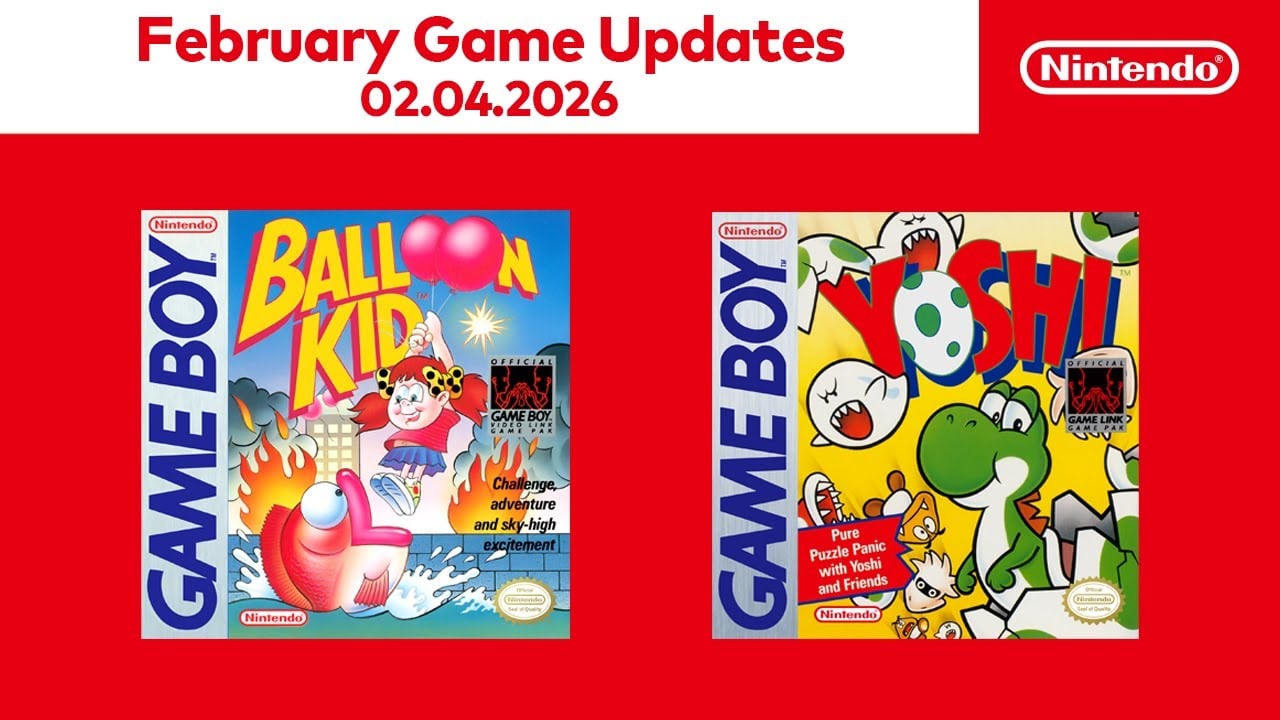
Summary:
Nintendo has added two more Game Boy titles to the Nintendo Switch Online lineup, and it’s the kind of update that feels small until you actually boot it up. From today, Switch Online subscribers can jump into Yoshi and Balloon Kid through the Game Boy – Nintendo Classics app. That means no extra purchase, no separate storefront hunt, and no awkward “Is this region locked?” guessing game. You open the classics app, update if needed, and the new arrivals are ready to play.
What makes this pairing fun is how different the vibes are. Yoshi is a puzzle-first experience with that classic early-90s Nintendo rhythm: quick decisions, tidy patterns, and the constant temptation to say, “One more round.” Balloon Kid, on the other hand, is more like a windy tightrope walk. You’re floating forward, managing momentum, and trying not to get popped by hazards that feel like they were placed by someone who enjoys a little mischief. Together, they cover two totally different moods, which is exactly what you want from a retro drop: something you can chill with and something that keeps your hands honest.
If you’re wondering what the trailer shows, what the games actually play like, and how to get started without faceplanting into the first obstacle, we’re laying it out clearly. No guesswork, no drama. Just the key details, the practical steps, and a few tips that make the first session feel good instead of frustrating.
Nintendo Switch Online adds two more Game Boy classics
There’s a particular kind of joy in these surprise retro additions, because they land like a little care package from the past. Nintendo Switch Online keeps building out its Game Boy – Nintendo Classics library, and this time the drop is Yoshi and Balloon Kid. Both are real Game Boy-era picks that instantly show Nintendo’s range back then: one leans puzzle and pattern recognition, the other leans action and movement control. When Nintendo adds games like these, it’s not just about padding a list. It’s about giving us more flavors to bounce between when we want something quick, familiar, and satisfying in a way modern games sometimes forget. You don’t need a tutorial the size of a novel. You need a few minutes, a bit of curiosity, and maybe the willingness to laugh when you mess up and get popped like a balloon at a birthday party.

What we’re getting today and why it’s a nice surprise
From today, subscribers can play both titles as part of the standard Switch Online offering for Game Boy – Nintendo Classics. That “from today” detail matters because it tells you this is live now, not a vague promise for later in the month. It’s also a nice reminder of how frictionless the classics apps can be when everything lines up: download the app once, keep your membership active, and new games simply appear as the library grows. And honestly, this pairing is smart. If you’re the kind of player who wants short sessions, Yoshi fits that pocket perfectly. If you want something a bit more tense and skill-driven, Balloon Kid delivers that “just one more attempt” energy. It’s like getting both a cozy snack and something spicy in the same bag – different cravings, same happy outcome.
Yoshi on Game Boy and the Mario & Yoshi name in Europe
Yoshi on the Game Boy is a puzzle game built around stacking and clearing falling enemies, and it has that classic arcade-like loop where the challenge ramps up as the pace increases. In Europe, you’ll often see it referenced as Mario & Yoshi, which can look confusing if you’re scanning lists and wondering whether you’re missing a separate release. You’re not. It’s the same core game, just marketed differently by region. The important part is how it plays: you’re catching falling characters on trays, making matches, and trying to manage the screen before things spiral. It’s the kind of puzzle setup that feels simple until it suddenly isn’t. One moment you’re calmly lining things up, the next you’re juggling a messy stack and bargaining with the universe for one clean match. It’s also a great fit for handheld-style play because rounds can be short, and progress is measured in “How long can we keep control?” rather than “How far are we from the next cutscene?”
Balloon Kid and how it connects to Balloon Fight
Balloon Kid is closely tied to Balloon Fight, and you can feel that lineage in the way movement and danger work together. You control a character floating with balloons, pushing forward through side-scrolling stages while trying to avoid hazards that can pop your balloons and end your run. The connection to Balloon Fight shows up in the shared DNA: that delicate balance between freedom and fragility. You’re not a tank, you’re basically a soap bubble with dreams, and the world is full of sharp objects. That’s what makes it fun. Every little success feels earned because your margin for error is slim. And because it’s a Game Boy title, the design is direct. It doesn’t waste your time. It asks you to learn the rhythm, respect the obstacles, and keep moving. If you like games where skill improves quickly and you can feel yourself getting better run by run, Balloon Kid has that old-school satisfaction baked in.
How to find and launch the games on Switch
If you already use the classics apps, this is straightforward, but it helps to spell it out so nobody gets stuck on the boring part. You’ll want the Game Boy – Nintendo Classics app on your Nintendo Switch. If you don’t have it installed yet, you can grab it from the Nintendo eShop and then launch it like any other application. Once inside, new additions typically appear in the library list, and sometimes an app update is required before everything shows correctly. The simplest approach is to highlight the app icon on the Switch home screen, press the + button, and check for updates. After that, open the app, browse the Game Boy lineup, and you should see Yoshi and Balloon Kid available to start immediately. It’s the kind of routine that becomes second nature, like checking the fridge even though you already know what’s in there. Still, we check, because hope is powerful.
Which membership you need and what is included
These two games are part of the Nintendo Switch Online offering tied to the Game Boy – Nintendo Classics library, which means you don’t need to buy them individually once you’re subscribed. The key practical point is this: you need an active Nintendo Switch Online membership, and you need access to the Game Boy classics app itself. From there, the games are included as part of the library you can play while your membership remains active. If you’re on a family plan, the same logic applies for the accounts covered by that plan, as long as they’re properly connected under the membership. If you’re ever unsure whether your membership is active, you can check your account status in the Switch settings. Think of it like a theme park wristband. If the band is valid, the rides are open. If it’s expired, the gate doesn’t budge, no matter how politely you ask.
What the new trailer focuses on
Nintendo also shared a trailer alongside this update, and the purpose of trailers for classics is usually simple: remind you what the game looks like in motion and trigger that “Oh yeah, I remember this” feeling. With Yoshi and Balloon Kid, the contrast is the whole point. Yoshi’s footage tends to highlight the falling-object puzzle flow and the way matches clear space, while Balloon Kid’s footage emphasizes floating movement, hazards, and the forward push of each stage. A good classics trailer doesn’t need to sell you a cinematic universe. It just needs to show enough gameplay to answer the basic question: “Is this my kind of fun?” If you’re already a Switch Online subscriber, it’s also a gentle nudge to actually open the app instead of letting the classics library grow quietly in the background like an ignored houseplant.
What stands out in Yoshi’s gameplay loop
Yoshi’s loop is all about control under pressure. You’re watching pieces fall, catching them, and aiming to create clean clears before the screen becomes a cluttered mess. The standout detail is how quickly the mood shifts: it starts calm, then ramps into that familiar puzzle panic where your brain is sprinting while your hands are trying to stay precise. The game rewards planning, but it also rewards quick improvisation when your perfect plan gets ruined by the next drop. It’s like trying to stack plates while someone keeps handing you more plates. You can do it, but only if you stay focused and keep the pile neat. If you enjoy puzzle games where small decisions compound into big outcomes, this is the kind of loop that can hook you fast.
What stands out in Balloon Kid’s stage design
Balloon Kid stands out because stage design and movement are inseparable. You’re not just navigating left to right, you’re constantly negotiating your altitude and momentum while hazards threaten your balloons. What makes it memorable is that the danger feels personal. When a balloon pops, it’s not an abstract health bar loss, it’s a direct hit to your ability to control the character. That creates tension without needing complex systems. The stages push you to read patterns, anticipate obstacles, and commit to movements at the right time. It’s like biking through a narrow path with puddles on both sides. You can ride slowly and carefully, but sometimes you still need a confident push forward, or you’ll wobble into trouble anyway.
Why these picks still matter in 2026
It’s fair to ask why anyone should care about early-90s Game Boy games when modern libraries are overflowing. The answer is that these games still deliver something modern design sometimes smooths away: immediacy. You start, you understand the goal quickly, and you’re playing for real within seconds. There’s also a cultural value in keeping these titles playable in an official, easy-to-access way. It preserves the weird little corners of Nintendo’s history, not just the biggest hits everyone already knows by heart. Yoshi and Balloon Kid also show two sides of Nintendo’s identity from that era: clever puzzle design and approachable action that still demands skill. And because they’re included with a membership many people already have, trying them isn’t a commitment. It’s a casual, low-stakes decision, like putting on a song you haven’t heard in years just to see if it still hits. Sometimes it does. Sometimes it hits harder.
A tiny time capsule of Nintendo’s handheld era
Game Boy games have a particular texture. The visuals are simple, the sound is iconic in its own chippy way, and the design language is focused because hardware limits forced clarity. That’s why playing these games now can feel like opening a time capsule that still works perfectly. You’re not only playing a game, you’re seeing how ideas were communicated with fewer pixels and fewer buttons. Yoshi’s puzzle structure shows how Nintendo could take a simple concept and tune it into something addictive. Balloon Kid shows how tension can come from movement and risk rather than complex progression systems. For players who grew up with these systems, it’s nostalgia with a controller. For players discovering them now, it’s like watching an old film and realizing the pacing is different, but the craft is still there. Either way, it’s a reminder that “old” doesn’t mean “irrelevant.” It often means “sharper than expected.”
Tips if you’re playing for the first time
If you’re new to both games, the best tip is to give yourself a few rounds to settle in. Retro games often feel tougher at first because they assume you’ll learn by doing, not by reading a tutorial. In Yoshi, focus on keeping your tray management tidy. Don’t chase flashy setups if the board is getting crowded. Clearing space is survival, and survival buys you time to make smarter matches. In Balloon Kid, treat your movement like you’re steering something delicate. Small adjustments are your friend, and panicked overcorrections usually end in a pop. Watch hazards before you commit to forward movement, and remember that patience is a skill, not a personality trait. If you bounce off either game in the first five minutes, that’s normal. Give it a little longer. These are the kind of games that feel better once your hands understand the rhythm, and suddenly you’ll notice you’re smiling at a run that would’ve crushed you earlier.
Conclusion
Yoshi and Balloon Kid joining the Game Boy – Nintendo Classics lineup is a neat reminder that Switch Online’s retro library keeps growing in ways that aren’t always predictable, but are often fun. One game scratches the puzzle itch with quick rounds and escalating pressure, while the other turns movement into a careful dance where every mistake feels immediate. The best part is how easy it is to try them. If you’ve already got the membership, the barrier is basically zero: update the app, launch it, and play. And if you’re the kind of player who loves discovering odd little pockets of Nintendo history, this is exactly the kind of drop that makes opening the classics app feel worthwhile. Sometimes we want a giant new release. Sometimes we just want a small surprise that fits into a coffee break and leaves us thinking, “Okay, that was actually great.”
FAQs
- Are Yoshi and Balloon Kid available right now on Nintendo Switch Online?
- Yes. Nintendo has added both games to the Game Boy – Nintendo Classics library for Switch Online members as of February 3, 2026.
- Do we need the Expansion Pack to play these Game Boy games?
- These titles are part of the Game Boy – Nintendo Classics offering tied to a Nintendo Switch Online membership, and they appear in the Game Boy classics app for subscribers.
- Why is Yoshi sometimes called Mario & Yoshi in Europe?
- That is a regional naming difference. The Game Boy puzzle game is commonly known as Mario & Yoshi in Europe, but it’s the same game.
- How do we find the games on the Switch?
- Install and open the Game Boy – Nintendo Classics app, make sure it’s updated, then browse the library list. The new games should appear there for members.
- Is there an official trailer for these additions?
- Yes. Nintendo and multiple official-facing outlets have shared the update alongside a trailer showing both games in action.
Sources
- More games flutter and float to Nintendo Classics, Nintendo.com, February 3, 2026
- Nintendo Expands Switch Online’s Game Boy Library With Two More Titles, Nintendo Life, February 4, 2026
- Nintendo Switch Online adds Game Boy games Yoshi and Balloon Kid, Nintendo Everything, February 4, 2026
- Two more Game Boy games have been added to Switch Online’s Nintendo Classics library, Video Games Chronicle, February 4, 2026
- Game Boy – Nintendo Classics add Balloon Kid, Yoshi, Gematsu, February 3, 2026