














Summary:
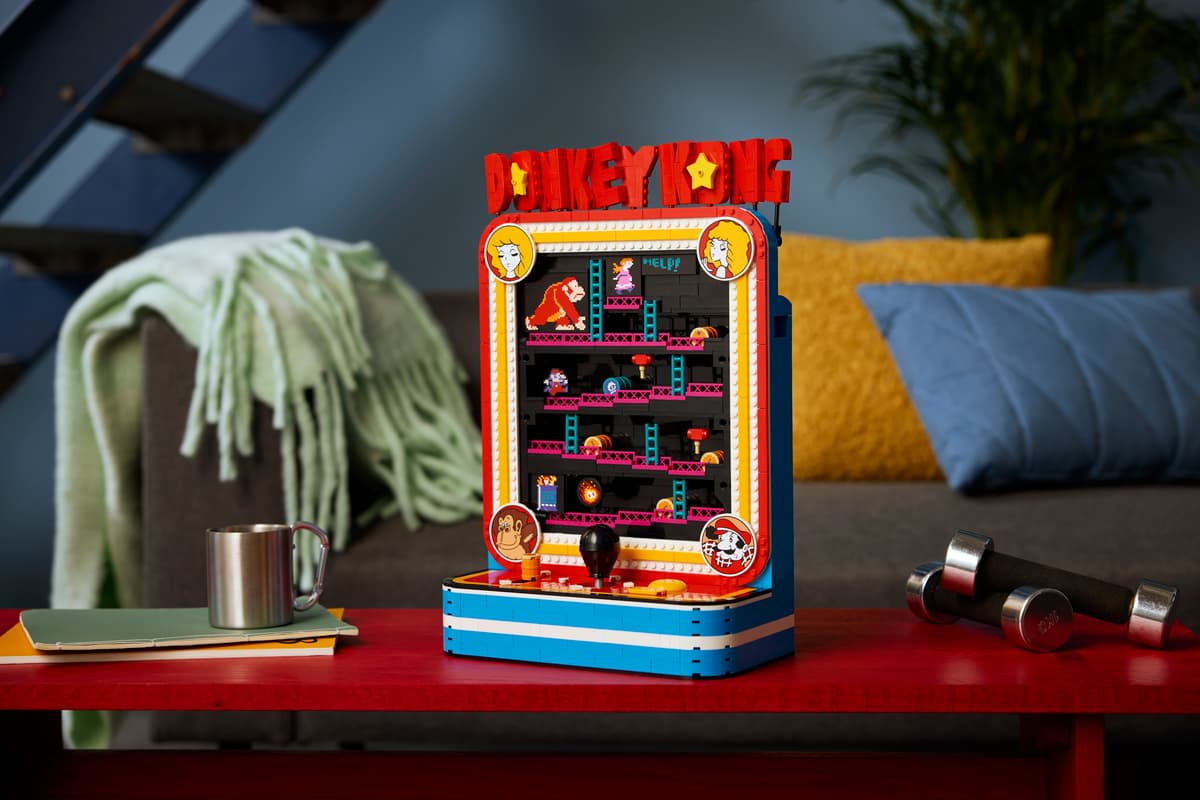
Nintendo and the LEGO Group are returning to the earliest days of arcade gaming with the LEGO Donkey Kong Arcade set, an interactive display model based on Nintendo’s legendary 1981 release. Launching on August 1, 2026, the adult-focused set recreates the unmistakable red cabinet and its famous construction-site stage using 1,371 pieces. It brings together Donkey Kong, Jumpman and Lady, placing the three characters inside a brick-built tribute to one of gaming’s most recognizable rivalries.
This isn’t simply a cabinet-shaped model destined to gather dust on a shelf. The build includes mechanical features that imitate the basic rhythm of the original game. A lever releases barrels from Donkey Kong’s platform, while a working joystick moves Jumpman from side to side. Pressing the cabinet’s button makes the determined hero leap, giving builders a chance to recreate his frantic attempts to avoid the rolling hazards. It’s a playful touch that turns a nostalgic display piece into something visitors will immediately want to try.
The set also includes familiar visual elements such as sloping platforms, ladders, a hammer and the arcade game’s industrial framework. Together, these details capture the look and personality of the original Donkey Kong without attempting to reproduce every part of the full game. With its mechanical design, historic characters and recognizable cabinet artwork, the LEGO Donkey Kong Arcade set is positioned as both a celebration of Nintendo history and an eye-catching conversation piece for retro gaming fans.
LEGO Donkey Kong Arcade Set Recreates Nintendo’s Classic Cabinet
Nintendo has officially revealed the LEGO Donkey Kong Arcade set, giving one of the company’s most important games a detailed brick-built tribute. The model recreates the classic red arcade cabinet that introduced players to Donkey Kong, Jumpman and Lady in 1981. Rather than presenting only a small scene inspired by the game, the designers have recreated the cabinet itself and placed a moving version of its construction-site challenge inside. The result looks immediately familiar, even from across the room. Its bright red exterior, blue platforms and scattered ladders resemble a physical piece of arcade history that has somehow shrunk to fit comfortably on a desk or display shelf. For fans who remember crowded arcades, jangling coins and glowing cabinets, it’s a wonderfully nostalgic sight.
The model is officially identified as LEGO set 72051 and has been created for builders aged 18 and older. That age recommendation reflects the set’s role as a detailed collector’s model rather than a traditional children’s playset. Even so, it hasn’t forgotten that LEGO models are supposed to be fun. The moving barrels and controllable Jumpman add a welcome sense of life to the cabinet, ensuring the finished creation does more than simply look pretty beside a row of game boxes.
The August Release Brings the Arcade Rivalry Back Home
The LEGO Donkey Kong Arcade set will launch on August 1, 2026, allowing Nintendo fans to recreate the famous confrontation between Donkey Kong and Jumpman at home. The timing places the model firmly among LEGO’s growing range of premium gaming displays, which have increasingly focused on recognizable hardware, characters and scenes from earlier generations. This particular choice carries plenty of weight. Donkey Kong wasn’t merely another successful arcade release. It helped establish characters and ideas that would shape Nintendo’s future, including the heroic carpenter who would eventually become known around the world as Mario.
That history gives the model an identity beyond its mechanical tricks. It represents the starting point of a rivalry that has survived for decades, changing from arcade battles into kart races, sports competitions and friendly appearances across Nintendo’s broader universe. Seeing Jumpman beneath Donkey Kong’s platform is like finding the first page of a very long family photo album. The artwork may be blockier and the names may be older, but the personality is already there.
A 1,371-Piece Build Designed for Adult Nintendo Fans
With 1,371 pieces, the LEGO Donkey Kong Arcade set offers a substantial building project without becoming impossibly large. Builders will assemble the cabinet’s red exterior, internal mechanisms, sloping platforms and miniature characters before bringing the different sections together. The complexity should provide enough variety to keep the process interesting, especially when construction reaches the moving components hidden inside the model. Those mechanisms are the beating heart of the set, quietly translating a lever pull or button press into action on the miniature screen.
The adult-focused presentation also makes the model suitable for game rooms, offices and dedicated LEGO displays. Its subject is playful, but the finished cabinet has the visual presence of a collector’s item. You don’t need an entire arcade corner to make it work, either. The shape is compact enough to stand on furniture while remaining instantly recognizable. Place it near a retro console collection and it should feel right at home. Place it in an office and someone will probably test the button before asking permission. Honestly, can you blame them?
Interactive Barrels Turn the Display Model Into a Playable Scene
The most distinctive feature is the working barrel system. Pulling a lever releases a barrel from the upper portion of the stage, allowing it to travel down the sloping platforms toward Jumpman. This simple action captures the central threat of the original game, where players had to read each barrel’s path and choose the right moment to jump. The LEGO version naturally provides a much smaller and more controlled interpretation, but it preserves the sense of anticipation. The moment a barrel begins moving, your eyes follow it automatically.
The mechanism reportedly cycles multiple barrels through the cabinet, creating a repeating flow rather than relying on a single loose piece. That design helps the model feel more like a tiny mechanical game and less like a static diorama. It also provides an excuse to keep pulling the lever, which may be dangerous news for anyone trying to finish actual work nearby. The rolling action demonstrates how clever engineering can communicate the feeling of a video game without using a screen, speaker or battery. Plastic gears, rods and gravity do all the heavy lifting.
The Joystick and Button Give Jumpman Room to Move
The cabinet’s controls are connected to Jumpman through internal mechanical components. Moving the joystick shifts him from side to side, while pressing the button makes him leap upward. These actions allow users to position the character and attempt to avoid the barrels rolling down the stage. The movement is intentionally simple, but it mirrors the most recognizable part of Donkey Kong’s gameplay. You move, you wait and then you jump while hoping your timing isn’t embarrassingly bad.
Because everything operates mechanically, the set remains true to the tactile appeal of LEGO. There’s no app to install, cable to connect or update to download. The response comes directly from the pieces inside the cabinet. Push the control and the character moves. Press the button and he jumps. That immediate connection between your hand and the model gives the display a personality that photographs alone cannot fully capture.
Mechanical Controls Preserve the Feel of Early Arcade Games
The controls also suit the history of the source material. Early arcade games relied on direct inputs and straightforward objectives, making every movement easy to understand but difficult to master. The LEGO model cannot reproduce the full challenge, score system or complete stage progression, yet it does capture that wonderfully clear relationship between action and consequence. A barrel rolls toward Jumpman, and you need to make him jump. No lengthy tutorial is required.
That simplicity is part of the charm. The mechanism provides enough interaction to remind players what made Donkey Kong exciting while keeping the focus on the physical build. It’s more mechanical toy than functional arcade machine, and that distinction works in its favor. Trying to include a full electronic version could have distracted from the craftsmanship. Instead, LEGO has created a miniature performance in which every lever and brick plays a visible role.
Donkey Kong, Jumpman and Lady Complete the Historic Lineup
The set includes brick-built versions of Donkey Kong, Jumpman and Lady, the three central figures from the original arcade game. Donkey Kong occupies the upper platform, ready to send another barrel down the stage. Lady waits near the top, while Jumpman begins below and attempts to navigate the hazards between them. Their positioning recreates the story of the original game without requiring dialogue or explanation. One look tells you exactly who is causing trouble and who has been given the exhausting job of climbing upward.
The decision to use the names Jumpman and Lady is particularly important. These names connect the set to the characters as they appeared during Donkey Kong’s earliest arcade era. Jumpman would later become Mario, while Lady became better known as Pauline. Using the original terminology reinforces the model’s historical focus and separates it from modern Super Mario adventures. This isn’t Mario exploring the Mushroom Kingdom. It’s a snapshot of the moment before that world fully took shape.
Jumpman Reflects Mario’s Earliest Video Game Appearance
Jumpman’s inclusion highlights how far Nintendo’s most famous hero has travelled. His early design was created around the limitations of arcade graphics, using bold colors and recognizable features that could be read from a small collection of pixels. His hat avoided the need to animate hair, while his moustache helped define his face. Those practical design choices eventually became permanent parts of Mario’s identity.
Within the LEGO cabinet, Jumpman is both a character and a functional component. His figure must remain recognizable while also responding to the joystick and jumping mechanism. That combination makes him more interesting than a figure placed motionless beside the cabinet. He’s an active participant, eternally preparing to leap over the next barrel. It may not be the easiest job in the Nintendo universe, but at least he never runs out of lives here.
Authentic Details Capture the Look of the Original Arcade Game
Beyond the moving characters and barrels, the model includes many of the visual elements associated with the original Donkey Kong stage. Sloped girders stretch across the interior, ladders connect different levels and a hammer represents one of Jumpman’s few ways to fight back against approaching hazards. These details give the cabinet depth and ensure it remains recognizable even when the controls are not being used.
The red casing is equally important. Arcade cabinets needed strong artwork and vivid colors to attract attention in noisy public spaces filled with competing machines. The LEGO model reflects that tradition through its bold outer shell and prominent branding. It doesn’t need flashing lights to stand out. The shape and color already announce exactly what it represents. For anyone familiar with Nintendo’s arcade history, the silhouette alone should be enough to trigger recognition.
The Cabinet Works as Both Retro Decor and a Display Piece
Once completed, the model is intended to function as retro decoration for an entertainment room, office or LEGO collection. The cabinet format provides a natural frame around the interior scene, making the set feel complete from the moment construction ends. Unlike an open playset, it doesn’t require a separate base or surrounding scenery. Everything important is contained within the machine.
That self-contained design may also make it easier to display alongside LEGO’s other gaming models. Nintendo fans have already seen brick-built interpretations of hardware and characters, including the Nintendo Entertainment System, Game Boy, Piranha Plant and Super Mario World’s Mario and Yoshi. The Donkey Kong cabinet adds something different by combining recognizable hardware with a moving game scene. It’s both the stage and the frame around the stage.
The Set Continues LEGO and Nintendo’s Retro Gaming Partnership
LEGO and Nintendo have steadily expanded their partnership beyond traditional character-based sets. Their collaborations now include interactive Super Mario courses, large display figures, Mario Kart vehicles and recreations of classic gaming hardware. The Donkey Kong Arcade model fits naturally into that range while pushing its mechanical side in a particularly creative direction. It celebrates a specific game, a recognizable machine and a foundational moment in Nintendo history all at once.
The project also follows a pattern of transforming digital experiences into physical movement. LEGO cannot recreate every animation or rule with bricks, but it can identify the action people remember most. In Donkey Kong, that action is jumping over barrels. The entire model is built around preserving that image. It’s a smart approach because nostalgia often lives in small moments rather than technical specifications. Players may forget a score from 1981, but they remember the panic of seeing another barrel roll toward them.
Donkey Kong’s Arcade Origins Remain Central to Nintendo History
Donkey Kong occupies a special place in Nintendo’s past because it introduced characters who would become central to the company’s identity. The arcade release established Donkey Kong as a memorable personality and gave Mario his first starring role, even though he had not yet received the name that would define him. The game’s success also demonstrated Nintendo’s ability to create characters and situations that could be understood almost instantly.
The LEGO set honors that simplicity by focusing on the first stage’s most familiar elements. There’s a villain at the top, a hero at the bottom and a stream of hazards between them. It’s a setup that reads like a mechanical cartoon. Even people who never played the original cabinet can understand the conflict by looking at the model, and longtime players gain an affectionate recreation of a scene they already know by heart.
LEGO Donkey Kong Arcade Price and Availability
The LEGO Donkey Kong Arcade set is scheduled to launch on August 1, 2026. In the United States, it carries an official price of $199.99. Regional pricing varies, with the set listed at £149.99 in the United Kingdom and €169.99 in several European markets. Pre-orders are available through the official LEGO store ahead of its general release.
As an 18+ collector’s model containing 1,371 pieces and several mechanical functions, it sits within LEGO’s premium display range. The price reflects not only the number of bricks but also the engineering required for the moving barrels, joystick and jumping mechanism. Buyers are essentially getting a display model and a manually operated miniature game in the same box. Whether that combination justifies the price will depend on personal interest, but the set offers more interaction than the average cabinet-shaped ornament.
Why the Set Could Appeal to Builders, Players and Collectors
The LEGO Donkey Kong Arcade set brings several audiences together. LEGO builders can enjoy assembling the internal mechanisms and exterior details. Nintendo collectors receive a physical tribute to one of the company’s most important releases. Retro gaming fans get a recognizable arcade cabinet that captures the basic action of the original without requiring vintage hardware, spare floor space or a suspiciously large supply of coins.
Its strongest quality may be the way those elements support one another. The mechanical features aren’t hidden extras unrelated to the display. They recreate the action shown inside the cabinet. The characters aren’t modern versions added for convenience. They reflect their arcade-era identities. Even the model’s size and shape serve a clear purpose by presenting the stage as part of the machine that originally housed it. Everything points back toward the same piece of Nintendo history.
Interactive Design Gives the Model Lasting Personality
Many display sets are admired once and then left untouched, but the LEGO Donkey Kong Arcade invites repeated interaction. Someone walking past can pull the barrel lever, move the joystick or press the jump button without dismantling anything. Those small actions give the finished build lasting energy and make it easier to share with friends or family. It becomes an object people gather around rather than one they only observe from a polite distance.
The interaction also creates a satisfying finish to the building process. After placing more than a thousand pieces, builders can test the mechanism and see the cabinet come alive. When the barrel rolls and Jumpman leaps, the model demonstrates why each hidden rod, lever and connection mattered. That final moment is the LEGO equivalent of switching on an arcade cabinet after a careful restoration. The lights may be imaginary, but the feeling is real.
Conclusion
The LEGO Donkey Kong Arcade set turns a defining Nintendo game into a detailed mechanical display built around its most famous challenge. With 1,371 pieces, representations of Donkey Kong, Jumpman and Lady, and controls that move the action inside the cabinet, it offers much more than a familiar red shell. The lever-operated barrels, working joystick and jump button allow the model to communicate the basic excitement of the original game through physical movement.
Launching on August 1, 2026, the set should appeal most strongly to adult LEGO builders, Nintendo collectors and anyone with fond memories of classic arcades. It honors the past without becoming frozen in it, using clever engineering to make a decades-old scene move again. Donkey Kong is still throwing barrels, Jumpman is still jumping and the rest of us are apparently still willing to watch him try one more time.
FAQs
- When will the LEGO Donkey Kong Arcade set be released?
- The LEGO Donkey Kong Arcade set is scheduled to launch on August 1, 2026.
- How many pieces are included in the LEGO Donkey Kong Arcade set?
- The set contains 1,371 pieces and is designed for builders aged 18 and older.
- Is the LEGO Donkey Kong Arcade set playable?
- It includes interactive mechanical features. A lever releases barrels, the joystick moves Jumpman sideways and the button makes him jump.
- Which characters are included in the LEGO Donkey Kong Arcade set?
- The model features Donkey Kong, Jumpman and Lady, reflecting the characters and names used for the original arcade game.
- How much does the LEGO Donkey Kong Arcade set cost?
- The official United States price is $199.99. Regional prices include £149.99 in the United Kingdom and €169.99 in several European markets.
Sources
- Donkey Kong Arcade 72051, LEGO, July 2026
- LEGO’s Donkey Kong Arcade Machine Lets Mario Jump Endless Barrels, The Verge, July 22, 2026
- Donkey Kong Arcade LEGO Set Officially Revealed, Available August 2026, Nintendo Life, July 23, 2026
- LEGO Donkey Kong Arcade Set Is Confirmed, Drops in August, Nintendojo, July 23, 2026
- LEGO Donkey Kong Arcade Set Gets Proper Reveal With First Official Images, Nintendo Everything, July 2026