














Summary:
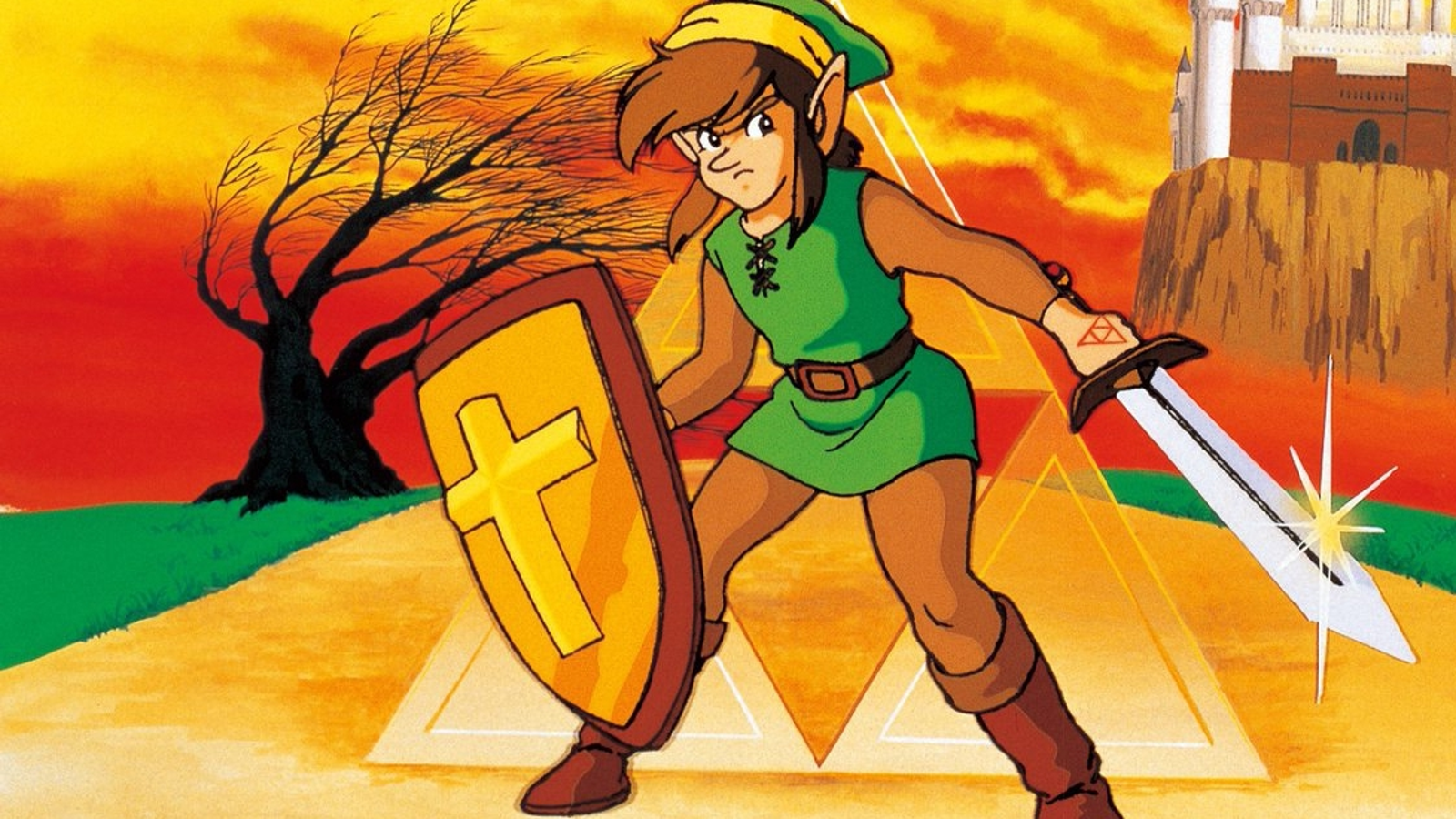
Shigeru Miyamoto’s resurfaced comments about Zelda 2: The Adventure of Link give us a rare, unusually direct look at how Nintendo views one of the strangest entries in The Legend of Zelda series. Zelda 2 has always been the odd one out. It followed the original game with side-scrolling combat, RPG-style leveling, towns, magic spells, and a harsher sense of challenge that felt miles away from the top-down exploration many players expected. Miyamoto has now been quoted again from a 2003 Superplay Magazine interview, where he explained that Zelda 2 started as his idea but was developed by another team at Nintendo. His most striking remark is that the game stayed largely the same during development and was “sort of a failure” because it did not grow in the way his projects usually did. Even more interesting, Miyamoto said Nintendo sees The Legend of Zelda: A Link to the Past as the real sequel to the original Zelda, while Zelda 2 works more like a side story about what happened to Link afterward. That does not erase Zelda 2’s importance. If anything, it makes the game more fascinating. Zelda 2 may not have become the blueprint for the series, but its risk-taking, difficulty, and strange identity helped Nintendo understand what Zelda should and should not become.
Why Miyamoto’s Zelda 2 comments matter now
Shigeru Miyamoto’s comments about Zelda 2 matter because they place one of Nintendo’s most debated sequels into sharper focus. For years, Zelda 2: The Adventure of Link has lived in a strange pocket of gaming history. Some players admire it for being bold, demanding, and different, while others see it as the moment Zelda briefly wandered into the wrong forest without a lantern. Miyamoto’s words help explain why that split exists. He did not simply say the game was different. He explained that it began as his own idea, yet the final work was handled by another team and did not evolve during development in the way he expected. That matters because Zelda has always been shaped by iteration, discovery, and polish. When a Zelda game does not grow in the oven, it can come out tasting unusual, even when the ingredients are interesting.
Zelda 2 remains the strange branch in Link’s family tree
Zelda 2 is not strange because it is bad by default. It is strange because it feels like a sequel from a parallel timeline where Nintendo decided Link needed more sword duels, more experience points, more towns, and far more reasons for players to grit their teeth. The original The Legend of Zelda built its magic around open-ended exploration, hidden caves, dungeon crawling, and that delicious feeling of finding something because curiosity pulled you off the path. Zelda 2, by contrast, mixed an overworld map with side-scrolling action scenes, random encounters, spell systems, and RPG-like character growth. That made it stand apart not only from the first game but also from nearly everything that followed. In hindsight, it feels less like the next natural step and more like Nintendo trying on a completely different outfit, then quietly hanging it in the back of the wardrobe.
Miyamoto’s idea changed hands during development
Miyamoto’s explanation is especially revealing because it separates the original concept from the final execution. He said Zelda 2 was his idea, but the actual game was developed by another team. That is not a tiny footnote. In game development, ideas are only the first spark. The final shape comes from endless decisions, adjustments, tests, fixes, experiments, and small creative turns that happen once a team gets its hands dirty. Miyamoto suggested that his games usually improve during that messy process because new ideas keep appearing as development continues. Zelda 2, in his view, did not benefit from that same creative growth. It stayed mostly the same. That gives his criticism a specific meaning. He was not just taking a swipe at the finished game. He was pointing to a development process that did not transform the original concept into something richer.
Why Zelda 2 felt so different from the original
The first Zelda gave players a world that felt mysterious, quiet, and open. It asked you to poke around, burn bushes, bomb walls, and trust your instincts. Zelda 2 still had an overworld, but it changed the rhythm completely. Instead of exploring every screen from above, players moved across a map and then entered side-scrolling combat areas, caves, towns, and palaces. Battles became more direct and technical. Link could jump, block, cast spells, earn experience, and level up attributes. That created a sharper action feel, but it also pulled the series away from the puzzle-box structure that made the original so gripping. For some fans, that shift gave Zelda 2 its personality. For others, it made the game feel like a sequel that had misplaced its compass. Both reactions make sense, which is why the game remains so easy to argue about.
The RPG systems gave Link a very different kind of journey
Zelda 2’s RPG elements are a huge part of its identity. Link does not simply collect items and grow stronger through discovery. He earns experience, improves his attack, magic, and life, and slowly becomes more capable through repeated combat. That design gives the adventure a tougher, grindier edge. It can feel rewarding when everything clicks, especially during duels where blocking high and low matters as much as swinging the sword. Still, it also changes the emotional flavor of Zelda. The series usually makes progress feel like unlocking secrets in a living world. Zelda 2 often makes progress feel like surviving a test. That is not automatically worse, but it is different. It gives the game a harsher personality, like an old teacher who believes every lesson should include at least one bruise and possibly a trip back to the start.
The side-scrolling combat made every enemy feel closer
The switch to side-scrolling combat also changed how danger felt. In the original Zelda, enemies surrounded Link on a flat plane, and the challenge came from movement, positioning, and reading patterns from above. Zelda 2 pulled the camera closer and forced players to deal with enemies face to face. That made fights more personal. Iron Knuckles, for example, were not just obstacles on a screen. They became tense sword fights where timing, height, and patience mattered. This idea was genuinely interesting, and it gave Zelda 2 a bite that some fans still love. Yet it also made the experience more punishing and less inviting. A missed jump, a badly timed block, or one unlucky encounter could turn progress into pain very quickly. Zelda 2 asked players to respect it, and sometimes it asked with a raised eyebrow and a sharpened blade.
The meaning behind calling Zelda 2 sort of a failure
When Miyamoto called Zelda 2 “sort of a failure,” the phrase deserves careful reading. He was not saying the game had no value, and he was not pretending it never existed. The wording sounds more like a creative judgment than a commercial obituary. The game tried things, but in his view, it did not keep improving throughout development. That is the key point. Nintendo’s best work often feels like a simple idea polished until every corner catches the light. Zelda 2 had ambition, but Miyamoto’s comments suggest that ambition did not fully mature into the kind of elegant adventure Nintendo wanted Zelda to represent. It remained an experiment that never quite found the perfect final form. That makes it a failure in one particular sense: not as a product without fans, but as a sequel that did not define the future of the series.
Failure can still teach a series where to go next
Creative failure is not always a dead end. Sometimes it is a signpost with mud on it. Zelda 2 may not have become the model for future Zelda games, but it likely helped Nintendo understand which parts of the original formula were too important to leave behind. The series did not continue down the side-scrolling RPG path. Instead, it eventually returned to overhead exploration, item-based puzzle solving, layered dungeon design, and a stronger sense of world structure. That return did not happen in a vacuum. When an experiment feels awkward, the lesson can be just as useful as success. Zelda 2 showed that Link could survive in a different format, but it also showed that Zelda’s heart beat loudest when exploration, secrets, and clever design worked together. Sometimes the wrong road helps you appreciate the right one.
Why A Link to the Past became the real sequel in Nintendo’s eyes
Miyamoto’s statement that A Link to the Past is viewed as the real sequel to The Legend of Zelda explains a lot about Nintendo’s long-term approach to the franchise. A Link to the Past did not simply copy the first game. It refined it. It brought back the top-down structure, expanded the world, sharpened dungeon design, gave Hyrule a richer atmosphere, and introduced a dual-world concept that still feels brilliant. It took the spirit of the original and made it cleaner, grander, and more confident. That is probably why Nintendo sees it as the truer continuation. It feels like the first Zelda growing up rather than running away from home. Where Zelda 2 asks, “What else can Link become?” A Link to the Past asks, “How powerful can this original idea be if we build it with more craft, more memory, and more magic?”
A Link to the Past restored the shape of classic Zelda
A Link to the Past brought back the familiar overhead view, but its importance goes far beyond the camera angle. It gave the series a stronger template for how exploration, items, dungeons, bosses, secrets, and story could fit together. Players moved through Hyrule with a clearer sense of discovery and reward. New tools opened new paths. Dungeons had identities. The world felt dense without becoming confusing for the wrong reasons. That structure became a foundation for later Zelda games, including entries that changed the perspective again. Even when the series moved into 3D, many of the core ideas from A Link to the Past remained visible. It is easy to see why Miyamoto would place it closer to the original than Zelda 2. A Link to the Past did not just continue the series. It taught the series how to speak fluently.
The Super Nintendo entry gave Hyrule a stronger identity
The jump to the Super Nintendo gave A Link to the Past more room to make Hyrule feel alive. The colors, music, environments, and dungeon themes made the world feel more memorable than the original could on older hardware. That mattered because Zelda was never only about mechanics. It was also about atmosphere. A cave entrance, a strange old man, a locked door, a cracked wall, or a hidden staircase can all feel exciting when the world has enough personality to make the player curious. A Link to the Past understood that better than almost anything of its time. It made Hyrule feel like a place with secrets tucked under every stone. Zelda 2 had towns and characters, which were interesting, but A Link to the Past made the whole world feel like a beautifully arranged mystery box.
The dual-world structure became one of Zelda’s defining ideas
One of A Link to the Past’s greatest strengths is the Light World and Dark World structure. That idea gave players two connected versions of Hyrule and turned exploration into a layered puzzle. A place that seemed ordinary in one world could become dangerous, changed, or meaningful in the other. That design made the world feel clever rather than merely large. It also gave the adventure a stronger dramatic pull, because the Dark World was not just a new map. It was a distorted reflection of everything players had already learned. This kind of design captures what Zelda does best. It rewards memory, curiosity, and experimentation. Compared with Zelda 2’s more linear and punishing progression, A Link to the Past feels like Nintendo finding a language that could carry the series for decades.
How Zelda 2 still earned a place in the series
Even with Miyamoto’s criticism, Zelda 2 should not be treated like a mistake that belongs in a locked chest. It brought ideas to the series that remain interesting, even if they did not become the main road forward. It made Link more physically expressive. It put greater emphasis on swordplay. It introduced magic as a more structured toolset. It showed towns and non-playable characters in a way that made the world feel populated. It also proved that Zelda could bend without snapping. That matters. Long-running series need experiments, even uncomfortable ones, because safe repetition can become its own kind of trap. Zelda 2 may not be the cozy campfire many fans return to first, but it is still part of the landscape. It is the rocky hill that makes the map more interesting.
The game’s difficulty helped build its cult reputation
Zelda 2 is famous for being tough, and that difficulty has become part of its legend. Some players bounce off it almost immediately. Others love the way it demands precision, patience, and stubbornness. There is a certain charm in that old-school severity, even when it feels like the game is glaring at you from across the room. The combat can be satisfying once learned, and the sense of achievement can be huge because progress rarely feels handed out freely. Still, that same toughness also explains why the game has never enjoyed the same broad warmth as A Link to the Past. Zelda often works best when challenge and wonder are balanced. Zelda 2 leans hard into challenge, then asks wonder to catch up later. For a specific kind of player, that is exactly the appeal.
The side story label makes more sense than it first sounds
Calling Zelda 2 a side story might sound dismissive at first, but it actually fits the game surprisingly well. Miyamoto described it as a story about what happened to Link after the events of The Legend of Zelda, rather than the true sequel in the creative sense. That distinction is useful. Chronologically, Zelda 2 can still matter as a continuation of Link’s journey. Creatively, though, A Link to the Past is the one that continues the original game’s design language. In other words, Zelda 2 can be part of the timeline without being the central blueprint. That is not an insult. Side stories can be valuable because they explore unusual corners, test odd ideas, and reveal things the main path might never touch. Zelda 2 does exactly that, even if it occasionally does so with a mischievous grin and a steep difficulty curve.
Not every sequel has to become the template
There is a temptation to judge every sequel by how much it shapes what comes next. By that measure, Zelda 2 looks awkward. But not every sequel needs to become the template. Some sequels are experiments, detours, or pressure tests. They ask questions the series may answer with “not quite,” and that answer can still be useful. Zelda 2 asked whether Zelda could become a side-scrolling RPG action game with towns, leveling, and demanding swordplay. Nintendo’s later choices suggest the answer was complicated. Some ideas were worth remembering, while the overall direction was not the future. That is a very normal part of creative growth. A series as beloved as Zelda can look inevitable from the outside, but behind the scenes it was shaped by choices, reversals, and lessons learned the hard way.
Fan debate keeps Zelda 2 alive decades later
Zelda 2 remains alive in fan discussion because it refuses to sit quietly. It is too important to ignore and too unusual to place neatly beside the series’ most beloved entries. That tension keeps people talking. Fans who love it often praise its bravery, combat, music, and sense of danger. Players who dislike it often point to its difficulty, repetition, cryptic progression, and distance from the first game’s magic. Both camps have a point. That is what makes Zelda 2 interesting. It is not a simple failure, and it is not a hidden masterpiece everyone misunderstood. It is a jagged, ambitious, uneven sequel with enough personality to survive decades of debate. In a way, that is a strange kind of success. Many safer games disappear completely. Zelda 2 still starts arguments at the table.
Miyamoto’s honesty gives fans more room to discuss it
Miyamoto’s honesty is valuable because it lets fans discuss Zelda 2 without pretending the game’s oddness is accidental. When a creator acknowledges that something did not work as intended, it does not shut down appreciation. It gives appreciation more texture. Fans can enjoy Zelda 2’s strengths while admitting that it sits apart from the main design identity of the series. That is healthier than forcing every Zelda game into the same trophy cabinet. The franchise is strong enough to contain triumphs, experiments, and awkward middle chapters. Miyamoto’s comments also show that Nintendo can be reflective about its own history. The company may be protective of its legacy, but this quote reveals a surprisingly candid view of how one major sequel landed internally. For fans, that kind of honesty is rare treasure.
What Miyamoto’s comments reveal about Nintendo’s design philosophy
The most interesting part of this story may be what it reveals about Nintendo’s larger design philosophy. Miyamoto’s criticism focuses on development momentum. He expected the game to improve as the team worked on it, with ideas building on ideas until the final result became stronger than the starting concept. That is a deeply Nintendo way of thinking. Great Nintendo games often feel simple on the surface because so much invisible work has gone into making them clear, playful, and responsive. Zelda 2, in his view, did not undergo enough of that transformation. It stayed close to the original idea rather than blossoming. That explains why the game can feel both fascinating and stiff. The seed was unusual, but the plant did not grow into the kind of shape Nintendo hoped to see.
The best Zelda games turn experiments into elegant adventures
Zelda has never been a series without experimentation. Ocarina of Time transformed the formula into 3D. Majora’s Mask built an adventure around time pressure and repetition. Breath of the Wild rethought exploration almost from the ground up. Tears of the Kingdom turned player creativity into a central tool. The difference is that those experiments were shaped into experiences that felt cohesive. Zelda 2 experimented too, but Miyamoto’s comments suggest its ideas did not become polished enough to define the series. That contrast matters. Nintendo does not avoid risk. It tries to refine risk until it feels natural in the player’s hands. When that refinement works, the result can feel timeless. When it does not, the result can become Zelda 2: brave, memorable, divisive, and forever standing slightly apart from the rest of Hyrule.
Conclusion
Miyamoto’s resurfaced comments do not reduce Zelda 2 to a punchline. They make it easier to understand why the game has always felt so different. Zelda 2 began with an idea from one of Nintendo’s most important creators, but its development path, side-scrolling combat, RPG systems, and unusual structure pulled it away from the spirit of the original. Miyamoto’s view that A Link to the Past is the real sequel makes sense because the Super Nintendo entry refined the first game’s core ideas instead of replacing them. Still, Zelda 2 deserves its place in the family. It tested boundaries, challenged players, and helped clarify what Zelda could become by showing what the series probably should not become too often. It is not the main road through Hyrule. It is the strange path off to the side, and sometimes those paths are the ones people remember most vividly.
FAQs
- Why did Shigeru Miyamoto call Zelda 2 sort of a failure?
- Miyamoto said Zelda 2 began as his idea, but another team developed the finished game. He explained that his games usually improve during development as new ideas appear, while Zelda 2 stayed mostly the same. His comment seems aimed at the creative process and final direction rather than saying the game had no value.
- Does Nintendo consider A Link to the Past the real sequel to The Legend of Zelda?
- According to Miyamoto’s resurfaced comments, Nintendo views A Link to the Past as the real sequel to the original The Legend of Zelda. He described Zelda 2 as more of a side story about what happened to Link after the first game.
- Why is Zelda 2 so different from other Zelda games?
- Zelda 2 uses side-scrolling combat, RPG-style leveling, towns, magic spells, and a more punishing structure. Those choices made it feel very different from the first game’s top-down exploration and from the formula later refined by A Link to the Past.
- Is Zelda 2 still worth playing today?
- Zelda 2 is worth playing for fans who enjoy difficult retro games and want to see one of Nintendo’s boldest experiments. It can be frustrating, but its combat, music, atmosphere, and strange identity still give it a loyal following.
- Did Zelda 2 influence later games in the series?
- Zelda 2 did not become the main template for the series, but some of its ideas still matter historically. Its focus on swordplay, magic, towns, and a more direct sense of danger showed Nintendo what could work in small doses, even if the larger format was not repeated as the core Zelda style.
Sources
- Shigeru Miyamoto thinks Zelda 2 was “sort of a failure,” and A Link to the Past is the “real sequel”, GamesRadar+, May 4, 2026
- Miyamoto felt Zelda 2 “was sort of a failure”, Nintendo saw Link to the Past as Zelda’s real sequel, Nintendo Everything, May 4, 2026
- Miyamoto: Zelda 2 was “sort of a failure” and Link to the Past is the “real sequel”, My Nintendo News, May 5, 2026
- Shigeru Miyamoto Considers This Zelda Sequel To Be “Sort Of A Failure”, Time Extension, May 8, 2026