














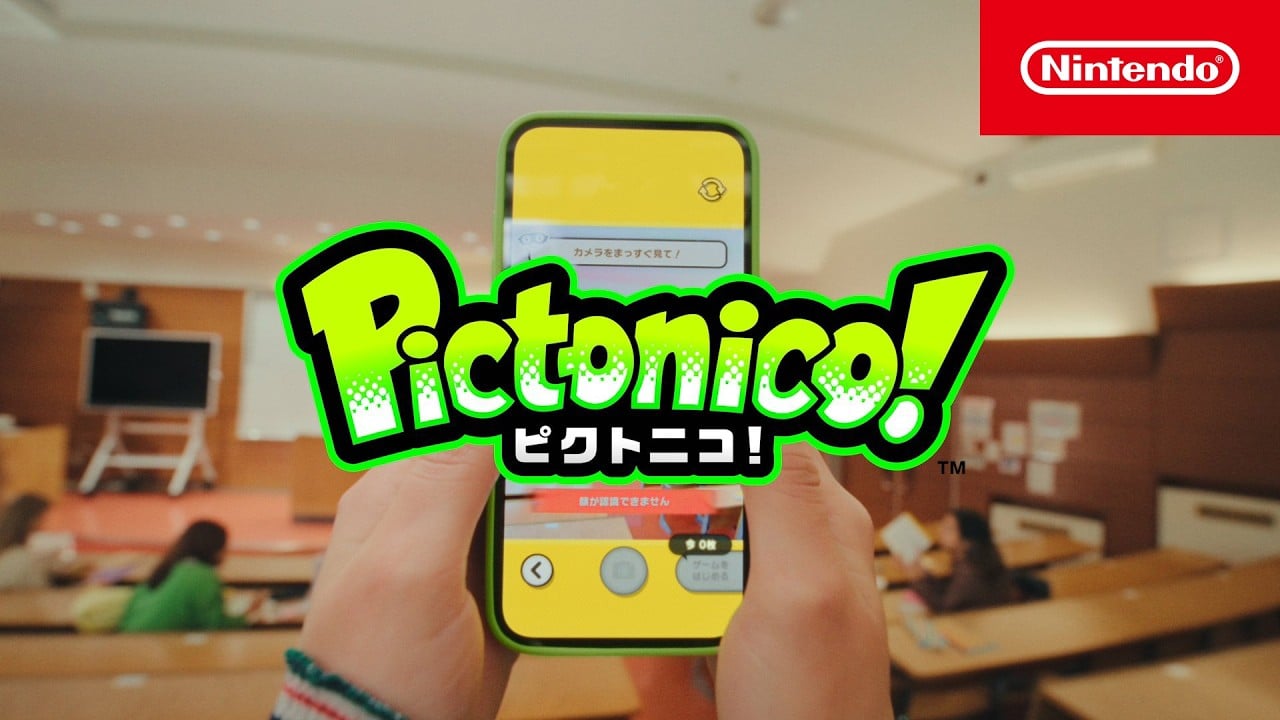
Summary:
Nintendo has revealed Pictonico, a new smart-device game built around a very simple, very funny idea: your own photos become the stars of quick-fire minigames. Instead of building its humor around a fixed cast of characters, Pictonico pulls from the pictures already on your phone or fresh shots taken on the spot, then drops those faces and moments into strange little challenges. That gives the game a personal twist right away. A boss can suddenly need feeding, a friend can become a final boss, a family member can show up in a goofy photo opportunity, and an old memory can be turned into something worth laughing about again.
The game is planned for iOS and Android, with Nintendo listing a scheduled release date of May 28, 2026. Pictonico is free-to-start, meaning players can try a selection of minigames at no upfront cost, while additional game volumes are required to access more of the experience. Nintendo’s official details also state that the game can feature up to 80 minigames and that photos used in play are not sent to Nintendo. That privacy note matters because Pictonico’s core hook depends on personal images. The result looks like one of Nintendo’s strangest mobile ideas in years, but also one of its most instantly understandable. Take a picture, play a minigame, laugh at the result, repeat until someone asks why grandpa is suddenly dressed like a ballerina.
Nintendo reveals Pictonico as a playful new smart-device game
Nintendo has introduced Pictonico as a new mobile game for smart devices, and the pitch is wonderfully odd in the most Nintendo-like way. The game takes photos from a phone and turns them into quick minigames, creating a personal spin on the kind of fast, silly challenges Nintendo fans often associate with its more chaotic side. Instead of asking players to master long missions or learn complicated controls, Pictonico seems built around instant reactions, surprising visual gags, and the kind of laughter that comes from seeing familiar faces dropped into ridiculous situations. It’s the type of idea that sounds tiny at first, then grows funnier the more you imagine what your camera roll could become.

Pictonico turns everyday photos into fast, silly minigames
The main attraction of Pictonico is right there in the premise: your photos become playable jokes. Nintendo’s description highlights scenarios that turn ordinary pictures into unexpected minigame setups, from helping a hungry boss to dealing with embarrassing school memories, noisy kids, old friends skydiving, and family members caught in the most absurd situations imaginable. That personal angle gives Pictonico an easy advantage over many mobile games because players don’t need to be sold on a new fictional world before they care. Their own friends, family, teachers, pets, and awkward selfies can do a lot of the heavy lifting. When a game can make your camera roll feel like a toy box, curiosity becomes part of the fun.
Why familiar faces make the joke land faster
Comedy often works best when there’s a little recognition baked into it, and Pictonico seems designed around that idea. A silly minigame starring a random character can be funny, but a silly minigame starring your best friend, your sibling, or that one photo you forgot existed can hit much harder. It’s like opening an old photo album and discovering someone has secretly turned every page into a tiny arcade cabinet. There’s also a social spark here, because players can take photos with friends in the moment and use them right away. That means Pictonico doesn’t have to be played quietly on the sofa. It can become a quick party trick, a lunch-break laugh, or a reason to point a phone camera at someone and say, “Trust me, this is going to be stupid in the best way.”
Why Pictonico feels close to WarioWare without being the same thing
The comparison to WarioWare is hard to avoid, and for good reason. Pictonico is built around short minigames, weird scenarios, quick reactions, and a playful sense of surprise. Nintendo’s own history gives players a clear mental shortcut here: think fast, do the silly thing, move on to the next challenge. Still, Pictonico has its own identity because its humor appears to come from player photos rather than a fixed cast of characters. That changes the rhythm of the joke. WarioWare often catches players off guard with strange commands and surreal visuals, while Pictonico adds a personal layer by making the faces and memories on your phone part of the punchline.
The photo hook gives Pictonico its own personality
Pictonico’s photo-based setup could help it stand apart from Nintendo’s existing minigame history. A traditional minigame collection has to rely on crafted characters, animations, and scenarios to stay fresh, while Pictonico can keep surprising players simply because every person’s photo library is different. One player might fill the game with family snapshots, another might use vacation pictures, and another might keep testing the weirdest selfies they can find. That flexibility matters because mobile games often thrive when they give players quick reasons to come back. In Pictonico’s case, every new photo could feel like fresh fuel. The same minigame might land differently depending on whether it stars a friend, a parent, or an unfortunate picture of you blinking at the worst possible time.
The release date, platforms, and free-to-start setup
Nintendo’s official Pictonico site lists the game as scheduled for release on Thursday, May 28, 2026, with availability through the App Store and Google Play. That places Pictonico on iOS and Android, making it another entry in Nintendo’s smart-device lineup rather than a traditional console release. The game is described as free-to-start, which means players can download it and try a small portion before deciding whether to buy more. That model makes sense for a strange concept like this. Nintendo can let the basic joke explain itself through hands-on play, because no trailer or store description can fully replace the moment when someone sees their own photo suddenly thrown into a bizarre minigame.
Free demos help the idea prove itself quickly
A free-to-start structure is a smart fit for Pictonico because the concept depends on immediate reaction. Players need to see how their photos are used, how the minigames feel, and whether the humor clicks with their own camera roll. A few free minigames can act like the first bite of a strange snack at a party. You might laugh, raise an eyebrow, and then immediately want someone else to try it. Nintendo’s store details make it clear that a game volume purchase is required for broader play, but the demo option should reduce the friction for curious players. For a mobile release built around novelty, that first free laugh could matter more than any traditional sales pitch.
How game volumes unlock more Pictonico minigames
Pictonico offers a selection of minigames for free, while additional game volumes unlock more of the full experience. Nintendo’s official description says the game features up to 80 minigames in total, ranging from easy challenges to trickier ones. That range is important because the game needs to stay accessible without becoming predictable too quickly. A good minigame collection lives or dies by pacing. Some challenges need to be silly and simple, while others need just enough bite to make players lean forward and focus. Pictonico’s paid volumes appear to be the way Nintendo expands that loop, giving players more photo-powered scenarios once the demo has done its job.
More minigames could keep the camera roll fresh
The promise of up to 80 minigames gives Pictonico room to stretch its central idea. If every challenge uses photos in a slightly different way, the game could encourage players to experiment with different images and people. Maybe a family portrait works brilliantly in one challenge, while a goofy close-up becomes the perfect fit for another. That kind of trial-and-error play is a natural match for mobile devices because it doesn’t demand a long session. You can open the app, test a few photos, laugh at the worst possible outcome, and move on. The danger for any novelty-driven game is repetition, but a larger minigame count gives Pictonico a better chance to keep the joke moving before it wears out its welcome.
Photo privacy details Nintendo has already clarified
Because Pictonico is built around personal photos, Nintendo’s privacy note is one of the most important details shared so far. The official store description states that photos are not sent to Nintendo. That’s a key reassurance for a game that asks players to use images from their device or take new pictures with friends. Nintendo also notes that a constant online connection is not required, although temporary network access may be needed for first launch and for purchasing game volumes. In plain terms, Pictonico’s core play idea does not appear to require uploading your pictures to Nintendo’s servers, based on the official description currently available.
Why the privacy message matters for a photo-based game
Players are understandably careful about apps that interact with personal photos. Camera rolls can include family moments, school memories, travel pictures, screenshots, pets, private jokes, and plenty of images nobody wants floating around online. So when a game’s central gimmick depends on using those photos, the trust factor has to be clear from the start. Nintendo’s statement that photos are not sent to Nintendo helps remove a major concern before it can overshadow the fun. That doesn’t mean players should stop paying attention to device permissions or store details, of course. But it does make Pictonico’s pitch easier to enjoy: your pictures become minigames, not mystery cargo being shipped somewhere behind the curtain.
Why Pictonico could work well as a social mobile game
Pictonico sounds like the kind of game that could spread through shared reactions. Someone tries it, laughs at a ridiculous photo result, shows it to a friend, and suddenly everyone wants to see what happens when their own face is added. That’s a powerful loop for a mobile game because it turns the player’s social circle into part of the experience. The best mobile party ideas usually don’t require long explanations. Pictonico has that advantage. You take a photo, the game turns it into something silly, and people react. It’s simple, visual, and easy to understand across ages. Even someone who doesn’t follow Nintendo closely can grasp the joke within seconds.
The camera makes every play session feel more personal
A phone camera is already one of the most-used tools on a smart device, so Pictonico doesn’t have to teach players a strange new behavior. It simply gives that familiar behavior a Nintendo-flavored twist. Instead of taking a photo just to save it, share it, or forget about it in a folder with 2,000 other images, players can turn it into a quick gag. That gives the game a loose, toy-like quality. It may not need a huge narrative or a complex progression system to be memorable. Its strongest moments could come from players pointing the camera at the room, testing whatever face is nearby, and discovering that the funniest possible minigame star was sitting across the table all along.
What Pictonico says about Nintendo’s mobile strategy
Pictonico is interesting because it doesn’t look like a simple mobile version of one of Nintendo’s biggest console franchises. Instead, it feels like a smaller, experimental idea designed around what phones can do naturally. That makes it stand out. Nintendo’s strongest mobile concepts tend to work best when they respect the device rather than trying to shrink a console experience into a touchscreen shape. Pictonico uses the camera, the photo library, quick play sessions, and social reactions as part of its foundation. That’s a very different approach from asking players to pretend their phone is a traditional controller. It feels lighter, stranger, and more willing to let the hardware lead the joke.
Nintendo’s odd ideas often work because they are easy to explain
Some of Nintendo’s most memorable experiments start with a pitch that sounds almost too simple. Draw something and play with it. Shake a controller like a toy. Put your face into a game. Pictonico sits comfortably in that tradition because the idea can be explained in a single sentence: your photos become minigames. That clarity matters in a crowded mobile market where players scroll past endless icons and store pages. A game doesn’t always need to look huge to stand out. Sometimes it just needs one hook sharp enough to make people stop and think, “Wait, what happens if I use this picture?” Pictonico has that kind of hook, and that may be its biggest strength.
Pictonico’s biggest appeal may be its weird little surprises
The official examples suggest that Pictonico is leaning into absurd, unpredictable humor. A boss needs help with food, embarrassing memories need washing away, a friend becomes a final boss, and a calm teacher turns out to be all muscle. These scenarios are silly on paper, but the personal photo layer could make them much funnier in motion. The game seems to understand that old photos already carry emotion. Some are sweet, some are embarrassing, and some are funny for reasons no one outside the group would understand. Pictonico’s trick is to take those memories and remix them into something playful, almost like a photo album that has had too much coffee.
The best moments may come from the wrong photo at the right time
There’s a special kind of comedy in using the “wrong” photo and discovering it works perfectly. A serious portrait could become hilarious in a chaotic minigame. A blurry selfie might suddenly feel like a masterpiece. A family photo could become the setup for a joke nobody saw coming. That unpredictable mix is likely where Pictonico will earn its biggest laughs. Since players can use existing photos or take new ones on the spot, the game encourages experimentation without making it feel like homework. It’s not about perfect images. It’s about funny outcomes. And honestly, the worse the photo, the better the punchline might be.
Conclusion
Pictonico looks like one of Nintendo’s most unusual mobile releases in years, and that weirdness is exactly why it has potential. By turning personal photos into quick minigames, it gives players a reason to laugh at their own memories, friends, and family snapshots in a way that feels immediate and easy to share. The free-to-start setup should help curious players try the idea without much friction, while the paid game volumes offer a path toward a larger collection of up to 80 minigames. The confirmed privacy note that photos are not sent to Nintendo is also a key part of the pitch, especially for a game built around camera-roll images. With its May 28, 2026 release planned for iOS and Android, Pictonico could become a small but memorable mobile oddity: quick to understand, easy to try, and probably dangerous around anyone with an embarrassing selfie.
FAQs
- What is Pictonico?
- Pictonico is a Nintendo mobile game that turns photos from your smart device into quick, silly minigames. Players can use existing photos or take new ones with friends and then watch those images become part of different challenges.
- When is Pictonico scheduled to release?
- Nintendo’s official site lists Pictonico as scheduled for release on Thursday, May 28, 2026. The game is planned for smart devices through the App Store and Google Play.
- Is Pictonico free to play?
- Pictonico is described as free-to-start. Players can try some minigames for free, but Nintendo says purchasing a game volume is required for broader gameplay access.
- How many minigames does Pictonico include?
- Nintendo’s store details say Pictonico can unlock up to 80 minigames in total through its game volumes, with challenges ranging from easy to trickier setups.
- Are photos sent to Nintendo when using Pictonico?
- Nintendo’s official store description states that photos used in Pictonico are not sent to Nintendo. Temporary network access may still be needed for first launch and game volume purchases.
Sources
- Pictonico!, Nintendo, May 18, 2026
- Pictonico! – Apps on Google Play, Google Play, April 30, 2026
- あなたの写真がゲームになる? スマートフォン向けアプリ『Pictonico!』, Nintendo, May 19, 2026
- Nintendo announces Pictonico! for iOS, Android – turn your photos into minigames, Gematsu, May 18, 2026
- Nintendo announces Pictonico, a new mobile game that turns your photos into mini-games, Video Games Chronicle, May 18, 2026