














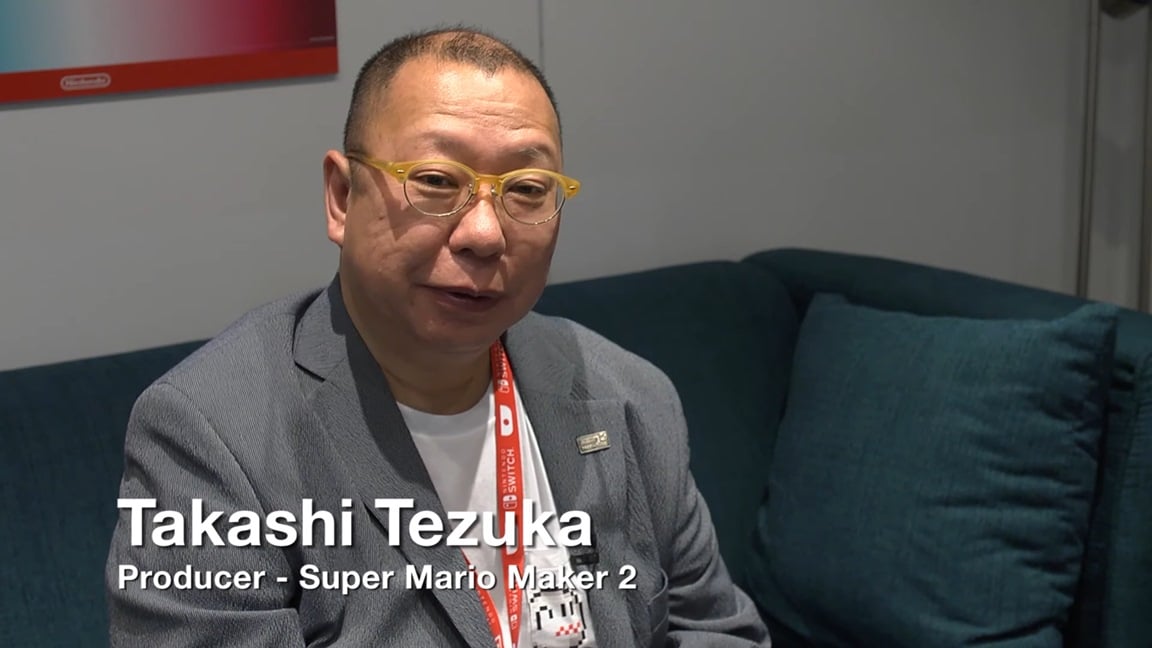
Summary:
Takashi Tezuka is stepping away from his position as an executive officer at Nintendo, but the veteran developer is not leaving the company or fully retiring from game development. The distinction was confirmed during Nintendo’s recent annual shareholders meeting, where Tezuka explained that he will continue working as a production producer. Nintendo president Shuntaro Furukawa also indicated that Tezuka will remain involved in the company’s development activities.
The clarification resolves confusion created by Nintendo’s earlier announcement that Tezuka would retire from his executive officer position on June 26, 2026. Because the original notice focused on his departure from that corporate role, several reports interpreted the change as the end of his entire Nintendo career. Tezuka’s own comments now make it clear that his responsibilities are changing rather than disappearing.
During the meeting, Tezuka looked back on 42 years of creating games at Nintendo. He recalled an era when development teams were effectively handcrafting unfamiliar forms of entertainment before describing the modern satisfaction of building much larger projects alongside many specialists. He also spoke warmly about working with technologies such as 3D graphics, stereoscopic 3D, and motion controls.
Although Shigeru Miyamoto is often the first name associated with Super Mario, Tezuka has been one of the franchise’s most influential creative figures for decades. His continued involvement gives Nintendo another valuable link between its earliest development philosophy and the increasingly complex production methods used for modern games.
Takashi Tezuka Is Not Fully Retiring From Nintendo
Reports of Takashi Tezuka’s retirement were not entirely wrong, but they were missing one rather important piece of the puzzle. Tezuka has concluded his term as one of Nintendo’s executive officers, yet he has not packed a cardboard box, waved goodbye to Mario, and disappeared into the Kyoto sunset. Instead, he will continue working with Nintendo as a production producer, allowing him to remain connected to game creation without holding the same corporate position.
That distinction matters because an executive role and a development role are not interchangeable. Stepping down as an officer changes Tezuka’s place within Nintendo’s management structure, but it does not automatically end his involvement with creative projects. His statement during the company’s shareholders meeting directly confirmed that he intends to remain active. Nintendo president Shuntaro Furukawa similarly explained that Tezuka will continue participating in development, putting an end to the idea that he was leaving the company completely.
For longtime Nintendo followers, the clarification is reassuring. Tezuka has helped shape some of the company’s most recognisable games and characters across more than four decades. Even if his future work happens away from the spotlight, his experience can still influence how teams approach design, production, and that famously difficult Nintendo question: is the game genuinely fun?
The Earlier Announcement Caused Confusion
The misunderstanding began with a corporate notice published by Nintendo in May 2026. The document listed personnel changes scheduled to take effect following the company’s annual general meeting of shareholders, including Tezuka’s retirement from his position as an executive officer on June 26. On paper, that language sounded final, especially when separated from any explanation of what he might do next.
Several reports consequently described Tezuka as retiring from Nintendo altogether. It was an understandable interpretation, but the original notice only addressed his formal executive position. It did not clearly state that he was ending every professional connection with the company. That small gap in information quickly grew into a much larger assumption as reports repeated the broader retirement claim.
The situation is a useful reminder that corporate job titles can hide more than they reveal. Nintendo frequently relies on experienced creators in advisory, supervisory, and production roles that are separate from board-level or executive responsibilities. Someone can therefore leave a senior management position while continuing to contribute to individual projects, development teams, or broader creative decisions.
Nintendo Clarifies Tezuka’s Continuing Development Role
The clearer picture emerged during Nintendo’s annual shareholders meeting. Furukawa confirmed that Tezuka would still hold a role connected to game development, while Tezuka described his future position as that of a production producer. His executive term has ended, but his relationship with Nintendo’s development organisation remains intact.
Production producers usually operate at a high level, helping projects move forward while supporting the people responsible for their direction and daily creation. The exact boundaries of Tezuka’s future work have not been publicly detailed, so it would be unwise to attach him to unannounced games or assume that he will oversee every new Mario release. What Nintendo has established is simpler and more concrete: Tezuka is staying involved.
That continuing presence could be particularly useful as Nintendo balances established series with new hardware, changing player expectations, and larger development teams. Tezuka has witnessed the company move from compact Famicom projects to international productions involving hundreds of contributors. Few people understand that transition from personal experience quite as well as he does.
Tezuka Reflects on 42 Years at Nintendo
Tezuka used the shareholders meeting to reflect on a career spanning 42 years. Rather than presenting his departure from the executive role as a sombre farewell, he described his time at Nintendo as enjoyable and rewarding. His comments carried the warmth of someone looking back at decades of work without closing the door on what comes next.
He recalled joining Nintendo when developers were creating unfamiliar kinds of play that could not simply be found sitting on toy-store shelves. That description captures the experimental spirit surrounding Nintendo’s early console games. Teams were not following a settled handbook for side-scrolling platformers, adventure games, or motion-controlled experiences. In many cases, they were writing the handbook while simultaneously trying not to set it on fire.
Tezuka also acknowledged how dramatically development has changed. Early teams were small enough for individual creators to touch many parts of a project directly. Modern productions bring together far more designers, programmers, artists, audio specialists, coordinators, localisation teams, and quality assurance staff. The work may be less like building a model by hand and more like conducting an orchestra, but Tezuka suggested that collaboration brings its own satisfaction.
From Handcrafted Ideas to Larger Development Teams
The contrast between Nintendo’s early development environment and its current structure is central to Tezuka’s story. During the 1980s, hardware limitations forced developers to communicate ideas through simple graphics, compact levels, and carefully reused resources. A tiny change to an animation, sound effect, or jump could transform how an entire game felt because there was little room for anything unnecessary.
Tezuka worked through that era and remained present as games expanded into detailed 3D worlds, online experiences, shared development pipelines, and international multimedia properties. Yet Nintendo’s core philosophy has often remained recognisable. Technology matters, but it is usually treated as a tool for creating an understandable and enjoyable experience rather than as the final goal.
That balance is one reason Tezuka’s perspective remains valuable. He has experience with direct, hands-on creation, but he also understands the demands of supervising large teams. Modern developers cannot simply copy the methods used to build an NES game. They can, however, preserve the same focus on clear ideas, responsive controls, and playful surprises while adopting the more complicated processes required today.
New Technology Kept Nintendo Development Exciting
Tezuka specifically mentioned the excitement of working with new technologies, including 3D graphics, stereoscopic 3D, and motion controls. Each of these developments created new possibilities but also introduced new design problems. A feature might look impressive in a demonstration, yet it still needed to become something players could understand within seconds. Nintendo has rarely been satisfied with technology that merely sits in the corner looking expensive.
The arrival of 3D graphics changed how developers thought about movement, cameras, navigation, and level structure. Stereoscopic 3D offered depth without requiring special glasses on Nintendo 3DS, while motion controls encouraged designers to reconsider how players could physically interact with games. Tezuka experienced these transitions as both a developer and a producer, helping Nintendo adapt familiar design principles to unfamiliar hardware.
His comments suggest that experimentation remained one of the most enjoyable parts of his career. The tools changed, the teams grew, and the screens gained considerably more pixels, but the creative challenge stayed surprisingly consistent: take something technically possible and turn it into something people actually want to play.
Tezuka’s Influence on Super Mario and Nintendo
Shigeru Miyamoto is closely associated with Mario’s creation, but Nintendo’s most famous series was never the work of one person. Tezuka was a central contributor during the franchise’s formative years and became one of the leading figures responsible for developing its design language across multiple generations. His work helped establish the rhythm, visual personality, secrets, transformations, and playful experimentation that players now expect from Mario.
Tezuka served in major development roles on games including Super Mario Bros., Super Mario Bros. 3, and Super Mario World. He was also deeply involved with The Legend of Zelda and later worked as a producer or supervisor across numerous Nintendo projects. His influence stretches beyond individual credits because many ideas introduced in those early games became foundations for later teams.
Super Mario is often praised for making movement feel joyful before a player even reaches a goal. That quality does not happen by accident. It requires designers to tune speed, momentum, animation, enemy placement, sound, and level geometry until the controls feel almost invisible. Tezuka’s long involvement with the series placed him at the centre of that process as Mario evolved from a collection of pixels into a global entertainment icon.
Why the Production Producer Role Still Matters
A production producer may not direct every level or personally adjust Mario’s jump height, but the role can still have a major impact on a project. Experienced producers help teams maintain focus, evaluate ideas, recognise production risks, and preserve a game’s identity as hundreds of smaller decisions accumulate. Think of it as keeping a ship pointed toward its destination while everyone else is busy building the deck, adjusting the sails, and arguing over whether the captain needs an elephant power-up.
Tezuka’s value comes partly from pattern recognition. After 42 years, he has seen promising concepts succeed, fail, mutate, and occasionally return decades later in a more practical form. That experience can help younger developers distinguish between an idea that needs refinement and one that simply does not fit the project.
His presence may also support continuity. Nintendo needs new voices and should never become a museum dedicated to recreating its own past. At the same time, veteran producers can explain why certain design principles exist, allowing newer teams to challenge those principles knowingly rather than discarding them by accident. The strongest creative succession is not a photocopy. It is a conversation between experience and fresh thinking.
What Tezuka’s Decision Means for Nintendo
Tezuka’s transition represents both change and continuity. Nintendo is gradually moving responsibilities away from the generation that established many of its biggest franchises, while experienced creators remain available in carefully selected roles. This approach gives younger staff room to lead without cutting them off from decades of institutional knowledge.
For players, the announcement does not promise a particular game, remake, sequel, or Mario project. It simply confirms that one of Nintendo’s most important creative veterans has not finished contributing. Any attempt to connect him to an unannounced release would go beyond what Nintendo has stated. His continued employment is meaningful enough without turning it into a treasure map for future announcements.
There is also something fitting about Tezuka remaining close to development. His shareholders meeting remarks focused less on status and more on the pleasure of making things with other people. Moving away from an executive position while continuing as a production producer appears consistent with that outlook. The title may have changed, but the work he values most can continue.
Conclusion
Takashi Tezuka has retired from his position as a Nintendo executive officer, but he has not fully retired from the company. He will continue contributing as a production producer and remain connected to game development, as confirmed by both Tezuka and Nintendo president Shuntaro Furukawa.
The clarification corrects earlier assumptions that his 42-year Nintendo career was ending completely. Instead, Tezuka is entering a different phase of that career. His experience spans handcrafted Famicom projects, the rise of 3D graphics, stereoscopic displays, motion controls, and the enormous collaborative productions of modern Nintendo. Few developers have watched the medium change from such a close vantage point.
His future responsibilities may be less visible than an executive title, but visibility has never been the best measure of influence. Tezuka has spent decades helping Nintendo transform simple ideas into games recognised around the world. Now he can continue sharing that knowledge while a new generation takes on more responsibility. Mario has not lost one of his most important creators just yet.
FAQs
- Is Takashi Tezuka retiring from Nintendo?
- No. Tezuka has retired from his position as an executive officer, but he will remain involved with Nintendo as a production producer.
- What will Takashi Tezuka do at Nintendo now?
- Tezuka stated that he will continue working as a production producer. Nintendo has also confirmed that he will remain involved in game development.
- Why did people believe Takashi Tezuka was leaving Nintendo?
- Nintendo’s earlier personnel notice said that he would retire as an executive officer on June 26, 2026. It did not initially explain his continuing production role, leading some reports to interpret the change as a full departure.
- How long has Takashi Tezuka worked at Nintendo?
- Tezuka has worked at Nintendo for 42 years and has contributed to numerous major series, including Super Mario and The Legend of Zelda.
- What games is Takashi Tezuka known for?
- Tezuka held important creative or production roles on games such as Super Mario Bros., Super Mario Bros. 3, Super Mario World, The Legend of Zelda: A Link to the Past, Yoshi’s Island, and Super Mario Bros. Wonder.
Sources
- Personnel Change of Company Officers, Nintendo Co., Ltd., May 8, 2026
- Mario Dev Takashi Tezuka Not Retiring From Nintendo, Contrary to Previous Reports, Nintendo Everything, June 25, 2026
- Retiring Mario and Zelda Director Takashi Tezuka Clarifies He’ll Still Be Involved at Nintendo, Video Games Chronicle, June 26, 2026
- Takashi Tezuka Reflects on Career, Will Remain Producer at Nintendo, Vooks, June 26, 2026
- Ask the Developer Vol. 11, Super Mario Bros. Wonder – Part 1, Nintendo, October 19, 2023