














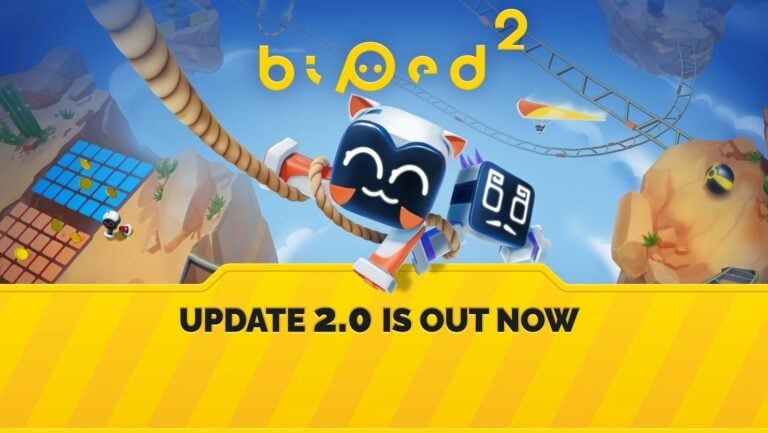
Summary:
META Publishing and NExT Studios have released the substantial Version 2.0 update for Biped 2 on Nintendo Switch, with additional performance improvements available when the game is played on Nintendo Switch 2. The update revisits the cooperative puzzle adventure from beginning to end rather than simply adding a few isolated fixes. All 17 levels have received meaningful changes, including revised puzzle mechanics, adjusted gameplay systems and improvements designed around feedback collected from players since launch.
The updated challenges cover a surprisingly broad range of ideas. Players can expect puzzles inspired by classic Japanese game shows, familiar logic-based tests and frantic games of tag involving elemental creatures. Levels 10 through 17 receive particular attention, introducing activities involving rotating mirrors, mazes and precarious balancing sections. These additions are intended to make later stages feel more varied while encouraging partners to communicate instead of waddling in opposite directions and hoping for the best.
Version 2.0 also tackles technical concerns involving camera angles, level geometry, gameplay mechanics and network stability. Some earlier design adjustments have been reversed after the development team determined they were not improving the experience, including changes made to level four. The final level and ending have also been reworked, giving the robots’ journey a more memorable conclusion and presenting global statistics after players complete the adventure. Together, these changes make Version 2.0 a strong reason for newcomers to begin the journey and for former players to give Biped 2 another chance.
Biped 2 Version 2.0 Launches on Nintendo Switch and Switch 2
Biped 2 has taken a rather large mechanical step forward with the arrival of Version 2.0 on Nintendo Switch. The update is also available to players using Nintendo Switch 2 through backward compatibility, where targeted optimizations are intended to provide stronger performance and a smoother overall experience. META Publishing and NExT Studios have treated this release as more than a routine patch, revisiting every stage and examining how the controls, puzzles, cameras and cooperative systems work together. That distinction matters because Biped 2 depends heavily on precise movement. When two tiny robots are trying to cross a narrow platform while their players debate whose left leg moved first, even a small technical interruption can become a spectacular tumble into the abyss.
The game originally launched for Nintendo Switch on November 5, 2025, expanding the cooperative ideas of its predecessor with support for solo play and groups of up to four players. Version 2.0 builds on that foundation by improving areas that caused frustration while adding new reasons to replay familiar locations. Existing owners can download the update without purchasing a separate Nintendo Switch 2 edition, making the enhancements part of the continuing support for the current release.
All 17 Levels Receive Substantial Puzzle and Gameplay Changes
Every one of Biped 2’s 17 levels has been significantly overhauled. That is an ambitious approach for an update because it means the changes are not confined to the opening hour or tucked away in a small bonus area. Players should notice differences throughout the entire adventure, from the earlier stages that introduce movement concepts to the later challenges that expect accurate timing and clear communication. The developers have adjusted puzzle mechanics, polished certain gameplay systems and reconsidered how challenges flow into one another.
These revisions should be especially noticeable to anyone who completed Biped 2 before Version 2.0. Familiar locations may still look recognizable, but the tasks within them can now demand different movements, strategies and cooperative responses. It is a little like returning to a house after somebody has rearranged every piece of furniture. You know where the kitchen should be, yet somehow you are still walking directly into a chair. That sense of recognition mixed with surprise could make a second playthrough feel considerably fresher than a typical repeat run.
New Challenges Expand the Variety of the Cooperative Adventure
The new puzzle ideas draw inspiration from several different styles of challenge. Some resemble the wonderfully dramatic contests associated with classic Japanese game shows, while others use traditional logic rules that require players to observe patterns and coordinate their actions. There are also chaotic games of tag featuring elemental creatures, adding movement and urgency to an adventure that often asks players to stop, think and carefully place each robotic foot.
This mixture matters because cooperative puzzle games can lose momentum when every obstacle relies on the same solution. Biped 2 already uses movement as part of its challenge, with players controlling the robots in ways that make walking, sliding and operating machinery feel playful rather than automatic. By combining that unusual locomotion with a wider selection of puzzle structures, Version 2.0 can create situations where communication must constantly adapt. One moment may require patient planning, while the next could involve frantic instructions such as, “Go left, not your other left.” That unpredictability is precisely where cooperative games often produce their funniest memories.
Levels 10 Through 17 Gain Additional Puzzles and Mechanics
The later half of the adventure receives some of the most visible additions. Levels 10 through 17 now include new puzzles involving rotating mirrors, maze navigation and balancing across moving or narrow platforms. Each activity tests a different aspect of the game’s movement system. Mirror puzzles are likely to emphasize observation and positioning, while mazes challenge players to coordinate routes and avoid separating at inconvenient moments. Balancing sections, meanwhile, place even greater pressure on careful movement, which is easier said than done when every leg feels like it has its own opinion.
These additions should help the later levels maintain a steady sense of progression. A good puzzle adventure needs to introduce new ideas without making earlier lessons feel irrelevant. Version 2.0 appears to approach that goal by combining familiar movement controls with unfamiliar situations. Players still need to understand how their robot moves, but they must apply that understanding in new ways. The result should make the second half feel less predictable while preserving the accessible controls that allow friends and family members to play together.
Technical Fixes Address Gameplay, Geometry and Camera Problems
NExT Studios has also focused on issues that affected the reliability of the adventure. According to the development team, player reports highlighted problems involving gameplay mechanics, level geometry and camera angles. These concerns can be particularly disruptive in a platforming puzzle game because players need to judge distances, understand the environment and trust that their actions will produce consistent results. A confusing camera angle or awkward piece of geometry can turn a clever challenge into an accidental wrestling match with the controls.
Version 2.0 includes numerous bug fixes and targeted adjustments intended to reduce those disruptions. The developers reviewed feedback and encouraged players to continue reporting problems through community discussions, where additional information can be requested when an issue cannot be reproduced internally. That approach shows why detailed reports matter. A simple message stating that something broke may identify the existence of a problem, but information about the level, player count and actions taken can help the team understand exactly where the gears stopped turning.
Cooperative Play Remains Central to the Biped 2 Experience
Cooperative play continues to sit at the heart of Biped 2. The game supports two-player and four-player teamwork, while solo play remains available for anyone who prefers to solve challenges alone. Many puzzles behave differently depending on the selected mode, preventing cooperative sessions from feeling like the single-player version with extra robots wandering around. Instead, partners may need to divide responsibilities, synchronize movements or combine their robots to operate specific mechanisms.
The update introduces additional improvements aimed at making multiplayer sessions more dependable. The development team has worked on network stability to reduce connection-related interruptions, while direct peer-to-peer connections on Steam have also become more reliable. Although that particular networking change concerns the PC version, it reflects the broader focus on making cooperative play less troublesome across supported platforms. Nobody wants to reach the final step of an elaborate puzzle only for a connection issue to send their partner into another dimension. The best arguments should be about puzzle solutions, not whether somebody has disappeared from the session.
Nintendo Switch 2 Receives Targeted Performance Improvements
Players running Biped 2 on Nintendo Switch 2 can expect performance enhancements as part of Version 2.0. META Publishing describes the update as delivering significant improvements and an enhanced experience on Nintendo’s newer system. Exact technical measurements, such as a specific resolution or frame rate target, were not announced alongside the update, so expectations should remain tied to the confirmed promise of improved performance rather than unsupported numbers.
Even without a detailed technical breakdown, optimization can have a meaningful effect on a game built around coordinated movement. More stable performance can make robot controls feel more predictable, improve the readability of active challenges and help groups respond to hazards without unexpected interruptions. Biped 2 is listed by Nintendo as supported on Nintendo Switch 2, with game behavior generally consistent with the original Nintendo Switch release. Version 2.0 goes a step further by addressing the experience on the newer hardware directly rather than relying entirely on standard backward compatibility.
Level Four Restores Familiar Mechanics Following Player Feedback
Not every change introduced after launch achieved the result the developers wanted. Version 2.0 therefore rolls back certain adjustments that were not working well, including the return of more familiar mechanics in level four. Reversing a design decision can be just as valuable as adding a brand-new feature, particularly when player feedback shows that an earlier approach was easier to understand or simply more enjoyable.
This change also illustrates the balance involved in updating a puzzle game. Altering one mechanic can affect timing, difficulty and communication across an entire stage. Something that appears more elegant on paper may feel awkward once thousands of players approach it in unpredictable ways. Restoring familiar mechanics does not mean development has moved backward. Instead, it suggests that NExT Studios is willing to compare its intentions with the actual player experience and adjust accordingly. Sometimes the smartest solution is not inventing a shinier wheel. It is putting the reliable old wheel back on the robot before it rolls down a hill.
The Revised Finale Offers a More Satisfying Conclusion
The seventeenth and final level has received special attention, including new puzzle elements and a revised ending. The development team wants the conclusion to provide a stronger sense of closure for the Bipeds’ journey, transforming the last stage into a more memorable test of everything players have learned. A finale carries considerable weight in a cooperative adventure. After hours of solving puzzles, navigating hazards and politely blaming one another for every fall, the final challenge needs to feel like a genuine payoff.
Completing the revised finale also reveals global game statistics covering the player’s achievements. This feature gives groups an additional way to reflect on their performance and compare their journey with the wider community. Statistics may not settle every friendly dispute, of course. One player will still insist that the number of falls was part of an advanced strategy. Even so, the addition creates a more defined reward after the closing challenge and gives completion-focused players another detail to examine once the adventure ends.
Version 2.0 Gives Previous Players a Reason to Return
Version 2.0 is particularly relevant for players who stepped away because of technical issues or felt that some stages did not reach their full potential. With all 17 levels reworked, numerous bugs removed and the finale revised, returning players are not simply downloading maintenance fixes. They are receiving a changed version of the adventure that can produce different challenges and require new solutions. The familiar robots, environments and cooperative principles remain, but the route through them has been reshaped.
New players also benefit because their first experience will include the lessons learned since the original release. They can begin with improved level flow, additional puzzle variety and the latest technical adjustments already in place. For groups searching for a light-hearted cooperative experience, Biped 2 offers a useful mix of accessible controls and coordination-based challenges. It can be played locally on one system or online, supports up to four participants and includes customization options for dressing the robots in suitably ridiculous hats. Saving an alien planet is important, but doing it while wearing matching headgear is clearly the mark of true professionalism.
Conclusion
Biped 2 Version 2.0 represents a substantial revision of the cooperative puzzle adventure on Nintendo Switch and Nintendo Switch 2. All 17 levels have been revisited, with new puzzle mechanics ranging from logic challenges and mazes to mirror-based activities and frantic encounters with elemental creatures. The later stages receive additional puzzles, level four restores familiar mechanics and the finale now delivers a revised conclusion followed by global achievement statistics.
The update also addresses technical concerns involving cameras, geometry, gameplay systems and multiplayer stability. Nintendo Switch 2 players receive targeted performance improvements, although specific frame rate and resolution figures have not been announced. Taken together, these changes make Biped 2 more inviting for first-time players and considerably more interesting for anyone returning after an earlier playthrough. The robots may still struggle to put one foot in front of the other, but the game surrounding them has taken a confident step forward.
FAQs
- Is Biped 2 Version 2.0 available on Nintendo Switch?
- Yes. Version 2.0 is available for Biped 2 on Nintendo Switch and can also be played on Nintendo Switch 2 through backward compatibility.
- What does the Biped 2 Version 2.0 update add?
- The update reworks all 17 levels, adds new puzzle mechanics, improves the finale, fixes technical issues and introduces adjustments based on player feedback.
- Does Biped 2 run better on Nintendo Switch 2?
- Version 2.0 includes targeted Nintendo Switch 2 optimizations and performance improvements. Specific resolution and frame rate figures have not been confirmed.
- Can Biped 2 be played with four players?
- Yes. Biped 2 supports solo play, two-player co-op and four-player co-op. Nintendo lists support for up to four players on one system and two to four players online.
- Which levels received new puzzles in Version 2.0?
- All 17 levels were overhauled, while levels 10 through 17 received additional puzzles involving mirrors, mazes, balancing challenges and other mechanics.
Sources
- Biped 2 Version 2.0 Update Now Available, Gematsu, July 2, 2026
- Biped 2 Version 2.0 Out Now With New Puzzles and Nintendo Switch 2 Enhancements, Nintendo Everything, July 2, 2026
- Biped 2 – Update 2.0: Patch Notes, Steam, April 3, 2026
- Biped 2 for Nintendo Switch, Nintendo, November 5, 2025
- Biped 2, META Publishing, November 5, 2025