














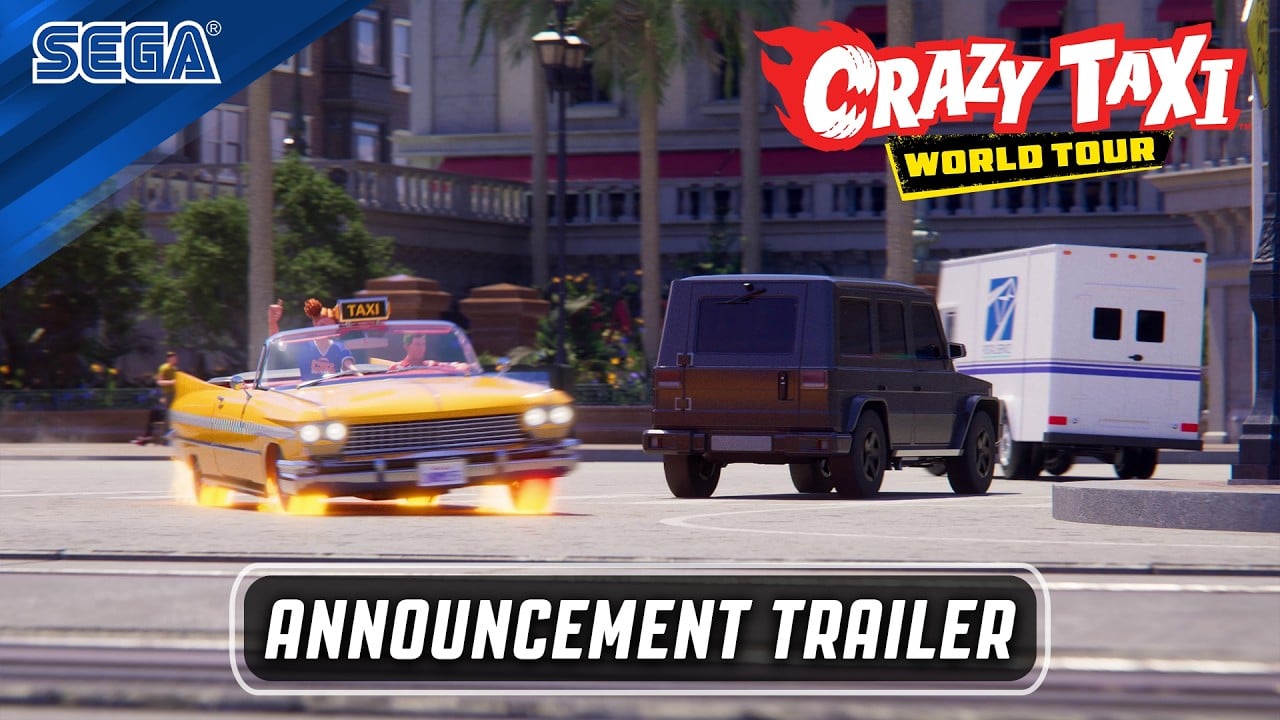
Summary:
Crazy Taxi: World Tour brings SEGA’s chaotic taxi series back with a bigger map, a broader platform lineup, and a familiar kind of arcade madness that feels built for players who miss games that simply grab the steering wheel and floor it. Set for release in 2027 on Nintendo Switch 2, PlayStation 5, Xbox Series X|S, and PC, the new entry follows Axel as he tries to recover his stolen taxi from a mysterious group of masked international car thieves. That setup gives the series a clearer story hook than its arcade roots, but the heart of the experience still appears to be speed, shortcuts, wild jumps, desperate deliveries, and cash earned by shaving seconds off impossible routes.
SEGA is also expanding the formula with five cities, dynamic missions, vehicle unlocks, customization options, cross-platform multiplayer, and an Arcade Mode designed to bring back the ticking-clock tension that made the original games so easy to understand and so hard to put down. It’s a modern comeback with plenty of nostalgia in the tank, but it also comes with a contemporary wrinkle: SEGA’s Steam page includes a generative AI disclosure, which has already become part of the wider conversation around the game. Even so, the core pitch remains simple and loud: Crazy Taxi is returning, Axel is back behind the wheel, and the meter is running again.
Crazy Taxi: World Tour brings SEGA’s loudest taxi ride back in 2027
Crazy Taxi: World Tour is officially shifting the long-running SEGA series back into gear, and honestly, subtlety was never invited to this party. The new game is planned for 2027 and brings the franchise to Nintendo Switch 2, PlayStation 5, Xbox Series X|S, and PC, giving the revival a wide launch lane from day one. That matters because Crazy Taxi has always been the kind of game that thrives on instant appeal. You see a passenger, slam the accelerator, fly through traffic like a caffeinated stunt driver, and somehow hope the fare still tips well. It’s simple, loud, and wonderfully ridiculous.
The announcement also gives SEGA another major piece in its larger push to bring classic names back for modern audiences. Crazy Taxi first built its identity on arcade speed, open-city chaos, and a punky sense of movement that made every route feel like a controlled disaster. World Tour keeps that recognizable spirit but stretches it into a larger adventure with multiple cities, story-driven missions, multiplayer options, and a more flexible approach to how players earn money behind the wheel. In other words, the taxi is still yellow, but the road ahead looks much bigger.
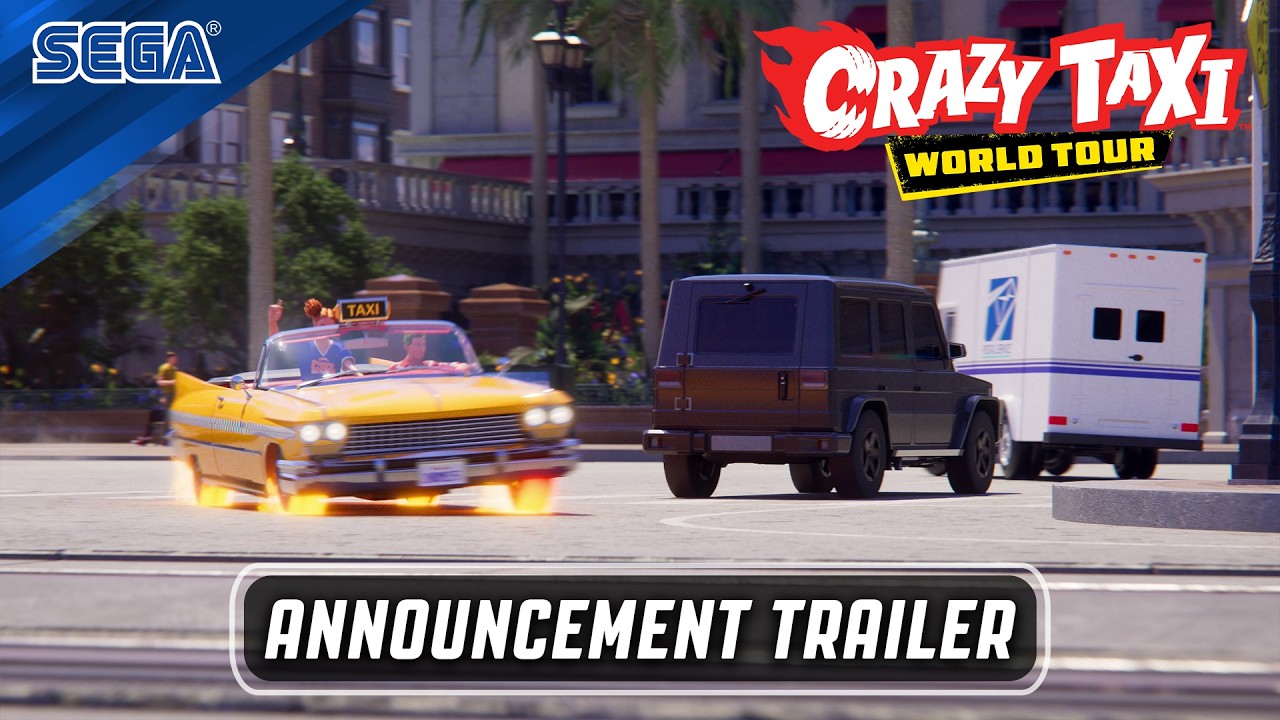
Axel returns with a stolen taxi and a globe-trotting problem
The setup for Crazy Taxi: World Tour centers on Axel, one of the series’ most recognizable drivers, as he chases down the masked villains who stole his beloved taxi. That is a wonderfully absurd starting point, but it also fits the tone perfectly. This is not a grim revenge thriller about personal loss and moral compromise. This is Crazy Taxi, so the emotional core is closer to “someone stole my ride, and now the whole planet is about to become a racetrack.” It’s silly in the best possible way, and that silliness gives the campaign room to be colorful without losing its arcade bite.
The story-driven World Tour Campaign sends Axel across the globe while he takes on missions, meets oddball characters, and navigates different terrain in five cities. That gives the game a stronger narrative frame than the older arcade structure, where the rhythm was usually built around quick passenger pickups and a timer screaming for mercy. Here, SEGA seems to be building a campaign that can carry players from one chaotic location to the next while still keeping the old promise intact: drive fast, take risks, get paid, and try not to turn every intersection into modern art.
Five cities give the classic formula a bigger playground
The five-city setup could be one of World Tour’s biggest changes, because location variety has always been a secret ingredient in Crazy Taxi’s recipe. The original appeal was not just speed. It was learning the shape of a city until every alley, ramp, hill, and impossible shortcut became part of your personal mental map. A good Crazy Taxi city is less like a normal road network and more like a pinball table with pedestrians, storefronts, hills, and traffic jams all begging to become part of the route. With five cities, World Tour has the chance to build that feeling on a much larger scale.
SEGA describes the game as featuring unique terrain and driving challenges across different locations, which suggests each city may push players to adapt rather than simply repeat the same habits. One area might reward vertical movement and jumps, while another could favor tight turns, crowded streets, or long stretches built for ridiculous speed. That variety could help the campaign feel like a true world tour rather than a simple change of scenery. The trick will be keeping every city dense, readable, and fun to master, because Crazy Taxi works best when chaos has just enough structure to make skill feel real.
Extreme driving keeps the series’ arcade heartbeat alive
Crazy Taxi has never been about careful lane discipline, and World Tour does not appear interested in changing that. SEGA is promising outrageous drifts, big air, high-speed routes, and extreme missions that push the driving far beyond polite road behavior. That is exactly where this series feels most at home. The fun comes from turning a simple taxi ride into a stunt show, where every curb looks like a ramp and every second saved feels like a tiny victory against common sense. It’s the kind of driving where the brake pedal probably feels neglected, but hey, it knew what it signed up for.
The key question is whether World Tour can preserve the snappy feedback that made older entries so satisfying. Crazy Taxi works because the loop is immediate: pick up a passenger, read the destination, improvise a route, and squeeze every possible dollar out of speed and style. Modern missions can add variety, but the core must stay responsive and readable. Players need to feel that every drift, jump, and shortcut is under their control, even when the screen looks like rush hour got launched from a cannon. If SEGA nails that rhythm, the bigger structure could make the return feel fresh without sanding off the wild edges.
Arcade Mode keeps the old-school chase against the clock intact
One of the smartest confirmed features is Arcade Mode, which brings back the race-against-the-clock structure that many fans associate with Crazy Taxi at its purest. This matters because not every player wants a campaign, unlock trees, or a long-term checklist. Some just want the timer, the city, the passengers, and that addictive feeling of trying one more run because the last mistake was clearly the traffic’s fault. Arcade Mode gives World Tour a way to honor that original loop while the broader campaign handles the bigger modern structure around it.
The return of Arcade Mode also helps balance nostalgia with expansion. A modern Crazy Taxi can have a global story, multiplayer, side missions, and customization, but the series still needs a place where the old rules shine without extra baggage. That timer-based format is brutally honest. You either learn the streets, chain your fares, and make smart route decisions, or you watch the clock run dry while your passenger wonders why their driver just treated a flower bed like a shortcut. That pressure is the heartbeat of the franchise, and keeping it alive is essential.
Multiplayer madness gives Crazy Taxi a wider competitive lane
World Tour is also bringing multiplayer into the spotlight, with cross-platform competition planned across several modes. That is a natural fit on paper, because Crazy Taxi has always had a score-chasing soul. Even when players were alone, the experience felt competitive. You were fighting the timer, the map, your own mistakes, and that one friend who somehow knew every shortcut after only two runs. Multiplayer could turn that familiar tension into something more direct, letting players show off wild driving skills against friends and online rivals across platforms.
The big opportunity is variety. Crazy Taxi multiplayer does not need to become a standard racing mode with taxis painted over it. The series has its own identity, and the best multiplayer ideas would likely build around fares, routes, stunts, cash totals, and messy city navigation. Imagine competing to deliver passengers under pressure, steal the best fares, complete stunt-heavy objectives, or outscore others in chaotic mission arenas. That kind of structure would let World Tour feel social without abandoning the core taxi fantasy. After all, this is not about finishing first on a clean circuit. It’s about making money while the city politely begs you to calm down.
Vehicle unlocks and customization add personal flair to every ride
SEGA is also adding vehicle unlocks and customization options, giving players more control over the look and personality of their ride. That is a smart modern addition, especially for a game built around expression. Crazy Taxi has always been stylish, loud, and exaggerated, so letting players create a one-of-a-kind vehicle feels like a natural extension of the series rather than a forced feature. A taxi in this world is not just transportation. It is a rolling character, a money machine, and sometimes a very questionable aircraft when the right hill appears.
The challenge will be making customization feel meaningful without slowing down the pace. Players should be able to personalize their taxi, experiment with different vehicles, and show off their style, but the system should not bury the game under menus. Crazy Taxi shines when it moves fast, and that should apply outside the driving too. Vehicle variety could also help give different players a sense of identity in multiplayer, especially if unlocks reward skill, exploration, or campaign progress. The best version of this feature would make every taxi feel personal while keeping the road, not the garage, as the main attraction.
Switch 2, PS5, Xbox Series, and PC make this a broad comeback
Crazy Taxi: World Tour is planned for Nintendo Switch 2, PlayStation 5, Xbox Series X|S, and PC, which gives the revival a strong multi-platform setup. For Nintendo fans, the Switch 2 version is especially interesting because Crazy Taxi feels like the kind of game that can work beautifully in shorter sessions. The classic loop is naturally snackable: take a few fares, chase a better score, try a wild shortcut, and maybe laugh when everything goes spectacularly sideways. If the Switch 2 version lands with solid performance, it could become a great fit for both portable play and docked chaos.
On PlayStation 5, Xbox Series X|S, and PC, the game has room to push larger environments, online modes, and fast visual feedback without losing the arcade clarity the series needs. PC players already have a Steam page to wishlist, while SEGA’s official site lists the major platforms and keeps Nintendo Switch 2 marked as part of the 2027 plan. The broad platform list also supports cross-platform multiplayer, which is important for keeping online modes busy. A game this loud should not feel lonely, unless the passenger just got out after your third near-miss with a delivery truck.
Generative AI disclosure adds a modern talking point around the release
Alongside the excitement, Crazy Taxi: World Tour has also drawn attention for SEGA’s generative AI disclosure on Steam. The Steam page states that SEGA used generative AI support tools during development and says no AI was used in reference to the performers in the game. That disclosure has already become part of the wider discussion around the announcement, with some players expressing concern and PC Gamer reporting additional comments that framed the tools as reference support rather than a replacement for human-made final assets.
For readers following the game mainly for its driving, this may feel like a separate industry conversation, but it is still part of the current picture around World Tour. The safest takeaway is simple: SEGA has publicly disclosed generative AI support tool usage, while also presenting the game as a human-developed SEGA project with performers excluded from that AI use. How much that affects public perception will depend on future messaging, gameplay footage, and player comfort with such tools. The taxi may be back on the road, but in 2026 and 2027, even arcade revivals have to drive through modern industry traffic.
Why this revival matters for long-time SEGA fans
Crazy Taxi: World Tour matters because it brings back a franchise that represents a very specific side of SEGA: fast, colorful, confident, and just a little bit unhinged. The original Crazy Taxi was not trying to be a careful simulation. It was a burst of arcade design, built around immediate fun and replayable pressure. That identity still has value, especially in a market where many games ask players to manage inventories, learn sprawling systems, or commit dozens of hours before the real fun starts. Sometimes, players just want to grab the wheel and make terrible traffic decisions for excellent reasons.
World Tour also arrives at a time when SEGA is actively revisiting several older franchises, which makes this more than a one-off comeback. It feels like part of a larger effort to reconnect with the company’s arcade DNA while presenting those names to a modern audience. If Crazy Taxi: World Tour succeeds, it could prove that classic SEGA energy still has plenty of gas left in the tank. The best outcome would be a game that respects the old formula, embraces new ideas carefully, and remembers that Crazy Taxi should always feel like a city-sized dare.
Conclusion
Crazy Taxi: World Tour is shaping up as a loud, colorful, and ambitious return for one of SEGA’s most recognizable arcade names. With Axel chasing his stolen taxi across five cities, a story-driven campaign, Arcade Mode, customization, and cross-platform multiplayer, the 2027 release is aiming for both nostalgic energy and modern scale. The generative AI disclosure will remain part of the conversation, but the core appeal is still easy to understand. Crazy Taxi is back, the meter is running, and somewhere out there, a passenger is probably about to ask for the fastest ride of their life.
FAQs
- When does Crazy Taxi: World Tour release?
- Crazy Taxi: World Tour is planned for release in 2027. SEGA has not yet announced a specific release date, so the confirmed timing is currently limited to the release year.
- Which platforms is Crazy Taxi: World Tour coming to?
- The game is planned for Nintendo Switch 2, PlayStation 5, Xbox Series X|S, and PC. The Steam page is already live for PC players who want to wishlist it.
- Who is the main character in Crazy Taxi: World Tour?
- Axel returns as the central driver in the new adventure. The story follows him as he tries to recover his stolen taxi from a mysterious group of masked villains.
- Does Crazy Taxi: World Tour include classic arcade-style gameplay?
- Yes. SEGA has confirmed an Arcade Mode that brings back the race-against-the-clock structure associated with the original games, alongside the larger World Tour Campaign.
- Will Crazy Taxi: World Tour have multiplayer?
- Yes. SEGA has confirmed multiple multiplayer modes with cross-platform play, allowing players to compete with friends and online rivals across supported platforms.
Sources
- Crazy Taxi: World Tour Official Website, SEGA, June 8, 2026
- Crazy Taxi: World Tour on Steam, Steam, June 8, 2026
- Crazy Taxi: World Tour – Official Announcement Trailer, Xbox, June 7, 2026
- Crazy Taxi: World Tour announced for PS5, Xbox Series, Switch 2, and PC, Gematsu, June 7, 2026
- Generative AI ‘was only used as a reference,’ Crazy Taxi creator says, PC Gamer, June 8, 2026