














Summary:
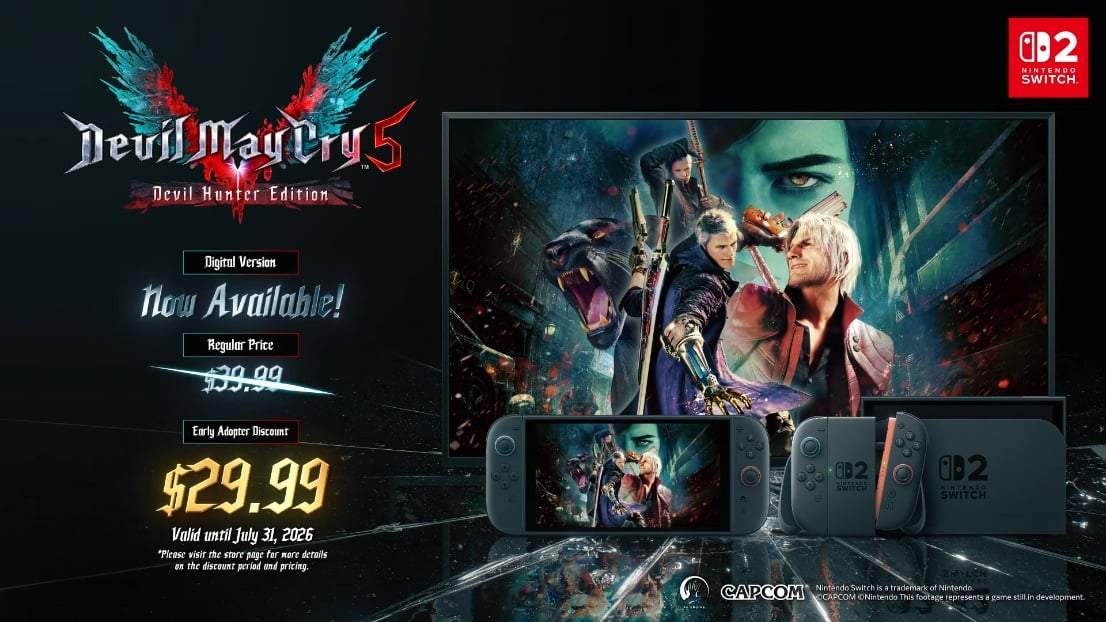
Capcom has released the launch trailer for Devil May Cry 5 Devil Hunter Edition, marking the stylish action game’s arrival on Nintendo Switch 2. The digital edition launched on June 23, 2026, allowing Nintendo players to enter the demon-infested streets of Red Grave City and experience one of Capcom’s most energetic combat systems at home or on the move. A physical edition is scheduled to follow on August 28, 2026.
The adventure follows Nero, Dante, and the mysterious V as they confront a rapidly spreading demonic invasion connected to the towering Qliphoth. Each hero approaches battle differently. Nero combines his sword and revolver with interchangeable Devil Breaker arms, Dante swaps between weapons and combat styles, and V commands demonic familiars before personally delivering the final blow. Vergil is also included as a playable character, adding another fast and precise fighting style to the package.
Devil Hunter Edition combines the original adventure with a selection of previously released extras, including Vergil, alternate costumes, bonus weapons, additional music, and other customization options. The Nintendo Switch 2 version targets fluid action in both handheld and television play, preserving the speed that makes launching enemies, maintaining combos, and chasing higher style ranks so satisfying. The launch trailer captures that familiar mixture of dramatic storytelling, absurd weapons, memorable characters, and gloriously theatrical demon hunting.
Devil May Cry 5 Devil Hunter Edition arrives on Nintendo Switch 2
Devil May Cry 5 has officially carved a path onto Nintendo Switch 2 through the newly released Devil Hunter Edition. Capcom launched the digital version on June 23, 2026, bringing the acclaimed stylish action experience to Nintendo hardware for the first time. The physical edition is scheduled for August 28, 2026, giving collectors another option if a box on the shelf still holds more charm than a tidy icon on the home screen. This version preserves the central adventure while packaging it with additional characters, costumes, music, weapons, and other previously released extras. More importantly, it places the game’s demanding combat in a portable format. That means you can chase an SSS style rank from the sofa, during a commute, or anywhere else that seems suitable for fighting a building-sized demon. Probably not during a quiet meeting, though. The clicking buttons may reveal your priorities.

Video link: https://www.youtube.com/watch?v=lhmW5GDCBFI
The launch trailer celebrates stylish portable demon hunting
The launch trailer wastes little time establishing what makes Devil May Cry 5 so distinctive. Blades flash, firearms roar, demons tumble through the air, and the heroes trade dramatic remarks while an entire city appears to collapse around them. It is loud, theatrical, and proudly excessive. In other words, it understands the assignment. Rather than presenting combat as a simple contest of survival, Devil May Cry treats every encounter like a performance. Defeating an enemy is only the beginning. The real challenge is doing it with variety, confidence, and enough flair to make the style meter climb. The trailer highlights Nero, Dante, V, and Vergil while offering glimpses of their contrasting abilities. It also emphasizes the scale of the demonic threat facing Red Grave City. For newcomers, the footage provides a sharp introduction to the series’ personality. For returning players, it acts as a reminder that few games make swinging a motorcycle like a sword appear perfectly reasonable.
Red Grave City provides the stage for a demonic invasion
The story begins as the roots of a massive demonic tree spread through Red Grave City, draining blood and transforming familiar streets into a nightmarish battlefield. This tree, known as the Qliphoth, is more than an unpleasant piece of landscaping. It stands at the centre of an invasion that threatens the wider world, forcing several demon hunters to confront both the creatures emerging from it and the personal history hidden beneath the crisis. The ruined city provides a dramatic backdrop for the adventure, shifting between abandoned roads, damaged buildings, underground tunnels, and organic environments formed by the Qliphoth itself. These locations often feel as though concrete, steel, roots, and flesh have been pushed into the same blender. The result is unsettling without losing visual clarity during battle. As the heroes move closer to the source of the invasion, their separate journeys begin to overlap, gradually revealing why the attack is connected to the bloodline of the legendary demon knight Sparda.
Nero fights back with swords, guns, and Devil Breaker arms
Nero enters Red Grave City with the directness of someone who has little patience for demonic theatrics, even though he contributes plenty of theatrics himself. His familiar weapons include the Red Queen, a sword fitted with a revving mechanism, and the Blue Rose revolver. By timing the Red Queen’s Exceed system correctly, players can empower attacks with fiery bursts that make Nero’s combos faster and more destructive. His most important addition is the Devil Breaker system. After losing his demonic right arm, Nero begins using mechanical replacements created by Nico. Each Devil Breaker provides a different function, from launching enemies and firing electrical attacks to manipulating movement or delivering enormous bursts of force. These arms can break when Nero takes damage during certain actions, and players can deliberately destroy one to escape danger or trigger a powerful effect. The system encourages experimentation because holding onto every arm too carefully can be less useful than sacrificing one at exactly the right moment.
Nico turns demonic scraps into wonderfully strange weapons
Nico travels alongside Nero in the Devil May Cry motorhome, serving as engineer, weapons artist, supplier, and enthusiastic commentator whenever an especially disgusting demon leaves behind useful material. Her creations give Nero access to a rotating collection of Devil Breaker arms, each built around a particular tactical idea. Some are suitable for controlling groups, while others improve mobility, create openings, or deliver concentrated damage against stronger opponents. The arms are collected throughout missions or purchased before heading into battle, so planning a loadout becomes part of Nero’s rhythm. Nico also injects warmth and humour into a story filled with family conflict, ruined cities, and creatures that look as though they crawled out of a fever dream. Her motorhome acts as a travelling workshop and temporary safe point, appearing in places where no sensible driver would attempt to park. That unlikely arrival becomes a running joke, but it also reinforces the game’s refusal to let apocalyptic circumstances interfere with its personality.
Dante brings unmatched combat freedom and theatrical flair
Dante remains the series’ most flexible fighter, combining a huge selection of melee weapons, firearms, styles, transformations, and improvised nonsense. He can switch between combat styles during battle, allowing experienced players to move from aggressive sword techniques to defensive counters, ranged control, or evasive manoeuvres without pausing the action. His weapon collection ranges from familiar swords and pistols to far stranger equipment, including a motorcycle that separates into bladed weapons. It sounds absurd because it is absurd, but that is exactly why it works. Dante’s complexity gives players an enormous amount of freedom when building combos. A single enemy can be launched, shot, pulled back toward the ground, struck with another weapon, and sent flying again before it gets an opportunity to complain. Learning every option takes time, yet the underlying controls remain responsive enough to make early experimentation enjoyable. Dante may joke through a catastrophe, but his combat system is serious craftsmanship hiding beneath a red coat and a grin.
V changes the rhythm through his summoned familiars
V approaches combat from a distance, making his missions feel noticeably different from Nero and Dante’s direct attacks. Rather than relying on conventional weapons, he commands three demonic familiars. Shadow performs close-range strikes, Griffon handles electrical attacks from a distance, and Nightmare enters the battlefield as a towering source of destruction. V can reposition himself while issuing commands, but his familiars cannot normally finish enemies. Once a demon has been weakened, V must move closer and deliver the final blow with his cane. This creates an unusual balance between safety and risk. You can remain away from the most dangerous attacks while setting up damage, but eventually you must step into the chaos. V can also read from his book to build Devil Trigger energy, creating the memorable sight of a calm, poetry-reading figure standing near a violent supernatural brawl. His methodical style may initially feel unfamiliar, yet it adds valuable variety and rewards careful management of positioning, resources, and familiar health.
Distinct combat systems keep every mission feeling fresh
The presence of several playable characters prevents the adventure from settling into one predictable routine. Nero rewards mechanical timing and smart use of disposable arms. Dante offers a toolset so large that mastering it can feel like learning an instrument with blades attached. V focuses on positioning and simultaneous familiar control, while Vergil favours precision, concentration, and rapid movement. These differences affect more than individual attacks. They change how players read enemy behaviour, control space, manage resources, and respond under pressure. The style ranking system ties everything together by rewarding varied moves rather than repeated safe attacks. Using the same technique again and again may keep you alive, but it will not make the soundtrack intensify or the ranking letters soar. The game gently pushes you toward creativity, then celebrates when you become confident enough to improvise. That design makes repeat playthroughs especially appealing because higher difficulties and unlocked abilities create new opportunities to refine routes, discover combinations, and turn familiar encounters into personal performances.
The RE Engine brings Red Grave City to Nintendo’s hardware
Devil May Cry 5 was developed with Capcom’s RE Engine, which supports detailed character models, dramatic lighting, dense effects, and environments that shift between recognisable urban spaces and grotesque demonic growth. On Nintendo Switch 2, maintaining smooth motion is particularly important because the combat depends on quick reactions and precise inputs. The Devil Hunter Edition has been presented as delivering fluid visuals in television and handheld modes, allowing the action to retain its responsiveness across both styles of play. Reports from launch coverage have highlighted 60 frames per second performance, although the visual presentation naturally differs from versions running on more powerful hardware. The central achievement is that battles remain readable even when attacks, particles, enemies, and pieces of demonic scenery fill the screen. Portable play also suits the mission structure well. Individual stages can be tackled in focused sessions, while the training area provides a convenient place to practise techniques without committing to a complete mission.
Devil Hunter Edition combines the adventure with additional extras
The Devil Hunter Edition includes the main Devil May Cry 5 experience alongside a range of additional material released for earlier versions. Vergil is included as a playable character, giving fans access to his fast, controlled fighting style throughout supported missions. The package also contains alternate character colours, additional battle music, bonus weapons, and other customization options. Among the more playful additions is Nero’s Mega Buster Devil Breaker, which draws inspiration from Capcom’s Mega Man series and briefly transforms his movement and attacks into a loving mechanical tribute. These extras do not replace the central campaign or fundamentally rewrite its structure, but they make the package more inviting for newcomers who want the available additions gathered together. Returning players may also appreciate the ability to experiment with Vergil or revisit favourite missions in handheld mode. However, this edition should not be confused with Devil May Cry 5 Special Edition, as certain features associated with that release are not included on Nintendo Switch 2.
Vergil offers speed, precision, and controlled aggression
Vergil’s combat style contrasts with the wild improvisation often associated with Dante. His attacks are fast and elegant, rewarding players who remain composed and avoid unnecessary movement. The Concentration mechanic strengthens Vergil when he fights with discipline, encouraging accurate attacks, carefully timed evasions, and confident positioning. His weapons support several ranges and rhythms, allowing him to cut through groups, focus pressure on individual targets, and move across arenas with remarkable speed. Summoned swords add another layer, giving him ranged options without interrupting the deliberate flow of his melee techniques. Vergil can appear almost effortless in the hands of an experienced player, but reaching that point requires restraint. Button mashing tends to turn his graceful offence into something closer to a cutlery drawer falling down the stairs. Once his systems begin to click, however, he becomes one of the most satisfying characters to use. His inclusion adds significant replay value, especially for players interested in mastering a more exacting approach.
Boss battles reward confidence, timing, and experimentation
Red Grave City is occupied by more than disposable creatures waiting to become combo practice. Its major demons provide memorable tests built around movement, observation, and controlled aggression. Early encounters introduce the importance of avoiding large attacks and recognizing openings, while later battles demand stronger command of each character’s abilities. Goliath, for example, establishes the game’s appetite for towering monsters and destructive arenas. Other bosses introduce unusual shapes, elemental attacks, sudden movement, and patterns designed to punish hesitation. The fights are spectacular, but they are rarely solved through spectacle alone. Players must learn when to attack, when to reposition, and when to spend valuable Devil Trigger energy. The best moments occur when defence turns into offence without breaking the flow. A well-timed dodge can become a launcher, which becomes an aerial sequence, which becomes the sort of excessive finishing move that makes subtlety pack its bags and leave town. These encounters give the combat systems enough resistance to reveal their real depth.
Nintendo Switch 2 gives the adventure a portable advantage
The ability to play Devil May Cry 5 in handheld mode changes how easily its systems can fit into everyday routines. The campaign remains a cinematic action experience, yet its mission-based structure works naturally in shorter sessions. You can clear a stage, practise a combo, adjust skills, or challenge a previous ranking without needing to remain tied to a television. That flexibility is particularly useful for a game built around repetition and improvement. A difficult technique becomes easier to practise when the training area is always within reach, and familiar missions can become quick score-chasing sessions rather than major commitments. Television play remains available for anyone who prefers a larger display and a traditional controller setup. The important point is choice. Devil May Cry 5 has spent years earning praise for its combat, characters, and unapologetic sense of style. Devil Hunter Edition gives Nintendo Switch 2 owners an opportunity to experience those qualities in a format that can move as freely as its heroes.
Conclusion
Devil May Cry 5 Devil Hunter Edition brings Capcom’s stylish demon hunting to Nintendo Switch 2 with its energetic combat, memorable cast, dramatic campaign, and selection of additional extras intact. Nero, Dante, V, and Vergil each provide a distinct reason to revisit missions, experiment with abilities, and push beyond simply surviving an encounter. The launch trailer captures the game’s personality perfectly, combining apocalyptic stakes with jokes, motorcycles, mechanical arms, demonic familiars, and enough airborne swordplay to make gravity feel optional. The digital edition is available now, while the physical version is scheduled for August 28, 2026. For Nintendo players who missed the original release, this is an accessible route into one of Capcom’s most accomplished action games. Returning demon hunters face a more personal question: how tempting does Red Grave City become when it can travel inside a bag? Judging by the familiar sound of revving swords and rising style ranks, the answer may be dangerously tempting.
FAQs
- When was Devil May Cry 5 Devil Hunter Edition released for Nintendo Switch 2?
- The digital edition launched on June 23, 2026. Capcom has scheduled the physical edition for August 28, 2026.
- Which characters are playable in Devil Hunter Edition?
- The main campaign features Nero, Dante, and V, each with a different combat system. Vergil is also included as an additional playable character.
- What does Devil Hunter Edition include?
- It includes the original adventure, Vergil, alternate character colours, additional battle music, bonus weapons, and other previously released extras.
- Does Devil May Cry 5 run at 60 frames per second on Nintendo Switch 2?
- Capcom describes the Nintendo Switch 2 release as providing smooth visuals in handheld and television modes, while launch reviews have reported 60 frames per second performance.
- Is Devil Hunter Edition the same as Devil May Cry 5 Special Edition?
- No. Devil Hunter Edition includes Vergil and numerous extras, but it does not include every feature associated with Special Edition, such as Turbo Mode and Legendary Dark Knight Mode.
Sources
- Devil May Cry 5 Devil Hunter Edition to Launch on Nintendo Switch 2!, Capcom, June 10, 2026
- Devil May Cry 5 Devil Hunter Edition for Nintendo Switch 2, Nintendo, June 23, 2026
- Devil May Cry 5: Devil Hunter Edition Nintendo Switch 2 launch trailer, Nintendo Everything, June 23, 2026
- Devil May Cry 5 Devil Hunter Edition Switch 2 review: still schooling modern action games, Creative Bloq, June 22, 2026
- With Devil May Cry 5, Capcom shows once again that it’s the master of Switch 2 ports right now, T3, June 22, 2026