














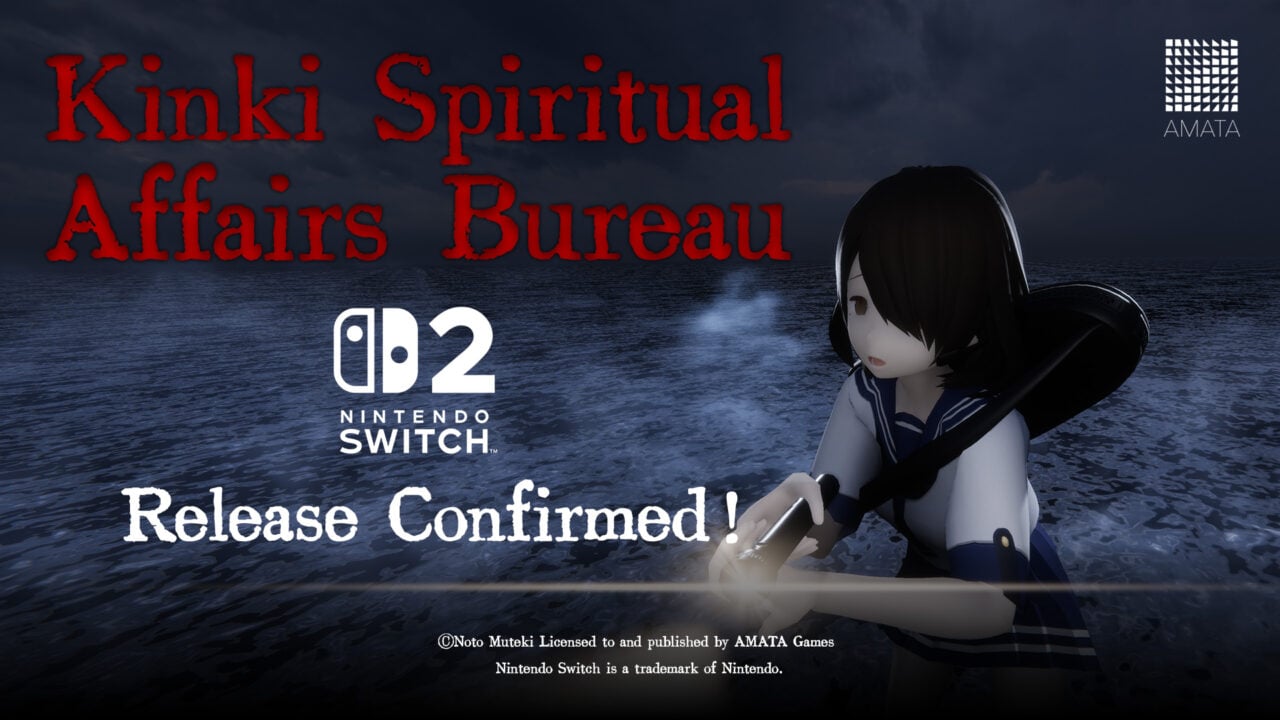
Summary:
Kinki Spiritual Affairs Bureau has recently arrived on Nintendo Switch 2, bringing Noto Muteki’s unusual Japanese horror third-person shooter to Nintendo’s newer console. Published by AMATA Games, the digital release gives players a rather different response to the supernatural than the helplessness often associated with Japanese horror. Instead of hiding in a cupboard and hoping the angry ghost eventually loses interest, players can confront unlawful spirits with firearms, unarmed attacks and stealth tactics.
The story follows Mizuki Shiraishi, an exorcist working for the Kinki Spiritual Affairs Bureau. She travels to Saiga Village in Nara after traces of the settlement mysteriously disappear from the internet. What should be an investigation quickly becomes something far more disturbing. The villagers have vanished, communications have been severed and an unusually large number of hostile spirits now occupy the area. Mizuki continues investigating with radio support from her superior Kohinata and junior colleague Maruoka while searching for the force responsible for the incident.
Players work through 10 stages featuring combat, stealth and story-driven cutscenes, while four difficulty settings accommodate different levels of experience. The Nintendo Switch 2 version also introduces mouse-like pointer controls through Joy-Con 2, giving players another way to handle aiming and interaction. Customizable controller configurations provide further flexibility for anyone who prefers a more traditional setup.
Kinki Spiritual Affairs Bureau is now available for Nintendo Switch 2
Kinki Spiritual Affairs Bureau has made its way to Nintendo Switch 2 after originally beginning life on PC and later expanding to other consoles. Developer Noto Muteki created the game around a wonderfully straightforward idea: what if the protagonist in a Japanese horror story was perfectly capable of fighting back? AMATA Games subsequently handled its expansion to additional platforms, with the Nintendo Switch 2 edition launching digitally through the Nintendo eShop recently. The release gives Nintendo players access to a single-player horror experience that mixes supernatural mystery with unusually aggressive action. Rather than asking you to spend every encounter creeping away from things that go bump in the night, the game hands its protagonist the means to confront them directly. That change creates an immediately different atmosphere. There is still darkness, isolation and the unpleasant possibility that something horrifying is waiting around the next corner, but Mizuki Shiraishi isn’t simply walking into danger empty-handed. Sometimes the proper response to a haunting, apparently, involves considerably more firepower.
A Japanese horror game where the spirits can actually be fought
The central idea behind Kinki Spiritual Affairs Bureau turns one of Japanese horror’s most familiar conventions upside down. Supernatural creatures are often frightening precisely because conventional weapons are useless against them. A locked door, a dark corridor and a determined ghost tend to be a bad combination when your options are limited to running and hiding. Noto Muteki approaches that relationship very differently. Mizuki is trained to deal with supernatural threats and can fight spirits instead of merely surviving their presence. That doesn’t remove the horror atmosphere. It changes the power balance. Enemies remain dangerous, environments retain their unsettling character and the mystery surrounding Saiga Village continues to give the adventure an ominous edge. The difference is that players are allowed to respond with force. The result sits somewhere between a supernatural investigation and an armed cleanup operation, creating a distinctive identity that separates the game from horror experiences built almost entirely around vulnerability and escape.
Mizuki Shiraishi investigates the disappearance of Saiga Village
Behind all the gunfire is a mystery centred on Saiga Village in Nara. Protagonist Mizuki Shiraishi is sent to investigate after traces of the village begin disappearing from the internet. That premise alone raises plenty of uncomfortable questions. An entire settlement doesn’t simply vanish from the digital world without somebody noticing, and the situation becomes considerably stranger once Mizuki arrives. The village’s residents are missing, electricity and communications have been cut off, and unlawful spirits have appeared in unusual numbers. The silence surrounding the area therefore becomes part of the mystery rather than merely atmospheric decoration. Mizuki isn’t wandering through an abandoned location because she took a wrong turn on a road trip. She is there professionally, searching for an explanation and attempting to uncover who or what is manipulating events behind the scenes. Radio contact with her colleagues provides a link to the outside world as the investigation moves through increasingly hostile territory.
Government exorcists turn supernatural investigations into armed operations
One of the most entertaining parts of the premise is how casually Kinki Spiritual Affairs Bureau treats the existence of professional exorcists. Within its fictional version of Japan, supernatural incidents aren’t solely the responsibility of frightened civilians, occult enthusiasts or unfortunate teenagers who entered the wrong building. Government agents can be dispatched to handle them. Mizuki belongs to the organisation named in the title, giving the game’s ghost hunting a procedural flavour that feels closer to an official investigation than an accidental encounter with the paranormal. That framing helps explain why she enters Saiga Village prepared for combat and why her response to hostile entities differs so sharply from the behaviour expected of a conventional horror protagonist. She has colleagues, responsibilities and an objective. The supernatural may be terrifying, but for Mizuki it is also part of the job. There is something delightfully absurd about treating a ghost infestation like an exceptionally unpleasant day at the office, and the game embraces that contrast without abandoning its darker atmosphere.
Combat mixes firearms, unarmed attacks and stealth
Kinki Spiritual Affairs Bureau doesn’t build its encounters around a single method of dealing with danger. Its core gameplay combines gunplay, unarmed combat and stealth, giving players several approaches when navigating areas occupied by supernatural threats. Firearms naturally provide the most obvious expression of the game’s fight-back philosophy, but close-range attacks ensure Mizuki isn’t entirely dependent on keeping enemies at a comfortable distance. Stealth introduces another layer. Being capable of fighting something doesn’t necessarily mean charging directly toward every spirit is the smartest choice, particularly when the situation offers an opportunity to avoid unnecessary danger. That combination makes encounters more varied than a straightforward shooting gallery. You can move cautiously, assess what is ahead and decide how aggressively you want to respond. It also reinforces Mizuki’s role as a trained operative rather than a helpless victim. She has tools and combat options at her disposal, but players still need to decide when those tools should actually be used.
Ten stages combine supernatural encounters with story-driven scenes
The adventure is divided across 10 stages, giving the investigation a defined structure as Mizuki works her way through Saiga Village and the mystery surrounding it. Those stages aren’t simply collections of enemies placed between loading screens. Story-driven cutscenes form an important part of the experience, allowing the narrative to continue developing between bouts of exploration, stealth and combat. That balance is particularly important for a premise like this because the strange disappearance of an entire village needs more than gunfire to remain interesting. Players are gradually given more context for the situation while Mizuki continues communicating with her colleagues and searching for the party pulling the strings. The relatively focused stage count also suits an experience built around a specific supernatural case rather than an enormous open world. Each area can contribute another piece to the investigation while maintaining forward momentum. There is little reason for a ghost-hunting government agent to stop everything because somebody nearby needs 20 medicinal herbs collected, after all.
Four difficulty settings make repeated playthroughs more approachable
Not every horror fan is equally comfortable with action games, and not every shooter enthusiast wants supernatural encounters to go easy on them. Kinki Spiritual Affairs Bureau addresses that difference with four difficulty settings designed to accommodate players ranging from beginners to more experienced challengers. The availability of several settings should make it easier to choose an experience that matches what you want from the game. Someone primarily interested in Mizuki’s investigation can select an approachable level rather than repeatedly colliding with difficult encounters, while players who enjoy mastering combat systems can push themselves further. Multiple difficulty options also give repeat visits more purpose. Returning to Saiga Village under tougher conditions can change how carefully you approach enemies and how effectively you need to use the available mechanics. Since firearms, melee attacks and stealth all contribute to survival, higher difficulty settings can encourage a stronger understanding of how those systems work together rather than relying on one comfortable tactic from beginning to end.
Joy-Con 2 mouse-style controls give the Switch 2 edition its own feature
The Nintendo Switch 2 version isn’t merely another place to play Kinki Spiritual Affairs Bureau. It also supports mouse-like pointer controls through Joy-Con 2, taking advantage of functionality offered by Nintendo’s newer controllers. For a third-person shooter, that option is particularly interesting because aiming is one of the areas where mouse-style input can significantly change how a game feels. Players who enjoy quicker pointer movement can use Joy-Con 2 in this manner instead of relying exclusively on conventional stick controls. It fits naturally with a game in which reacting to supernatural targets can mean the difference between confidently clearing a room and discovering that the ghost had a much better plan. The feature also gives the Nintendo Switch 2 edition a control option directly connected to the hardware rather than limiting the conversion to performance and compatibility changes. Traditional controller play remains available, so the mouse-style approach is an additional choice rather than a requirement imposed on everyone.
Controller customization provides another way to personalize the experience
Players who prefer conventional controls aren’t locked into a rigid button layout either. Kinki Spiritual Affairs Bureau allows controller button configurations to be changed, which can be particularly useful in a game combining several different forms of interaction. Gunplay, melee combat and stealth can place different demands on your hands, and a layout that feels intuitive to one player may feel awkward to somebody else. Being able to reorganize controls lets players create an arrangement that better matches their habits. When combined with Joy-Con 2 mouse-style input, the Nintendo Switch 2 version therefore offers several ways to approach basic control. Some players may immediately gravitate toward pointer aiming, while others will prefer familiar analogue controls with customized button assignments. Neither approach changes the underlying investigation, but comfort matters when a hostile spirit decides to appear at exactly the wrong moment. Wrestling with the controls should ideally be less frightening than whatever Mizuki is currently trying to exorcise.
The launch trailer shows the unusual blend of horror and aggressive combat
The Nintendo Switch 2 launch trailer provides a useful look at why Kinki Spiritual Affairs Bureau doesn’t fit neatly into the usual image of a Japanese horror game. Dark environments and supernatural figures establish the expected sense of unease, only for the action to shift toward direct confrontation. Mizuki isn’t merely observing the nightmare unfolding around her. She fights through it. That contrast is the game’s defining hook, and seeing it in motion makes the idea immediately understandable. The atmosphere can move from quiet tension to sudden violence without requiring the protagonist to surrender control of the situation. It also highlights how the title combines several genres without completely abandoning any of them. There is a supernatural mystery driving the story, horror imagery shaping the environments and third-person action determining how many encounters play out. For Nintendo Switch 2 owners wondering whether this is a traditional hide-and-survive experience, the trailer makes the answer wonderfully clear: hiding is an option, but fighting back is very much part of the job.
Why Kinki Spiritual Affairs Bureau stands apart from traditional Japanese horror games
Kinki Spiritual Affairs Bureau’s greatest distinguishing feature isn’t simply that it contains ghosts, guns or a mysterious abandoned village. Plenty of games use those ingredients. What makes this one unusual is the relationship between them. The supernatural entities aren’t treated as untouchable forces that automatically reduce the player to prey, and Mizuki isn’t an ordinary civilian trying desperately to reach daylight. She is a government exorcist arriving with the explicit purpose of investigating and dealing with paranormal trouble. That gives familiar horror imagery a very different energy. A dark corridor can still make you wonder what is waiting at the other end, but there is also the possibility that whatever appears should be worried about Mizuki. Combining that premise with a 10-stage structure, several difficulty settings, combat and stealth options, story scenes and Nintendo Switch 2-specific pointer controls creates an experience with a personality of its own. Horror is still present, but helplessness is no longer mandatory.
Conclusion
Kinki Spiritual Affairs Bureau brings an unusual kind of supernatural investigation to Nintendo Switch 2. Noto Muteki’s game takes the atmosphere and imagery associated with Japanese horror and pairs them with a protagonist who has been trained to confront the paranormal rather than simply escape it. Mizuki Shiraishi’s investigation of Saiga Village provides the mystery, while firearms, close-range combat and stealth give players different ways to survive what they uncover. Ten stages and story-focused cutscenes move the case forward, four difficulty options broaden accessibility and customizable controls let players adapt the experience to their preferences. The Nintendo Switch 2 edition adds another interesting option through Joy-Con 2 mouse-style pointer controls, giving the conversion a feature connected specifically to Nintendo’s hardware. If you’ve ever watched a horror protagonist flee from a ghost and wondered why nobody arrived with a government-issued solution to the problem, Kinki Spiritual Affairs Bureau appears quite happy to provide an answer.
FAQs
- Is Kinki Spiritual Affairs Bureau available on Nintendo Switch 2?
- Yes. Kinki Spiritual Affairs Bureau recently launched digitally for Nintendo Switch 2 through the Nintendo eShop. AMATA Games lists July 30, 2026 as the official release date, although Nintendo’s European listing shows July 29, 2026 for that region.
- What type of game is Kinki Spiritual Affairs Bureau?
- It is a Japanese-style horror third-person shooter that mixes firearms, unarmed combat and stealth. Unlike many horror games built around avoiding supernatural enemies, Kinki Spiritual Affairs Bureau allows players to directly fight the spirits threatening them.
- Who is the protagonist of Kinki Spiritual Affairs Bureau?
- Players control Mizuki Shiraishi, an exorcist employed by the Kinki Spiritual Affairs Bureau. She travels to Saiga Village in Nara to investigate the disappearance of its residents and the mysterious removal of traces of the village from the internet.
- Does Kinki Spiritual Affairs Bureau support Joy-Con 2 mouse controls?
- Yes. The Nintendo Switch 2 edition supports mouse-like pointer controls using Joy-Con 2. Players can also use conventional controller inputs, and button configurations can be changed to create a more personalized control layout.
- How many stages and difficulty settings are included?
- Kinki Spiritual Affairs Bureau includes 10 stages and four difficulty settings. The different difficulty levels are intended to accommodate a range of players while also giving those who return to the game an opportunity to tackle its encounters under more demanding conditions.
Sources
- A Japanese-style horror TPS game where you can fight back against the spirits, “Kinki Spiritual Affairs Bureau” Release Confirmed for Nintendo Switch2!, AMATA Games, February 28, 2026
- Japanese-style horror third-person shooter Kinki Spiritual Affairs Bureau on the way to Nintendo Switch 2, Nintendo Everything, July 29, 2026
- Kinki Spiritual Affairs Bureau for Switch 2 launches July 30, Gematsu, July 29, 2026
- A Japanese-style horror TPS game where you can fight back against the spirits, “Kinki Spiritual Affairs Bureau” Nintendo Switch 2 versions are available today!, AMATA Games, July 30, 2026
- A Japanese-style horror TPS game where you can fight back against the spirits, “Kinki Spiritual Affairs Bureau” Nintendo Switch 2 versions are available today!, AMATA K.K., July 30, 2026