














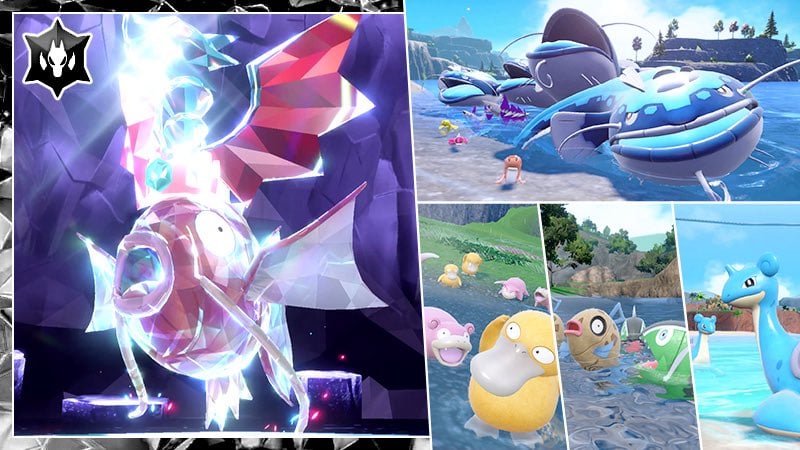
Summary:
The Pokémon Company has announced a new seasonal event for Pokémon Scarlet and Pokémon Violet, bringing a wave of Water-type activity to the games from July 17 through August 6, 2026. At the centre of the event is an unusually intimidating opponent: Magikarp. The famously floppy Fish Pokémon will appear in seven-star Tera Raid Battles with the Mightiest Mark and Dragon as its Tera Type, turning one of the series’ most famously fragile creatures into a potentially tricky raid boss.
The event also introduces several special mass outbreaks across Paldea and the locations included in The Hidden Treasure of Area Zero. Dondozo, Tatsugiri and Veluza will gather around Casseroya Lake, while Psyduck and Slowpoke will appear throughout Paldea. Trainers exploring Kitakami can encounter Feebas and White-Striped Basculin, and those visiting Blueberry Academy will find Lapras outbreaks in the Terarium.
Each featured species has an increased chance of carrying a particular personality mark. These marks give Pokémon distinctive titles, making the outbreaks especially appealing to collectors who enjoy tracking down unusual combinations of species, marks, Poké Balls and appearances. With raid battles, outbreak hunting and multiple regions to explore, the event offers plenty to do during its three-week run. Whether you’re chasing a mighty Magikarp, searching for a marked Feebas or simply looking for an excuse to return to Casseroya Lake, the summer celebration casts a wide net.
Pokémon Scarlet and Violet Water-Type Event Begins July 17
Pokémon Scarlet and Pokémon Violet are preparing to make a sizeable splash with a Water-type event running from July 17 at 00:00 UTC until August 6 at 23:59 UTC. Rather than focusing on a single activity, the celebration combines a seven-star Tera Raid Battle with several mass outbreaks spread across Paldea, Kitakami and Blueberry Academy. That structure gives both battlers and collectors something worthwhile to pursue.
The schedule is also more generous than the brief raid weekends trainers may be accustomed to. With approximately three weeks available, there should be enough time to tackle the raid, explore every outbreak location and search for Pokémon carrying their featured marks. You won’t necessarily need to squeeze everything into one frantic weekend while staring nervously at the calendar.
Some parts of the event take place in locations introduced through The Hidden Treasure of Area Zero. Access to Kitakami and Blueberry Academy therefore requires the expansion pass, although the Magikarp raid and Paldea-based outbreaks remain tied to the base game’s region. Trainers who own the expansion will have the fullest selection of outbreak targets available.
Mighty Magikarp Makes an Unexpected Seven-Star Raid Debut
Magikarp is the unlikely star of the event’s black crystal Tera Raid Battles. The featured Pokémon carries the Mightiest Mark, which is normally reserved for powerful opponents appearing in seven-star raids. Seeing that distinction attached to Magikarp is a wonderfully strange twist. This is, after all, the Pokémon best known for splashing around while absolutely nothing happens.
Appearances can be deceptive, particularly in Tera Raid Battles. Seven-star opponents receive substantial advantages that can transform an otherwise modest Pokémon into a formidable challenge. Raid bosses can use scripted actions, remove stat changes, reset negative effects and activate shields that reduce incoming damage. Magikarp’s ordinary reputation is unlikely to provide an accurate picture of what awaits inside the black crystal.
The special Magikarp can be caught once per save data. Trainers may continue joining the raid and collecting its rewards after securing their catch, but they won’t be able to capture another copy on the same save. That makes the choice of Poké Ball surprisingly meaningful for collectors. Is this the moment for a Dive Ball, Lure Ball or something deliberately dramatic? A Master Ball would certainly make a statement, even if that statement raises a few eyebrows.
Dragon Tera Type Changes the Battle
The raid’s Magikarp uses Dragon as its Tera Type, replacing its normal Water-type defensive identity while it remains Terastallized. Dragon-type Pokémon are weak to Ice, Dragon and Fairy attacks, so those types appear to be the natural starting point when considering possible counters. However, choosing a raid Pokémon based only on super-effective damage can quickly lead to disaster.
Magikarp’s complete raid move set and scripted behaviour will determine which counters perform reliably. A Fairy-type attacker might resist Dragon-type moves, but it could still struggle if Magikarp carries coverage capable of exploiting its other weaknesses. Likewise, a powerful Dragon-type attacker may deal enormous damage while also taking super-effective hits in return. Seven-star battles reward preparation, not merely pressing the brightest super-effective button and hoping for applause.
Trainers should also remember that Magikarp retains its usual underlying type for Same-Type Attack Bonus calculations. Its Dragon Tera Type changes its defensive weaknesses and strengthens any Dragon-type move it may use, but Water-type attacks can remain dangerous. Waiting until the event begins and its full behaviour has been confirmed will make it easier to build a dependable strategy.
Why Magikarp Could Still Pose a Serious Challenge
Standard Magikarp have an extremely limited natural move pool, which makes this raid especially intriguing. Event raid Pokémon can use carefully selected moves and scripted actions that don’t reflect the experience of encountering the same species in the wild. The Pokémon Company can also adjust factors such as health, shield timing and stat resets to create a battle that feels suitably demanding.
That opens the door to several possibilities. Magikarp could rely on high-powered moves added specifically for the event, use status effects to disrupt attackers or turn Flail into a genuine threat as its health falls. It may also employ setup moves that compensate for its ordinary stats. Until the raid becomes available, any precise strategy would be guesswork, so investing piles of resources into a counter too early could leave you with a beautifully trained benchwarmer.
The contrast between Magikarp’s reputation and the Mightiest Mark is clearly part of the joke, but the battle itself may have teeth. Seven-star raids have repeatedly demonstrated that an amusing premise can hide a carefully designed challenge. Trainers should approach the black crystal with an open mind, a well-trained team and perhaps a healthy suspicion of any fish wearing a glowing Dragon crown.
Casseroya Lake Hosts Three Mark-Focused Mass Outbreaks
Casseroya Lake will become particularly busy during the event, with mass outbreaks featuring Dondozo, Tatsugiri and Veluza. All three Pokémon are closely connected to the enormous lake in northwestern Paldea, making the location a natural home for this part of the celebration. Expect the shoreline and surrounding waters to be packed with considerably more fins than usual.
Mass outbreaks are valuable because they gather large numbers of the same species within a defined area. This makes it easier to inspect multiple Pokémon, defeat or capture them and repeatedly search for desirable characteristics. Event outbreaks add another incentive by increasing the likelihood that featured Pokémon will carry specific personality marks.
Casseroya Lake can be visually demanding and awkward to navigate, particularly when Pokémon spawn across the water or close to uneven shorelines. Trainers may find it helpful to approach each outbreak patiently rather than charging around at full speed. Using the camera, sending out a Pokémon with Let’s Go and checking targets carefully can make the hunt feel less like trying to count fish during a storm.
Dondozo, Tatsugiri and Veluza Receive Featured Marks
Dondozo encountered in the Casseroya Lake outbreaks are more likely to carry the Rowdy Mark, granting the title “Dondozo the Rowdy.” The combination suits the enormous Big Catfish Pokémon rather nicely. Dondozo already has the presence of something that could overturn a boat merely by changing its mind, so a rowdy title hardly feels out of character.
Tatsugiri will have an increased chance of carrying the Crafty Mark, which provides the title “Tatsugiri the Opportunist.” Curly Form, Droopy Form and Stretchy Form Tatsugiri can appear, giving collectors several variations to pursue. Finding the preferred form with the featured mark, desired gender and ideal Poké Ball could become one of the event’s more absorbing hunts.
Veluza will be associated with the Ferocious Mark and the title “Veluza the Rampaging.” Anyone who has explored Casseroya Lake already knows that wild Veluza rarely need encouragement to charge at passing trainers. The Ferocious Mark feels less like a special personality and more like an official confirmation of what players have experienced since launch.
Paldea Welcomes Psyduck and Slowpoke Outbreaks
Elsewhere in Paldea, mass outbreaks will feature Psyduck and Slowpoke. These two familiar Pokémon share a wonderfully absent expression, making their paired appearance feel intentional. While the Casseroya Lake selection leans towards energetic or aggressive personalities, Psyduck and Slowpoke offer a much calmer atmosphere. Calm might be generous, actually. They mostly look as though they have forgotten why they attended.
Psyduck will have an increased chance of carrying the Absent-Minded Mark, which grants the title “Psyduck the Spacey.” Few species could wear that title more naturally. Psyduck is frequently depicted struggling with headaches and confusion, so the mark complements its established personality without feeling forced.
Slowpoke can appear with the Zoned-Out Mark, providing the title “Slowpoke the Daydreamer.” This is another fitting pairing and a charming choice for anyone building a collection around personality-rich Pokémon. Both outbreaks take place in the base game’s Paldea region, so trainers don’t need access to the expansion areas to participate in these particular hunts.
Kitakami Features Feebas and White-Striped Basculin
Trainers travelling to Kitakami can search for mass outbreaks of Feebas and White-Striped Basculin. These may be among the most practically useful outbreaks in the entire event because both Pokémon can be less convenient to locate under normal circumstances. Gathering them into visible outbreak groups removes much of the usual wandering and lets players concentrate on marks, stats and other desired traits.
Feebas will have an increased chance of carrying the Prideful Mark, granting the title “Feebas the Arrogant.” There is something delightful about an unassuming Feebas wearing such a grand title, particularly when it can later evolve into the elegant Milotic. The mark remains after evolution, allowing trainers to raise a Milotic known as “the Arrogant.” Honestly, Milotic can probably pull it off.
The featured Basculin is specifically its White-Striped Form, which can evolve into Basculegion after meeting the necessary evolution condition. These Basculin are more likely to carry the Ferocious Mark, granting the title “Basculin the Rampaging.” That title will also remain if the Pokémon evolves, giving collectors an opportunity to obtain a marked Basculegion with a particularly appropriate introduction.
Lapras Appears Throughout Blueberry Academy
Blueberry Academy’s Terarium hosts the final featured mass outbreak, with Lapras appearing in greater numbers. Lapras is usually a memorable encounter thanks to its size, gentle design and long history within the series. Seeing several of them gathered within the Terarium should create one of the event’s most striking scenes, like a small fleet of friendly sea creatures arriving for an academic conference.
The academic comparison is surprisingly suitable because these Lapras have an increased chance of carrying the Intellectual Mark. A Lapras with this mark receives the title “Lapras the Scholar,” which fits Blueberry Academy’s setting perfectly. The combination of location, species and title makes this one of the most thematically satisfying hunts included in the event.
Accessing Blueberry Academy requires The Hidden Treasure of Area Zero and sufficient progress through its storyline. Trainers who haven’t yet reached the Terarium should keep that requirement in mind before planning their hunt. Those who already have access can travel between the different biomes and look for the event icon that identifies the Lapras outbreak.
How Marks Make the Featured Pokémon More Collectible
Marks are special attributes that can be found on certain Pokémon, particularly those encountered in the wild. When a Pokémon with a mark is selected for battle, its mark can provide a unique title displayed alongside its name. The feature doesn’t directly increase battle strength, but it adds personality and rarity to an individual Pokémon.
That distinction is important. The event increases the likelihood of encountering the featured marks, but it doesn’t guarantee that every Pokémon in an outbreak will carry one. Trainers will still need to inspect their catches through the Pokémon’s summary screen. The Mark Charm, obtained through progress in the Blueberry Pokédex, can further improve the general chance of finding marked Pokémon and may be useful during repeated outbreak hunts.
Collectors can combine marks with other characteristics to create highly individual targets. A trainer might seek a shiny Feebas with the Prideful Mark, a particular Tatsugiri form with the Crafty Mark or a Lapras caught inside a matching Poké Ball. Each additional preference makes the hunt more demanding, but it also turns the final catch into something that feels genuinely personal.
How to Access the Raid and Mass Outbreak Events
Pokémon Scarlet and Violet must receive the latest Poké Portal News before the event encounters can appear. Connect the Nintendo Switch system to the internet, open the game’s main menu and select Poké Portal. From there, choose Mystery Gift and then select the option to check Poké Portal News. A paid Nintendo Switch Online membership isn’t required simply to update the event data.
Online multiplayer participation does require the appropriate Nintendo Switch Online access. Trainers who haven’t unlocked black crystal raids in their own game may still be able to join another player’s Magikarp raid through a Link Code. Hosting seven-star raids directly requires completing the relevant postgame progression and unlocking higher-level Tera Raid Battles.
Event mass outbreaks can be identified on the map by their distinctive glowing icons. Kitakami and Blueberry Academy outbreaks will only be visible to players who own The Hidden Treasure of Area Zero and have gained access to those destinations. Keeping the game connected and updating the Poké Portal News after July 17 should ensure the correct raid and outbreak data are active.
Preparing for the Mighty Magikarp Tera Raid
Preparation for a seven-star raid begins with patience. It may be tempting to immediately train a Fairy-type powerhouse because Dragon is weak to Fairy, but the best counter will depend on Magikarp’s Ability, moves, raid script and shield timing. Once the event begins, trainers can examine successful builds and choose an option that suits solo play or coordinated multiplayer.
A proper raid Pokémon should generally be raised to level 100, use an appropriate nature and have carefully allocated Effort Values. Its held item and move set should support the intended role rather than simply maximize visible damage. Support Pokémon can be just as valuable as attackers, particularly when they reduce the boss’s offensive stats, heal allies or strengthen the team’s defenses.
Random online groups can produce unpredictable results, so understanding the chosen Pokémon’s role is essential. Attacking immediately isn’t always the smartest option. A turn spent lowering Magikarp’s stats or supporting teammates may prevent several knockouts later. Seven-star raids are less like ordinary battles and more like group puzzles, except the puzzle occasionally resets everyone’s stat changes and hits the team with a tidal wave.
Making the Most of the Three-Week Event
The event’s longer schedule provides room to divide the available activities instead of tackling everything at once. Trainers could begin by completing the Magikarp raid, then work through the Paldea outbreaks before travelling to Kitakami and Blueberry Academy. Focusing on one target at a time makes it easier to manage storage space and track which featured marks have already been obtained.
Preparing useful supplies in advance can also smooth out the experience. Stocking up on preferred Poké Balls prevents an awkward shopping trip when the perfect marked Pokémon appears. Clearing several boxes gives captured Pokémon somewhere to go, while sandwich ingredients can support additional hunting goals. Players seeking shiny Pokémon should remember that the event announcement focuses on marks rather than explicitly promising increased shiny rates.
Most importantly, the event is broad enough to suit different play styles. Competitive battlers can examine the unique Magikarp, collectors can pursue marked outbreak Pokémon and casual players can simply enjoy seeing familiar Water types gather in unusual numbers. There is no need to catch every possible combination. Choose the targets that make you smile and let the rest swim freely.
Conclusion
Pokémon Scarlet and Violet’s Water-type celebration brings together one of the games’ strangest seven-star raids and a varied selection of mark-focused mass outbreaks. From July 17 through August 6, trainers can challenge a Dragon Tera Type Magikarp with the Mightiest Mark, explore Casseroya Lake for Dondozo, Tatsugiri and Veluza, and hunt additional featured species across Paldea, Kitakami and Blueberry Academy.
The event’s personality marks add charm to every location, whether you’re searching for a spacey Psyduck, an arrogant Feebas or a scholarly Lapras. Mighty Magikarp may attract the most attention, but the wide selection of outbreaks gives the celebration lasting appeal. After years of being mocked for Splash, Magikarp finally has its moment to look genuinely threatening. Trainers may want to save the laughter until after the raid is won.
FAQs
- When does the Pokémon Scarlet and Violet Water-type event begin?
- The event begins on July 17, 2026 at 00:00 UTC and ends on August 6, 2026 at 23:59 UTC.
- What Tera Type does the Mighty Magikarp have?
- The seven-star Magikarp has Dragon as its Tera Type and carries the Mightiest Mark.
- Can the Mighty Magikarp be caught more than once?
- The special Magikarp can be caught once per save data. Trainers can continue completing the raid for rewards after catching it.
- Which Pokémon appear in the event mass outbreaks?
- The outbreaks feature Dondozo, Tatsugiri, Veluza, Psyduck, Slowpoke, Feebas, White-Striped Basculin and Lapras across the available regions.
- Is The Hidden Treasure of Area Zero required for the event?
- The expansion is required to reach the Feebas and White-Striped Basculin outbreaks in Kitakami and the Lapras outbreaks at Blueberry Academy. The Paldea encounters remain available through the base game.
Sources
- Pokemon Scarlet/Violet Water-Type Tera Raid And Mass Outbreak Event Announced For July 2026, NintendoSoup, July 10, 2026
- Pokémon Scarlet and Pokémon Violet Events, The Pokémon Company International, July 10, 2026
- Pokémon Scarlet and Violet Water-Type Summer Event Announcement, Pokémon Official, July 10, 2026
- Pokémon Scarlet and Violet In-Game Events, Victory Road, July 10, 2026
- Pokémon Scarlet and Violet Tera Raid Battle Events, Serebii.net, July 10, 2026