














Summary:
Publisher Mebius and developer Thousand Games are bringing Monochrome Echoes – White – to Nintendo Switch, giving players another unusual role-playing adventure to watch during summer 2026. The game is currently scheduled to launch through the Japanese Nintendo eShop for 2,800 yen, although an exact release date has not yet been announced. There is also no confirmed western edition at present. Even so, international players have a meaningful reason to keep an eye on the Japanese release because the existing PC edition recently received an English translation.
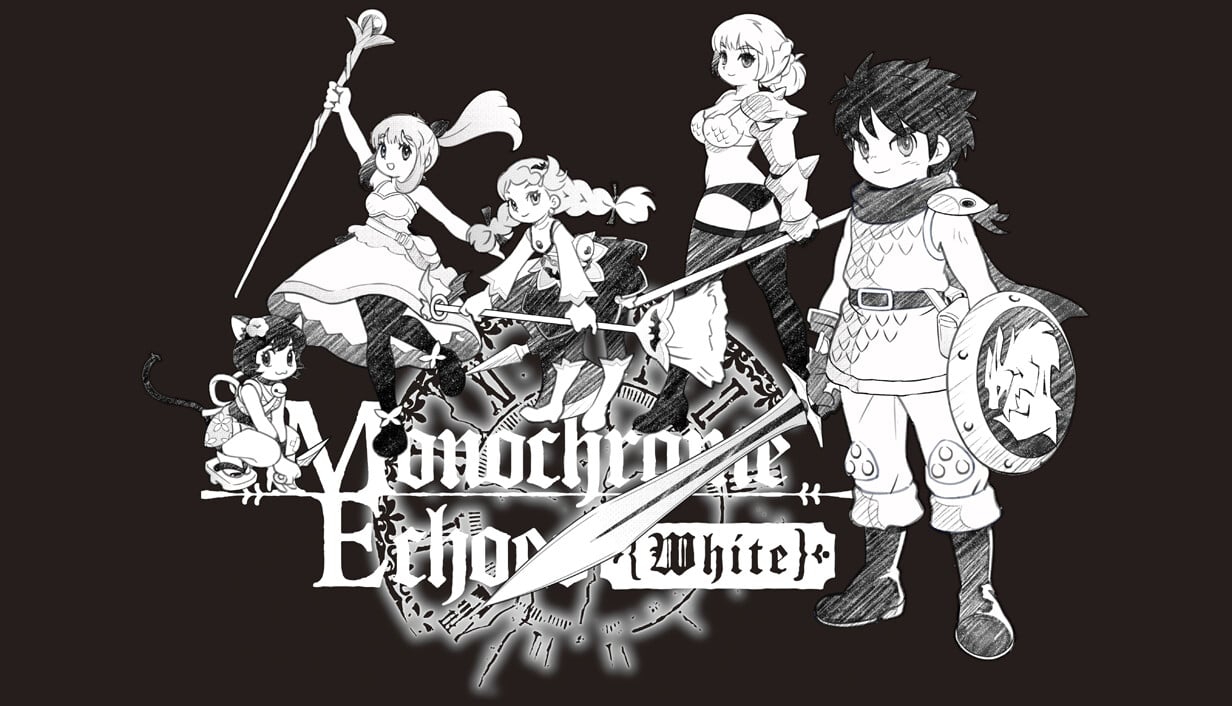
Monochrome Echoes – White – originally reached PC through Steam in 2025. It combines turn-based battles, dungeon exploration, class development and randomly generated equipment within a stark fantasy world formed around the opposing ideas of white and black. Players assume the role of someone summoned from another world to help reseal a Demon King whose prison weakens every 200 years. That familiar fantasy setup leads into a less conventional adventure across the Archipelago of Ruins, where players gradually reveal maps, assemble a party and experiment with equipment carrying different skills.
The game adapts and expands systems associated with Quester, adding class changes, skill panels, bounties and greater freedom when creating character builds. A separate Black variation is also available on PC and introduces randomized dungeons, but only the White edition has been announced for Nintendo Switch. With English already supported by the PC release, the biggest remaining questions concern language support on Switch, the final launch date and whether Mebius plans to release the game beyond Japan.
Monochrome Echoes White is coming to Nintendo Switch
Monochrome Echoes – White – is officially making the jump from PC to Nintendo Switch. Publisher Mebius and developer Thousand Games have confirmed that the fantasy role-playing game will be released through the Japanese Nintendo eShop during summer 2026. It is a fitting destination for a game built around party management, exploration and gradual character development. Those systems often work particularly well on a portable console, where a quick dungeon expedition can fit comfortably between longer sessions. Of course, anyone who has ever promised to explore for only ten minutes knows how these things usually go. One newly uncovered passage leads to another battle, another piece of equipment appears, and suddenly the clock has performed a small act of sorcery.
The Switch edition follows the PC version, which entered Early Access on March 6, 2025 before receiving its full release on April 24, 2025. That existing version gives us a clear idea of what the console release should offer. Players can expect a turn-based hack-and-slash structure focused on exploring dangerous areas, defeating enemies, collecting equipment and refining a party through flexible progression systems. The announcement has not identified any Switch-exclusive features, but the core experience already contains several layers of customisation that should keep dedicated role-playing fans busy.

The Japanese eShop release is planned for summer 2026
Mebius currently plans to release Monochrome Echoes – White – on the Japanese Nintendo eShop during summer 2026 for 2,800 yen. The publisher has not revealed a specific day, so the launch window remains broad. There is also no confirmed physical edition, which means the announced version should be treated as a digital release unless the companies share different plans later. The relatively modest price reflects the game’s independent origins, but it should not be mistaken for a tiny or stripped-back experience. Its appeal lies in interconnected progression systems, repeatable exploration and the constant possibility of discovering equipment that changes how a party member performs.
The announcement refers specifically to Nintendo Switch rather than Nintendo Switch 2. Players using newer Nintendo hardware may still be able to access the game through backward compatibility, but no dedicated Nintendo Switch 2 edition or upgrade has been announced. That distinction matters because it keeps expectations grounded. There is no confirmed information about upgraded resolution, improved performance or platform-specific controls. For now, the important point is refreshingly simple: the game is coming to Nintendo’s established hybrid system, and Japanese players will be able to purchase it through the eShop during the summer.
An English translation could make the Japanese version accessible
The possibility of English-language support is one of the most interesting details surrounding the Switch announcement. The PC edition recently received an official English translation, and its Steam listing now identifies both English and Japanese as supported languages. That makes an English option for the Japanese Switch release seem plausible, especially because the translation work already exists. However, neither Mebius nor Thousand Games has formally confirmed the language options for the console edition. It would therefore be premature to guarantee that English will appear in the final Switch download.
Still, the existing localisation changes the conversation considerably. Without it, international players would have little reason to expect an accessible Japanese release. With it, there is at least a realistic path toward importing the game digitally and playing it in English. Nintendo Switch software is not restricted to one hardware region, although purchasing Japanese eShop games generally requires access to a Nintendo Account associated with Japan and an accepted payment method or Japanese eShop credit. Players should wait for the official store listing before making any purchase decisions, as that page should provide a definitive language list.
A fantasy world divided between white and black
Monochrome Echoes presents a world shaped by the contrast between white and black, where swords and magic determine who survives. This stark visual and thematic foundation gives the game a distinctive identity before the first dungeon has even been explored. Rather than filling every corner with a rainbow of competing colours, the setting uses opposition as its backbone. Light and darkness, safety and danger, order and chaos all sit close together. It is a fitting approach for an adventure concerned with a seal that protects civilisation while never fully removing the threat beneath it.
The premise borrows recognisable ideas from otherworldly summoning stories, but it directs them toward a dungeon-focused role-playing structure. Players are not merely tourists arriving in a strange kingdom with suspiciously convenient abilities. They are called into a repeating historical cycle, one that has already demanded heroes from other worlds many times before. That history lends weight to the player’s arrival. You are important, certainly, but you are also part of an established ritual. The world has seen heroes before, and it expects you to perform the same impossible duty once again.
The summoned hero must help seal the Demon King again
Long before the player’s adventure begins, a hero summoned from another world helped seal away the Demon King during the age of the Ancient Empire. The victory was incomplete, however, because the seal could not hold forever. It weakens every 200 years and must be restored before the Demon King can return. Responsibility for maintaining this cycle belongs to the Clan of the Sealers, a group that summons a new hero whenever the appointed time arrives.
The player becomes the latest outsider dragged into this ancient responsibility. It is not exactly the sort of travel invitation anyone hopes to find waiting in their inbox. There is no relaxing resort, no welcome drink and very little chance of spending the afternoon beside a pool. Instead, the newly summoned hero must venture into the Archipelago of Ruins, uncover its dangers and help prevent a sleeping evil from awakening. The setup creates a clear objective while leaving room for discoveries about previous heroes, the ancient empire and the true nature of the repeating seal.
The repeating cycle gives the adventure historical weight
A seal that must be renewed every 200 years does more than provide a convenient reason for the protagonist to enter the story. It suggests that the world has been living beneath a permanent shadow for generations. Entire civilisations can rise, change and disappear during two centuries, yet the same duty remains. Every new era inherits a danger it did not create and a ritual it cannot safely ignore. That idea gives the setting a quiet sense of fatigue. The people may be accustomed to the cycle, but familiarity does not make the threat less frightening.
It also raises questions that could make the narrative more interesting than its initial hero-versus-Demon-King premise suggests. Why was the original seal incomplete? What happened to the heroes summoned during earlier cycles? Does the Clan of the Sealers understand the full truth, or has important knowledge been lost over time? The available description does not answer those questions, so they should not be treated as confirmed plot points. Even so, the premise naturally creates mystery around the ruins and the generations that previously crossed them.
Exploration and character growth shape the main adventure
Monochrome Echoes is built around two closely connected activities: exploration and development. Players venture into dangerous territory, reveal the map, fight enemies and return with resources or equipment that can strengthen the party. Those improvements then make it possible to push farther during the next expedition. It is a familiar rhythm, but familiar systems can be deeply satisfying when each part feeds naturally into the next. Exploration creates opportunities for growth, while growth opens routes that previously felt too risky.
The game describes itself as a hack-and-slash RPG, though its battles use a layered turn-based system rather than real-time action. Here, hack-and-slash refers more broadly to the focus on repeated combat, valuable loot and character builds. Players are encouraged to test combinations rather than follow a single rigid path. A weapon might provide a skill that complements one class especially well, while another item could inspire an entirely different role for the same character. Progress becomes less like climbing a straight staircase and more like arranging a complicated toolbox.
Flexible classes and skill panels support varied party builds
Class changes and skill panels expand the character-building options beyond basic increases to health, attack or defence. A class system allows party members to shift their combat responsibilities, while skill panels provide another route for shaping their strengths. Together, these features should let players develop specialised characters or create flexible adventurers capable of covering several needs. A heavily protected front-line fighter may keep dangerous enemies occupied, while another party member focuses on damage, recovery or useful support abilities.
The most appealing part is the freedom to choose a preferred party rather than being forced into one fixed formation throughout the adventure. That choice encourages experimentation. Perhaps you enjoy a balanced team that always has an answer ready. Perhaps subtlety has never been your style, and you would rather build a party that solves every disagreement with an unreasonable amount of damage. Both approaches can be entertaining when progression systems give them enough room to function. The inclusion of class changes should also reduce the risk of permanently damaging a character through an early decision made before the systems were fully understood.
Layered turn-based battles reward preparation
The battle system expands upon mechanics associated with Quester and uses layered turn-based encounters. Although the announcement does not provide every mechanical detail, the broader emphasis is clearly on preparation, party composition and the interaction between skills. Success should depend on more than selecting the strongest attack whenever a character’s turn arrives. Equipment choices, class roles and the order in which abilities are used can all influence whether an encounter ends in victory or an awkward retreat.
This approach suits a game where the thrill of discovery is closely linked to tactical possibilities. Finding a powerful weapon is exciting because of its numbers, but finding one that completes a build can feel even better. Suddenly, a character who seemed merely useful becomes the centre of the party’s strategy. That transformation is one of the great pleasures of loot-driven role-playing games. The treasure chest does not simply contain a stronger sword. It contains a new idea, wrapped in steel and probably guarded by something unpleasant.
Bounties add another reason to confront dangerous enemies
Bounties are among the additional systems highlighted for Monochrome Echoes – White -. While the available description does not explain their exact structure, they provide another reason to engage with the game’s combat encounters and search its maps carefully. A bounty system can direct players toward particular targets, reward mastery of difficult fights and introduce goals beyond simply reaching the next location. It also fits naturally within a settlement serving adventurers, where dangerous creatures and troublesome enemies would quickly become the subject of paid requests.
These optional objectives may also help create a useful rhythm between major expeditions. Instead of always advancing directly toward the central threat, players can pursue a bounty, improve the party and become familiar with recently unlocked abilities. That breathing room is valuable in a systems-heavy RPG. It gives players an opportunity to test ideas without placing every experiment against a major story encounter. Sometimes the best preparation for saving the world is accepting a smaller job, earning a reward and discovering that the strange new weapon in your inventory is much better than it first appeared.
Random equipment makes every discovery more meaningful
Weapons and other pieces of equipment are discovered with randomly assigned skills, making loot a central part of the experience. Two items from the same general category may support entirely different strategies depending on the abilities attached to them. That variation encourages players to inspect what they find rather than immediately judging equipment by a single attack or defence value. An object that initially appears weaker could become more valuable when paired with the right class, skill panel or party arrangement.
Randomised equipment also gives repeated exploration a stronger sense of possibility. You may know the general layout of an area or understand the enemies waiting inside, but the rewards can still surprise you. This unpredictability is the fuel that keeps many loot-based adventures moving. The next useful item might be waiting around the corner, at the end of a difficult battle or inside a container that looks entirely ordinary. Naturally, it may also be another piece of equipment that does absolutely nothing for your current build. The treasure gods have a sense of humour.
The Archipelago of Ruins offers an unusual setting
The adventure takes place across the Archipelago of Ruins, the region where the Demon King sleeps. Instead of presenting one continuous continent, the game frames its world as a collection of broken locations surrounded by a random sea. Players explore this environment while gradually uncovering the map, creating a feeling of pushing into forgotten territory one piece at a time. The archipelago format also supports a natural division between destinations, challenges and discoveries without making the setting feel like a simple chain of unrelated dungeons.
There is only one town within the ruins archipelago, making it an especially important refuge. It serves as the centre of everyday adventurer life, a place for preparation and recovery between dangerous expeditions. The official description characterises that life as happy and embarrassing, suggesting that the settlement may contain lighter character moments alongside the larger struggle against the Demon King. That contrast can keep the adventure from becoming relentlessly grim. Even heroes responsible for an ancient seal occasionally need conversations that do not involve the possible collapse of civilisation.
Developing the map turns progress into something visible
Map development is one of the clearest ways the game represents progress. Each expedition reveals another portion of the surrounding area, replacing uncertainty with useful knowledge. A once-empty space becomes a route, a landmark, a danger zone or a promising destination. The result is satisfying because players can see the direct effect of their exploration. Character levels and equipment values may rise quietly within menus, but a growing map displays accomplishment in a more immediate form.
Gradual mapping also encourages curiosity. An incomplete route invites questions. Does it lead toward a valuable resource, a powerful enemy or the next major objective? Could a previously overlooked passage connect two areas and make future expeditions safer? Good exploration systems turn blank spaces into promises, and Monochrome Echoes appears eager to use that appeal. The journey is not solely about arriving at the Demon King’s resting place. It is also about learning the shape of a broken world and becoming capable of surviving within it.
Monochrome Echoes builds upon ideas introduced in Quester
The game adapts and enhances systems from Quester, a dungeon exploration RPG associated with many of the same creators. Monochrome Echoes is not presented merely as a direct copy with a different setting. Its expanded features include class changes, skill panels and bounties, all of which add more ways to shape the party and approach exploration. Game design is credited to Hironori Kato, while Toshimichi Kuwahara of Thousand Games serves as producer.
This connection gives experienced Quester players a useful reference point, but prior familiarity should not be necessary to understand the new adventure. Monochrome Echoes has its own world, characters and central conflict. The relationship is primarily mechanical, with proven ideas being adapted to fit a fantasy story about summoned heroes and a recurring demonic threat. For newcomers, that means the game can stand on its own. For existing fans, it offers the appeal of recognisable foundations combined with additional systems and a different atmosphere.
The Black variation has not been confirmed for Nintendo Switch
The PC release is accompanied by another version known as Monochrome Echoes – Black -. This variation introduces randomised dungeons, making its exploration less predictable than the White edition. The Nintendo Switch announcement, however, refers only to Monochrome Echoes – White -. Mebius and Thousand Games have not announced a Switch release for Black, nor have they indicated that its random dungeon features will be included as an option within the White edition.
Players should therefore view the two releases as separate products unless the companies state otherwise. It is certainly possible that Black could arrive later, but there is no factual basis for presenting that as an established plan. The White edition already includes random elements through its sea and equipment systems, while its map development appears to offer a more deliberately structured sense of exploration. Black’s randomised dungeons would provide a different flavour, especially for players interested in repeated runs and unpredictable layouts.
What remains unknown about a western release
No western Nintendo Switch release has been announced. The current plans cover the Japanese eShop, leaving players in North America, Europe and other regions without a dedicated local launch. The recently completed English translation creates a practical foundation for broader distribution, but localisation alone does not confirm that Mebius intends to publish the console version internationally. Store preparation, age ratings, regional pricing and promotional arrangements can all affect whether a game reaches additional markets.
The final language options for the Japanese Switch edition also remain unconfirmed. English is available in the PC version, so its inclusion would be logical, but logic is not the same thing as an official listing. The Japanese eShop page should settle that question when it becomes available. Until then, the safest position is that English support is possible rather than guaranteed. Players interested in importing should also wait for technical details, including file size, supported controllers and any differences from the Steam edition.
Even with those unanswered questions, the announcement gives Nintendo Switch owners another distinctive RPG to follow. Its monochrome fantasy world, repeating historical cycle and build-focused dungeon exploration create an appealing mixture. The game is not trying to win attention with cinematic spectacle or a continent covered in map icons. Its hook is more intimate: one more path to uncover, one more party adjustment to consider and one more mysterious item that might transform the next battle.
Conclusion
Monochrome Echoes – White – will bring its otherworldly summoning story and loot-focused role-playing systems to the Japanese Nintendo eShop during summer 2026. Priced at 2,800 yen, the Switch version will let players explore the Archipelago of Ruins, develop a chosen party, change classes, unlock skills and search for randomly enhanced equipment. Its central story follows another hero summoned into a centuries-old cycle, tasked with helping reseal the Demon King before an incomplete prison fails once again.
The PC edition’s recent English translation makes the console announcement particularly interesting for players outside Japan, but English support on Switch and a western release have not yet been confirmed. The Black variation, which features randomised dungeons, is also absent from the current console plans. Those questions leave room for further announcements, while the confirmed White edition already offers plenty to consider. For players who enjoy methodical exploration, flexible builds and the dangerous promise of one more treasure chest, this monochrome adventure could add an intriguing shade to the Switch library.
FAQs
- When will Monochrome Echoes – White – be released on Nintendo Switch?
- Mebius plans to release the game through the Japanese Nintendo eShop during summer 2026. A specific launch date has not yet been announced.
- How much will Monochrome Echoes – White – cost on Nintendo Switch?
- The Japanese Nintendo eShop version will cost 2,800 yen. Pricing for other regions has not been announced because there is currently no confirmed western release.
- Will the Nintendo Switch version support English?
- The PC edition supports English following a recent localisation update. English has not yet been formally confirmed for the Nintendo Switch edition, so players should check the final Japanese eShop listing.
- What type of RPG is Monochrome Echoes – White -?
- It is a turn-based hack-and-slash RPG focused on exploration, party development, class changes, skill panels, bounties and equipment with randomly assigned skills.
- Is Monochrome Echoes – Black – also coming to Nintendo Switch?
- Only Monochrome Echoes – White – has been announced for Nintendo Switch. There is currently no confirmation that the Black variation or its randomised dungeons will reach the console.
Sources
- Monochrome Echoes: White coming to Switch this summer, Gematsu, June 18, 2026
- Monochrome Echoes – White – coming to Nintendo Switch, Nintendo Everything, June 19, 2026
- Monochrome Echoes – white – on Steam, Steam, April 24, 2025
- Monochrome Echoes – white – English Localization, Steam News, June 2026
- Thousand Games releases Monochrome Echoes – white – on PC Steam in Japanese, with English release to follow, RPG Site, April 25, 2025