














Summary:
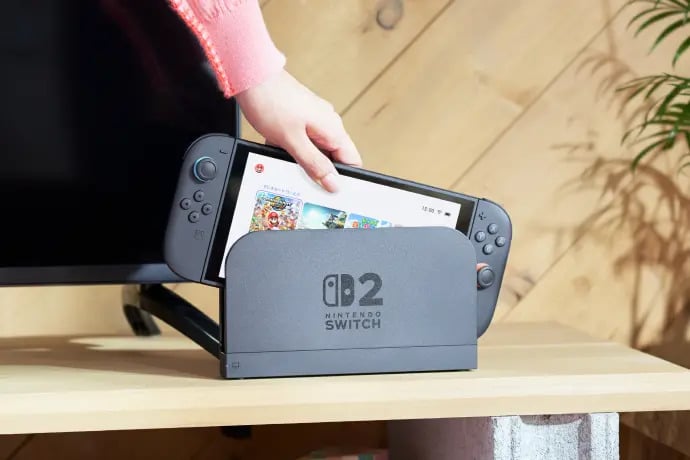
A newly surfaced Nintendo patent describes a docking station that could support both the Nintendo Switch 2 and the original Nintendo Switch. Published in China after being filed in January 2025, the proposed design would reportedly recognise which console had been inserted by detecting differences in how each system negotiates power delivery. Once identified, the dock could automatically adjust its USB connection, video output and cooling fan speed to suit the hardware.
When connected to a Nintendo Switch 2, the patented dock would use a USB 3 data standard, provide higher-resolution video output and operate its internal fan at a faster speed. An original Nintendo Switch would instead trigger USB 2 functionality, lower-resolution video output and reduced fan speeds. The process appears designed to happen without requiring players to select a mode or change any settings manually.
Such an accessory could be particularly useful for families and enthusiasts who continue to use both Nintendo systems. Rather than keeping two docks, two HDMI connections and a small jungle of cables around the television, players could theoretically switch between consoles using a single station. However, the filing does not confirm that Nintendo plans to release the product. Nintendo Patents Watch has suggested that it may represent an earlier research project or a concept that was ultimately rejected. Like many patents, it offers an intriguing look at Nintendo’s hardware experiments without guaranteeing that the pictured accessory will ever reach shops.
Nintendo Patent Reveals a Dock Designed for Two Switch Generations
Nintendo has explored a docking station that could bridge the gap between its original hybrid console and its successor. The patent, highlighted by Nintendo Patents Watch, describes a Nintendo Switch 2 dock capable of supporting both the Switch 2 and the first Nintendo Switch. That is notable because Nintendo’s currently available docks are designed around their respective systems rather than serving as one shared home for both machines. The Switch 2 console cannot simply be placed inside the original Switch dock, meaning players who regularly use both devices need separate equipment. This patented design imagines a more flexible alternative. Instead of treating the two consoles as completely separate guests, the dock would welcome both through the same front door and prepare the room differently depending on who arrived.
How the Dock Could Identify the Connected Nintendo Console
The heart of Nintendo’s proposed design is its ability to identify the console connected to it. According to Nintendo Patents Watch, the original Switch and Switch 2 handle USB Power Delivery negotiation differently. The dock could monitor that exchange to determine which system had been inserted, rather like recognising someone by the way they knock on the door. Once the console’s identity was established, the dock would apply the appropriate operating profile automatically. Players would not need a physical switch, a menu option or a companion application to choose between modes. This matters because sending the wrong combination of power, data behaviour or output settings to a device could result in poor performance or failed communication. Automatic detection would make the accessory feel straightforward, despite the technical juggling taking place behind its plastic shell.
Switch 2 Mode Would Prioritise Faster Data and Higher Resolution
When the patented dock detected a Nintendo Switch 2, it would reportedly enable the USB 3 data standard and support higher-resolution video output. Those choices align with the greater capabilities of Nintendo’s newer console. The Switch 2 can display supported games at resolutions up to 4K through its dedicated dock, while compatible displays can support frame rates of up to 120 frames per second at lower resolutions. The original Switch, by comparison, targets video output up to 1080p in TV mode. A shared dock would therefore need to avoid applying one fixed output profile to both machines. It would have to let the Switch 2 stretch its legs while ensuring the older console was not asked to perform a technical gymnastics routine it was never built to attempt.
Higher Fan Speeds Could Support Switch 2 Performance
The patent also specifies a higher fan speed when the dock is being used with a Nintendo Switch 2. Nintendo’s official Switch 2 dock already includes an internal fan that helps stabilise performance, making active cooling one of the clearest differences between the newer docking solution and earlier Switch docks. Increasing the fan’s revolutions per minute for the newer console would make sense because higher output resolutions and greater processing demands can generate additional heat. With an original Switch attached, the same level of cooling might be unnecessary and needlessly noisy. A variable fan profile could therefore balance temperature management with comfort. Nobody wants their evening adventure accompanied by a dock that sounds like a tiny vacuum cleaner preparing for take-off, especially when the connected console does not need that much airflow.
Original Switch Mode Would Scale the Dock Back Automatically
When an original Nintendo Switch was detected, the proposed dock would operate under a less demanding profile. It would reportedly use USB 2, provide lower-resolution video output and reduce the speed of its cooling fan. These settings would better reflect the capabilities and requirements of the older console. The original Switch supports TV output up to 1080p, so enabling the dock’s more demanding Switch 2 configuration would offer no meaningful visual benefit. Reducing the fan speed could also lower noise and energy use while still providing any airflow required by the shared hardware. The appealing part is not simply that both systems could fit. It is that the dock would adapt its behaviour rather than forcing one console to live with settings intended for the other. That distinction turns the idea from a basic physical adapter into a genuinely intelligent accessory.
Why a Shared Dock Could Be Useful in Multi-Console Households
A universal Nintendo dock would solve a very ordinary problem, and ordinary problems are often the ones players notice every day. Many Switch 2 owners have kept their original Switch rather than trading it in or placing it permanently in a cupboard. Families may use the older console in another room, preserve downloaded games on it or continue playing titles that rely on original Joy-Con features. Collectors may also prefer to keep both systems active. At present, using each console on the same television can involve changing HDMI inputs, swapping power adapters or leaving two bulky docks beside the screen. A shared solution would make switching between generations as simple as lifting one console out and placing the other inside. It is not flashy, but neither is a tidy desk until you have lived with a messy one.
One Dock Could Reduce Cable and Entertainment Centre Clutter
The practical value becomes even clearer when we look behind the television. Every dedicated dock typically brings another power connection, HDMI cable and physical unit competing for space. Add a soundbar, streaming box, router and another console or two, and the back of an entertainment centre can quickly resemble a bowl of electronic spaghetti. A dual-compatible Nintendo dock could remove at least one power adapter, one HDMI connection and one docking station from that arrangement. It could also help players with televisions that have a limited number of HDMI ports. However, convenience would depend on the final physical design. The original Switch and Switch 2 have different dimensions, so the dock would need to hold both securely without scratching their screens, blocking ventilation or allowing the smaller system to wobble around like a loose cartridge in an oversized case.
The January 2025 Filing May Represent an Abandoned Concept
The patent was reportedly filed in China in January 2025, several months before the Nintendo Switch 2 launched on June 5, 2025. That timing is important because it suggests Nintendo may have explored the shared dock while the final Switch 2 hardware and accessory strategy were still taking shape. Nintendo Patents Watch has raised the possibility that the design was part of a research and development project or an idea that Nintendo ultimately rejected. Companies routinely protect inventions and technical approaches that never become commercial products. A patent can preserve an option, prevent competitors from copying a method or document one branch of a development process. It should not be treated as a product announcement hiding beneath legal paperwork. For now, the design is evidence that Nintendo considered the idea, not proof that a universal dock is waiting in a warehouse.
What the Patent Could Mean for Future Nintendo Accessories
Even if this exact docking station never reaches the market, the patent offers an interesting glimpse at how Nintendo approached the transition between Switch generations. The company clearly examined ways for accessories to recognise different hardware models and adjust their behaviour accordingly. That concept could influence later docks, charging stations or other devices intended to work across multiple members of the Switch family. It could also become useful if Nintendo introduces revised Switch 2 models with different cooling or output requirements. A dock that identifies the connected hardware before selecting a suitable profile would be easier to reuse across a growing product range. Still, there has been no official announcement confirming development, pricing or availability. Until Nintendo says otherwise, the universal dock belongs in the fascinating but crowded drawer labelled “patented ideas that may or may not escape the laboratory.”
Conclusion
Nintendo’s newly surfaced patent describes a clever docking station that could automatically support both the original Switch and Nintendo Switch 2. By detecting differences in power negotiation, the dock could enable faster USB data, higher-resolution video and stronger cooling for Switch 2 while applying lighter settings to the original console. The idea could be genuinely useful for households that regularly move between both systems, particularly where HDMI ports and shelf space are in short supply. However, the January 2025 filing does not indicate that a retail launch is planned. It may reflect an abandoned prototype, an early accessory proposal or technology Nintendo simply wanted to protect. The design gives us an intriguing glimpse behind the curtain, but for now, players should keep their existing docks and cables exactly where they are.
FAQs
- What does Nintendo’s shared Switch dock patent describe?
- It describes a docking station capable of supporting both Nintendo Switch 2 and the original Nintendo Switch. The dock could identify the connected console and automatically adjust its USB standard, video output and cooling fan speed.
- How would the dock recognise a Switch or Switch 2?
- The patent reportedly uses differences in USB Power Delivery negotiation to distinguish between the two consoles. That detection would allow the dock to select the correct operating mode without requiring manual input.
- What settings would the dock use for Nintendo Switch 2?
- With a Switch 2 connected, the dock would reportedly use USB 3, support higher-resolution video output and operate its cooling fan at a higher speed.
- What settings would it use for the original Nintendo Switch?
- The original Switch would reportedly trigger USB 2, lower-resolution video output and a slower fan speed that better matches the older console’s capabilities and cooling requirements.
- Has Nintendo announced this universal dock for release?
- No. Nintendo has not announced a product based on the patent. The January 2025 filing may represent research, an early prototype or a concept that was rejected before the Switch 2 reached the market.
Sources
- A Nintendo Patent Published in China Describes a Switch 2 Dock That Can Also Support Switch 1, Nintendo Patents Watch, July 16, 2026
- Nintendo Filed a Patent for a Dock That Supports Both Switch and Switch 2, NintendoSoup, July 16, 2026
- Power Up Your Play With Nintendo Switch 2 and Mario Kart World Launching Today, Nintendo, June 5, 2025
- Nintendo Switch 2 Launches June 5, Bringing New Forms of Game Communication to Life, Nintendo, April 2, 2025