




Summary:
The Ocarina of Time remake was rebuilt from the ground up to preserve the original game’s feel while updating controls, visuals and design for modern players. Nintendo’s development team chose to recreate every system rather than porting the original code, implementing features, testing them against the N64 classic, and iterating until the balance felt right. That process led to notable changes like adding a dedicated jump button, removing auto-jump, and reworking level geometry to account for freer movement. The art team embraced a puppet-show, practical-effects aesthetic so characters remain familiar but feel more tangible. These design choices were made with both longtime fans and newcomers in mind, and developers carefully weighed trade-offs—like removing fast travel—so exploration and discovery still reward players. NintendoReporters explains what this means for players and why those choices matter.
Everything Was Rebuilt From Scratch for The Legend of Zelda – Ocarina of Time
Nintendo decided not to use the original game’s code as a base, choosing instead to rebuild The Legend of Zelda: Ocarina of Time from scratch. That decision is rooted in more than nostalgia; the team concluded that nearly three decades of changes in hardware, design expectations and tooling made a port impractical. Recreating systems, models and behaviors allowed developers to implement modern rendering, physics and input handling while repeatedly comparing each implementation to the original. The approach meant more work up front, but it also gave the team granular control over how Link moves, how enemies react, and how environments feel, so that the remake could honor memories without becoming an exact copy. For you as a player, that means you should expect familiar beats and layouts, but with a responsiveness and polish designed for current controllers and displays.
Why Rebuilding Made Sense After Nearly Three Decades
When a game is nearly 30 years old, the original technical foundations can be brittle or hard to adapt. Developers on the remake pointed out that porting aged code and then layering modern features can introduce compromises you might not spot until late in development. By rebuilding, the team could reimplement a mechanic, test it side-by-side with the N64 version, and refine it until it matched the original’s intended rhythm and feel. That gave them the freedom to modernize input and camera systems in ways that suit players who started with Breath of the Wild or Tears of the Kingdom, while still keeping the core identity of puzzles, dungeons and story intact. The rebuild strategy also opened opportunities to rethink art, audio and environment density so Hyrule feels alive on newer hardware like Nintendo Switch 2 (Nintendo Switch 2).
Controls: Bringing Jumping Back with a Button
One of the most noticeable gameplay changes is the addition of a dedicated jump button. In the original, jumping was context-sensitive and often triggered automatically by pushing the Control Stick forward in certain locations. Players used to modern Zelda titles expect a discrete jump action, so the team implemented a jump button while being mindful of how that change ripples through level design. Implementing a jump button wasn’t simply a control swap; it required revisiting ledge distances, enemy encounters and puzzle logic so that new freedom didn’t break intended progression. The developers even implemented multiple control schemes so veterans of the N64 version and newcomers familiar with later titles can both find a comfortable setup.
Removing Auto-Jump and Player Expectation
Auto-jump in the original helped guide players across fixed gaps and prevented certain edge-case behaviors, which simplified level design at the time. With modern expectations, however, auto-jump starts to look arbitrary: why can Link jump there but not here? Removing auto-jump gives players consistent control, but it also makes level geometry a bigger responsibility for designers. The team had to anticipate new player behavior, adding checks and subtle tweaks to environments so that players could explore freely without easily breaking progression or bypassing puzzles. That balancing act explains why a single control change can create dozens of follow-up tasks in testing, iteration and environment redesign to maintain both challenge and fairness.
Balancing Young and Adult Link’s Movement
Another subtle design challenge came from the fact the game features both Young Link and Adult Link, each with slightly different movement profiles. Jump height and reach differ between ages, so the team needed to ensure single pieces of terrain worked for both versions without creating awkward or unfair gaps. That meant redesigning some ledges and platforming sequences and performing careful playtesting to find distances that felt natural for each Link while preserving the original level flow. The result aims to keep the original puzzles and traversal intact while offering smoother, more predictable platforming across both character states, so you won’t feel like the rules changed mid-game.
Art Direction: Puppet-Show Feel and Practical Effects
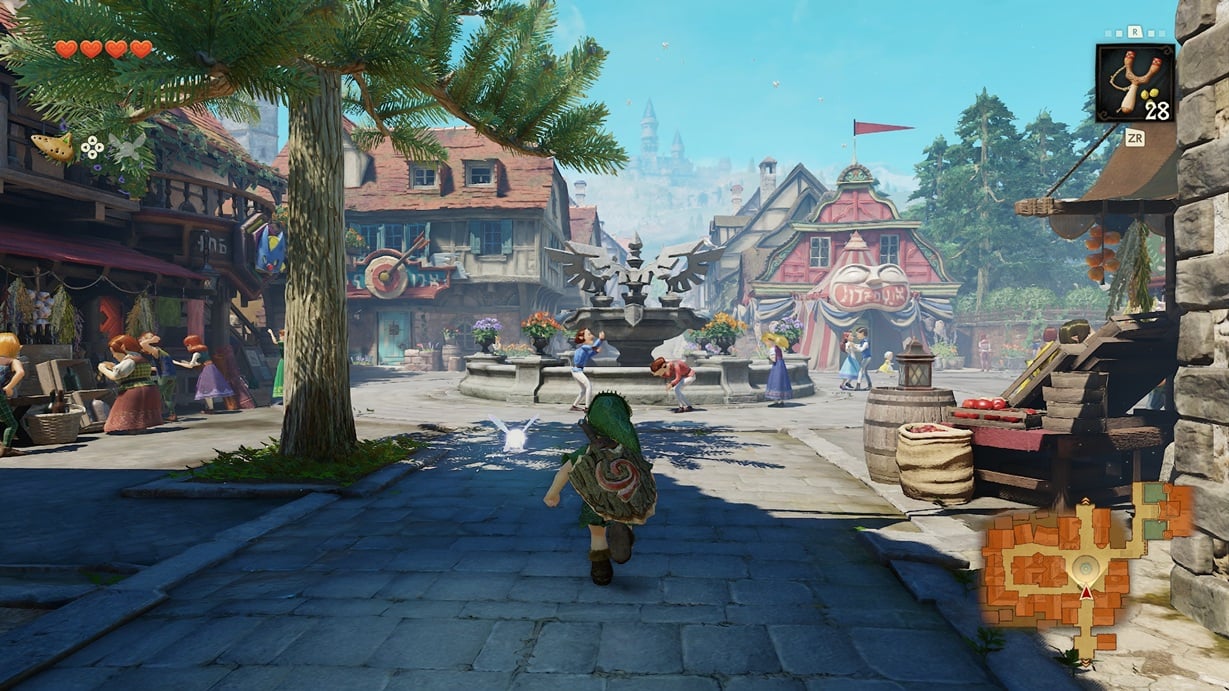
On the visual side, art director Aya Shida described using phrases like “puppet-show feel” and “the analog feel of practical effects films” as guiding ideas. The goal was not photorealism but a believable, tactile world where colorful, quirky characters sit naturally inside a denser, more detailed Hyrule. That aesthetic helps bridge the old and new: characters read clearly from a distance, keeping their iconic silhouettes, while models, textures and lighting bring more presence up close. The team made 3D models of key landmarks and iterated on lighting and materials so that the rebuilt Hyrule feels like a place that could exist, yet still carries the dreamlike charm players remember. These choices help preserve memories while making the world more immersive for modern displays.
Keeping the Original’s Spirit While Updating Visuals
Updating visuals is always a negotiation between honoring the source and offering something fresh. Developers explained they frequently compared new implementations with the original to avoid turning the remake into something unrecognizable. Character redesigns were allowed, but with care: distance impressions and iconic silhouettes needed to stay intact so returning players recognize Link, Zelda and other characters instantly. Meanwhile, increased environment density and the ability to rotate the camera create more opportunities for small discoveries, meaning that exploration on newer hardware can feel rewarding in different ways. For NintendoReporters readers, that means the Hyrule you explore will have more detail and angle-dependent surprises without losing the core locations you remember.
Development Challenges and QA
Rebuilding everything from scratch leads to a mountain of quality assurance tasks. Each change requires designers and testers to anticipate unexpected player behavior, especially when old shortcuts or constraints are removed. The team talked about implementing features, comparing them to the original, and repeating that process to make sure responsiveness and timing matched players’ expectations. Small adjustments—like how Link responds to a button press or how an enemy telegraphs a move—can dramatically affect feel, so QA had to be exhaustive. For players, that shows up as smoother animations, fewer janky moments, and a sense that controls respond the way they expect, which is crucial for a game whose identity rests heavily on feel.
Anticipating Player Behavior When Removing Restrictions
Removing systems that implicitly constrained players means developers must think like players and foresee creative use cases. If Link can now jump anywhere, what prevents sequence breaks? If camera freedom lets you see off-screen secrets, does that break puzzle intent? The team walked through these questions repeatedly, testing and redesigning specific areas so that freedom feels empowering rather than exploitative. The result is a game where exploration still rewards curiosity, but designers have added safeguards or adjusted geometry where necessary to preserve intended solutions. For you, that translates to fewer frustrations and more consistent rules, whether you grew up with the N64 original or jumped into Zelda with more recent releases.
Conclusion
Nintendo’s remake of Ocarina of Time reflects a patient, careful approach: rebuild where needed, preserve the game’s soul, and modernize controls and visuals to meet today’s expectations. The team balanced respect for the original with smart updates like a jump button and an art direction that feels handcrafted. For fans, this should feel familiar and polished; for newcomers, it should offer a clear, modern Zelda experience. NintendoReporters will keep following developer insights, and if you love Zelda, this remake looks built to honor memories while giving the adventure a fresh coat of paint for the present generation.
FAQs
- Was the remake built from the original game’s code?
- No. Nintendo rebuilt the game from scratch, reimplementing systems and comparing each feature to the original during development.
- Why did Nintendo add a jump button?
- Developers added a dedicated jump button because modern players expect direct jumping control; they then adjusted level design to accommodate that change.
- Did Nintendo remove auto-jump?
- Yes. Auto-jump was removed to make jumping consistent everywhere, which required redesigning certain areas to avoid unintended behavior.
- How did the art direction change?
- The art team pursued a puppet-show, practical-effects aesthetic that keeps characters familiar while making the world feel more tangible and detailed.
- Will this feel different to players of Breath of the Wild?
- Developers made adjustments so players familiar with recent Zelda games won’t be jarred, but the remake preserves the original’s pacing and design philosophy.
Sources
- Ask the Developer Vol. 24: The Legend of Zelda: Ocarina of Time — Part 2, Nintendo, November 2, 2026
- Ask the Developer Vol. 24, The Legend of Zelda: Ocarina of Time – Chapter 1, Nintendo, November 2, 2026
- Ask the Developer Vol. 24, The Legend of Zelda: Ocarina of Time – Chapter 3, Nintendo, November 2, 2026
- Zelda: Ocarina of Time remake had a Breath of the Wild QoL feature removed, GamesRadar+, November 2, 2026