














Summary:
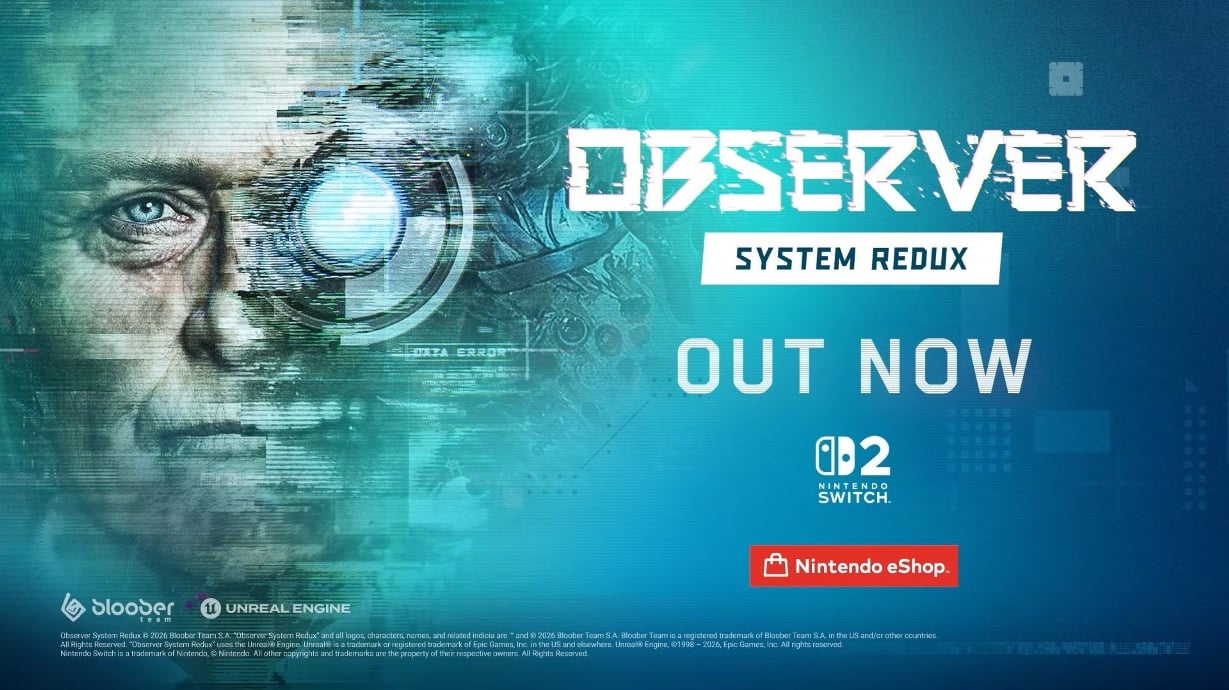
Bloober Team has released the launch trailer for Observer: System Redux following the psychological horror game’s arrival on Nintendo Switch 2. Set in a grim cyberpunk vision of 2084, the story follows elite investigator Daniel Lazarski as he searches for his missing son inside a decaying apartment building filled with frightened residents, damaged technology and secrets that refuse to stay buried. His investigation becomes increasingly disturbing when he uses the Dream Eater, an invasive device capable of entering the minds of dead and dying people. These sequences blur memories, fears and reality until even the player may struggle to separate one from another.
The Nintendo Switch 2 release adapts Bloober Team’s unsettling detective experience to Nintendo’s newer hardware while introducing optional Joy-Con 2 mouse controls and motion controls. Mouse functionality can provide more precise camera movement while examining rooms, following clues and interacting with the environment. Motion controls offer another option for players who enjoy physically adjusting their aim during first-person exploration. The game can also be played in handheld mode or through a docked setup, allowing its oppressive world to follow players beyond the television.
Rutger Hauer portrays Daniel Lazarski in one of the defining elements of the experience. His weary performance gives the character a sense of history, exhaustion and vulnerability that fits the bleak setting perfectly. Observer: System Redux is available digitally through the Nintendo eShop for Nintendo Switch 2, giving horror fans another dark and mature mystery to investigate on the system.
Observer: System Redux arrives on Nintendo Switch 2
Observer: System Redux has officially reached Nintendo Switch 2, bringing Bloober Team’s unsettling cyberpunk investigation to Nintendo’s current hardware. Its release followed an appearance during a recent Nintendo Direct, leaving only a brief gap between the announcement and the moment players could begin exploring its rain-soaked, technology-infested world. That quick turnaround suits a game built around confusion and sudden discoveries. One moment it appeared as a surprise addition to the system’s library, and shortly afterward the doors to its dystopian apartment complex were already open.
This is not a cheerful vision of tomorrow filled with spotless cities, helpful robots and refrigerators that politely remind you to buy milk. The future presented here is diseased, exhausted and dangerously unstable. Technology has become woven into human bodies and private thoughts, yet society has not become safer or kinder because of it. Instead, corporations exercise enormous control while war and cybernetic illness have left ordinary people struggling to survive. The result is a setting that feels futuristic without ever feeling clean or glamorous.
The Nintendo Switch 2 edition also arrives with features developed around the capabilities of the system. Optional mouse controls and motion controls give players additional ways to investigate, while handheld support makes it possible to take the mystery away from the television. Whether that is a wise idea before bed is another question entirely. Observer: System Redux has a habit of placing unpleasant images in the back of your mind and leaving them there long after the screen goes dark.

A disturbing cyberpunk future shaped by disease and corporate power
The world of Observer: System Redux is set in 2084, after a digital plague and years of conflict have changed the shape of society. A disease known as the Nanophage has devastated large parts of the population, particularly those who embraced cybernetic enhancements. Meanwhile, a devastating war has weakened governments and allowed powerful corporations to take control of everyday life. People may have advanced implants and digital connections, but they live in cramped rooms, failing buildings and an atmosphere of constant suspicion.
This contrast gives the setting much of its personality. Cyberpunk stories often balance extraordinary technology against social decay, but Observer pushes that imbalance to an uncomfortable extreme. Human beings can replace body parts, connect directly to machines and store fragments of experience, yet they still cannot escape poverty, trauma or fear. Technology is not a ladder leading everyone toward a brighter future. It is closer to a rusty tool that powerful institutions use to tighten their grip.
The Krakow apartment building where much of the investigation unfolds becomes a miniature portrait of this broken society. Its narrow corridors, flickering lights and locked doors create an immediate sense of confinement. Every resident appears to be hiding something, although not every secret is connected to the central case. Some are simply trying to protect what little privacy remains in a world where investigators can literally enter another person’s mind. That possibility hangs over every conversation. What would privacy mean when memories can be searched like a damaged hard drive?
Daniel Lazarski’s search turns into a personal nightmare
Players assume the role of Daniel Lazarski, a veteran investigator working for the Chiron Corporation. He belongs to a specialised police unit known as the Observers, whose members can connect to neural implants and examine the thoughts of suspects or victims. Daniel begins his journey after receiving a mysterious communication from his estranged son, Adam. The signal leads him to a neglected apartment building, where a routine search quickly turns into something far more personal and dangerous.
Daniel’s relationship with Adam gives the mystery an emotional centre. He is not merely solving another case for an employer or chasing a criminal because a mission briefing told him to do so. He is looking for someone from whom he has become painfully distant. That sense of regret follows him through every corridor. The investigation is therefore driven by professional instinct and parental desperation at the same time, creating a tension that becomes harder to ignore as the situation deteriorates.
The building enters lockdown shortly after Daniel arrives, trapping him alongside its residents. From that point onward, every room can contain a clue, a frightened witness or something far worse. The environment encourages patient observation rather than reckless action. Players examine objects, scan biological evidence and analyse electromagnetic signals while trying to reconstruct events. It feels less like charging through a haunted attraction and more like carefully pulling on a loose thread, knowing the entire fabric may unravel once you tug hard enough.
The Dream Eater transforms memories into crime scenes
Daniel’s most powerful investigative tool is the Dream Eater, a device that allows him to enter the minds of people who are dead, injured or otherwise incapable of providing a normal account. The technology sounds useful on paper. A witness cannot lie when an investigator can directly experience fragments of their memories. Unfortunately, human consciousness is not a neatly organised filing cabinet. It is emotional, contradictory and filled with fears that may have little connection to objective reality.
Dream Eater sequences abandon the comparatively grounded logic of the apartment building and plunge Daniel into unstable mental landscapes. Rooms stretch, objects repeat, voices overlap and familiar spaces transform without warning. These moments are not simple recordings of past events. They are distorted experiences shaped by trauma, addiction, guilt and physical pain. The player must move through them without always knowing what is real, symbolic or deliberately hidden.
That uncertainty makes the Dream Eater both useful and terrifying. Daniel may find information that could never be recovered through ordinary detective work, but every connection also places his own mind under pressure. Entering another person’s worst memories is not like watching security footage. It is closer to stepping inside a nightmare while the dreamer controls the architecture. Doors lead where they should not, time loses meaning and disturbing images appear with little warning. The device helps Daniel continue his investigation, yet each use carries the sense that he is sacrificing another piece of his stability.
Rutger Hauer gives the investigation its emotional weight
Daniel Lazarski is portrayed by Rutger Hauer, whose voice gives the character an unmistakable mixture of authority, fatigue and sadness. Hauer was closely associated with science-fiction cinema throughout his career, making his presence particularly fitting in a story about artificial memories, decaying bodies and uncertain identity. His performance never treats Daniel like an unstoppable action hero. The investigator sounds experienced, but he also sounds worn down by the world around him.
That vulnerability matters because Observer relies heavily on atmosphere and internal tension. Daniel spends long periods alone, speaking through communication systems, questioning residents or reacting to increasingly disturbing discoveries. A less distinctive performance could have made those scenes feel empty. Hauer instead gives even short observations a sense of personal history. You can hear frustration in Daniel’s exchanges with uncooperative residents and concern whenever the trail points toward Adam.
The role is also especially meaningful because it was among Hauer’s final performances. His involvement gives the game an emotional resonance beyond its fictional story, particularly for players familiar with his work in Blade Runner and other genre productions. Observer does not simply borrow a recognisable voice for publicity. It builds its protagonist around that voice. Hauer’s delivery becomes part of the building’s atmosphere, as essential to the experience as its buzzing lights, distorted screens and rain-streaked windows.
System Redux expands the original experience
Observer: System Redux is an enhanced version of the original Observer rather than a straightforward re-release. It updates the visual presentation, introduces gameplay refinements and includes additional story material. The central investigation remains focused on Daniel Lazarski and his search for Adam, but the expanded edition adds side cases that give players more opportunities to learn about the building and the people living inside it.
These additional investigations strengthen the setting because the residents are not merely background decorations waiting behind locked doors. They have their own fears, relationships and personal disasters. The side cases provide glimpses of how ordinary people cope with addiction, isolation and cybernetic dependence in 2084. Not every tragedy is connected to the primary mystery, which makes the world feel more believable. Life continues to go wrong even when Daniel is not looking directly at it.
System Redux also benefits from mechanical improvements intended to make exploration and investigation feel smoother. Updated character models, environmental details and lighting help reinforce the oppressive atmosphere, while quality-of-life changes reduce some of the friction found in the original release. The improvements do not turn the experience into a conventional action game, and that is a good thing. Observer works because it asks players to slow down, look closely and listen carefully. The enhanced edition polishes that formula without sanding away its rough, unsettling identity.
Joy-Con 2 mouse controls support careful investigation
The Nintendo Switch 2 version introduces optional mouse controls using the Joy-Con 2 controllers. This control method can be particularly useful in a first-person investigation built around examining environments and selecting small details. Moving a Joy-Con 2 across a compatible surface allows it to function like a mouse, offering a different level of precision from traditional analogue-stick camera movement.
Observer frequently asks players to inspect rooms for biological traces, electronic signals and interactive objects. A precise pointer can make those searches feel more deliberate. Instead of nudging an analogue stick until the camera rests over the correct object, players can move more directly toward whatever has caught their attention. That may sound like a small difference, but detective games live or die by how comfortable it feels to examine their environments. When every bloodstain, cable or discarded item could matter, smoother camera control can help the investigation maintain its rhythm.
The feature remains optional, so players who prefer a conventional controller setup are not forced to rearrange their coffee table into a miniature desk. That flexibility is important. Mouse controls may feel natural while playing in a docked or tabletop configuration, while standard controls may be more practical in handheld mode. Giving players both approaches allows them to decide how closely they want the experience to resemble a traditional console game or a first-person PC investigation.
Motion controls offer another way to explore Krakow
Optional motion controls provide another input method for players who prefer to adjust the camera through physical movement. Gyroscopic aiming can make first-person exploration feel more immediate, especially when used for small corrections after moving the camera with an analogue stick. Rather than relying entirely on the thumbstick, players can tilt or reposition the controller to focus on environmental details.
This approach can suit Observer’s slower pace. The game is not centred on frantic gunfights that demand constant rapid movement. Much of the experience involves scanning rooms, following visual clues and searching dark corners. Motion controls can therefore feel like an extension of Daniel’s own attention, allowing the player to shift their view toward something suspicious with a subtle movement.
Not everyone enjoys motion aiming, of course. Some players prefer the predictability of analogue controls, while others may find physical movement uncomfortable during longer sessions. By making the feature optional, the Switch 2 edition avoids treating one control style as the correct choice. Players can use traditional inputs, motion assistance or Joy-Con 2 mouse functionality depending on their setup. That range of options is valuable in a game where immersion depends heavily on feeling comfortable enough to explore slowly.
Handheld and docked play suit different kinds of horror
Observer: System Redux can be played in Nintendo Switch 2 handheld mode or with the system docked to a television. Each setup creates a slightly different relationship with the game’s world. A large screen can showcase the architecture, lighting and visual distortions with greater impact, while a dark room and a good audio setup can make the apartment building feel even more imposing. When a corridor fills the television and a distant sound travels across the room, the experience can become wonderfully uncomfortable.
Handheld play offers a more intimate kind of tension. Holding the screen close brings Daniel’s investigation into your personal space, almost like reading a forbidden file under the covers. The smaller display may reduce some of the theatrical scale, but it also creates a private connection with the environments and characters. Headphones can make whispered voices, electrical interference and sudden audio changes feel especially close.
Portability also suits players who prefer to explore in shorter sessions. Observer can be emotionally demanding because of its oppressive imagery and psychological themes. Being able to pause, move to another room or continue away from the television gives players more control over the pace. Still, carrying the game anywhere means its nightmares can travel too. A quiet evening train may seem like the perfect place to investigate until the Dream Eater starts turning familiar shapes into something deeply unpleasant.
The launch trailer sets the mood without wasting time
The launch trailer provides a concentrated look at the game’s visual identity, central mystery and Nintendo Switch 2 features. It presents the neon-lit decay of 2084 alongside glimpses of Daniel’s investigation, the apartment building and the surreal mental spaces reached through the Dream Eater. Rapid cuts between physical environments and distorted memories reflect the uncertainty players will face throughout the story.
Rutger Hauer’s presence remains central to the presentation, immediately giving Daniel a recognisable voice and personality. The trailer also highlights the contrast between methodical detective work and psychological chaos. One moment Daniel may be scanning a room for evidence, while the next he is surrounded by impossible architecture and fragmented images. That contrast explains Observer more effectively than a long mechanical demonstration could. This is a detective experience, but its crime scenes do not always obey the laws of reality.
The footage also draws attention to the Nintendo Switch 2 control options, including Joy-Con 2 mouse support and motion controls. These features are not presented as replacements for the original experience. Instead, they offer new ways to interact with it. The trailer ultimately communicates a simple message: the investigation is ready, the building is waiting and entering other people’s minds remains an absolutely terrible idea. Naturally, that makes it difficult to resist.
Observer: System Redux is available through the Nintendo eShop
Observer: System Redux is now available digitally for Nintendo Switch 2 through the Nintendo eShop. The release expands the range of mature psychological horror experiences on the system and gives players access to one of Bloober Team’s most distinctive worlds. Its combination of cyberpunk detective fiction, environmental storytelling and surreal horror makes it stand apart from games built primarily around combat or sudden jump scares.
Players should expect a story-driven experience that rewards patience and curiosity. Carefully examining rooms, listening to conversations and following optional leads can reveal details that are easy to miss when rushing forward. The atmosphere is often more important than the immediate objective. A flickering screen, a strange noise behind a wall or a resident refusing to open the door can tell you as much about the setting as a formal explanation.
The Switch 2 release may also appeal to players who experienced the original Observer on earlier hardware but never played the expanded System Redux edition. The added cases, updated presentation and system-specific control options provide reasons to return. Newcomers, meanwhile, can begin with the enhanced version without needing any previous knowledge. All they need is curiosity, a tolerance for disturbing imagery and the questionable willingness to connect their brain to somebody else’s final nightmare.
Conclusion
Observer: System Redux brings a bleak and memorable cyberpunk mystery to Nintendo Switch 2, supported by optional Joy-Con 2 mouse controls, motion controls and the flexibility of handheld or docked play. Bloober Team’s vision of 2084 remains frightening because its technology does not solve humanity’s problems. It magnifies them, turning memories into evidence and private fears into places an investigator can physically explore.
Daniel Lazarski’s search for his missing son gives the story a personal foundation, while Rutger Hauer’s performance adds weariness and emotional weight to every discovery. The launch trailer captures that combination of detective work, technological decay and psychological instability without revealing the mystery’s most important answers. Observer: System Redux is available now through the Nintendo eShop for Nintendo Switch 2, ready for players willing to enter a future where even the mind is no longer private.
FAQs
- Is Observer: System Redux available on Nintendo Switch 2?
- Yes. Observer: System Redux was released digitally for Nintendo Switch 2 on June 18, 2026, and can be purchased through the Nintendo eShop.
- Does Observer: System Redux support Joy-Con 2 mouse controls?
- Yes. The Nintendo Switch 2 edition includes optional Joy-Con 2 mouse controls, which can provide precise camera movement while exploring rooms and examining evidence.
- Can Observer: System Redux be played with motion controls?
- Yes. Optional motion controls are available alongside traditional controller inputs and Joy-Con 2 mouse functionality.
- Who voices Daniel Lazarski in Observer: System Redux?
- Daniel Lazarski is voiced by actor Rutger Hauer. His performance gives the veteran investigator a weary and emotionally grounded personality.
- Is Observer: System Redux an action-focused horror game?
- No. It is primarily a first-person psychological horror and detective experience. Players investigate environments, scan evidence, question residents and enter damaged memories using the Dream Eater.
Sources
- Observer: System Redux | Nintendo Switch 2 Games, Nintendo, June 18, 2026
- Bloober Team’s Observer: System Redux Launches on Nintendo Switch 2 on June 18, Bloober Team, June 9, 2026
- Observer: System Redux Coming to Switch 2 on June 18, Gematsu, June 9, 2026
- Bloober Team Is Bringing Its Cyberpunk Horror to Switch 2, Nintendo Life, June 9, 2026
- Observer: System Redux Announced for Nintendo Switch 2, Nintendo Everything, June 9, 2026