














Summary:
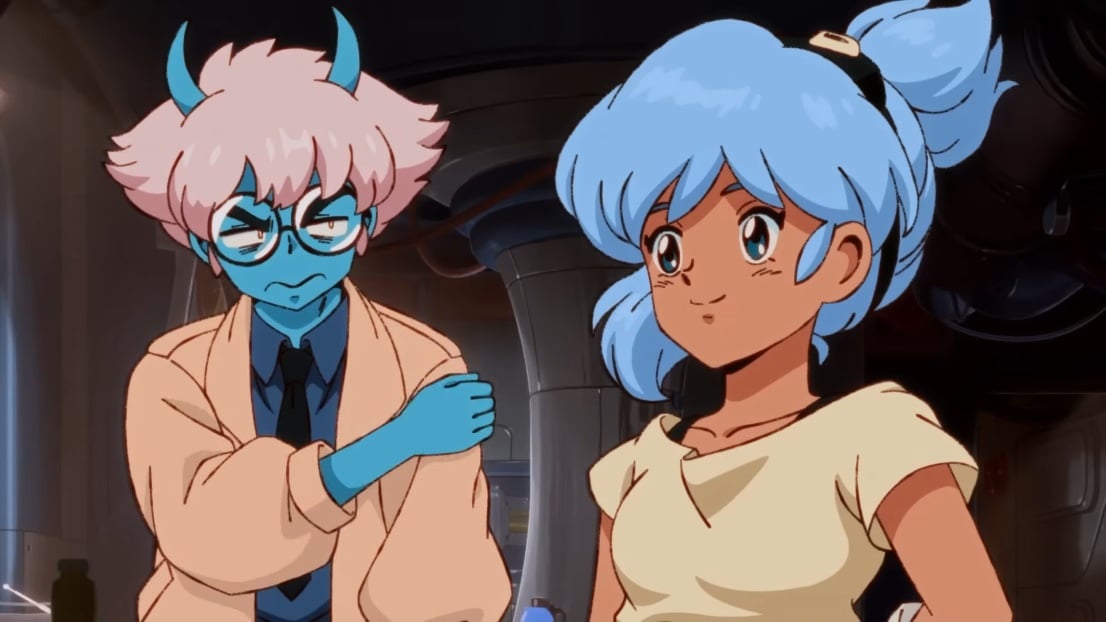
Orbitals has offered another look at its intergalactic adventure with the release of its opening movie and the announcement of its English and Japanese voice casts. The cinematic introduction leans proudly into the warmth, energy and visual personality of classic Japanese animation, establishing the mood of Maki and Omura’s journey before players even take control. Studio Massket, which has supported the production of several Japanese anime projects, worked on the opening and is also creating cinematic cutscenes that will appear throughout the game.
The story follows Maki and Omura, two young explorers who must leave their endangered station home after it becomes trapped inside a supernatural cosmic storm. Saving the Settlement will require them to fly beyond the storm wall, investigate abandoned stations, survive asteroid fields and solve problems that neither character can handle alone. Orbitals has been created specifically as an asymmetric two-player experience, with local split-screen, online multiplayer, Nintendo Switch 2 GameShare and the Orbitals Global Friend’s Pass providing several ways to form a team.
The newly announced cast gives the adventure another layer of personality. Rebecca Wang voices the determined mechanic Maki, while Stephen Fu plays the thoughtful cartographer Omura. Jonathan Ha, Cassie Ewulu and Brent Mukai portray other important figures encountered during the journey. Japanese performers include Risa Kageyama, Ryota Ōsaka, Masaaki Mizunaka, Mayumi Oda and Tatsuya Kobayashi. Orbitals is scheduled to launch exclusively for Nintendo Switch 2 on September 3, 2026.
Orbitals Opening Movie Brings Its Retro Anime Universe to Life
The opening movie for Orbitals immediately establishes that this is not simply a science-fiction adventure with a few anime-inspired decorations sprinkled on top. Its presentation embraces the expressive faces, dramatic framing, vivid cosmic scenery and energetic sense of motion associated with classic Japanese animation. Maki and Omura are introduced as small figures facing a universe that feels impossibly large, dangerous and inviting all at once. That contrast gives the sequence its emotional spark. Space may be filled with supernatural storms and forgotten stations, but the heart of the story rests with two close friends who refuse to abandon their home. The opening works like the first minutes of a television series you discovered on a quiet weekend morning, when one episode somehow became six. It gives players a taste of the personalities, relationships and looming dangers that will shape the adventure without explaining every mystery before the journey begins.
The movie also offers a clearer sense of the tone Shapefarm wants to achieve. Orbitals can be colourful, humorous and playful, yet its central situation carries genuine urgency. The Settlement is crumbling, a cosmic storm has cut it off from the wider universe and its inhabitants need help. Maki and Omura are not hardened veterans with decades of spaceflight experience behind them. They are young explorers relying on courage, improvised solutions and one another. That makes the enormous machinery, hostile environments and strange creatures around them appear even more intimidating. It also makes their determination easier to support. Who does not enjoy watching enthusiastic underdogs take on a problem far bigger than either of them expected?

Studio Massket Helps Shape the Game’s Hand-Crafted Cinematics
Studio Massket worked with the Orbitals team to create the opening animation and is contributing hand-crafted cinematic scenes that appear throughout the adventure. The studio has previously operated as a support team on Japanese anime productions, making it a fitting partner for a project that wants to capture the visual language of traditional animation rather than merely imitate its surface details. Shapefarm has explained that the teams worked closely together to preserve the nostalgic warmth associated with the medium while defining an original universe with its own characters, locations and rules. That distinction matters. Orbitals is not attempting to recreate one particular show or borrow another series’ identity. Instead, it draws from familiar artistic techniques and emotional rhythms to make a new world feel as though it might have been sitting on an old videotape all along, patiently waiting to be discovered.
The collaboration is especially important because cinematic scenes can carry emotional information that ordinary gameplay may not communicate as quickly. A glance between Maki and Omura can show years of friendship. A lingering shot of the Settlement can underline what the pair stands to lose. A sudden shift in scale can turn an asteroid field or supernatural phenomenon into something awe-inspiring. When those sequences share a consistent visual identity with the rest of the experience, they become more than rewards placed between playable sections. They help bind the journey together, giving major discoveries and character moments room to breathe before the next puzzle, narrow escape or questionable bit of improvised space engineering begins.
A Nostalgic Anime Style Built for a Brand-New World
Orbitals aims to recreate the feeling of classic anime without making nostalgia its only attraction. Its artwork uses bold silhouettes, expressive character animation and richly coloured science-fiction settings to create a universe that feels both familiar and fresh. The warmth comes from more than visual filters or deliberately aged effects. It can be seen in the human scale of the story, the close relationship between its heroes and the mixture of humour and danger that surrounds them. Maki and Omura may be travelling through space, but their conversations and occasional disagreements should remain recognisable to anyone who has tried to complete a difficult task with a close friend. One person has a plan, the other has a different plan and somehow the broken machine is now making an alarming noise. That is cooperation in its purest form.
The retro influence also gives Shapefarm an opportunity to present science fiction with a more tactile personality. Ships, tools and stations appear designed to be touched, repaired and occasionally struck until they behave. Rather than presenting a perfectly clean future filled with silent glass panels, Orbitals shows a world of mechanical parts, worn surfaces and equipment that seems to have a history. This helps the Settlement feel like a genuine home instead of a temporary backdrop. When the cosmic storm threatens that home, players have a stronger reason to care. They are not saving an abstract marker on a map. They are protecting a place filled with familiar faces, personal memories and probably at least one machine held together by optimism.
Voice Acting and Music Complete the Saturday Morning Feeling
The cinematic presentation is supported by full voice acting and an original soundtrack designed to channel the spirit of the era that inspired Orbitals. English and Japanese are among the available voiced languages, while additional language options broaden the number of players who can experience the personalities and emotional beats through spoken performances. Voice acting is particularly valuable in a story built around partnership. Maki and Omura need to feel like people who have known each other for most of their lives, not strangers who happened to receive matching mission objectives. Their timing, teasing, concern and frustration can make that history believable even during short exchanges. A strong performance can turn a simple warning into a moment of panic or transform a small joke into something players remember long after the puzzle has been solved.
Music has an equally important role. A sweeping theme can make a ship launch feel heroic, while quieter melodies can give abandoned stations an eerie sense of loneliness. Orbitals moves between intimate character scenes and large cosmic environments, so its soundtrack must support both ends of that spectrum. When the animation, acting and music work together, the result can evoke the sensation of watching the opening credits of an animated series and knowing an adventure is about to begin. The difference, of course, is that the controller is already in your hands and the person sitting beside you may soon be responsible for opening the wrong airlock.
Maki and Omura Face a Cosmic Storm Together
At the centre of Orbitals are Maki and Omura, two inseparable explorers raised together in the Settlement. Their home has become trapped inside a supernatural cosmic storm and is gradually falling apart, forcing them to venture beyond the storm in search of assistance. The task would be intimidating for seasoned professionals, let alone two adventurers with considerably more determination than experience. That imbalance gives the story both tension and charm. Maki and Omura are not travelling because they have every answer. They are travelling because remaining still would mean watching their home collapse around them. Their willingness to act, despite the dangers and uncertainty ahead, makes them easy heroes to support.
Maki is presented as a strong-headed mechanic and the youngest person living in the Settlement. Her practical skills and forceful personality suggest that she will often be the first to tackle a mechanical obstacle, particularly when patience starts running thin. Omura is a quieter cartographer who frequently becomes lost in his thoughts. He brings a more reflective temperament to the partnership, balancing Maki’s direct approach. Their contrasting personalities should create opportunities for humour and disagreement, but their shared history keeps the relationship grounded. They grew up together almost like twins, meaning their partnership is not simply a convenient arrangement created for the mission. It is the emotional foundation of the entire adventure.
Asymmetric Two-Player Co-op Places Teamwork First
Orbitals has been designed from the ground up as an asymmetric adventure for two players. Maki and Omura possess different tools and responsibilities, so each participant experiences the same situation from a distinct perspective. One player might operate machinery while the other searches for a route forward. One may need to manipulate an object that the other cannot reach, or relay information visible only from one side of an obstacle. The result is cooperation built around communication rather than two characters performing identical actions beside one another. Success depends on understanding what your partner can do, explaining what you can see and resisting the temptation to press the suspicious glowing button before discussing it.
This structure can make even familiar puzzle concepts feel more personal. A locked door is no longer an obstacle that one person solves while the other waits. It becomes a shared problem divided into connected tasks. Both players must contribute, and each should have moments when their particular ability becomes essential. That sense of mutual reliance is one of the strongest tools available to a cooperative adventure. A successful solution feels earned by the pair rather than delivered by the player who happened to recognise the answer first. It also creates memorable stories when communication breaks down spectacularly. Sometimes the best co-op moments are not flawless victories but recoveries from mistakes that absolutely, definitely belonged to the other person.
Local Split-Screen and Online GameShare Offer Flexible Play
Players will be able to experience Orbitals through local split-screen or online multiplayer. Local play allows both participants to share one Nintendo Switch 2 system and watch the adventure unfold from their respective viewpoints. This arrangement suits a game that encourages constant discussion, as both players can point at the screen, compare information and react to unexpected events in the same room. It also preserves the social energy associated with traditional couch co-op. Solving a difficult challenge together feels particularly satisfying when you can immediately celebrate with the person beside you instead of directing an enthusiastic cheer into a headset.
Online options include support for Nintendo Switch 2 GameShare and the Orbitals Global Friend’s Pass. GameShare can allow compatible games to be shared for multiplayer sessions, while the Friend’s Pass provides another route for bringing a partner into Orbitals without requiring both participants to own the complete game. Exact account, internet and Nintendo Switch Online requirements depend on the chosen online method, but the broader intention is clear: Shapefarm wants it to be relatively easy for owners to find someone and begin playing. That accessibility is important for an adventure built exclusively around two participants. The most brilliantly designed cooperative puzzle in the universe is not much use when your intended partner is stranded behind a purchase screen.
Character-Specific Tools Make Communication Essential
Maki and Omura use their own tools to open routes, overcome hazards and interact with the strange machinery encountered beyond the storm wall. Because their abilities are not interchangeable, players must learn how the two sets of equipment fit together. A tool that appears limited in isolation may become essential when combined with something controlled by the other character. This gives the puzzles room to evolve. Early situations can teach the basic relationship between abilities, while later areas can introduce distractions, environmental threats or multiple steps that test whether both players truly understand their roles.
Clear communication will be as important as quick reactions. Players may need to describe symbols, call out timing cues or explain changes happening on another part of the screen. The asymmetric design means one person may understand only half of the problem until their partner shares the missing information. That can create the pleasant spark of two separate observations suddenly connecting into one solution. It can also produce several minutes of confusion because someone described a hexagon as “the slightly round square.” Either way, both participants remain involved. Orbitals appears determined to make cooperation an active process rather than a setting selected from the main menu.
Exploring Beyond the Storm Wall Introduces New Dangers
The search for help takes Maki and Omura beyond the supernatural storm surrounding their home and into uncharted reaches of space. Their journey includes piloting a ship through hazardous asteroid fields, investigating mysterious abandoned stations and encountering unusual creatures and characters. These environments are more than colourful stops along a straight route. Each location can introduce its own mechanical challenges, visual identity and questions about what happened there. An empty station floating in darkness naturally invites curiosity, but entering it is another matter entirely. When the lights flicker and the doors close behind you, curiosity suddenly starts sounding like a questionable career choice.
Exploration also gives the adventure room to vary its pace. High-speed ship sequences can create urgency before a slower puzzle area asks both players to observe their surroundings carefully. Cinematic scenes can then provide story developments or reveal more about the wider universe before the next challenge begins. That rhythm is well suited to Orbitals’ animated influences, allowing energetic sequences and quieter character moments to support one another. The storm wall acts as both a physical obstacle and a narrative boundary. Crossing it means leaving the limited safety of home behind and entering a universe where the pair cannot predict who, or what, they will meet.
Orbitals English Voice Cast Gives the Settlement Its Personality
The announced English-language cast places Rebecca Wang in the role of Maki and Stephen Fu as Omura. Their performances will carry much of the adventure because the relationship between the two protagonists sits at the centre of the story. Wang must communicate Maki’s confidence, stubbornness and mechanical enthusiasm without losing the vulnerability of someone trying to save the only home she has known. Fu’s portrayal of Omura must complement that energy with a quieter and more thoughtful presence. Their exchanges will need to sound natural enough to suggest a lifelong bond, even when the characters are arguing over an improvised plan in the middle of a cosmic emergency.
Jonathan Ha voices Togen, the reserved leader of the Settlement. Cassie Ewulu plays Kinakoko, a loud and blunt mechanic whose kindness comes wrapped in a rough exterior. Brent Mukai portrays Jaga, an exuberant merchant encountered during Maki and Omura’s travels. Together, these characters can give the Settlement and wider universe a sense of community. The stakes become more meaningful when players recognise the people affected by the storm, understand their personalities and hear the concern behind their words. Jaga’s presence also suggests that not every encounter beyond the storm will involve silent ruins or immediate danger. A larger-than-life merchant can bring welcome humour, although experience tells us that enthusiastic space traders rarely offer their finest goods without asking for something unusual in return.
Japanese Voice Cast Adds Another Fully Voiced Option
The Japanese voice cast includes Risa Kageyama, Ryota Ōsaka, Masaaki Mizunaka, Mayumi Oda and Tatsuya Kobayashi, alongside additional performers. Their involvement supports the game’s close relationship with Japanese animation and gives players another way to experience its characters. The availability of multiple fully voiced languages is particularly fitting for a project developed by an international team in Tokyo and inspired by a medium enjoyed around the world. Rather than treating the Japanese track as a small optional extra, Orbitals presents its global casts as an important part of how the universe is brought to life.
Different performances can also change how familiar scenes feel. A character may sound more restrained in one language or express humour with slightly different timing in another. Players who enjoy replaying cooperative adventures may therefore have another reason to revisit the journey with a different voice setting. The visual storytelling remains the same, but the rhythm and emotional texture of conversations can shift. That flexibility complements a world designed to bridge influences from different places and periods. Orbitals may celebrate the spirit of older Japanese animation, but its cast and intended audience extend far beyond one country.
Orbitals Launches for Nintendo Switch 2 on September 3
Orbitals is scheduled to launch exclusively for Nintendo Switch 2 on September 3, 2026, with Kepler Interactive publishing Shapefarm’s cooperative adventure. The game supports two players on a single system and online, with Nintendo’s store listing also confirming compatibility with local and online GameShare. Its combination of asymmetric puzzles, cinematic storytelling, space exploration and retro anime presentation gives it a distinct place in the Nintendo Switch 2 line-up. Rather than adding cooperative play to an otherwise solo structure, every major element appears to have been built around the relationship between Maki and Omura.
The opening movie and cast announcement offer a clearer picture of what players can expect from the finished experience. This is a journey driven by friendship, communication and the determination to protect a threatened home. Studio Massket’s cinematics give that journey an animated identity, while the English and Japanese casts provide voices for the heroes and communities at its centre. There are still plenty of mysteries beyond the storm wall, but the direction is now easy to understand. Grab a partner, decide who is better at reading maps and prepare to discover whether either of you can follow instructions when an asteroid field starts filling the screen.
Conclusion
Orbitals is shaping up as a strongly defined two-player adventure that understands the appeal of both classic anime and cooperative problem-solving. Its opening movie captures the colourful energy and emotional warmth of its inspirations, while Studio Massket’s involvement gives the cinematic sequences an authentic hand-crafted quality. Maki and Omura provide a likeable centre for the story, with their contrasting personalities and lifelong friendship supporting both the narrative and the asymmetric gameplay. The announced voice actors further strengthen the Settlement and the unusual characters waiting beyond the storm.
Most importantly, cooperation is woven into the game’s foundation. Local split-screen, online multiplayer, GameShare and the Global Friend’s Pass give players several ways to team up, but communication will still determine whether that partnership succeeds. Every tool, puzzle and dangerous journey through space appears designed to remind both participants that neither hero can save the Settlement alone. When Orbitals arrives for Nintendo Switch 2 on September 3, 2026, players will be able to find out whether their friendship can survive cosmic storms, abandoned stations and the timeless co-op question: who was supposed to press the button?
FAQs
- When will Orbitals be released for Nintendo Switch 2?
- Orbitals is scheduled to launch exclusively for Nintendo Switch 2 on September 3, 2026.
- Can Orbitals be played alone?
- Orbitals has been designed as a two-player cooperative adventure. Its puzzles, tools and asymmetric challenges require Maki and Omura to work together.
- Does Orbitals support local and online multiplayer?
- Yes. Two players can play through local split-screen or online. The game also supports Nintendo Switch 2 GameShare and the Orbitals Global Friend’s Pass.
- Who voices Maki and Omura in English?
- Rebecca Wang voices Maki, while Stephen Fu provides the English voice of Omura.
- Who created the animated cutscenes for Orbitals?
- Studio Massket worked with Shapefarm on the opening animation and hand-crafted cinematic cutscenes used throughout the game.
Sources
- Orbitals – Coming to Nintendo Switch 2 in 2026, Orbitals, July 6, 2026
- Pre-order Available – Orbitals, Nintendo, June 22, 2026
- Orbitals – Nintendo Switch 2 Exclusive, Nintendo, June 2026
- Orbitals Opening Movie Released and Voice Cast Announced, Nintendo Everything, July 6, 2026
- Orbitals Opening Animation Unveiled, My Nintendo News, July 6, 2026