














Summary:
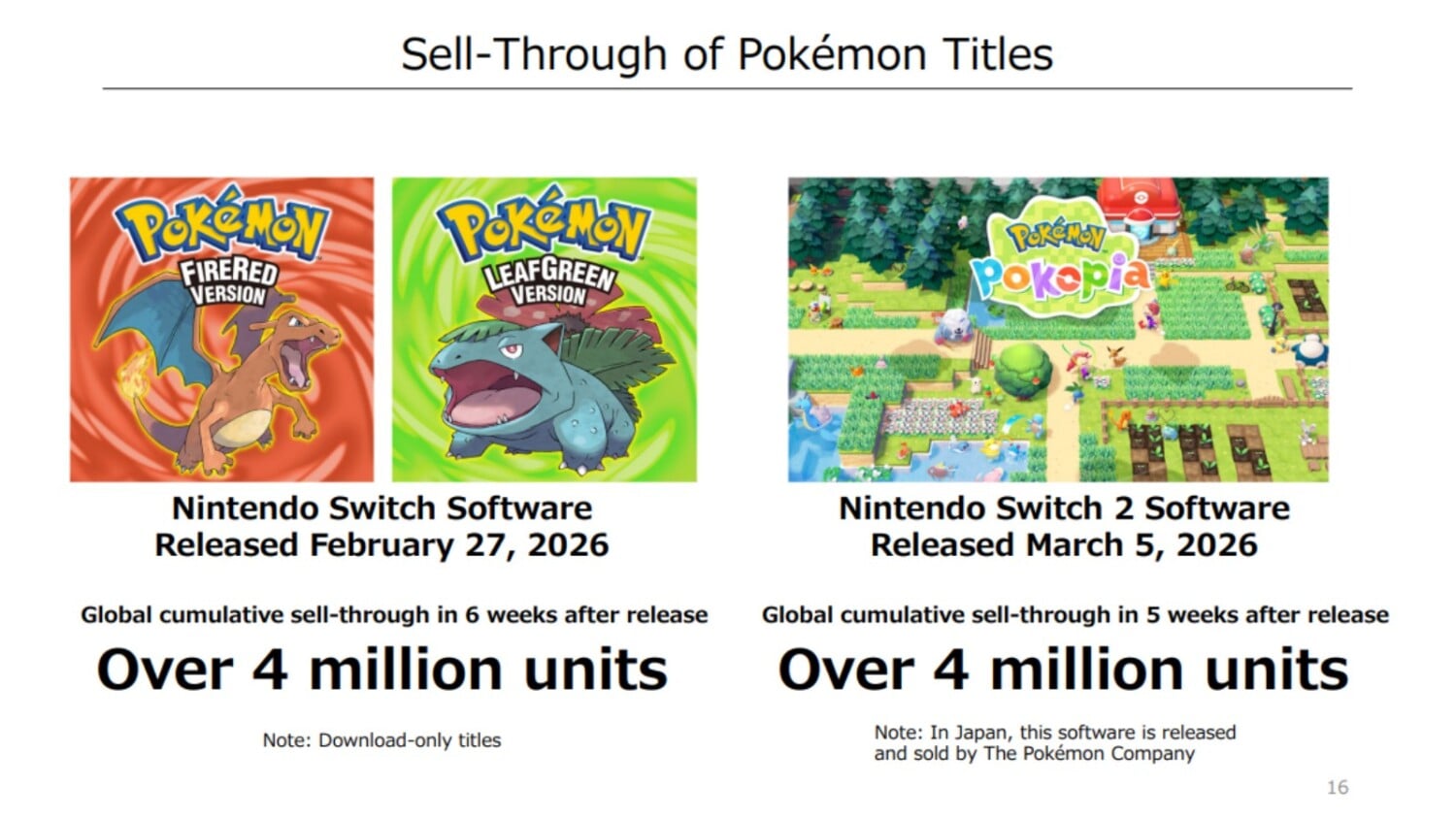
Nintendo’s latest financial results have given Pokémon fans a clearer look at how strongly the franchise is performing across both Nintendo Switch and Nintendo Switch 2. Pokémon Pokopia, released for Nintendo Switch 2 on March 5, 2026, has already passed 4 million units in global sell-through within its first five weeks. That is a striking early result for a Switch 2 exclusive, especially because Pokopia takes the franchise in a softer, cozy life-sim direction rather than leaning on the traditional mainline formula. At the same time, Pokémon FireRed and Pokémon LeafGreen have shown that nostalgia remains a powerful force, with their Nintendo Switch re-releases together passing 4 million units in global sell-through within six weeks. The figures are especially interesting when placed next to Pokémon Legends Z-A. Nintendo’s data lists Pokémon Legends Z-A at 3.94 million units on Nintendo Switch 2 and 8.85 million units on Nintendo Switch, meaning the newer Switch 2 ecosystem is already capable of producing major sales moments, while the original Switch still carries huge weight. Together, these results paint a clear picture: Pokémon can thrive through brand-new experiments, beloved classics, and cross-platform releases all at once.
Pokémon Pokopia reaches a major early sales milestone
Pokémon Pokopia has quickly become one of the most interesting early success stories on Nintendo Switch 2. Nintendo’s latest financial results state that the game passed 4 million units in global cumulative sell-through within its first five weeks after releasing on March 5, 2026. That is a strong number by almost any standard, but it feels even more notable because Pokopia is not a traditional Pokémon adventure built around gym battles, badges, or a familiar creature-collecting journey. Instead, it leans into a cozier rhythm, the kind of game where the appeal seems to come from settling in, building a space, interacting with Pokémon, and enjoying a gentler kind of loop. In other words, Pokopia appears to be catching players who may not always rush toward the more competitive or story-heavy side of the series. That makes the sales figure feel less like a fluke and more like a sign that Pokémon still has room to stretch its legs in fresh directions.
FireRed and LeafGreen prove classic Pokémon still has serious pull
While Pokopia shows the strength of a newer idea, Pokémon FireRed and Pokémon LeafGreen show the staying power of the series’ past. Nintendo’s financial materials confirm that the Nintendo Switch versions of FireRed and LeafGreen passed 4 million units in global cumulative sell-through together within their first six weeks. These games originally carried players back to Kanto with a Game Boy Advance remake of the earliest Pokémon adventures, and their return on Switch seems to have struck exactly the right nostalgic chord. For many players, FireRed and LeafGreen are not just old games. They are comfort food. They are that familiar route music, that first starter choice, and the feeling of walking into tall grass while hoping something exciting appears. Nintendo did not need to reinvent these releases to make them matter. The company simply put two beloved Pokémon experiences in front of a huge modern audience, and the audience responded with wallets open and Poké Balls ready.
Why Pokopia’s Switch 2 performance stands out
Pokopia’s 4 million figure stands out because it belongs entirely to Nintendo Switch 2, a newer platform that is still building out its library and audience compared with the original Switch. That detail matters. A game selling well on a huge established install base is impressive, but a game selling more than 4 million units early in the life of a newer system says something different. It suggests that Pokopia is not just riding the Pokémon name. It is also helping define what Switch 2 can offer. Nintendo has specifically highlighted that many players are using features such as GameShare, which are exclusive to Nintendo Switch 2. That gives Pokopia a useful role beyond raw sales. It becomes a showcase piece, a game that can say, “Here is why this new hardware changes how you play with others.” For a franchise as familiar as Pokémon, that kind of platform-specific identity is valuable.
Pokopia’s cozy direction gives the series a wider doorway
One of the most important parts of Pokopia’s early success is the kind of player it seems designed to welcome. Nintendo has said the game is being picked up by a broad range of players regardless of gender, and that detail fits the game’s softer tone. Not everyone comes to Pokémon for battle strategy, ranked competition, or a grand region-saving storyline. Some players want to decorate, explore, relax, and spend time with their favorite creatures without feeling like they are racing against a rival every few minutes. Pokopia appears to understand that. It gives Pokémon a wider doorway, one that can invite younger players, casual fans, returning fans, and people who simply enjoy warm, low-pressure play. Think of it like opening a side gate into the same beloved garden. The flowers are familiar, the creatures are familiar, but the path through it feels calmer and more personal.
GameShare and Switch 2 features appear to be helping adoption
Nintendo’s mention of GameShare is worth paying attention to because it shows how Pokopia may be doing more than selling copies. It may also be teaching players how Nintendo Switch 2 is different. New hardware features can sound nice on a spec sheet, but they become meaningful when a popular game gives people a reason to use them. Pokopia seems to be doing exactly that. When a Pokémon release encourages players to try platform-specific sharing features, it gives Nintendo a softer, friendlier way to show off the system’s capabilities. That is much easier to understand than a technical chart. Players do not need a lecture on hardware design. They just need a moment where they can say, “Oh, that’s useful,” while playing something they already care about. Pokopia’s early numbers suggest that this approach is landing well.
How Pokopia compares with Pokémon Legends Z-A on Switch 2
The comparison between Pokopia and Pokémon Legends Z-A is where the sales picture becomes especially interesting. Nintendo’s figures list Pokémon Legends Z-A at 3.94 million units on Nintendo Switch 2, while Pokopia passed 4 million units within five weeks on the same platform. That puts Pokopia slightly ahead on Switch 2 specifically, which is a meaningful achievement for a spin-off style release. However, the comparison needs a little care. Pokémon Legends Z-A is not underperforming overall. Its sales are split across platforms, and the original Switch version accounts for a much larger figure. Still, Pokopia’s Switch 2-only result shows that the new system can support major Pokémon success without leaning on a cross-generation release. That is a nice feather in its cap. Maybe not a giant Legendary Pokémon feather, but still a pretty impressive one.
Pokémon Legends Z-A remains stronger across the wider Switch family
Pokémon Legends Z-A remains a major performer when the full Switch family is considered. Nintendo’s financial materials list the Nintendo Switch version at 8.85 million units and the Nintendo Switch 2 version at 3.94 million units. Together, that gives Legends Z-A a much larger total than Pokopia’s reported Switch 2 figure. This distinction is important because it keeps the comparison fair. Pokopia is shining brightly on Switch 2, while Legends Z-A is benefiting from the massive reach of the original Switch as well as the newer system. The result is not really a winner-takes-all story. It is more like two different kinds of success sitting at the same table. One shows the power of a new exclusive concept on fresh hardware. The other shows the continuing strength of a major Pokémon release across a much broader player base.
What these results say about Nintendo’s release strategy
Nintendo’s Pokémon results suggest a smart mix of old and new. On one side, Pokopia gives Switch 2 an exclusive Pokémon release with a distinct identity. On the other, FireRed and LeafGreen give Switch owners access to two deeply familiar classics that many fans already trust. That combination is hard to ignore because it reaches different emotional buttons at the same time. Fresh curiosity brings people to Pokopia. Nostalgia brings people to FireRed and LeafGreen. Together, they create a Pokémon lineup that does not rely on one kind of fan. Some players want something they have never tried before. Others want to revisit the game that defined their childhood. Many want both, because of course they do. Pokémon has always been good at turning small choices into big feelings, and Nintendo’s release strategy seems to understand that perfectly.
Old favorites and fresh ideas are working side by side
The success of Pokopia and FireRed and LeafGreen shows that Nintendo does not have to choose between innovation and nostalgia. The two can support each other. Pokopia gives the franchise a different shape on Switch 2, showing that Pokémon can feel warm, flexible, and socially inviting without following the usual structure. FireRed and LeafGreen, meanwhile, remind players why Kanto still holds such a firm place in the series’ heart. When both approaches pass 4 million units in roughly the same early sales window, it sends a simple message: the Pokémon audience is not one single crowd with one single desire. It is a huge mix of players with different histories, habits, and expectations. Some want the comfort of a familiar journey. Others want a new way to live alongside Pokémon. Nintendo is giving both groups something to enjoy.
Download-only releases can still create major commercial moments
The FireRed and LeafGreen re-releases are also notable because Nintendo’s financial materials describe them as download-only titles. That makes their 4 million combined sell-through figure even more impressive, because there is no physical box sitting on a store shelf doing the nostalgic heavy lifting. The appeal comes from convenience, familiarity, and the enormous strength of the Pokémon name. Digital re-releases can sometimes feel quieter than big boxed launches, but these numbers show they can still become major commercial moments when the timing, platform, and brand are right. For players, it is simple: a beloved Pokémon classic appears on a modern system, and suddenly returning to Kanto is only a few button presses away. That kind of easy access is powerful. Nostalgia becomes even stronger when there is no cartridge drawer to search through.
The bigger meaning for Pokémon on Nintendo Switch 2
Pokopia’s performance gives Nintendo Switch 2 a valuable early proof point for Pokémon. The platform does not only need ports, upgrades, or familiar franchise entries to build momentum. It can also support a dedicated Pokémon experience that feels tailored around the system’s social features and broader audience goals. That matters for the future of the franchise on the hardware. If Pokopia can pass 4 million units in five weeks with a gentler concept, Nintendo and The Pokémon Company may feel more confident exploring other formats on Switch 2. Not every Pokémon game needs to chase the same structure. Some can be playful experiments. Some can be classics brought forward. Some can be ambitious mainline-style releases that bridge generations. The exciting part is that all of these lanes appear viable right now, and that gives Pokémon plenty of room to grow.
Conclusion
Nintendo’s latest Pokémon sales figures show a franchise firing on multiple cylinders. Pokémon Pokopia passing 4 million units within five weeks on Nintendo Switch 2 is a major early win for a softer, cozier kind of Pokémon experience. FireRed and LeafGreen reaching the same milestone together within six weeks proves that classic Pokémon adventures still have serious commercial power, especially when made easily available on modern hardware. Pokémon Legends Z-A adds another layer to the story, with stronger total momentum across both Nintendo Switch and Nintendo Switch 2. Put together, these results show a brand that can move forward, look backward, and still bring players along for the ride. That is the magic trick Pokémon keeps pulling off. Somehow, whether we are meeting something new or returning to an old favorite, it still feels like there is another patch of tall grass worth exploring.
FAQs
- How many units has Pokémon Pokopia sold?
- Pokémon Pokopia passed 4 million units in global cumulative sell-through within its first five weeks after releasing for Nintendo Switch 2 on March 5, 2026.
- How many units did Pokémon FireRed and LeafGreen sell on Switch?
- The Nintendo Switch re-releases of Pokémon FireRed and Pokémon LeafGreen together passed 4 million units in global cumulative sell-through within their first six weeks.
- Is Pokémon Pokopia selling better than Pokémon Legends Z-A on Switch 2?
- On Nintendo Switch 2 specifically, Pokopia has passed 4 million units, while Nintendo’s figures list Pokémon Legends Z-A at 3.94 million units on the same platform. Pokémon Legends Z-A has a much higher total when its original Switch version is included.
- Why is Pokémon Pokopia’s sales performance important?
- Its performance matters because it shows that a Switch 2-exclusive Pokémon experience with a cozy, social direction can reach a large audience quickly, rather than relying only on the traditional Pokémon formula.
- What do these figures suggest about Pokémon’s future on Switch 2?
- They suggest that Pokémon has room to succeed on Switch 2 through different formats, including new exclusive ideas, classic re-releases, and larger cross-platform entries.
Sources
- Financial Results Explanatory Material – Fiscal Year Ended March 2026, Nintendo, May 8, 2026
- Financial Results Explanatory Material, Nintendo, May 8, 2026
- Pokemon Pokopia And FireRed/LeafGreen Switch Release Both Cross 4 Million Units Sold Worldwide, NintendoSoup, May 8, 2026
- Pokopia is already in the top 5 best-selling Pokemon spin-offs of all time, GamesRadar+, May 8, 2026
- Pokémon Pokopia Has Sold Through Over 4 Million Units, Insider Gaming, May 8, 2026