














Summary:
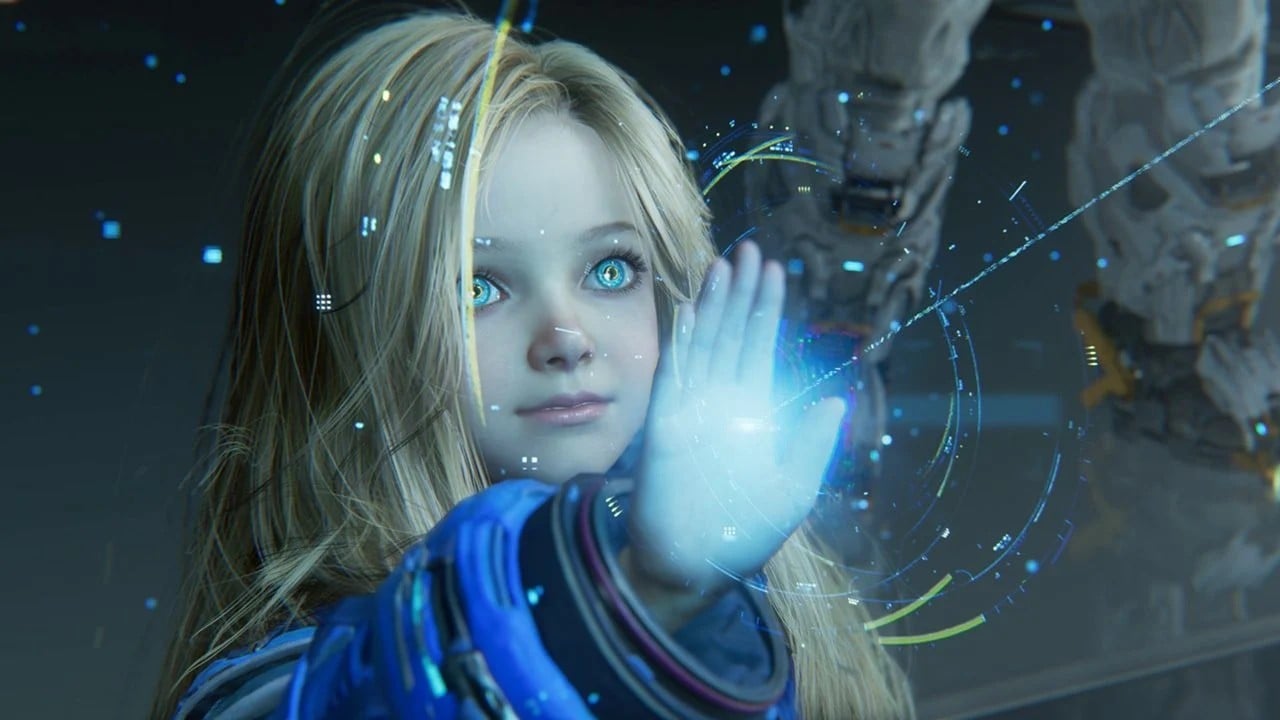
Pragmata’s Diana is immediately recognizable thanks to her exceptionally long blonde hair, but that defining feature nearly disappeared during development. At the 2026 Computer Entertainment Developers Conference, Capcom animation department members Kenji Irie and Serina Ohara discussed the work behind the game’s character models, including the demanding process used to animate Diana’s hair. The team originally considered replacing her flowing hairstyle with a much shorter bob cut because of the technical and financial burden involved in producing it.
Rather than relying on traditional hair cards, which use textured polygonal surfaces to create the appearance of hair, Pragmata renders Diana’s hairstyle using individually simulated strands. A conventional hair-card setup would have required only 22 animation joints. Capcom’s strand-based approach instead produced roughly 430,000 animation points, dramatically increasing the amount of work needed to create, adjust, simulate, and process every movement.
Capcom even built a prototype version of Diana with a bob cut to determine whether a shorter style could lower production costs. The idea was ultimately abandoned because her long hair contributed too much to her personality, silhouette, and role within Pragmata’s lunar adventure. It also brings movement to scenes in which players spend long periods looking at the back of the character. Although Diana has fewer than 20,000 rendered strands, each one was carefully arranged to make her hairstyle appear natural, lively, and suitably eccentric.
Diana’s Pragmata Hairstyle Almost Changed During Development
Diana’s long blonde hair has become one of the most recognizable visual elements in Pragmata. It flows behind her as she travels across the Moon with Hugh Williams, giving the young android an almost weightless appearance that fits the game’s distant lunar setting. Yet that familiar design was not guaranteed to survive production. Capcom seriously considered cutting her hair into a bob because the original hairstyle placed an unusually heavy burden on the development team. This wasn’t merely a matter of artists spending a few extra afternoons adjusting loose strands. Diana’s hair required a complicated animation system involving hundreds of thousands of moving points, making it significantly more expensive to build and process than a conventional hairstyle. The proposal reached the prototype stage, meaning players came surprisingly close to meeting a very different version of Diana.
Capcom Reveals the Story at CEDEC 2026
The story behind Diana’s hairstyle emerged during CEDEC 2026, where Capcom animation department members Kenji Irie and Serina Ohara presented a development case study focused on Pragmata. Their presentation examined how the studio created the game’s character models, with particular attention given to facial expressions and hair movement. These details may seem small beside Pragmata’s science-fiction environments and combat systems, but they play an enormous role in making its characters believable. A face can communicate fear, trust, or uncertainty without a single spoken word, while convincing hair movement helps prevent a character from looking like a plastic model being pushed through a scene. Diana presented an especially difficult challenge because her hair is almost as long as she is tall, leaving Capcom with a choice between technical convenience and a design that better represented her personality.
Why Diana’s Long Hair Created a Technical Challenge
Long hair is notoriously difficult to animate because it rarely behaves as one simple object. It bends, twists, separates, collides with clothing, and reacts to every movement the character makes. Add changes in direction, combat animations, environmental motion, and camera positioning, and those golden locks quickly become a developer’s version of trying to untangle holiday lights in the dark. Diana’s hairstyle presented all of these problems on a much larger scale. Her hair needed to move naturally while avoiding distracting clipping errors, unnatural stretching, or strands passing through her body. The team also had to preserve a consistent silhouette so that she remained recognizable from different angles. Every additional layer of simulation increased the production burden, particularly when the animation needed to work reliably across several hardware platforms, including Nintendo Switch 2.
Individual Hair Strands Required Around 430,000 Animation Points
Many games create hairstyles through hair cards, which are flat polygonal surfaces covered with transparent hair textures. When several cards are layered together, they can produce the appearance of a full hairstyle without requiring every strand to exist as separate geometry. This approach is efficient, flexible, and widely used, particularly when developers need to balance visual quality with performance. Capcom chose a much more demanding method for Diana. Pragmata renders her hair through individually represented strands, allowing it to flow, separate, and bend with a greater sense of physical detail. According to the developers, a hair-card version would have needed only 22 animation joints. The individual-strand system generated roughly 430,000 animation points. That difference is staggering. It transforms the hairstyle from a manageable accessory into a dense animated system requiring considerable production, simulation, and processing resources.
A Bob Cut Prototype Offered a More Affordable Alternative
Faced with those costs, Capcom explored a practical solution: give Diana much shorter hair. The studio discussed changing her hairstyle during the concept art phase and created a prototype model with a bob cut. A shorter style would naturally reduce the amount of hair requiring simulation, potentially lowering the time and resources needed for modelling, animation, testing, and performance adjustments. From a strictly technical perspective, the bob made plenty of sense. It would have been easier to control, less likely to collide with Diana’s clothing, and simpler to display during complicated movement. Game development is filled with these compromises, where a striking idea must prove that it deserves the resources required to bring it to life. In Diana’s case, however, the cheaper option solved a production problem while creating a new creative one.
Diana’s Long Hair Became Part of Her Personality
The developers ultimately decided that the bob cut did not communicate Diana’s character as effectively as the original design. Her long blonde hair supports her youthful appearance while adding a playful, slightly unusual quality that matches her outgoing and occasionally eccentric personality. A hairstyle can tell us a surprising amount about a character before they speak. Diana’s flowing hair makes her look energetic and free-spirited, while its exaggerated length gives her a distinctive silhouette that separates her from more conventional science-fiction companions. The bob version may have been technically efficient, but efficiency alone doesn’t create a memorable character. Capcom concluded that Diana’s original hairstyle strengthened her identity and reinforced the contrast between her innocent appearance and the dangerous situation surrounding her. Removing it would have saved resources, but it also would have removed some of the visual charm that makes her feel unique.
Hair Movement Helps Bring the Lunar Setting to Life
Diana’s hair was also retained because of what it contributes to Pragmata’s lunar atmosphere. The developers wanted its movement to convey a sense of life on the Moon, an environment that might otherwise feel cold, mechanical, and empty. Her hair provides constant organic motion against metallic corridors, artificial structures, and the vast stillness of space. It ripples and shifts as she moves, almost functioning like a visual heartbeat within the setting. That contrast matters. Without small signs of motion, a futuristic environment can easily appear sterile or lifeless. Diana’s hairstyle softens that impression and makes her presence feel warmer. It also strengthens the idea that she is a young girl pulled into an adventure she wasn’t prepared to face. The long hair may be technically artificial, just like Diana herself, but its movement gives her an unmistakable sense of vitality.
The Player’s Camera Influenced Diana’s Final Design
Capcom also considered how often players would see Diana from behind. During large portions of Pragmata, the camera gives players a clear view of the back of her head while she accompanies Hugh. That perspective made her hairstyle more than a decorative detail shown during conversations or cinematic scenes. It became one of the visual elements players would observe throughout much of the adventure. A static or understated hairstyle could have made those views feel repetitive, particularly across long stretches of exploration. Diana’s flowing hair gives the screen continuous movement, reacting to her actions and helping each step feel more animated. It is similar to a cape in a superhero game, where the fabric adds energy even when the character is simply running forward. Because Diana remains close to the camera, the quality of that movement directly affects how polished and alive the entire experience feels.
Capcom Used Fewer Than 20,000 Individual Strands
Although Diana’s hair is animated through a strand-based system, Capcom did not attempt to recreate the exact number of hairs found on a human head. An average person has roughly 100,000 hairs, while Diana’s model contains fewer than 20,000 individually rendered strands. That reduction demonstrates how digital character creation often relies on carefully controlled illusion rather than literal replication. Artists don’t necessarily need to reproduce every physical detail. They need enough well-placed detail to convince the viewer that the character is believable. Diana’s strands were adjusted and arranged to create the impression of volume while preserving the shape and movement of her hairstyle. Each strand had to contribute to the final result without adding unnecessary complexity. It is a careful balancing act, where too little hair can look thin and artificial, but too much can waste processing resources without producing a noticeable improvement.
Natural Movement Required Careful Artistic Control
Rendering thousands of strands is only part of the challenge. The hair still needs to behave in a way that suits Diana rather than moving like an uncontrolled bundle of cables. Capcom’s artists carefully adjusted the strands to create a natural appearance while preserving the lively character of her design. Perfect realism was not necessarily the goal. Diana’s hairstyle needed to look physically convincing, but it also had to express her personality through slightly exaggerated motion and shape. This is where technical animation and artistic judgement meet. A simulation can calculate how hair should fall, yet an artist decides whether that result feels appealing on screen. The team needed to prevent the hairstyle from becoming too chaotic during movement while ensuring it never looked stiff. That balance allows Diana’s hair to remain visually active without constantly distracting players from exploration, combat, or the story unfolding around her.
Pragmata Shows How Technical Choices Shape Character Design
Diana’s near-transformation offers a revealing look at how character designs evolve during game production. Concept art can suggest almost anything, but every idea eventually meets the realities of modelling, animation, processing power, schedules, and budgets. Something as apparently simple as hair can affect several departments and create months of additional work. Developers must then decide whether the creative value justifies that effort. In this case, Capcom tested an alternative instead of immediately abandoning the original idea. The bob cut prototype allowed the team to compare the practical benefits of shorter hair with the emotional and visual qualities of the longer design. That process helped prove that Diana’s hairstyle was not an unnecessary flourish. It contributed to her identity, supported the game’s atmosphere, improved the player’s view during gameplay, and strengthened her role within the lunar setting.
The More Efficient Design Was Not Necessarily the Better Design
The decision to keep Diana’s long hair highlights an important truth about visual development: the least expensive solution isn’t always the one players will remember. A bob cut could still have produced an appealing character, but it would have changed the way Diana appears in nearly every scene. Her silhouette would be smaller, her movement less pronounced, and her presence against the Moon’s rigid architecture more restrained. Capcom believed those losses outweighed the savings. This doesn’t mean production costs were ignored. The team still reduced and arranged the strand count carefully, showing that the final result involved compromise rather than unlimited technical ambition. What matters is where that compromise was made. Instead of changing the central idea, the developers refined the technology supporting it. Diana kept the hairstyle that suited her, while the team found a manageable way to create the desired effect.
Diana’s Hair Remains a Defining Part of the Finished Game
With Pragmata now available on Nintendo Switch 2 and other supported platforms, players can see the result of Capcom’s decision throughout the finished adventure. Diana’s long blonde hair follows her through the lunar facility, providing movement, personality, and a striking contrast with the surrounding machinery. Most players may never stop to count strands or think about the hundreds of thousands of animation points working behind the scenes. They simply see a character whose appearance feels right. That invisible technical effort is often the mark of effective animation. The system is complicated, but the result appears effortless. Knowing that Diana almost received a bob cut makes her final look even more interesting. Her hairstyle isn’t merely a concept artist’s decorative choice. It survived technical concerns, cost discussions, prototype testing, and performance demands because Capcom believed it was fundamental to who Diana is.
Conclusion
Diana’s hairstyle came surprisingly close to being shortened, but Capcom ultimately chose character identity over the most convenient technical solution. Animating her long hair with individual strands required around 430,000 animation points, compared with only 22 joints for a traditional hair-card approach. That enormous difference led the team to create and evaluate a bob cut prototype during development. The shorter design could have reduced production costs, yet it failed to provide the same personality, movement, and visual connection to Pragmata’s lunar world. By keeping fewer than 20,000 carefully arranged strands, Capcom found a balance between visual ambition and practical performance. The finished hairstyle gives Diana a recognizable silhouette, keeps the player’s view visually active, and helps a cold science-fiction environment feel more alive. Sometimes an expensive head of hair really does earn its place.
FAQs
- Why did Capcom consider giving Diana a bob cut?
- Capcom considered shortening Diana’s hair because animating her long hairstyle with individual strands significantly increased production, simulation, and processing costs. A bob cut would have reduced the amount of hair that needed to be created and controlled.
- How many animation points does Diana’s hair use?
- Diana’s strand-based hairstyle uses roughly 430,000 animation points. Capcom explained that a more conventional hair-card system would have required only around 22 animation joints.
- How many individual hair strands are included in Diana’s model?
- Diana’s model contains fewer than 20,000 individually rendered strands. These were carefully positioned and adjusted to create the appearance of a full, natural hairstyle without reproducing every hair found on a real human head.
- Why did Capcom keep Diana’s long hair?
- The developers believed her long blonde hair was important to her youthful, outgoing, and occasionally eccentric personality. Its movement also helped create a sense of life within Pragmata’s lunar environment.
- Is Pragmata available on Nintendo Switch 2?
- Yes. Pragmata is available for Nintendo Switch 2. It is a single-player science-fiction action-adventure following Hugh Williams and the android girl Diana on the Moon.
Sources
- Pragmata Developers Considered Giving Diana a Bob Cut to Reduce Rendering Costs, Automaton, July 30, 2026
- Development Examples of Hair and Facial Expressions in Pragmata, CEDEC 2026, July 2026
- PRAGMATA Official Website, Capcom, 2026
- PRAGMATA Nintendo eShop Listing, Nintendo, April 2026
- Pragmata Surpasses One Million Units Worldwide, Capcom, April 20, 2026