














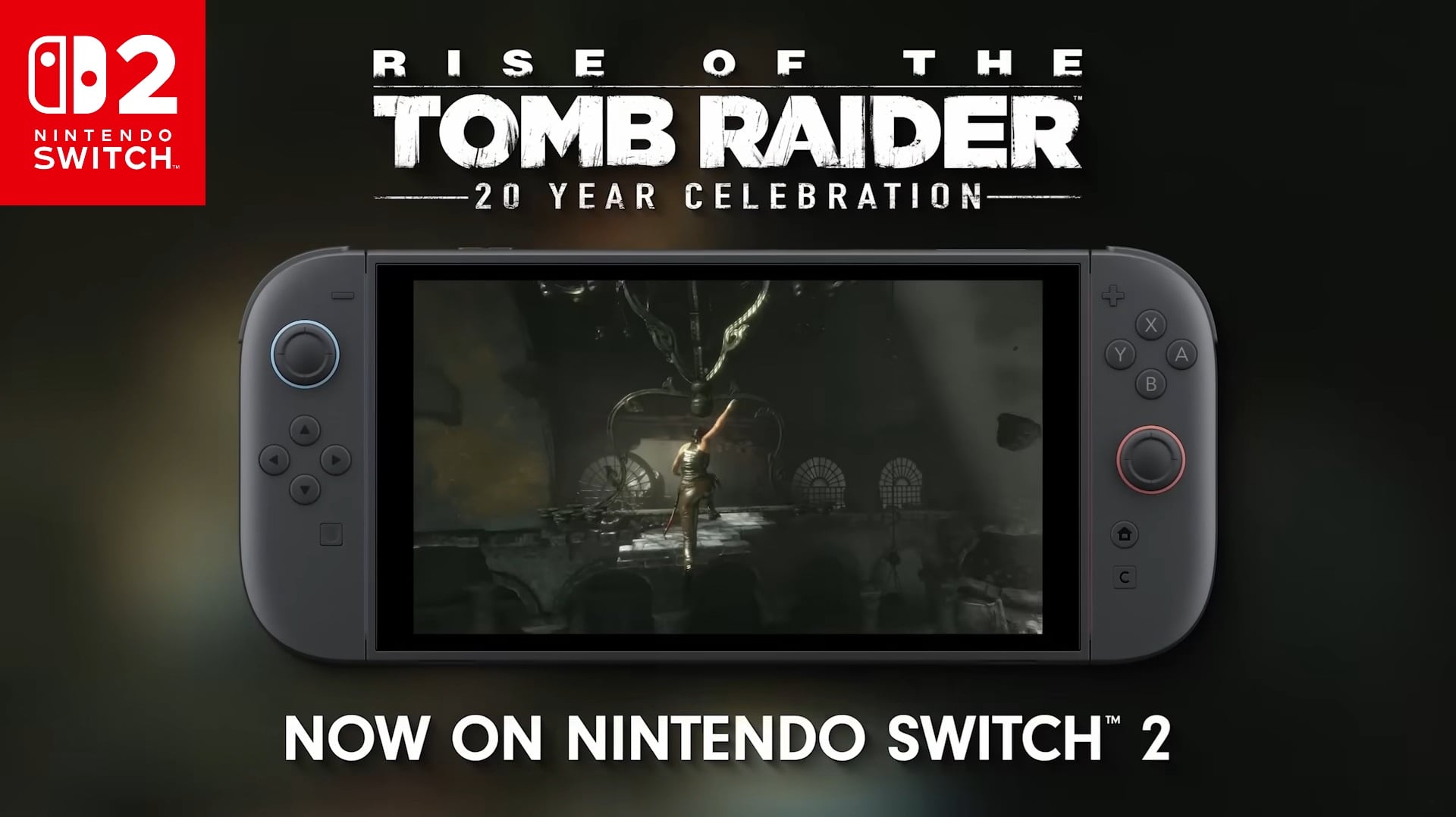
Summary:
Rise of the Tomb Raider: 20 Year Celebration has brought the second chapter of Lara Croft’s Survivor Trilogy to Nintendo hardware for the first time. Announced and released for Nintendo Switch 2 during the June 2026 Nintendo Direct, the launch follows Aspyr’s earlier release of Tomb Raider: Definitive Edition on Nintendo Switch and Nintendo Switch 2. This complete edition includes the main adventure alongside the downloadable expansions, additional outfits, weapons, challenge modes and other previously released extras.
Aspyr product manager Anna Grant and senior game producer Kay Gilmore have now explained how the team approached the conversion. According to the developers, running such a visually demanding game on a portable platform required considerable optimization. Rise of the Tomb Raider targets 30 frames per second on Nintendo Switch 2 after months of experiments with a possible 60 FPS mode. Although the higher frame rate could sometimes be reached, maintaining it consistently would have required substantial reductions to visual quality and could have caused stuttering during demanding action sequences.
The developers also considered bringing the adventure to the original Nintendo Switch. That version was abandoned because it would have required removing or heavily reducing fog, particles, snow effects, vegetation and environmental detail. Aspyr felt those sacrifices would change too much of the experience. Gyro aiming remains another popular request, and while no update has been promised, the studio says it is discussing the feature. Aspyr has also expressed enthusiasm for further Nintendo projects, although Shadow of the Tomb Raider has not been confirmed for Nintendo Switch 2.
Rise of the Tomb Raider Expands the Switch 2 Library
Rise of the Tomb Raider: 20 Year Celebration is now available on Nintendo Switch 2, finally giving Nintendo players access to the middle chapter of Lara Croft’s modern origin story. Its arrival came with a pleasant dose of surprise because the game was announced and released during the same Nintendo Direct. There was no lengthy countdown, no trail of mysterious social media posts and no opportunity for Lara’s latest expedition to become buried beneath months of speculation. One moment it was absent from the system, and the next it was waiting in the Nintendo eShop.
The release follows Tomb Raider: Definitive Edition, which brought the opening chapter of the Survivor Trilogy to both Nintendo Switch systems. Rise builds upon that foundation with larger environments, more elaborate tombs, expanded crafting and a stronger focus on exploration. Lara travels into the frozen Siberian wilderness in pursuit of the Divine Source, an ancient object associated with immortality. Naturally, she isn’t the only person searching for it. The organization known as Trinity is also on the trail, turning the expedition into a dangerous race through snow-covered ruins, military installations and forgotten underground chambers.
Aspyr Reveals the Work Behind the Nintendo Switch 2 Port
Bringing an older game to newer hardware may sound simple from the outside. Surely the developers press a large button marked “Switch 2,” wait for a progress bar and celebrate with cake, right? The reality is considerably less convenient. Aspyr explained that porting Rise of the Tomb Raider involved a substantial amount of work, particularly because the team wanted to preserve the qualities that made the original release memorable while adapting it to a portable system.
The studio’s primary objective was to remain faithful to the original experience. That meant retaining the dense environments, atmospheric lighting, weather effects and cinematic presentation rather than producing a noticeably stripped-down conversion. Nintendo Switch 2 provides considerably more power than its predecessor, but it remains a compact hybrid system. Developers therefore had to balance image quality, graphical features, performance and power limitations across both handheld and docked play. Aspyr says achieving a 30 FPS presentation required significant effort, underlining how demanding Rise of the Tomb Raider remains despite originally launching more than a decade ago.
The Complete 20 Year Celebration Edition Arrives
The Nintendo Switch 2 release is based on Rise of the Tomb Raider: 20 Year Celebration, the expanded edition that previously brought the game and its additional material together. The package begins with the full campaign, in which Lara follows her late father’s research and searches for the Divine Source. It then adds the expansions and optional modes released after the original launch, making this much more than a bare-bones conversion of the base adventure.
Included additions cover Baba Yaga: The Temple of the Witch, Cold Darkness Awakened, Blood Ties, Lara’s Nightmare, Endurance Mode and cooperative Endurance play. Players also receive extra outfits, weapons, expansion cards, classic Lara skins and the demanding Extreme Survivor difficulty. Blood Ties offers a particularly different pace by allowing players to explore Croft Manor and uncover details about Lara’s family history. Endurance Mode, meanwhile, challenges players to survive hostile environments while managing hunger, warmth and limited supplies. Together, these extras give Nintendo Switch 2 owners several ways to continue playing after the main campaign reaches its conclusion.
Why the Original Nintendo Switch Version Was Abandoned
Rise of the Tomb Raider originally appeared across more than one hardware generation, including Xbox 360 and Xbox One. That history naturally raises a question: if the game could run on Xbox 360, why couldn’t it be released for the original Nintendo Switch? Aspyr did consider the possibility, but the studio ultimately concluded that Nintendo’s first hybrid system lacked the performance needed to deliver the game at an acceptable quality level.
Porting isn’t simply a matter of comparing specification sheets or pointing to an older version that once existed. Modern rereleases are often expected to include improved assets, downloadable additions and presentation features associated with later editions. Aspyr wanted to preserve the identity of the 20 Year Celebration package rather than build a heavily reduced interpretation around the limitations of the original Switch. The studio therefore waited for more capable Nintendo hardware instead of forcing Lara to crawl through Siberia with half the scenery missing behind her.
Preserving the Snow, Fog and Visual Effects
The environmental presentation is central to Rise of the Tomb Raider. Snow bends, breaks and gathers around Lara as she moves. Fog rolls through valleys and ruins. Particles drift through the air while fires, explosions and collapsing structures fill busy scenes with movement. These details aren’t merely decorative sprinkles on top of the game. They help Siberia feel harsh, dangerous and physically present, giving every frozen cliff and abandoned facility a stronger sense of place.
Aspyr indicated that an original Nintendo Switch conversion would have required major cuts to particles, fog, snow, trees and other environmental assets. Removing enough of those elements to achieve suitable performance would have changed the atmosphere and weakened the intended sense of immersion. The developers decided that this wasn’t an acceptable trade. Nintendo Switch 2 offered enough additional power to retain the effects more faithfully, allowing the team to produce a portable version without hollowing out the environments that players were meant to explore.
Why Rise of the Tomb Raider Runs at 30 FPS
One of the most discussed aspects of the Nintendo Switch 2 release is its 30 frames-per-second target. With more games offering 60 FPS modes, some players hoped that the newer hardware would allow Rise of the Tomb Raider to reach the same mark. Aspyr did not ignore that possibility. The developers spent months testing and optimizing a 60 FPS presentation, but they couldn’t achieve the desired level of consistency without making serious visual compromises.
Rise of the Tomb Raider is more demanding on the graphics processor than Tomb Raider: Definitive Edition, even though both adventures belong to the same trilogy. Its larger areas, denser effects and more complicated scenes place a heavier burden on the hardware. A frame rate target also has to survive the busiest moments, not merely look impressive while Lara stands beside a quiet campfire. Combat encounters, explosions, weather effects and rapidly changing scenery can place very different demands on the system. Aspyr determined that maintaining 60 FPS through those moments would require reductions that could leave players dissatisfied with the overall image.
An Unlocked Frame Rate Was Also Considered
A fixed 60 FPS mode wasn’t the only option explored. Aspyr also investigated unlocking the frame rate so the game could rise above 30 FPS whenever the hardware had enough breathing room. On paper, that sounds like an appealing compromise. Quiet scenes might run more smoothly, while busier moments could fall back toward the lower end. In practice, however, a constantly fluctuating frame rate can make movement feel uneven and can create visible stuttering when the workload suddenly increases.
The team concluded that an unlocked option would not remain stable enough during demanding sequences. A frame rate that jumps between higher and lower values can feel less polished than a consistent target, particularly during aiming, traversal and fast combat. Rather than include a mode that looked smooth in selected locations but struggled when the action intensified, Aspyr chose the more predictable 30 FPS target. It isn’t the headline number some players wanted, but the decision reflects an effort to protect visual fidelity and maintain steadier performance throughout the full adventure.
Gyro Aiming Could Still Be Added
Gyro aiming has become a popular feature among Nintendo players because it allows small physical movements of the controller to fine-tune a shot. Traditional analogue-stick aiming can handle broad camera movement, while gyro input helps with the final adjustment. It can feel a little like moving a mouse, except your desk has been replaced by a Joy-Con and your coffee is now dangerously close to becoming part of the control scheme.
Rise of the Tomb Raider currently lacks gyro aiming on Nintendo Switch 2, and players have asked Aspyr to add it. The studio has acknowledged that feedback and says the feature will be discussed. However, no update has been promised. That distinction matters. Considering a feature means the team may investigate how it fits with the existing controls, interface and aiming systems, but it doesn’t guarantee that development will proceed. For now, players should treat gyro support as a possibility rather than an announced addition. Still, the fact that Aspyr is listening gives the request a little more life than a relic sealed behind an unbreakable wall.
Nintendo Direct Provided the Ideal Launch
Announcing Rise of the Tomb Raider during a Nintendo Direct gave Aspyr an immediate way to reach the audience most likely to care about the new version. According to the studio, both Aspyr and Nintendo wanted to create an exciting launch, while Nintendo’s enthusiasm for Tomb Raider helped make the presentation a natural fit. The surprise release also allowed viewers to move directly from watching the trailer to downloading the game.
That approach suits a well-known adventure particularly well. Rise of the Tomb Raider doesn’t need months of explanation before players understand what it offers. Lara Croft is one of gaming’s most recognizable characters, and the Survivor Trilogy already has an established reputation. A sudden release transforms the announcement into an event without leaving prospective buyers trapped in a long waiting period. It also reinforces Nintendo Switch 2 as a home for larger third-party games that previously skipped Nintendo hardware, which may prove just as significant as the arrival of this individual title.
Aspyr Hints at More Nintendo Switch Projects
Aspyr has developed a growing relationship with the Tomb Raider series on Nintendo platforms. The publisher previously released Tomb Raider I-III Remastered, Tomb Raider IV-VI Remastered and Tomb Raider: Definitive Edition. Rise of the Tomb Raider continues that pattern, moving the catalogue further into Lara’s modern era while giving players access to another major chapter on portable hardware.
The studio has not disclosed sales figures for Tomb Raider: Definitive Edition on Nintendo Switch and Nintendo Switch 2, but it has spoken positively about releasing games on Nintendo platforms. Aspyr expects to work on additional Switch projects and views Nintendo as one of its preferred partners. That doesn’t confirm a particular title, but it does indicate that Rise isn’t being treated as an isolated experiment. Strong technical results and a receptive audience could make Nintendo Switch 2 an increasingly regular destination for Aspyr’s catalogue, especially where the original Switch lacked enough performance for faithful conversions.
Shadow of the Tomb Raider Remains Unconfirmed
Once the first two Survivor Trilogy games are available on a system, the obvious question practically writes itself: what about Shadow of the Tomb Raider? The third adventure concludes the modern trilogy and would give Nintendo Switch 2 owners the complete story. Aspyr was asked about that possibility, but the response stopped short of confirming a port, release window or active development project.
The studio instead pointed to its history with Tomb Raider and expressed a desire to remain involved with the franchise for years to come. That is encouraging, but it shouldn’t be interpreted as an announcement hidden behind clever wording. Shadow of the Tomb Raider is a demanding game with its own technical requirements, so any Nintendo Switch 2 version would need a separate development and optimization process. For the moment, Lara’s third Survivor adventure remains outside the confirmed Switch 2 lineup. The door isn’t locked, but nobody has placed the key in our inventory yet.
Conclusion
Rise of the Tomb Raider: 20 Year Celebration gives Nintendo Switch 2 owners a complete version of Lara Croft’s Siberian expedition, including its expansions, challenge modes, outfits and additional equipment. Aspyr’s comments reveal that the conversion required careful compromises rather than a straightforward transfer. The developers considered an original Nintendo Switch release, a 60 FPS mode and an unlocked frame rate, but each option would have introduced cuts or inconsistencies that the studio considered too damaging.
The resulting version prioritizes stable 30 FPS performance and the preservation of the game’s visual atmosphere. Gyro aiming remains under consideration, although players should wait for an official announcement before assuming it will arrive. Aspyr’s continued enthusiasm for Nintendo hardware also leaves room for additional projects, even though Shadow of the Tomb Raider has not been confirmed. For now, Nintendo players can finally experience the second Survivor Trilogy entry and see how Lara’s search for the Divine Source holds up on a portable platform.
FAQs
- Is Rise of the Tomb Raider available on Nintendo Switch 2?
- Yes. Rise of the Tomb Raider: 20 Year Celebration was released digitally for Nintendo Switch 2 on June 9, 2026, following its announcement during a Nintendo Direct.
- Does Rise of the Tomb Raider run at 60 FPS on Nintendo Switch 2?
- No. The Nintendo Switch 2 version targets 30 FPS. Aspyr tested 60 FPS for several months but determined that it would require significant visual compromises and would not remain consistent during demanding scenes.
- Why wasn’t Rise of the Tomb Raider released for the original Nintendo Switch?
- Aspyr considered an original Nintendo Switch version, but it would have required major reductions to effects such as fog, particles, snow, vegetation and environmental detail. The studio felt those cuts would compromise the experience too heavily.
- Will gyro aiming be added to Rise of the Tomb Raider?
- Aspyr has acknowledged requests for gyro aiming and says the feature is being discussed. No update or release date has been promised.
- Is Shadow of the Tomb Raider coming to Nintendo Switch 2?
- Shadow of the Tomb Raider has not been announced for Nintendo Switch 2. Aspyr has expressed interest in continuing to work with the franchise, but it has not confirmed a port of the trilogy’s final game.
Sources
- Rise of the Tomb Raider Nintendo Switch 2 Interview: Devs on Bringing the Game Over, Lack of Switch 1 Version, Gyro Controls, More, Nintendo Everything, July 5, 2026
- Rise of the Tomb Raider Nintendo Switch 2 Devs Explain Why It Doesn’t Run at 60 FPS on the Console, Nintendo Everything, July 3, 2026
- Rise of the Tomb Raider Announced for Nintendo Switch 2, Out Today, Nintendo Everything, June 9, 2026
- Rise of the Tomb Raider: 20 Year Celebration Switch 2 Review, Nintendo World Report, June 16, 2026
- Tomb Raider: Definitive Edition Available Now on Nintendo Switch and Nintendo Switch 2, Tomb Raider, November 18, 2025