















Summary:
Shellbound is officially heading to Nintendo Switch 2, with developer Fake Lobster and publisher Kinetic Publishing planning to release the unusual Metroidvania in Summer 2028. Instead of sending players through another ruined castle or sprawling underground kingdom, Shellbound builds its interconnected world on and inside a gigantic living snail. Players take control of a parasite born from the creature’s fading mucus trail before gradually becoming entangled in the mysteries surrounding the enormous organism, its inhabitants and its unexpected return to movement after an incredibly long slumber.
The biological setting isn’t simply there for decoration. Shellbound is designed around a reactive ecosystem where the player’s behaviour can directly influence the creatures encountered later. Eliminating too many members of a particular species can cause that species to evolve into a stronger form, potentially providing new abilities when controlled through the protagonist’s parasitic powers. Those abilities can then be used during combat, platforming, puzzle solving and exploration. The enormous snail also functions as a living superorganism whose biological processes can reshape the environment itself. Combined with unusual locations such as copper cities, forests and mucus mines, Shellbound is shaping up to have a particularly strange identity. Friendly characters, quests, hidden areas and an interactive friendbook further expand a world where almost everything appears connected to the creature beneath your feet.
Shellbound Is Coming to Nintendo Switch 2 in Summer 2028
Shellbound has officially joined the growing Nintendo Switch 2 lineup, with Fake Lobster and Kinetic Publishing confirming that the game is planned to launch in Summer 2028. It’s certainly not difficult to understand why the announcement immediately stands out. We’re talking about a Metroidvania where an entire civilisation exists around a gigantic snail, while the player begins life as a tiny parasite near the very bottom of its food chain. That’s already considerably stranger than wandering through the usual collection of forgotten castles and mysterious ruins. The Nintendo Switch 2 version is planned alongside releases for PC, PlayStation 5 and Xbox Series X|S. While the release remains some distance away, the initial reveal establishes the main ideas behind Shellbound clearly, including exploration, combat, platforming, environmental puzzles, enemy possession and a world capable of changing according to the player’s actions.
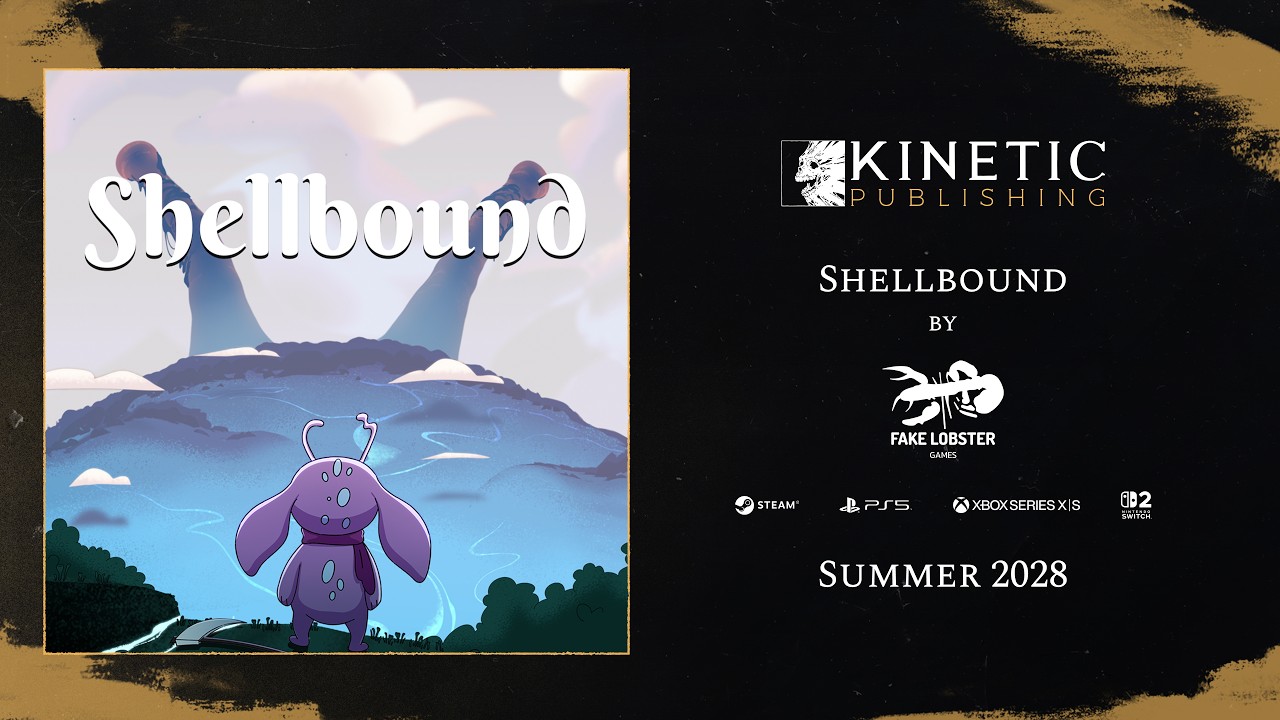
A Metroidvania Where the Entire World Lives on a Giant Snail
Shellbound takes place in an otherwise barren world where life depends on the fertile mucus produced by one colossal snail. Yes, mucus is effectively the foundation of civilisation here. Strange? Absolutely, but that’s also part of the charm. The protagonist is a parasite that emerges from the almost dried-out trail left behind by the creature and initially occupies an uncomfortable position near the bottom of the ecosystem. Following that trail eventually leads towards the ancient snail itself, opening access to a surprisingly varied world spread across its enormous body and winding shell. Forests, settlements and industrial areas aren’t positioned on ordinary continents. They’re part of a biological environment sustained by a living creature. Shellbound therefore turns its central snail into far more than a memorable backdrop. It serves as the physical foundation of the interconnected world that players will gradually learn to navigate.
Playing as a Parasite Changes How Exploration and Progression Work
Being a parasite comes with advantages, even if it doesn’t sound particularly glamorous at first. Shellbound gives its protagonist the ability to take control of other creatures, turning the inhabitants of the ecosystem into potential tools for exploration, combat and puzzle solving. Rather than simply defeating every creature blocking the path, players can consider what an enemy might allow them to accomplish once possessed. Different creatures provide different movement, traversal and combat possibilities, meaning a troublesome opponent could eventually become exactly what you need to reach somewhere new. This gives the traditional Metroidvania progression formula an interesting twist. New areas don’t necessarily need to remain inaccessible until the protagonist permanently acquires another movement upgrade. Clever use of creatures found within the environment can create alternative opportunities for reaching hidden locations and overcoming obstacles.
Enemy Control Opens Routes, Solves Puzzles and Changes Combat
The parasite ability appears to sit at the heart of Shellbound’s gameplay rather than functioning as an occasional gimmick. Controlled enemies can provide strategic advantages during fights, but their usefulness stretches beyond combat encounters. Certain creatures can help the player traverse difficult terrain, interact with environmental obstacles, enter secret locations and solve puzzles that would otherwise be impossible to overcome. That creates an appealing question whenever something unusual appears nearby: should you destroy it, avoid it or find out what happens when you take control? Shellbound can use those choices to make individual enemy types feel more meaningful than disposable obstacles. The official description even indicates that some NPCs can be controlled through the same parasitic system. If Fake Lobster successfully connects those powers to the game’s level design, learning what each creature can do could become just as important as discovering entirely new regions.
Shellbound’s Ecosystem Evolves in Response to the Player
One of Shellbound’s most interesting ideas is that the ecosystem doesn’t simply wait patiently for players to carve their way through it. Repeatedly killing enemies belonging to the same species can eventually cause that species to evolve, producing stronger and potentially substantially different forms when encountered again. Suddenly, repeatedly clearing the same harmless creature isn’t necessarily free of consequences. The ecosystem effectively pushes back. Those evolved enemies bring additional abilities of their own, however, and the protagonist’s parasite powers mean their adaptations can ultimately become useful tools. That relationship creates an unusual risk-and-reward loop. Players may make future encounters more dangerous through aggressive behaviour, yet the resulting evolutionary change can introduce abilities that open additional possibilities. Rather than treating enemies and progression as separate systems, Shellbound attempts to make them parts of the same biological chain reaction.
The Giant Snail Functions as a Living and Changing World
The enormous snail beneath Shellbound’s world isn’t simply alive according to the story. Its bodily functions are intended to have tangible effects on the people living there, the surrounding environment and the way players explore. The creature has awakened after a slumber lasting millennia and started moving again, yet its destination and reason for waking remain unknown. That movement potentially turns the setting itself into part of the central mystery. A mountain doesn’t normally decide to get up and go somewhere, after all. Shellbound’s world essentially does. Fake Lobster describes the creature as a superorganism, with its biology influencing pathways and helping form a living labyrinth. This gives the developers an opportunity to make environmental changes feel naturally connected to the setting rather than arbitrary. When the ground beneath an entire civilisation is a living animal, practically any biological change can have enormous consequences.
Strange Biomes Stretch Across the Snail and Into Its Shell
Exploration will take players through distinctly different environments spread across the snail’s body and deep within its shell. Confirmed examples include dense forests, copper cities and mucus mines, suggesting civilisation has learned to use the biological resources provided by its gigantic host. The prospect of exploring organs and internal spaces adds another wonderfully bizarre dimension. A conventional cavern can already make a good Metroidvania maze, but a labyrinth that is literally part of a living organism has considerably more potential to squirm, shift and surprise you. The variety should also help communicate the enormous scale of the creature. Travelling from an outdoor forest into an established city and eventually descending through biological passages can make the snail feel less like a single level and more like an entire continent that happens to breathe. That’s an image that’s difficult to forget.
NPC Friendships and Quests Add Another Layer to Exploration
Not every inhabitant of Shellbound wants to eat the tiny parasite wandering through its home. Players will encounter friendly NPCs throughout the journey, with quests and secrets providing reasons to spend time learning more about the communities that have developed around the ancient creature. Shellbound also features an interactive friendbook that tracks these relationships. That social element could prove particularly valuable because the setting naturally raises questions about how different species and civilisations coexist on an organism this enormous. What does everyday life look like when your world is alive? How have settlements adapted to the snail’s biology, and what happens to those communities now that the creature has unexpectedly started moving again? Quests provide an opportunity to explore those questions on a personal level, giving the broader mystery smaller stories and individual faces rather than leaving everything focused exclusively on the parasite’s journey.
Fake Lobster Is Building Shellbound With Kinetic Publishing
Shellbound is being developed by German indie studio Fake Lobster and published by Kinetic Publishing. It is Fake Lobster’s debut game, making the scale of its ideas particularly notable. Rather than treating its Metroidvania foundations as a rigid template, the studio is experimenting with interconnected systems built around possession, biological evolution and environmental change. Fake Lobster co-founder Eric Frantzen has explained that the team wanted to make the kind of exploration-focused game it enjoys playing while introducing its own parasitic twist. Co-founder Nils Klatt has also indicated that the partnership with Kinetic Publishing provides the support needed to work on Shellbound full-time. That backing gives the project room to develop its unusual concepts while retaining the identity that made the premise interesting in the first place. A giant snail might sound ridiculous for about five seconds, and then the gameplay possibilities start making an unusual amount of sense.
Shellbound’s Nintendo Switch 2 Release Is Planned for Summer 2028
Nintendo Switch 2 owners will have to wait until Summer 2028 before Shellbound is currently expected to arrive, but its announcement establishes another unusual Metroidvania for the system’s future lineup. The confirmed platforms are Nintendo Switch 2, PC, PlayStation 5 and Xbox Series X|S. No more precise launch date has been announced at this stage, so Summer 2028 remains the window to keep in mind. Shellbound is also far enough from release that details surrounding the final Nintendo Switch 2 version, such as resolution, frame rate or platform-specific features, haven’t been outlined. What we do know already provides plenty to chew on, preferably more pleasantly than the parasite does. Exploring an enormous living snail, possessing enemies, triggering evolutionary changes and watching biology influence the environment gives Shellbound a collection of systems that could help distinguish it within a genre packed with memorable worlds.
Conclusion
Shellbound takes the familiar foundations of a 2D Metroidvania and wraps them around one wonderfully bizarre idea: your entire adventure unfolds across and inside a colossal living snail. Fake Lobster isn’t relying on the unusual premise alone, either. The parasite protagonist can control enemies and use their individual abilities during platforming, combat and puzzle solving, while repeatedly eliminating species can force those creatures to evolve into more dangerous forms. The snail’s biology can influence its environments, settlements are scattered across different regions of its enormous body, and friendly NPCs offer quests and secrets through an interactive friendbook. Meanwhile, the mystery surrounding the creature’s awakening provides the journey with a larger narrative question. Shellbound is currently scheduled to reach Nintendo Switch 2 alongside PC, PlayStation 5 and Xbox Series X|S in Summer 2028. There’s plenty more to learn before then, but this gigantic gastropod has already given us one particularly unusual world to keep an eye on.
FAQs
- Is Shellbound coming to Nintendo Switch 2?
- Yes. Fake Lobster and Kinetic Publishing have officially confirmed Shellbound for Nintendo Switch 2. The game is also planned for PC, PlayStation 5 and Xbox Series X|S.
- When will Shellbound be released?
- Shellbound is currently planned for Summer 2028. A specific release date within that launch window has not yet been announced.
- What type of game is Shellbound?
- Shellbound is a 2D Metroidvania combining exploration, platforming, combat and puzzles. Its progression systems include controlling creatures and using their abilities to overcome obstacles and discover new areas.
- Why do enemies evolve in Shellbound?
- The ecosystem reacts to the player’s behaviour. Killing too many enemies belonging to one species can cause that species to evolve into a stronger form with different abilities, which can subsequently be useful through the parasite control mechanic.
- Where does Shellbound take place?
- The adventure takes place across and inside an enormous ancient snail in a barren world where life depends on the creature’s fertile mucus. Locations include forests, copper cities, mucus mines and biological areas within its shell.
Sources
- Explore a Living World on the Back of a Giant Snail in Shellbound, a Parasitic Metroidvania Coming to PC and Consoles in Summer 2028, Swipe Right, August 12, 2026
- Shellbound Coming to Nintendo Switch 2, Nintendo Everything, August 12, 2026
- Kinetic Publishing and Fake Lobster Announce Shellbound for Consoles and PC, GamesBeat, August 12, 2026
- Shellbound on Steam, Steam, 2026