














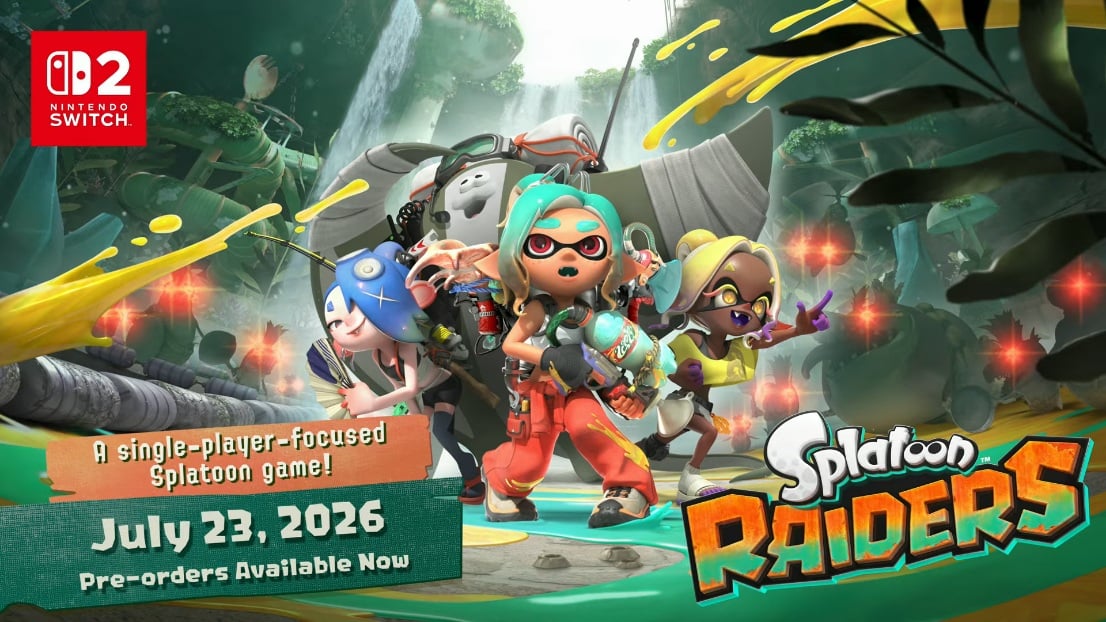
Summary:
Splatoon Raiders may place a strong emphasis on its solo treasure-hunting adventure, but players will not have to explore the Spirhalite Islands alone. Nintendo has provided a clearer explanation of the game’s multiplayer options, confirming that groups of up to four players can head out on raids together through online play or local wireless connections. Friends can create their own rooms, add an optional password and work as a team while searching for valuable treasure and battling the enemies standing in their way.
The cooperative experience will not simply place extra players into an unchanged solo mission. Enemy strength and the items available during a raid may vary depending on the circumstances, giving groups a slightly different challenge from players travelling alone. This should help multiplayer sessions feel like a proper part of the adventure rather than a separate mode bolted onto the side.
Nintendo has also introduced Call for Help, a feature aimed at solo players who need an extra pair of ink-covered hands. Activating it connects the game to the internet and allows another player to join the raid temporarily. Players can also answer requests from others, with successful assistance providing a Help Bonus that can include weapons, gadget parts and other materials. A cooldown prevents repeated use immediately after a successful raid, encouraging players to treat the option as valuable backup rather than a permanent shortcut. Splatoon Raiders launches exclusively for Nintendo Switch 2 on July 23, 2026.
Splatoon Raiders Multiplayer Goes Beyond Its Solo Focus
Splatoon Raiders has frequently been described as a single-player-focused adventure, which makes sense when you consider its story-driven structure and emphasis on exploring the mysterious Spirhalite Islands alongside Deep Cut. However, Nintendo is not asking every raider to tackle the entire journey alone. The game includes several cooperative features that allow other players to become part of the treasure hunt, whether they are close friends sitting nearby or online partners joining from elsewhere. This distinction matters because the multiplayer options are woven into the main raiding experience rather than presented as an unrelated competitive diversion. You are still exploring, fighting enemies and searching for useful treasure, but now you can share those moments with other players. That could make tricky encounters easier to manage, while also creating the kind of cheerful chaos that naturally follows whenever four Splatoon players start spraying ink in the same direction. Well, roughly the same direction. Team coordination is always the dream, even when reality looks more like an exploding paint shop.

Four Players Can Explore the Spirhalite Islands Together
Up to four players can participate in a raid together, allowing one host and three additional raiders to form a full group. The shared objective remains centred on exploring environments, defeating hostile creatures and gathering treasure, but adding more people should change the rhythm of each expedition. One player might focus on pushing ahead, while another handles nearby threats or keeps an eye out for useful items tucked away from the obvious route. Splatoon’s movement and weapon mechanics already encourage players to cover ground quickly, so a coordinated team could potentially search an area far more efficiently than one person acting alone. At the same time, splitting up too enthusiastically could leave someone surrounded by enemies and wondering where everybody disappeared to. The four-player limit feels well suited to this style of play because it provides enough room for teamwork without turning every raid into a crowded ink storm. It also gives existing Splatoon groups a new way to play together outside the competitive battles traditionally associated with the series.
Online and Local Wireless Play Offer Flexible Options
Nintendo is supporting both online multiplayer and local wireless connections in Splatoon Raiders. Online play allows friends to meet up without being in the same location, making it the most convenient option for groups spread across different homes or regions. Local wireless, meanwhile, lets nearby Nintendo Switch 2 owners connect their systems and play together without sharing a single display. That choice is especially useful for households, gaming meetups and those wonderfully ambitious trips where everyone remembers to bring a console but somebody inevitably forgets a charging cable. Supporting both connection methods gives players more control over how they organise their cooperative sessions. It also means the multiplayer experience is not restricted to one specific setup. Whether you are playing from the sofa, visiting a friend or joining an online group after dinner, the basic goal remains the same: assemble a team, prepare your equipment and head out in search of treasure. The availability of local wireless also continues a familiar Nintendo tradition of encouraging nearby players to connect their systems for shared adventures.
Private Rooms Make It Easier to Play With Friends
Players who want to organise a cooperative session can create a multiplayer room and invite friends to join them. An optional password can be added, giving the host greater control over who enters the group. This is a small feature on paper, but it can prevent a surprising amount of confusion when several people are trying to meet in the same online space. Rather than hoping everyone selects the correct room or accidentally inviting an unexpected guest into the expedition, the group can share a password and gather privately. Once everyone has arrived, the team can set out together and begin searching for treasure. Room-based multiplayer should also make it easier for regular groups to plan longer sessions, especially when players want to work through several raids rather than treating each one as an isolated event. The setup appears designed to keep the process straightforward, allowing friends to spend more time playing and less time navigating menus. After all, the real obstacles should be the enemies on the islands, not an invitation screen.
Raids Adapt When Additional Players Join the Hunt
Bringing extra players into a raid does not mean the group will simply overpower every encounter without resistance. Nintendo has indicated that enemy strength can change during multiplayer sessions, helping the challenge adjust when more raiders join the action. This type of scaling is important because an encounter designed for one person could become laughably easy when attacked by four well-equipped players. Stronger opposition should encourage the group to cooperate rather than treating the raid as a casual sprint towards the nearest treasure chest. What players can acquire may also change at times, suggesting that multiplayer raids could offer slightly different opportunities or rewards depending on the situation. Nintendo has not outlined every calculation behind these adjustments, so the exact balance will become clearer once players can compare solo and cooperative expeditions directly. Even so, the general idea is easy to understand. More teammates provide more firepower, mobility and tactical options, while the game responds by making sure the islands still have a few sharp teeth hidden beneath all that colourful ink.
Call for Help Gives Solo Players Temporary Assistance
Call for Help is one of the more unusual additions to Splatoon Raiders because it bridges the gap between solo play and organised multiplayer. A player exploring alone can activate the feature before heading into a hunt, connect to the internet and request assistance from another raider. When somebody answers, that helper joins the expedition temporarily and provides support during the raid. This could be especially valuable when a particular mission, enemy group or boss encounter proves difficult to overcome without backup. Instead of leaving the game to assemble a permanent party, the solo player can request targeted assistance and continue moving forward. There is a limitation, however. After a successful raid completed with help, the requesting player must wait before using Call for Help again. The cooldown prevents the system from becoming an unlimited solution to every difficult encounter. It is better understood as an emergency signal flare: useful when the situation becomes uncomfortable, but not something you can fire into the sky every five minutes simply because a Salmonid looked at you funny.
Answering Help Requests Comes With Useful Rewards
Call for Help works in both directions, meaning players can also volunteer to assist somebody else. By going online and responding to an active request, a raider can enter another player’s hunt and help them complete the objective. Successful assistance provides a Help Bonus, creating a practical reason to support strangers or other online players even when your own progress is not currently blocked. Nintendo has confirmed that these bonuses may include weapons, gadget parts and other materials, all of which can contribute to the broader progression system. This reward structure turns helpful behaviour into a worthwhile activity rather than relying entirely on goodwill. Of course, rescuing a fellow raider from a difficult situation may already feel satisfying, but receiving useful equipment afterwards certainly sweetens the deal. The feature could also encourage experienced players to revisit encounters and experiment with different loadouts while supporting newer raiders. Because the helper is joining temporarily, the system offers a lighter commitment than forming a full room and planning an extended cooperative session.
Cooperative Features Support Different Ways to Play
The different multiplayer options give Splatoon Raiders room to accommodate several types of players. Some people will want to experience the story alone, carefully searching each corner and progressing at their own pace. Others will immediately gather three friends and turn every treasure hunt into a lively group expedition. Call for Help sits neatly between those approaches, allowing solo raiders to request assistance without committing to regular cooperative play. That flexibility may be one of the system’s greatest strengths. It avoids presenting multiplayer as an all-or-nothing decision and lets players change their approach depending on the challenge in front of them. A quiet solo session can suddenly become a two-player rescue mission, while an organised room can provide a full evening of shared exploration. The options also preserve the identity Nintendo has established for the game. Splatoon Raiders remains a single-player-focused adventure, but its cooperative features acknowledge that Splatoon has always been closely connected to social play, teamwork and the unpredictable energy created when several players share the same battlefield.
Splatoon Raiders Launches on Nintendo Switch 2
Splatoon Raiders will launch exclusively for Nintendo Switch 2 on July 23, 2026. The game follows a mechanic who travels with Deep Cut to the Spirhalite Islands, where the group searches for treasure and confronts Salmonid enemies. Players can customise their character, adjust their equipment and use a selection of weapons and upgradeable gadgets while exploring the islands. The multiplayer systems add another layer to that central adventure without replacing its solo foundation. Four-player rooms provide a structured way to play with friends, local wireless supports nearby groups and Call for Help creates quick online partnerships when someone needs assistance. Together, these features suggest that the experience has been built to remain welcoming whether you prefer travelling alone or sharing every raid with a familiar squad. Nintendo’s dedicated presentation made the cooperative structure much clearer, and the ability to earn materials by helping other players could give the online community a useful reason to stay active well after completing the main journey.
Conclusion
Splatoon Raiders may lead with its single-player adventure, but its multiplayer features appear substantial enough to become an important part of the experience. Up to four players can explore together through online play or local wireless, while private rooms and optional passwords make it easier for friends to form a reliable group. Enemy strength and potential rewards may adapt during cooperative raids, helping the action remain balanced when additional players join. Call for Help adds another useful option by letting solo players request temporary online assistance, while successful helpers can earn weapons, gadget parts and other materials through Help Bonuses. The cooldown attached to successful help requests should stop players from leaning on the feature constantly, preserving the value of preparation and individual progress. With several ways to connect and play, Splatoon Raiders gives players the freedom to decide when they want companionship and when they would rather face the islands alone. The treasure may be important, but sometimes the real prize is having someone nearby when the Salmonids start causing trouble.
FAQs
- Does Splatoon Raiders support multiplayer?
- Yes. Splatoon Raiders supports cooperative multiplayer for up to four players through online play or local wireless connections.
- Can you play the entire Splatoon Raiders adventure with friends?
- Nintendo says players can hunt for treasure and progress through the story together, although the exact structure of every cooperative activity may vary.
- What is Call for Help in Splatoon Raiders?
- Call for Help is an online feature that lets a solo player request temporary assistance from another raider before heading out on a hunt.
- What do players receive for helping another raider?
- Successful helpers receive a Help Bonus that may include weapons, gadget parts or other useful materials.
- When will Splatoon Raiders be released?
- Splatoon Raiders will launch exclusively for Nintendo Switch 2 on July 23, 2026.
Sources
- Splatoon Raiders Direct Spills the Ink on the Treasure-Filled Adventure Coming to Nintendo Switch 2, Nintendo, July 1, 2026
- Splatoon Raiders – Nintendo Switch 2 Exclusive, Nintendo, April 21, 2026
- Splatoon Raiders Multiplayer Features Detailed, Nintendo Everything, June 30, 2026
- Splatoon Raiders Direct Details Enemies, Weapons, Tanks, Customization, Upgrades, and More, Gematsu, June 30, 2026
- Splatoon Raiders Nintendo Direct: Every Announcement, Nintendo Life, June 30, 2026