














Summary:
Nintendo has released the launch trailer for Star Fox, offering one more look at Fox McCloud’s return before players head back into the Lylat System on Nintendo Switch 2. Released worldwide on June 25, 2026, the game reimagines the beloved Star Fox 64 adventure with redesigned characters, dramatically updated environments, newly produced cinematic sequences, fully voiced dialogue and an orchestral soundtrack. The familiar battle against Andross remains at the heart of the experience, but nearly every part of the presentation has been rebuilt for Nintendo’s newer hardware.
The adventure once again places players inside the Arwing as Fox, Falco, Peppy and Slippy fight their way across planets, asteroid fields, enemy bases and hazardous regions of space. Branching mission routes remain an important part of the structure, encouraging repeat playthroughs and rewarding pilots who experiment with different objectives. Campaign Mode is joined by Challenge Mode, where completed stages return with altered goals, and Battle Mode, which supports competitive 4-vs-4 clashes between Team Star Fox and Team Star Wolf.
Nintendo Switch 2 features also play a major role. Joy-Con 2 mouse controls provide an alternative aiming method, while cooperative play allows one person to steer and another to operate the weapons. GameShare broadens local and online multiplayer possibilities, and GameChat includes animated Star Fox character avatars and playful augmented-reality filters. Taken together, these additions turn a familiar journey into a far more social and visually ambitious flight through the stars.
Star Fox launch trailer prepares pilots for takeoff
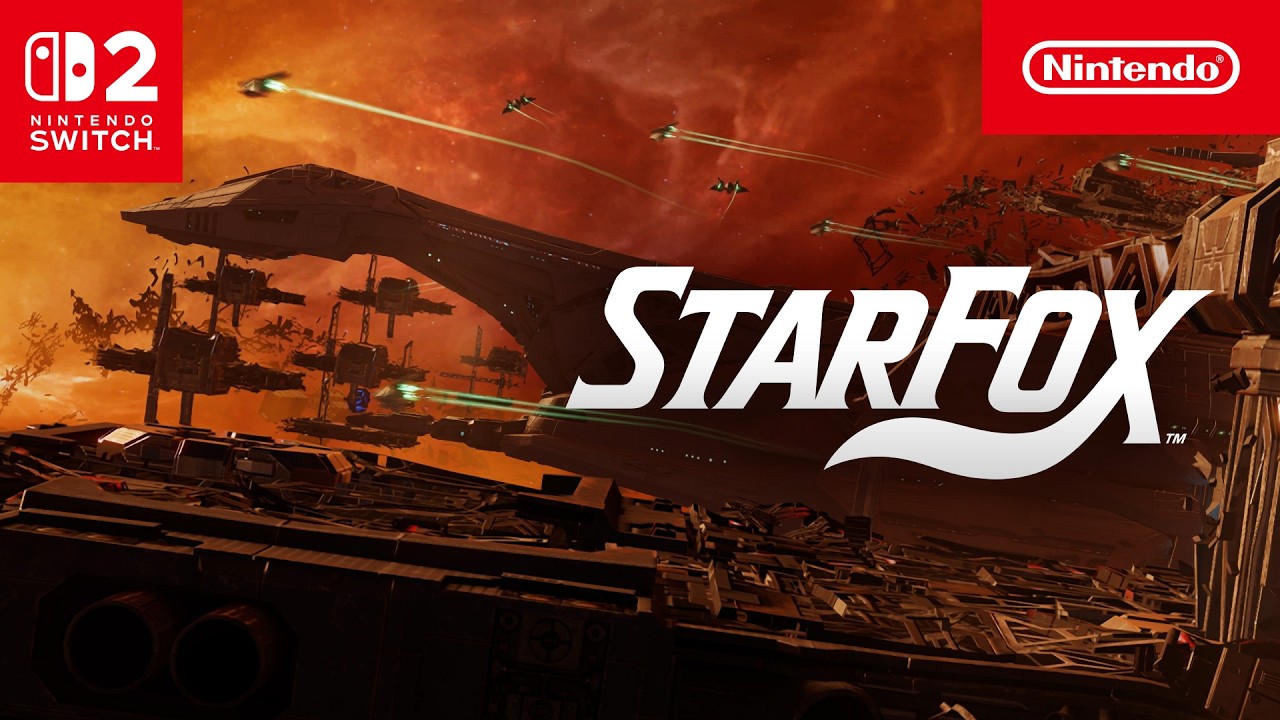
Nintendo’s Star Fox launch trailer acts as a final mission briefing before Fox McCloud and his crew return to active duty on Nintendo Switch 2. Rather than focusing on a single feature, the footage moves quickly through the game’s major attractions. We see cinematic encounters, high-speed Arwing battles, familiar locations, branching routes and several of the multiplayer options that extend the experience beyond the campaign. It feels less like a quiet reminder and more like General Pepper urgently pointing at a star map while alarms flash in the background. The message is clear: Andross is causing trouble again, and apparently nobody else in the Lylat System has learned how to perform a barrel roll.
Star Fox launched exclusively for Nintendo Switch 2 on June 25, 2026. The new release is based on Star Fox 64, although calling it a simple visual refresh would undersell the scale of the work. Nintendo has rebuilt stages with more detailed environments, introduced redesigned character models and expanded the story through additional dialogue and cinematic scenes. The underlying arcade structure remains recognisable, but its presentation has been reshaped to feel more dramatic and expressive. For returning pilots, it offers a familiar route through the stars. For newcomers, it serves as an accessible introduction to one of Nintendo’s most distinctive action series.
A cinematic return to the familiar Lylat System
The conflict begins with Andross once again threatening the Lylat System, forcing Fox McCloud and the Star Fox team to answer General Pepper’s call. That basic setup will immediately sound familiar to anyone who played Star Fox 64, yet the remake gives the journey more room to breathe. Mission briefings now provide additional context between stages, while fully voiced scenes allow the crew’s personalities to emerge more clearly. Falco remains confident enough to fill an entire hangar, Slippy still has a remarkable talent for attracting danger and Peppy continues to offer the kind of advice that has echoed through gaming history for decades.
The visual redesign reaches far beyond the characters. Corneria has become a brighter and more detailed battlefield, filled with futuristic buildings, invading forces and environmental destruction. Zoness retains its identity as a polluted ocean world, but its murky waters and industrial wreckage now carry greater visual weight. Other missions send the crew through asteroid belts, enemy installations, planetary surfaces and the interior of a nebula. These locations are not merely polished versions of old maps. They have been rebuilt to support a more cinematic sense of scale, helping every mission feel like part of a larger interplanetary campaign rather than a collection of disconnected shooting galleries.
Classic Arwing combat receives a modern upgrade
Flying the Arwing remains the central attraction, and the basic language of Star Fox combat is as direct as ever. You accelerate, brake, fire lasers, avoid incoming attacks and perform evasive manoeuvres when enemy formations begin closing in. Somersaults can help Fox slip behind a pursuing fighter, while barrel rolls deflect hostile fire and create a moment of breathing room during intense encounters. Boosting provides a sudden burst of speed, which can be useful when chasing targets, escaping danger or simply trying to look impressive in front of Falco. The mechanics are approachable, but skilled play depends on timing, positioning and learning how each stage tries to catch you off guard.
The remake’s updated visuals give these familiar actions more impact. Laser fire cuts through busy battlefields, enemy ships break apart with greater detail and larger encounters benefit from more dramatic camera work. The orchestral soundtrack adds another layer of energy, turning even routine attack waves into something that feels fit for a space opera. Yet the action still follows an arcade philosophy. Success is not only about reaching the end of a stage. Players are encouraged to improve their scores, protect their teammates, discover hidden conditions and understand exactly when a mission can split onto a different path.
Campaign Mode keeps branching routes at its core
Campaign Mode takes the Star Fox team across the Lylat System on a mission to stop Andross. Players can begin on Easy or Normal difficulty, making the adventure approachable for newcomers while still giving experienced pilots room to test their skills. Normal play eventually opens the path towards Expert difficulty, although unlocking it requires dedication and strong medal performances. Those medals are earned by demonstrating mastery within individual missions, so merely surviving is not always enough. Accurate shooting, high enemy counts and effective team support can all matter when pursuing the best results.
The branching route system remains one of the campaign’s defining ideas. Actions taken during a mission can alter what happens next, sending the team towards different planets, objectives or encounters. A pilot who follows the most obvious route may see only part of what the game offers, while another might trigger an alternate objective and find an entirely different road through the system. That structure makes repetition meaningful. Revisiting a stage is not simply about collecting a higher score. It can reveal another chapter of the journey, a harder confrontation or a mission that was previously hidden behind a specific condition.
This design also suits shorter play sessions. A single campaign route can move at a brisk pace, but the wider adventure gradually unfolds across repeated attempts. It resembles exploring a maze where the walls move whenever you make a different decision. One successful rescue, unusual manoeuvre or completed secondary goal can redirect the entire journey. Players who enjoy experimentation will therefore have plenty of reasons to return, even after seeing the credits for the first time.
Challenge Mode gives experienced pilots new objectives
Challenge Mode allows players to revisit stages they have already completed while pursuing goals that differ from those found in the campaign. Instead of simply reaching the finish line, a challenge might demand more precise shooting, better survival skills or a different approach to familiar enemy formations. Some objectives do not appear during regular campaign missions, which gives the mode its own identity rather than making it feel like a basic stage-selection menu. Normal and Expert difficulty options also make it possible to choose between a manageable test and something likely to make your trigger finger file a formal complaint.
The value of Challenge Mode lies in how it changes the player’s relationship with each stage. A location that once felt predictable can become demanding when the rules shift or when familiar shortcuts no longer provide the easiest answer. Because the missions are built around focused goals, they also offer a practical way to practise specific techniques. Pilots can improve their aim, refine their movement and learn how to handle enemy waves without committing to another complete campaign route. It is a natural extension of Star Fox’s score-driven roots, rewarding repetition while ensuring the repeated missions still ask something new from the player.
Battle Mode introduces competitive 4-vs-4 dogfights
Battle Mode is one of the remake’s largest additions, bringing up to eight players together for 4-vs-4 confrontations between Team Star Fox and Team Star Wolf. Rather than placing every match inside the same empty arena, the mode features stages with different objectives and settings. On Corneria, teams fight to secure control of a designated zone. Fichina shifts the focus towards collecting energy crystals, while Sector Y challenges players to retrieve cargo taken by space pirates. These goals encourage coordination and prevent every battle from becoming a chaotic cloud of Arwings chasing the nearest target.
Private matches allow groups of friends to compete together, while online matchmaking opens the door to opponents from other locations. Team composition and communication are likely to matter, particularly when an objective requires players to divide their attention. One pilot might defend a captured zone while another intercepts incoming enemies. A teammate carrying valuable cargo may need protection, and a crystal-collecting run can quickly collapse when the opposing team appears from behind an asteroid. It is still Star Fox, so lasers will inevitably fill the screen, but victory demands more than simply firing at everything with wings.
The rivalry between Star Fox and Star Wolf makes the team format a natural fit. Their clashes have always carried a competitive edge, and Battle Mode turns that rivalry into something players can control directly. It adds a social layer to a series traditionally centred on replaying a solo campaign, potentially giving the game a longer life for groups that enjoy coordinated multiplayer action.
GameShare and cooperative controls expand the crew
GameShare gives Star Fox several ways to involve additional players, even when not everyone owns a separate copy. Up to four people can participate through supported local or online arrangements, although the available features depend on the systems being used. Online GameShare through GameChat is limited to Nintendo Switch 2 systems. Local GameShare can also share compatible experiences with an original Nintendo Switch, making it easier to bring another player into the action when multiple consoles are nearby.
Cooperative play can also divide the responsibilities inside the Arwing. One player handles the flight controls while another takes charge of aiming and firing. That setup changes the usual solo rhythm because success now depends on communication. The pilot may line up a target only for the gunner to notice a more dangerous enemy approaching from another direction. Meanwhile, the gunner might have the perfect shot prepared just as the pilot decides that an emergency somersault would be an excellent idea. Done well, the arrangement can feel like a coordinated cockpit crew. Done badly, it may sound like two friends politely debating who flew directly into the asteroid.
The option adds flexibility without replacing traditional controls. Solo players can still manage every aspect of the Arwing themselves, while friends can share duties when they prefer a more collaborative experience. It is a sensible way to make the campaign and selected challenges more approachable for households or groups with different skill levels.
Joy-Con 2 mouse controls offer another way to aim
Joy-Con 2 mouse controls are available during solo play in Campaign Mode and Challenge Mode, giving players an alternative to conventional button-based aiming. The system allows seamless switching between control methods, so pilots are not locked into one setup for an entire mission. By placing a Joy-Con 2 controller on a suitable surface, players can aim with movements similar to those used with a computer mouse. This can provide a more direct connection between hand movement and the targeting reticle, especially during sequences filled with smaller or faster enemies.
The feature does not fundamentally change what Star Fox asks players to do, but it can change how aiming feels. Some players will prefer the familiar precision of analogue controls, while others may find mouse movement faster and more intuitive. Seamless switching makes experimentation less intimidating because there is no need to restart a stage or dig through menus whenever one method feels better for a particular encounter. Combined with the cooperative gunner option, mouse controls also create a convincing division between navigation and weapon operation. One person can concentrate on steering the Arwing through narrow spaces while another tracks targets independently, turning the controller setup into a miniature command station.
GameChat avatars bring the Star Fox team into conversations
Star Fox also makes use of GameChat through interactive character avatars. Players can appear as Fox McCloud or another member of the crew while talking with friends, with the selected avatar mirroring facial expressions and body movements. It is a playful addition that connects the game’s redesigned cast with Nintendo Switch 2’s communication features. Instead of displaying a standard camera feed, players can effectively join a conversation as one of the pilots they have been guiding through the Lylat System.
Augmented-reality filters provide another humorous option. Star Fox-inspired ears can be placed over the player’s image, while a Falco-style beak moves as the user speaks. Is it essential to defeating Andross? Probably not. Will someone spend an unreasonable amount of time interrupting a serious tactical discussion while wearing an animated bird beak? Almost certainly. The filters fit the series’ personality and give groups a light-hearted way to remain visually connected during GameChat sessions. They also demonstrate how Nintendo is using individual games to shape the presentation of its broader social features rather than treating communication as a completely separate system.
Star Fox aims to unite nostalgia and modern presentation
The central challenge facing this remake is balancing two very different expectations. Star Fox 64 is remembered for its fast missions, memorable dialogue, alternate routes and highly replayable arcade design. Changing too much could weaken the qualities that made it endure. Changing too little, however, could leave the return feeling like a museum piece wearing expensive new textures. Nintendo’s approach appears to preserve the underlying structure while rebuilding the presentation and adding features that were not possible in the original release.
The expanded cinematics and voice work give the characters more space to develop, while the overhauled environments make the Lylat System feel richer and more dramatic. Challenge Mode builds on the series’ appetite for repeat play, and Battle Mode introduces a competitive destination for up to eight pilots. Mouse controls, GameShare and GameChat then connect the experience to the defining functions of Nintendo Switch 2. None of these additions erase the game’s arcade identity. Instead, they frame it in a way that feels more suitable for a modern console.
That combination may be particularly appealing to players who have heard famous lines from Star Fox for years without experiencing the adventure that produced them. Veterans can revisit familiar planets and search for alternate paths, while newcomers receive a version built around contemporary visuals, controls and social features. Fox McCloud may be flying an old route, but the ship around him has been thoroughly rebuilt.
Conclusion
The Star Fox launch trailer provides a final overview of an ambitious return for Fox McCloud and his team. The Nintendo Switch 2 release keeps the branching campaign, rapid Arwing combat and replay-focused structure associated with Star Fox 64 while introducing a fully redesigned visual presentation, orchestral music, expanded dialogue and new cinematic scenes. Challenge Mode adds specialised objectives, and the 4-vs-4 Battle Mode broadens the experience with objective-based team matches across Corneria, Fichina and Sector Y.
Nintendo Switch 2 features further distinguish this version. Joy-Con 2 mouse controls offer another aiming option, cooperative play lets friends divide flying and shooting duties, and GameShare makes selected multiplayer experiences easier to share. GameChat avatars and augmented-reality filters add a more playful social element, letting players carry the personalities of Fox, Falco and the rest of the crew beyond the battlefield. Whether you remember every route through the Lylat System or have never sat inside an Arwing before, this remake offers a polished invitation to fly, fight and perform at least one completely unnecessary barrel roll.
FAQs
- When was Star Fox released for Nintendo Switch 2?
- Star Fox was released worldwide for Nintendo Switch 2 on June 25, 2026. It is an exclusive Nintendo Switch 2 game and reimagines the campaign and core structure of Star Fox 64.
- Is the new Star Fox a remake of Star Fox 64?
- Yes. The game is based on Star Fox 64, but it features redesigned characters, rebuilt stages, additional mission briefings, fully voiced cinematic sequences, orchestral music and new multiplayer features.
- Does Star Fox support online multiplayer?
- Yes. Battle Mode supports competitive 4-vs-4 matches with up to eight players. Players can join private battles with friends or use online matchmaking to compete against other pilots.
- How do the Joy-Con 2 mouse controls work in Star Fox?
- Players can use a Joy-Con 2 controller like a mouse for more direct aiming during solo Campaign Mode and Challenge Mode. The game allows seamless switching between mouse and traditional button controls.
- Can two players control the same Arwing?
- Yes. During supported cooperative play, one player can concentrate on flying while another handles aiming and shooting. The roles can also be reversed, allowing friends to choose the responsibilities that suit them best.
Sources
- Star Fox – Nintendo Switch 2 Exclusive, Nintendo, June 25, 2026
- Star Fox Trailer Reveals New Gameplay Footage of the Spacefaring Adventure Launching on Nintendo Switch 2 This Month, Nintendo, June 9, 2026
- Star Fox Launches for Nintendo Switch 2 on 25 June, and You Can Enjoy a Free Demo Available Now, Nintendo, June 12, 2026
- Star Fox Nintendo Switch 2 Launch Trailer, Nintendo Everything, June 24, 2026
- Star Fox Overview Trailer, Gematsu, June 2, 2026