














Summary:
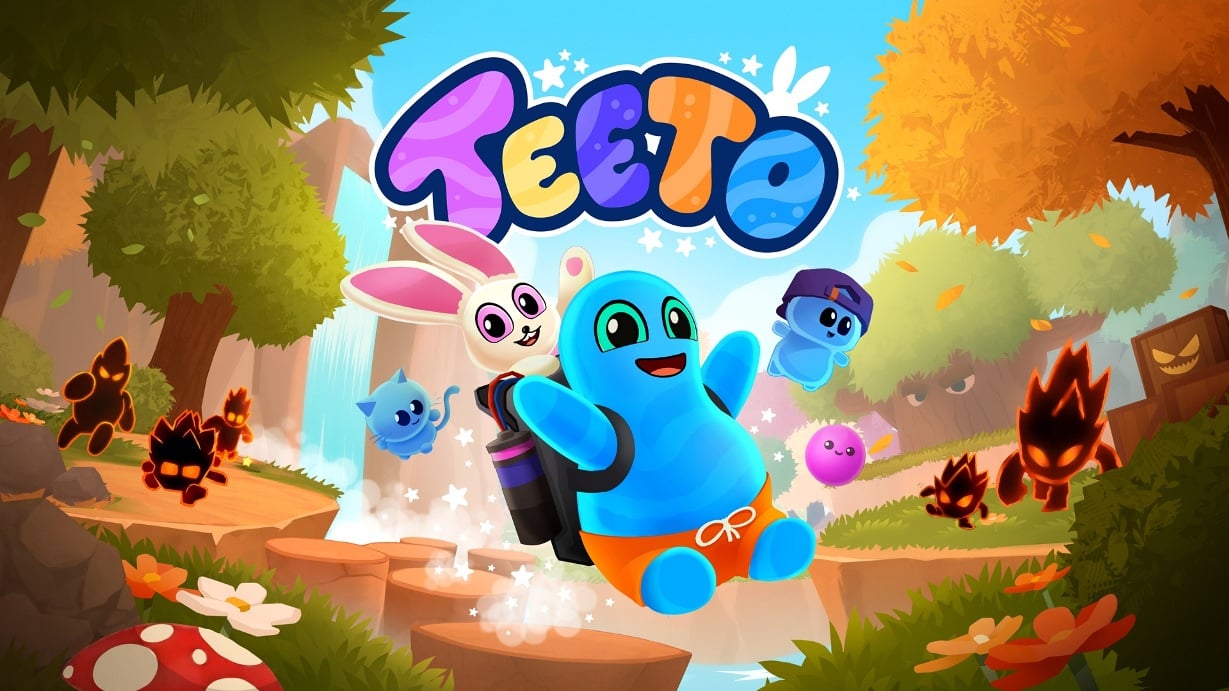
Teeto has officially arrived on Nintendo Switch and Nintendo Switch 2, and a colorful launch trailer offers a closer look at the cheerful chaos awaiting players. Developed by Eat Pant Games and published by Super Rare Games, the 3D adventure platformer follows Teeto, an expressive blue blob, and Nory, a resourceful bunny equipped with a Vionite-powered backpack. Together, the unlikely heroes must stop a mysterious shadow corruption from draining the life and color from their world.
The adventure is built around Teeto’s ability to absorb objects and transform into useful new forms. Each transformation provides a different power that can help players navigate environments, solve puzzles, confront shadow creatures, and uncover secrets tucked away from the main path. Nory’s technology plays an important part in managing these unusual abilities, turning everyday objects into surprisingly effective tools.
Players can explore alone or invite someone to join through local split-screen co-op. Working together opens the door to coordinated puzzle-solving, shared exploration, and the sort of playful mishaps that often make cooperative platformers memorable. The journey also features a growing population of mischievous creatures known as Michaels, a cast of eccentric characters with unusual problems, and a wardrobe filled with outfits ranging from stylish to delightfully ridiculous. Teeto is available digitally through the Nintendo eShop for both Nintendo platforms.
Teeto Launch Trailer Celebrates Its Nintendo Switch Debut
Teeto has bounded, bounced, and probably wobbled its way onto Nintendo Switch and Nintendo Switch 2. The newly released launch trailer introduces players to a bright 3D world filled with platforming challenges, unusual transformations, energetic characters, and an alarming number of creatures named Michael. It wastes little time establishing the game’s playful personality, showing Teeto rolling through environments, changing shape, solving puzzles, and confronting the shadowy forces threatening the world.
Developed by Eat Pant Games, Teeto draws on the welcoming spirit of classic 3D platformers while giving its central character a distinctive ability. Teeto is not limited to a fixed collection of jumps and attacks. Instead, the little blob can absorb objects found throughout the environment and use their properties to overcome whatever stands ahead. That mechanic gives the adventure a flexible foundation, allowing a simple object to become a tool, weapon, traversal method, or punchline.
The trailer also highlights the relationship between Teeto and Nory. They may look like an odd pair, but their abilities complement each other throughout the journey. Teeto provides the shape-shifting potential, while Nory brings the technology, knowledge, and determination needed to keep their mission moving. Their shared adventure is now available digitally on both generations of Nintendo hardware.

Teeto and Nory Face a World Consumed by Shadow Corruption
The cheerful scenery hides a serious problem. Shadow corruption is spreading across the world, bringing dangerous creatures with it and pushing everything toward complete disorder. Teeto and Nory must investigate the cause, restore balance, and prevent the remaining areas from being swallowed by the growing darkness. It is a familiar platforming setup, but the game presents it with warmth, humor, and a cast that rarely seems interested in treating anything with complete seriousness.
The corruption provides more than a distant threat mentioned during story scenes. It influences the environments, enemies, and obstacles encountered along the way. Areas that should feel lively have been disrupted, and shadow creatures stand between the heroes and the answers they need. Restoring the world therefore requires more than reaching the end of each path. Players must learn how Teeto’s transformations interact with the surroundings and determine which ability can break through each new problem.
That contrast between colorful locations and creeping darkness gives the adventure a clear sense of purpose. You are not collecting items simply because a checklist says they are nearby. Exploration contributes to a larger rescue effort, whether you are assisting a stranded character, tracking down a missing Michael, or clearing corruption from a previously inaccessible route. Even when the stakes rise, the game keeps its tone light enough to remain inviting for families and younger platforming fans.
Absorbing Objects Gives Teeto an Unusual Range of Powers
Teeto’s defining talent is the ability to absorb different objects and transform into new forms based on their properties. Rather than treating the environment as decoration, the game encourages players to look at nearby objects and wonder what might happen if Teeto absorbs them. Could that ordinary item provide a stronger attack? Might it allow Teeto to cross a gap, reach a higher ledge, or activate an unusual mechanism? Experimentation is part of the fun.
Each transformation gives the developers room to introduce new mechanics without replacing the character players have already grown attached to. Teeto remains the same charming blob at heart, but the available forms can change how an area is approached. One transformation might focus on movement, while another could be designed for combat or environmental interaction. The result is a platformer where curiosity is often rewarded. When something looks absorbable, there is a good chance it serves a purpose, even when that purpose is slightly ridiculous.
The mechanic also supports a natural rhythm of discovery. New objects can appear as the journey progresses, giving players fresh powers and encouraging them to reconsider obstacles seen earlier. A hidden path that looked impossible during an initial visit may become manageable after learning the right transformation. This approach gives exploration more meaning and helps abilities feel like genuine additions to Teeto’s growing toolkit.
Nory’s Vionite Backpack Supports Transformations and Puzzles
Nory is much more than a companion following Teeto from one area to another. Her Vionite-powered backpack helps the pair access and control their unusual abilities, making her an essential part of both the story and the gameplay. The backpack supports Teeto’s transformations and allows the duo to use absorbed objects in creative ways. Without Nory’s technology, Teeto’s strange talent would be considerably harder to direct toward something useful.
The partnership gives the game a buddy-adventure quality. Teeto may have the raw ability to change form, but Nory provides the practical support that turns that talent into a solution. It is similar to carrying a toolbox where one friend is somehow both the toolbox and the building material. That may not sound efficient on paper, but it seems to work rather well when shadow creatures are knocking on the door.
Puzzles are designed to make players consider how the characters and transformations work together. Progress may require activating mechanisms, moving through unusual terrain, defeating enemies, or spotting an object whose purpose is not immediately obvious. Instead of relying only on precise jumping, Teeto blends traditional platforming with environmental problem-solving. The backpack connects those ideas, ensuring that transformations feel tied to the world rather than functioning as disconnected power-ups.
Split-Screen Co-op Lets Two Players Share the Adventure
Teeto can be played alone, but local split-screen co-op allows two players to experience the adventure together. A second player can join the journey and help with exploration, transformations, combat, and puzzle-solving. Cooperative platformers often produce their best memories when carefully planned teamwork suddenly turns into cheerful confusion, and Teeto appears more than willing to create those moments.
Sharing the screen means both players can explore their immediate surroundings without being permanently locked together. One person might investigate a suspicious corner while the other works on the obvious route forward. That freedom can make secret hunting more efficient, although it may also lead to debates about who was supposed to press the switch and who wandered away looking for another costume. Either outcome fits the playful nature of the game.
The co-op mode also makes the adventure more approachable for households where players have different experience levels. A confident platforming fan can help with demanding jumps or enemy encounters, while a less experienced partner searches for objects and contributes to puzzles. Cooperation turns progress into a shared accomplishment. When both players finally discover the correct transformation or rescue a stubborn Michael, the victory belongs to the team rather than a single controller.
Cooperation Encourages Creative Puzzle-Solving
The transformation system becomes particularly interesting when two players can coordinate their actions. A puzzle that feels straightforward alone may support a different solution when another person is present. Players can divide responsibilities, test multiple ideas, and help each other reach areas that might otherwise require careful timing. This makes local multiplayer more than a decorative option attached to the main adventure.
Good cooperative puzzles create conversation. One player spots an environmental clue, the other finds an absorbable object, and both spend a moment trying to understand how those pieces connect. Sometimes the solution appears instantly. At other times, both players stare at the screen in silence before realizing the answer was sitting beside them. Teeto’s object-based abilities are well suited to that process because they encourage experimentation instead of demanding a single obvious reaction.
The ability to explore together also supports the game’s friendly tone. Saving a world from corruption sounds stressful, but doing it beside a friend makes the task feel more like a colorful weekend adventure. Mistakes become funny stories, accidental discoveries feel more exciting, and unusual transformations become something both players can react to at the same time.
Missing Michaels Add Mischief and Collectible Hunting
Not every problem in Teeto can be blamed on the shadow corruption. Some of the chaos comes from Michael, or more accurately, from an increasingly unmanageable number of Michaels. The situation began with Nory’s first experiment, which produced a single Michael. Unfortunately, Michael did not remain single for long. One became two, two became four, and the population continued multiplying until the tiny creatures were scattered throughout the world.
Players are tasked with finding these missing troublemakers and bringing them home. Their presence gives the game a humorous collectible hunt that fits naturally into the larger adventure. Michaels can be tucked away in hidden corners, placed behind environmental puzzles, or positioned somewhere that requires a particular transformation to reach. Locating them rewards careful observation and gives players a reason to investigate beyond the most direct route.
The idea also gives the world a little extra personality. Collectibles in platformers can sometimes feel like anonymous tokens, but the Michaels are connected to Nory’s history and the consequences of her experiment. They are not simply floating objects waiting to be counted. They are miniature agents of mischief whose disappearance has created a very specific headache. Tracking them down feels like helping Nory clean up a scientific mistake that became far more adorable than expected.
Hidden Areas Reward Players Who Explore Carefully
Searching for Michaels naturally encourages players to inspect ledges, paths, and objects that might otherwise be ignored. Teeto’s transformations add another layer to this process because a hidden collectible may require the correct form rather than a difficult jump alone. Players must pay attention to their surroundings and remember where certain obstacles appeared. A suspicious wall, unusual platform, or inaccessible opening could become important after a new ability has been discovered.
This structure gives the world room to reward curiosity. The main objective may point in one direction, but a strange sound or partially concealed path can pull you somewhere else. That brief detour might reveal a Michael, costume, useful item, or character in need of assistance. Exploration feels better when the world consistently provides reasons to leave the obvious road, and Teeto’s varied rewards support that habit.
Collectible hunting can also add replay value for players who initially focus on completing the story. After reaching the end, they can return to earlier locations with greater knowledge of Teeto’s abilities and search for anything they missed. Because transformations affect navigation and puzzle-solving, revisiting familiar areas may reveal routes that were easy to overlook during the first trip.
Quirky Characters Offer Tasks, Rewards, and Hidden Secrets
Teeto and Nory meet a colorful assortment of characters during their mission. Many of these residents have their own dilemmas, requests, and odd little problems that need solving. Helping them can lead to useful items, secret information, unexpected abilities, or access to areas that were previously unavailable. These encounters make the world feel inhabited rather than presenting it as a collection of empty obstacle courses.
Side tasks can also provide a welcome change of pace. After confronting enemies or completing a demanding platforming sequence, stopping to help someone with a strange local problem gives the adventure room to breathe. The characters may be worried about the spreading corruption, but their personal concerns can be smaller, sillier, and more relatable. Not every crisis needs to involve the end of the world. Sometimes someone has simply lost an object in a place that was clearly a terrible spot to leave it.
Rewards help connect these optional interactions to the main journey. A character might provide an item that makes exploration easier or reveal information about a nearby secret. Others could introduce abilities that expand the ways Teeto interacts with the environment. By helping residents, players gradually build a network of allies, turning the mission into a community effort rather than a lonely fight against the darkness.
Optional Favors Make the World Feel More Reactive
When characters respond to the player’s actions, the world begins to feel reactive. Completing a favor can change a conversation, open a route, or provide evidence that Teeto and Nory are improving the lives of the people they meet. These smaller signs of progress are important because the central threat is broad and intimidating. Restoring balance becomes easier to appreciate when individual characters visibly benefit from the heroes’ efforts.
Optional favors also give players more control over the pace of the adventure. Someone who wants to follow the main objective can keep moving, while a completionist can inspect every conversation and search for every reward. Families playing together may enjoy these tasks because they provide clear short-term goals. Find the missing object, reach the unusual location, or work out which transformation can solve the problem. Each favor becomes a compact challenge within the larger journey.
The game’s humorous presentation should help these interactions avoid becoming routine. Quirky personalities and unusual requests can transform an ordinary errand into a memorable encounter. In a world already overflowing with blobs, bunnies, shadow monsters, and multiplying Michaels, even the smallest favor has room to become wonderfully strange.
Unlockable Costumes Give Teeto Plenty of Personality
Saving the world may be Teeto’s main responsibility, but appearance has not been forgotten. Players can unlock a range of costumes for the small blue hero, including outfits that look genuinely stylish and others that proudly embrace complete nonsense. The wardrobe adds a light customization system that allows players to give Teeto a little more personality while exploring.
Costumes are particularly enjoyable in a character-driven platformer because the hero remains visible throughout most of the experience. Every cutscene, jump, puzzle, and dramatic confrontation becomes slightly different when Teeto arrives wearing something absurd. The outfit may not make the shadow creatures any less dangerous, but it can certainly make the battle against them more fashionable.
Unlockable clothing also provides another reason to complete optional activities. A hidden costume can be just as satisfying to discover as a traditional collectible, especially when it changes Teeto’s appearance in an immediately noticeable way. Players who enjoy personalization can build a favorite look, while completionists can attempt to fill the entire wardrobe. Co-op partners may even find themselves competing over who discovered the best outfit first.
Customization Complements Teeto’s Transforming Identity
Costumes fit especially well in Teeto because transformation is already central to the character’s identity. The blob changes form to gain abilities, so changing appearance outside those transformations feels like a natural extension of the same playful idea. Teeto is visually flexible, and the wardrobe celebrates that flexibility without interfering with the mechanics used for exploration or combat.
The contrast between costumes and story events can also create some delightful visual comedy. A serious character might explain the danger of the shadow corruption while Teeto stands nearby dressed for an entirely different occasion. That mismatch is part of the charm. The world may be in danger, but the game understands that players still want moments of silliness between puzzles and battles.
For younger players, costumes can provide a simple but meaningful form of ownership. Choosing what Teeto wears makes the character feel more personal, even when the underlying abilities remain unchanged. For older platforming fans, the outfits offer another collectible category to complete. Either way, the customization supports the game’s cheerful atmosphere and gives exploration another visible reward.
Teeto Is Available Through the Nintendo eShop
Teeto launched digitally on July 15, 2026, and is available through the Nintendo eShop for Nintendo Switch and Nintendo Switch 2. The release gives players on either platform access to the same central adventure starring Teeto and Nory. Nintendo’s official listings identify it as an action, platforming, and adventure game published by Super Rare Games, with Eat Pant Games serving as the developer.
The Nintendo Switch version supports handheld, tabletop, and television play, making it easy to continue the adventure in different settings. Local split-screen co-op is naturally best suited to a larger display, but solo players can carry Teeto’s journey with them in handheld mode. The game is also available on PC and PlayStation 5, although the Nintendo editions are the focus of the newly shared launch coverage.
For platforming fans, Teeto offers a mixture of familiar movement, environmental puzzles, collectible hunting, cooperative play, and an absorbing mechanic that gives the adventure its own identity. The launch trailer provides a useful introduction, but the real appeal lies in experimenting with objects and discovering how many strange forms one small blob can become.
Conclusion
Teeto brings a bright and imaginative 3D platforming adventure to Nintendo Switch and Nintendo Switch 2. Its absorbing mechanic turns ordinary objects into useful transformations, while Nory’s Vionite backpack helps connect those powers to puzzles, combat, and exploration. The spreading shadow corruption gives the pair a reason to travel, but the missing Michaels, quirky residents, hidden secrets, and unlockable costumes ensure the journey never becomes too serious.
Local split-screen co-op strengthens the experience by allowing two players to experiment and explore together. Whether you are carefully coordinating abilities or accidentally sending your partner in the wrong direction, the shared adventure has plenty of room for memorable moments. Teeto is now available through the Nintendo eShop, giving platforming fans a new world of blobs, bunnies, transformations, and delightfully uncontrolled mayhem to discover.
FAQs
- What type of game is Teeto?
- Teeto is a colorful 3D adventure platformer that combines exploration, environmental puzzles, combat, collectibles, transformations, and character-driven tasks.
- Is Teeto available on Nintendo Switch 2?
- Yes. Teeto is available digitally for Nintendo Switch 2 through the Nintendo eShop. A separate Nintendo Switch version is also available.
- Can Teeto be played cooperatively?
- Yes. The game supports local split-screen co-op, allowing two players to explore, solve puzzles, transform, and face enemies together.
- What are Teeto’s transformation abilities?
- Teeto can absorb different objects and transform into new forms. These forms provide abilities used for movement, combat, puzzle-solving, and discovering hidden areas.
- Who developed and published Teeto?
- Teeto was developed by Eat Pant Games and published by Super Rare Games, with Super Rare Originals and CouchPlay Interactive also associated with its wider release.
Sources
- Teeto for Nintendo Switch 2, Nintendo, July 15, 2026
- Teeto for Nintendo Switch, Nintendo, July 15, 2026
- Teeto, Super Rare Games, July 15, 2026
- Teeto, Eat Pant Games, July 15, 2026
- Teeto Launch Trailer – 3D Adventure Platformer Out on Nintendo Switch 2 and Switch, Nintendo Everything, July 20, 2026