














Summary:
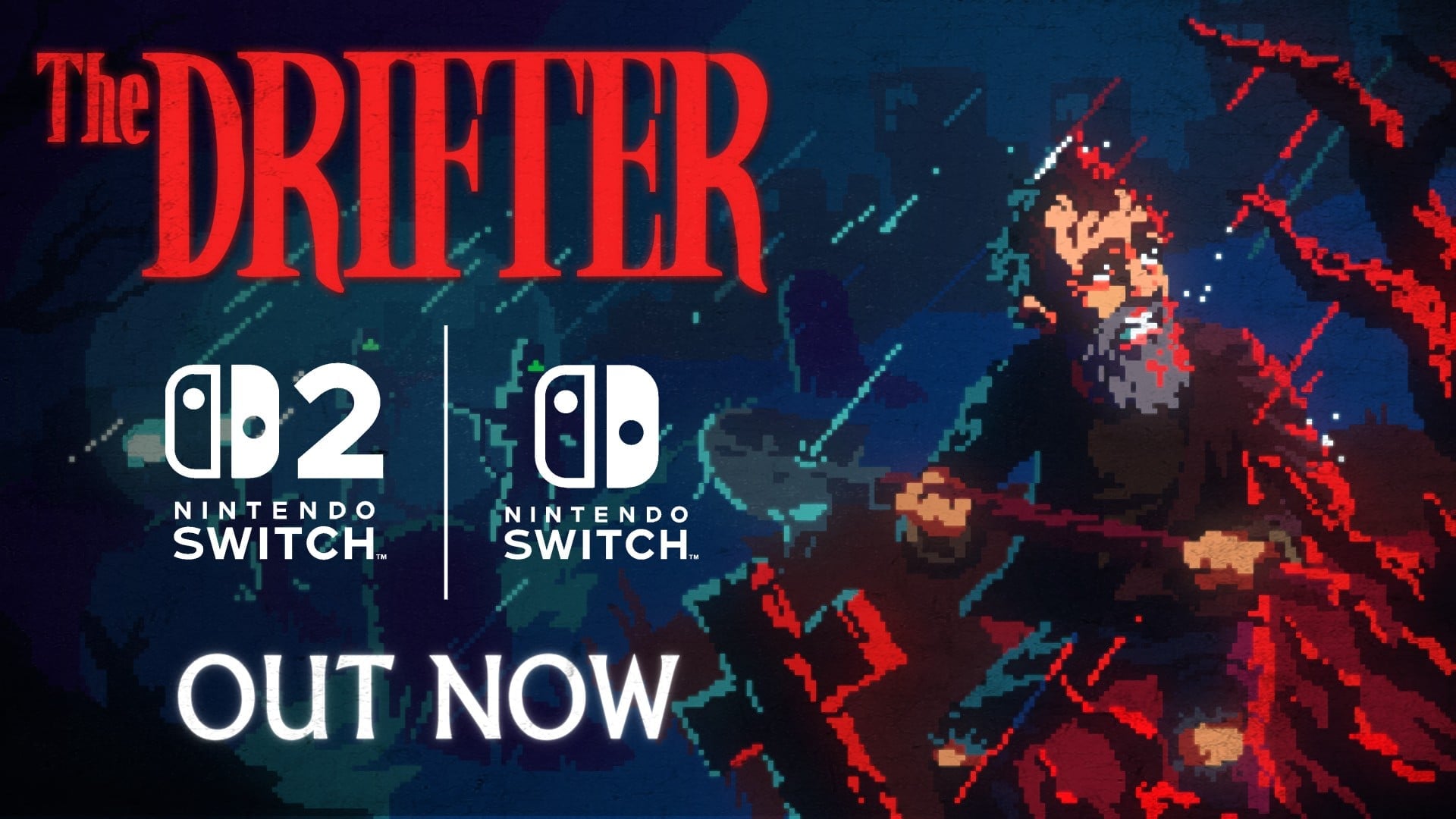
Powerhoof has released a new launch trailer for The Drifter, marking the arrival of its pulp adventure thriller on Nintendo Switch and Nintendo Switch 2. The mystery-driven experience follows Mick Carter, a drifter who is murdered before inexplicably waking up alive moments before his death. Rather than receiving time to process that rather inconvenient development, Mick becomes entangled in a dangerous conspiracy involving murder, secretive corporations and the centuries-spanning obsession of a madman.
The Drifter draws inspiration from classic point-and-click adventures while adopting a quicker and more urgent style of storytelling. Investigative puzzles connect dramatic scenes without bringing the momentum to a halt, while sharp dialogue, detailed pixel artwork, expressive animation and professional voice acting build a grim cinematic atmosphere. A brooding dark-synth soundtrack completes the presentation, giving Mick’s increasingly strange investigation the energy of a forgotten late-night thriller discovered on an old videotape.
Nintendo Switch 2 players receive several technical and control enhancements. The dedicated edition supports resolutions of up to 4K and frame rates of up to 120fps, providing sharper pixel artwork and smoother parallax scrolling on compatible displays. Joy-Con 2 mouse functionality also lets players switch between traditional point-and-click input and the game’s twin-stick control system. The regular Nintendo Switch release retains the portable appeal and controller-friendly design, making it possible to investigate Mick’s death from the sofa, on the train or anywhere else that feels suitable for uncovering an alarming corporate conspiracy. Both versions are available digitally.
The Drifter Celebrates Its Nintendo Switch Launch With a New Trailer
Powerhoof has marked the arrival of The Drifter on Nintendo Switch and Nintendo Switch 2 with a new launch trailer. The footage celebrates the game’s transition to Nintendo hardware while highlighting the mixture of murder mystery, science fiction, horror and pulp storytelling that defines Mick Carter’s increasingly dangerous predicament. Rather than presenting a quiet detective tale filled with patient conversations over cups of tea, The Drifter throws its protagonist into trouble almost immediately. Mick is murdered, revived and forced to investigate events that seem determined to become stranger every time he discovers another clue. The launch trailer offers a brisk introduction to that escalating chaos, showing expressive pixel animation, tense confrontations and environments that appear ordinary until something deeply unpleasant happens. It is an effective reminder that point-and-click adventures do not have to move at the speed of someone carefully organising a desk drawer. This one has had its brake lines cut.
A Murdered Wanderer Becomes Trapped Inside His Own Mystery
The Drifter follows Mick Carter, a wandering man whose return to familiar surroundings leads directly into a nightmare. He witnesses a violent event, becomes a target himself and is killed before he can make sense of what is happening. That should normally be the end of a protagonist’s investigation, but Mick awakens moments before his death with the terrifying knowledge of what is about to occur. His resurrection places him at the centre of a mystery that is both personal and dangerously broad. He is not merely trying to identify a stranger’s killer or recover a stolen object. Mick must determine why he came back, who wanted him dead and how his fate connects to a network of shadowy corporations, hidden experiments and an obsession stretching across a thousand years. Helping someone solve their own homicide is an unusual task, even by adventure-game standards, and it gives every discovery an immediate emotional weight.
Mick Carter Has Little Time to Understand His Second Chance
Mick’s return from death does not provide the comforting sense of security that resurrection might suggest. He remembers being killed, remains hunted and has no reason to believe that another fatal encounter will end quite so conveniently. That uncertainty creates tension around even ordinary investigations. Entering a quiet room, questioning a suspicious character or examining an abandoned object may expose another thread of the conspiracy, but it could also bring Mick closer to whoever is trying to silence him. His situation makes the mystery feel urgent without transforming the experience into an action game. The player still observes environments, collects information and solves practical problems, yet the narrative gives those familiar actions a sharper edge. Every clue feels like a step away from confusion and towards danger. Mick may have escaped death once, but he has not escaped the people, forces or secrets responsible for placing him in that position.
Pulp Fiction Influences Give the Conspiracy a Distinctive Personality
The Drifter openly embraces the heightened drama of pulp thrillers. Its story draws on influences associated with Stephen King, Michael Crichton and John Carpenter, combining unsettling supernatural ideas, dangerous scientific ambition and ordinary people caught inside extraordinary events. Powerhoof also describes a touch of 1970s Australian grindhouse, which helps distinguish the setting from the rain-soaked American cities and European mansions frequently visited by mystery games. The result is a tale that feels gritty, strange and knowingly theatrical without becoming a parody of its inspirations. Mick is not a polished secret agent carrying gadgets in every pocket. He is an exhausted man trying to understand why his life has suddenly become the centrepiece of a feverish conspiracy. That grounded perspective allows the larger ideas to feel more alarming. When the world starts bending around an everyday person, the impossible tends to look far more threatening.
Shadowy Corporations and Ancient Obsessions Raise the Stakes
The mystery expands far beyond the circumstances of Mick’s death. Secretive corporations operate behind the visible events, suggesting that the violence surrounding him is organised rather than accidental. The conspiracy also reaches into the distant past through the thousand-year obsession of a madman, connecting modern institutions to motives that have survived for generations. That combination gives The Drifter room to move between intimate danger and larger questions about power, mortality and human ambition. A corporation can hide its actions behind locked doors, paperwork and respectable branding, while an ancient fixation is far harder to contain. Put the two together and you have a recipe for disaster, or at least a very uncomfortable annual shareholders’ meeting. Mick must pull apart these layers gradually, finding the points where apparently unrelated events touch and identifying who benefits from the chaos unfolding around him.
Fast Storytelling Keeps the Traditional Adventure Formula Moving
Classic point-and-click adventures are often associated with patient exploration, lengthy conversations and puzzles that invite players to inspect every object twice. The Drifter retains the investigative foundation of that style while placing greater emphasis on momentum. Its story is designed as a roller-coaster, pushing Mick from one revelation into the next without losing the opportunity to explore environments or think through a problem. That balance is important because speed alone does not create tension. A mystery needs space for suspicion to grow and for players to consider what a clue might mean. The Drifter uses its puzzles as connective tissue between dramatic sequences, allowing the player to participate in the investigation instead of watching events unfold from a distance. The result aims to feel active without abandoning the thoughtful interaction that makes point-and-click adventures appealing in the first place.
Razor-Sharp Narrative Beats Maintain a Sense of Urgency
The story’s major moments are arranged to keep Mick moving forward, whether he is escaping immediate danger, questioning a witness or discovering evidence that changes his understanding of the conspiracy. Each narrative beat is intended to lead naturally into the next objective. That structure reduces the likelihood of wandering through every available location simply because the correct path has become impossible to recognise. Players still need to pay attention, make connections and experiment, but the surrounding drama provides a clear reason for doing so. Why is this object important? Who left it here? What does it reveal about Mick’s death? These questions are tied directly to his survival rather than existing as isolated obstacles. It gives the adventure a muscular rhythm, like a thriller that pauses long enough for you to catch your breath before opening another door that probably should have remained closed.
Logical Investigative Puzzles Connect Each Major Discovery
The Drifter places logical, grounded puzzles between its dramatic story moments. These challenges are designed around investigation and practical problem-solving instead of deliberately obscure combinations. That does not mean every answer immediately waves from the corner of the screen, but solutions should make sense within Mick’s surroundings and current objective. A useful adventure-game puzzle creates a satisfying moment of recognition. The player notices a detail, remembers another piece of information and suddenly understands how the two fit together. A frustrating one asks why Mick has decided that a rubber chicken is the only possible tool for repairing an industrial generator. The Drifter favours the first approach, using environmental clues and narrative context to point players towards solutions. This helps maintain the quicker pace while still rewarding observation and deduction.
Investigation Remains Central Without Smothering the Story
Every puzzle serves as part of Mick’s effort to understand what happened to him. Objects, conversations and locations are not merely scattered across the world as arbitrary barriers. They provide information about characters, reveal hidden connections or allow Mick to reach the next part of his investigation. This approach keeps the player involved in the unfolding mystery because progress depends on interpreting evidence rather than simply selecting the correct dialogue prompt. The pacing also benefits from puzzles that support the story instead of interrupting it. When a solution feels connected to Mick’s circumstances, completing it produces more than mechanical satisfaction. It can reveal a motive, expose a lie or uncover another part of the conspiracy. The mystery and the interaction pull in the same direction, which is exactly where they should be heading when somebody has already been murdered once.
Nintendo Switch 2 Delivers Sharper Pixel Art and Smoother Motion
The Nintendo Switch 2 Edition of The Drifter takes advantage of the newer hardware with support for resolutions of up to 4K and frame rates of up to 120fps. The exact output naturally depends on the display and playing conditions, but these options allow the game’s dense pixel artwork to appear particularly sharp on compatible screens. Higher frame rates also improve the smoothness of animation and parallax scrolling, helping layered backgrounds move past one another with greater fluidity. Pixel art may use deliberately visible blocks, but presenting it well still depends on clean scaling, stable movement and carefully handled detail. The enhanced edition preserves the handmade appearance while giving its environments more clarity. Rain, shadows, industrial spaces and grim urban locations can retain their crunchy texture without looking muddy. It is a little like cleaning the window of a suspicious roadside motel. The view remains unsettling, but at least you can see it properly.
High Frame Rates Enhance the Layered Scrolling Effects
Parallax scrolling creates depth by moving foreground and background layers at different speeds. It is a familiar technique in 2D games, yet its effectiveness depends heavily on smooth motion. The Drifter uses layered environments to make streets, interiors and landscapes feel more substantial than a single flat backdrop. Support for up to 120fps on Nintendo Switch 2 can make those layers glide with added fluidity, particularly during scenes involving camera movement or detailed animation. The benefit is not simply a larger number printed on a technical specification. Smoother movement can strengthen the cinematic presentation and make transitions feel more immediate. When Mick runs through a threatening location or the camera shifts to reveal something alarming, consistent motion helps the scene maintain its impact instead of drawing attention to the machinery behind it.
Joy-Con 2 Mouse Functionality Supports Classic Point-and-Click Play
Nintendo Switch 2 players can use the Joy-Con 2 mouse sensor functionality to control the pointer directly. This offers a more traditional way to interact with environments, examine objects and choose dialogue options. For players who grew up guiding an arrow across computer screens, mouse-style input can feel like returning to a familiar language. It also suits the investigative nature of The Drifter, where carefully selecting environmental details forms a central part of play. The useful twist is that players are not locked into one method. The game allows switching between mouse-based point-and-click interaction and its twin-stick controller system. That flexibility means the controls can change alongside the situation. A player may prefer mouse movement while sitting at a desk, then return to the sticks when relaxing on the sofa or playing in another position.
Switching Control Methods Makes the Adventure More Flexible
The ability to swap between control styles prevents the Nintendo Switch 2 Edition from treating one input method as the only correct choice. Traditional point-and-click controls offer direct cursor movement, while the twin-stick system is built around the physical layout of a modern controller. Both approaches lead through the same mystery, but they can create noticeably different rhythms. Mouse input encourages precise movement between interactive details, whereas twin-stick controls make the adventure feel closer to other controller-driven narrative games. Players can choose whichever method feels natural rather than wrestling with a rigid design. That matters for an experience where attention should remain on suspicious characters, environmental clues and Mick’s increasingly worrying situation. The last thing anyone needs during a murder investigation is an argument with the cursor.
Twin-Stick Controls Make Handheld and Television Play Feel Natural
Powerhoof designed The Drifter with controller play in mind rather than treating it as a late conversion from mouse input. Its twin-stick system was built to support both handheld sessions and play on a television. This gives Nintendo Switch owners a control method suited to the console’s flexible nature, whether the system is held directly, placed on a table or connected to a larger display. Adventure games can struggle on controllers when a slow virtual cursor is expected to imitate a mouse without any meaningful adaptation. The Drifter approaches the problem more deliberately, using twin-stick input to make navigation and interaction feel responsive. That design also means regular Nintendo Switch players receive a control scheme shaped around their hardware instead of depending on the mouse functionality found on Joy-Con 2.
Portable Play Fits Mick Carter’s Unpredictable Investigation
The Drifter’s story-driven structure makes it well suited to portable sessions. Players can explore a location, solve an investigative puzzle or continue through another dramatic sequence without needing a permanent desk setup. The Nintendo Switch version allows Mick’s grim journey to travel almost anywhere, which feels strangely appropriate for a game about a man who has spent much of his life drifting from place to place. Of course, playing a tense conspiracy thriller on public transport may create the occasional awkward moment when someone glances over during a particularly violent scene. That is their problem now. More importantly, handheld play gives players another way to engage with the mystery, while the television option preserves the impact of its larger animated scenes and dark environments.
Detailed Pixel Art Creates a Grim and Unpredictable Australian World
The Drifter uses raw, detailed pixel art rather than smoothing every surface into a clean modern illustration. Its characters, backgrounds and effects retain a rough texture that matches the story’s grim tone. Streets feel damp and unwelcoming, industrial locations seem heavy with machinery, and quiet interiors carry the uncomfortable suggestion that somebody may be watching from outside the frame. High-impact animation gives the artwork additional energy during violent confrontations and cinematic transitions. Pixel art is sometimes mistaken for visual simplicity, but convincing animation within a limited grid requires careful control over posture, timing and silhouette. A few changed pixels can transform a calm expression into fear or make an impact feel brutally immediate. Powerhoof uses those constraints to create scenes that look handcrafted while moving with dramatic confidence.
Australian Grindhouse Energy Separates the Setting From Familiar Mysteries
The Australian influence gives the environments and dialogue a character that differs from the familiar settings of many noir and conspiracy stories. The Drifter does not need to imitate smoky American detective offices or fog-covered English villages to create mystery. Its atmosphere comes from local voices, harsh landscapes, worn urban spaces and the slightly reckless energy associated with grindhouse cinema. That regional flavour helps the stranger elements stand out. When supernatural events and corporate secrets invade a world that feels culturally specific, the contrast gives them added force. Mick’s surroundings are not merely decorative backgrounds. They shape his personality, the people he encounters and the tone of the unfolding investigation. The result feels less like a collection of genre references and more like a pulp thriller that knows exactly where it lives.
Voice Acting and Dark-Synth Music Strengthen the Cinematic Atmosphere
Professional voice acting gives the cast distinct personalities and helps conversations maintain the urgency of the wider story. Mick needs to sound exhausted, suspicious and frightened without becoming passive, while the people around him must leave players wondering who can be trusted. Spoken performances can communicate hesitation, hidden hostility and panic in ways that written dialogue alone may not capture. The voice work is supported by a brooding dark-synth score that reinforces the game’s cinematic ambitions. Electronic textures fit naturally with the science-fiction and horror elements, while heavier tones create unease before the source of danger becomes visible. Together, the performances and music make The Drifter feel closer to an interactive thriller than a silent sequence of puzzle rooms.
The Soundscape Keeps Quiet Scenes From Feeling Safe
A strong thriller understands that silence is rarely empty. The Drifter’s music and environmental sound can turn an apparently calm location into a place where danger feels close enough to touch. Low electronic notes, distant mechanical noises and carefully timed effects keep tension present while Mick searches for clues. The game does not need a monster to leap into view every few minutes when the soundtrack can quietly suggest that something is wrong. Voice acting contributes to that uncertainty as well. A friendly response may sound rehearsed, while a pause can reveal more than the words surrounding it. These details help the mystery breathe between major revelations. Players are given enough space to investigate, but not enough comfort to forget that Mick’s killer may still be searching for him.
The Drifter Brings Powerhoof’s Distinctive Style to Nintendo Consoles
Powerhoof is known for games with striking pixel artwork, expressive animation and mechanical ideas that do not neatly follow familiar templates. The Drifter carries that personality into the adventure genre while moving away from the multiplayer dungeon battles associated with Crawl. It is a single-player experience built around narrative momentum, investigation and atmosphere, yet the visual confidence remains immediately recognisable. The studio’s approach gives the game a physical sense of movement that is not always present in point-and-click adventures. Characters do more than stand beside objects and explain them. They run, struggle, react and occupy scenes with exaggerated but purposeful animation. Bringing the game to Nintendo Switch and Nintendo Switch 2 allows a wider group of players to experience that mixture of old-school interaction and modern pacing.
A Digital Release Makes the Mystery Immediately Accessible
The Drifter is available as a digital download for Nintendo Switch and Nintendo Switch 2. Players can therefore begin Mick Carter’s investigation directly through Nintendo’s digital storefront, without waiting for a physical copy to arrive or checking whether a nearby retailer has stocked it. The Nintendo Switch 2 Edition provides the enhanced resolution, frame-rate support and Joy-Con 2 mouse functionality, while the regular Switch version delivers the same central mystery with its controller-friendly design and portable format. The launch trailer serves as a final invitation to enter Mick’s violent and unpredictable world, although invitation may be too polite a word. The game is more likely to grab players by the collar, point towards a freshly committed murder and ask whether they would mind solving several impossible events before anyone else dies.
Conclusion
The Drifter brings a fast-moving blend of point-and-click investigation, pulp horror and science-fiction conspiracy to Nintendo Switch and Nintendo Switch 2. Mick Carter’s attempt to solve his own murder gives the story an immediate hook, while logical puzzles ensure players remain involved in uncovering the truth. Detailed pixel artwork, forceful animation, professional performances and dark-synth music give the mystery a cinematic personality rooted in Australian grindhouse influences. Nintendo Switch 2 enhances the presentation with support for up to 4K and 120fps, alongside Joy-Con 2 mouse functionality that complements the existing twin-stick controls. Whether played with a pointer, a controller, on a television or in handheld mode, The Drifter offers a tense mystery where death is merely the beginning of Mick’s problems. The launch trailer celebrates its arrival, and both Nintendo versions are now available digitally.
FAQs
- What is The Drifter about?
- The Drifter follows Mick Carter, a murdered wanderer who awakens moments before his death and must investigate his own homicide. His search leads into a conspiracy involving secretive corporations, murder and an obsession stretching back a thousand years.
- Is The Drifter available on Nintendo Switch?
- Yes. The Drifter is available digitally for both Nintendo Switch and Nintendo Switch 2.
- What enhancements are included in the Nintendo Switch 2 Edition?
- The Nintendo Switch 2 Edition supports resolutions of up to 4K, frame rates of up to 120fps and Joy-Con 2 mouse functionality on compatible equipment.
- Can The Drifter be played without mouse controls?
- Yes. The game includes a twin-stick controller system designed for handheld and television play. Nintendo Switch 2 players can switch between that system and mouse-style point-and-click input.
- Who developed The Drifter?
- The Drifter was developed by Powerhoof and Dave Lloyd, with Powerhoof also serving as its publisher.
Sources
- The Drifter Drifts Onto Switch & Switch 2, Powerhoof, June 23, 2026
- The Drifter Launch Trailer, Nintendo Everything, June 27, 2026
- The Drifter – Nintendo Switch 2 Edition, Nintendo, June 22, 2026
- The Drifter, Steam, July 17, 2025
- Pulp Thriller The Drifter Launches on Switch and Switch 2 on June 22, Bloody Disgusting, June 11, 2026