




Summary:
The Digital Foundry analysis of The Legend of Zelda: Ocarina of Time remake reveals a thoughtful, modern rebuild that preserves the original game’s spirit while delivering clear technical improvements on the Nintendo Switch 2. Key takeaways include a target of 60 frames per second, dynamic resolution scaling that reaches up to 1440p in docked mode and down toward 1080p, handheld ranges between 1080p and 720p, and the use of SMAA with AMD FSR 1 instead of DLSS. Beyond raw numbers, Digital Foundry highlights richer materials, new lighting and global illumination, more detailed environments, and small interactive touches like foliage reacting to Link and physicalized pot shards. These changes point to a remake that balances visual polish and stable performance, and gives both longtime fans and newcomers a version of Hyrule that feels alive and modern.
Digital Foundry – The Legend of Zelda: Ocarina of Time’s key technical findings
Digital Foundry’s breakdown is the best place to start when you want a measured look at how this remake was built and how it performs. Their analysis identifies several consistent technical patterns: an image pipeline that relies on SMAA anti-aliasing paired with AMD FSR 1 spatial upscaling rather than Nvidia DLSS, dynamic resolution scaling that targets a higher ceiling in docked play, and an emphasis on stable 60 FPS across both docked and handheld. They also call out a lot of visual work – new physically based materials, a more advanced global illumination approach, and more detailed art assets across environments. For fans comparing eras, Digital Foundry draws direct lines between the remake and previous builds of modern Zelda games, noting familiar tech choices while highlighting careful tuning to keep performance rock solid.

Resolution, dynamic scaling and why the numbers matter
Resolution is more than a single number for this remake. Digital Foundry reports a docked ceiling that reaches around 1440p, with dynamic scaling dropping toward roughly 1080p under load, while handheld play moves between 1080p and 720p depending on scene complexity. That dynamic approach lets the game deliver higher fidelity where it counts – wide vistas, menus, and cutscenes – while pulling back in dense zones to preserve smooth frame pacing. The absence of DLSS means Nintendo and the developer relied on FSR 1 and SMAA for image quality and temporal stability, so visual sharpening and artifact handling differ from DLSS-equipped titles. For players, this means crisp presentation in many moments and occasional softness when scaling is doing the heavy lifting, but overall a consistent experience that prizes smoothness over peak resolution spikes.
Frame rate: locked target, stability and VRR implications
One of the most welcome findings is the remake’s target of 60 frames per second and how consistently it hits that mark. Digital Foundry notes performance is very stable, with only tiny loading hiccups affecting the frame rate rather than large, sustained drops. That stability makes variable refresh rate features less necessary in practice, because the game rarely deviates from its target. Compared with the original N64’s roughly 20 FPS and the 3DS remaster’s 30 FPS, the 60 FPS target fundamentally changes how the game feels – movement is crisper, camera control is more responsive, and combat timing benefits. For players who care about responsiveness, the stable 60 FPS is a defining improvement that makes traversal and targeting feel modern without altering the core pacing that makes Ocarina of Time memorable.
Visual upgrades and engine tech influences
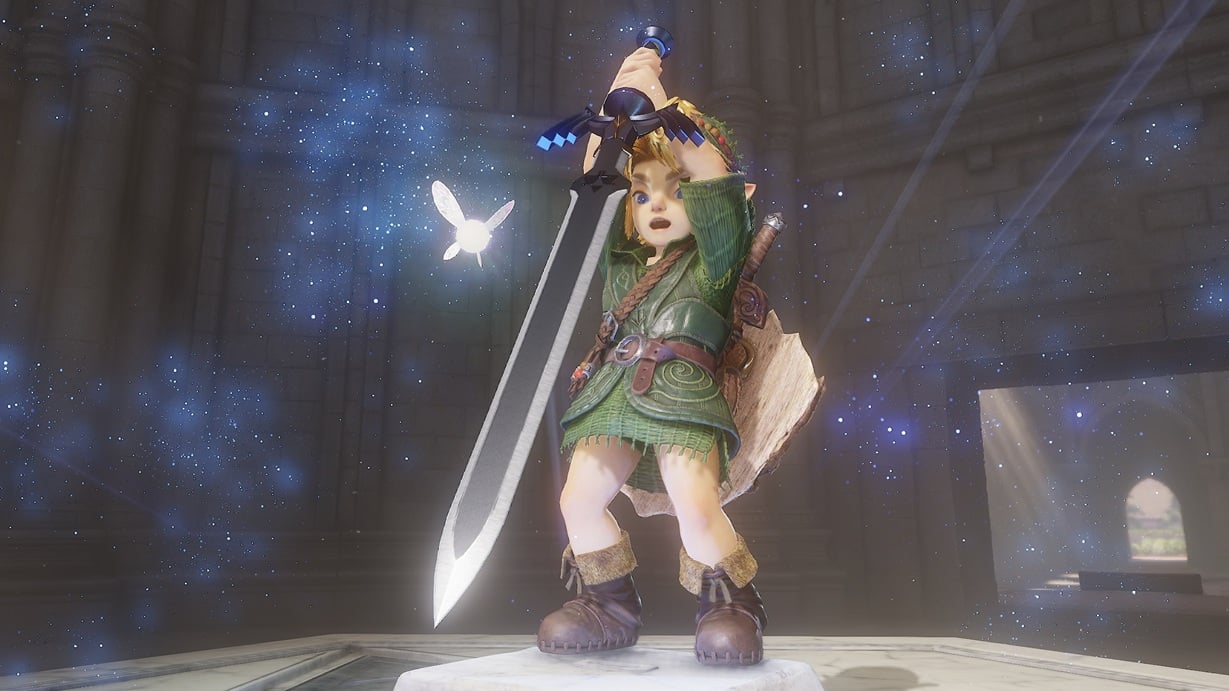
Beyond resolution and framerate, the remake shows a clear investment in modern rendering techniques. Digital Foundry suggests the project borrows underlying tech and workflows familiar to recent Zelda titles, which helps explain the jump in asset quality and material fidelity. The remake introduces physically based materials, richer global illumination and ambient occlusion, and more robust cutscene presentation. That combination brings depth to bricks, foliage and architecture that used to be flat or hinted at on older hardware. The team also integrated both baked lighting and selective real-time elements to balance quality and performance. These choices mean the world reads as both handcrafted and technically contemporary, with lighting and materials that respond believably under different times of day and camera angles.
World details – foliage, physics and small interactive flourishes
Small touches give the remake a lived-in feeling. Digital Foundry highlights lush, varied foliage that responds to Link’s movement and to wind or air in the environment, which helps scenes feel tactile rather than purely decorative. Pots and breakable objects now leave physical shards that remain in place, and fluid simulations and low-lying fog add atmosphere in appropriate areas. Navi is called out as an actual light source in certain scenes, which changes how nearby surfaces are shaded and can make dark places feel more dynamic. The level team also reworked zones like Castle Town so some previously loading-heavy segments feel seamless, while other parts still use major zone loading. Together these details add up to a world that reacts and rewards exploration in ways that were impossible on the original hardware.
Gameplay tuning and design changes that respect the original
Gameplay changes are careful and selective – they modernize controls and options without rewriting the game. The remake adds new animation work, different HUD options, voice acting in cutscenes, and tweaks such as allowing full 360-degree movement when climbing. Some mechanics get narrowly adjusted for clarity – the Hookshot now attaches only to specific points rather than anywhere, and a previously animated drawbridge was made static so it no longer rises and falls with the sunset. These decisions suggest a philosophy of preserving the original’s design while removing ambiguous or frustrating interactions. Where environments needed it, Nintendo reshaped or reworked areas such as the castle yard, but retained the feel of the original Hyrule; the result is familiar territory that also offers fresh surprises for players revisiting the map.
Loading behavior, seamlessness and map flow
Loading is another area where the remake makes targeted choices. Digital Foundry observes that while major zones still require loads, many buildings and interiors are handled without separate loading screens, which improves flow while keeping memory and CPU costs manageable. Castle Town is highlighted as now being fully seamless in many parts, which removes jarring transitions players remember from earlier versions. There are still moments where the engine streams or swaps large assets, so very large areas may trigger small, brief hiccups. Overall the compromise leans toward continuous exploration wherever practical, and the changes make travel feel more natural without hiding the technical realities of streaming a richer world on the Switch 2.
What these technical choices mean for fans and newcomers
For longtime players, the remake keeps the bones of Ocarina of Time intact while giving the world a level of detail and smoothness that modern audiences expect. The jump to 60 FPS alone transforms control and camera interactions, making well-worn routes feel snappier and fights more immediate. New visual flourishes, improved lighting and physicalized debris bring a new sense of place, while selective gameplay tweaks remove friction without erasing nostalgia. New players get a version of the game that looks and feels like a modern Nintendo title, with clearer performance and presentation. For everyone, this remake is a reminder that careful tech choices – stable frame pacing, dynamic resolution, and visual polish – can refresh a classic without losing what made it great in the first place.
Conclusion
The Digital Foundry analysis shows Nintendo and its team struck a careful balance between honoring the original Ocarina of Time and bringing it into the modern era. Performance prioritizes a stable 60 FPS, resolution scales to keep visuals strong where it matters, and the art and lighting upgrades make Hyrule feel both familiar and new. Small interactive touches and design tweaks improve the player experience, while streaming choices keep exploration smooth in most areas. For fans of the series, this remake offers a polished, playable Hyrule that stays true to the game’s DNA while benefiting from decades of technical progress.
FAQs
- Does the remake run at 60 FPS?
- Yes – Digital Foundry reports the remake targets a stable 60 frames per second in both docked and handheld modes, with only very small loading-related dips.
- What resolution does it use on Switch 2?
- The game uses dynamic resolution that can reach up to about 1440p in docked play and scales down toward 1080p when required; handheld play ranges between 1080p and 720p according to analysis.
- Does Ocarina of Time remake use DLSS?
- No – Digital Foundry finds the remake does not use DLSS and instead uses SMAA with AMD FSR 1 for image processing.
- Are there changes to the world and levels?
- Yes – Some areas have been reshaped or reworked, Castle Town has more seamless sections, and certain mechanics or environmental interactions were adjusted to improve flow.
- What visual and physics upgrades should I expect?
- Expect physically based materials, improved global illumination and ambient occlusion, foliage that reacts to movement, physicalized shards for broken pots, and more detailed environmental artistry overall.
Sources
- The Legend of Zelda: Ocarina of Time 2026 – Switch 2 DF Tech Review, Digital Foundry, November 4, 2026
- The Legend of Zelda: Ocarina of Time on Switch 2 delivers on every front as a remake, TechRadar, November 4, 2026
- Zelda: Ocarina of Time remake tech analysis, including frame rate and resolution, NintendoEverything, November 4, 2026