














Summary:
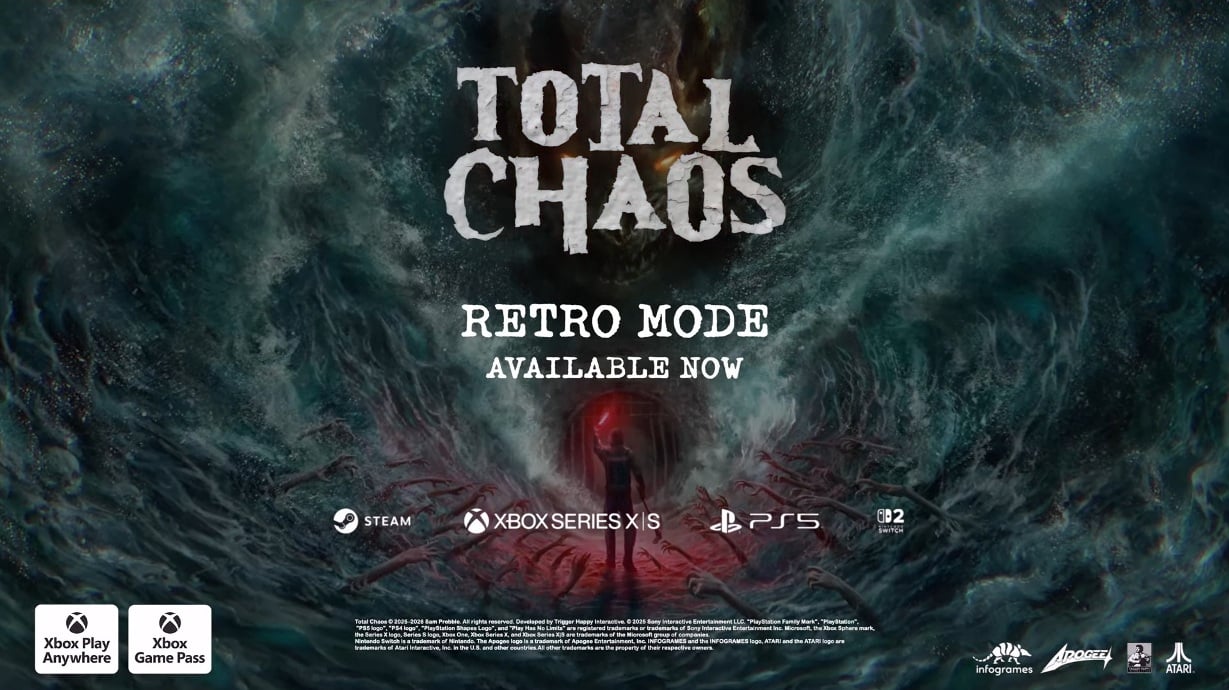
Total Chaos has received a substantial update that gives its nightmare world a distinctly older appearance. Apogee Entertainment and Trigger Happy Interactive have introduced Retro Graphics mode, allowing players to explore Fort Oasis with reduced texture detail, stronger pixelation, low-poly creatures and post-processing effects inspired by classic survival horror. The visual option pays tribute to the game’s beginnings as a total conversion mod for Doom II while also recalling the rough, shadowy presentation associated with PlayStation 2-era horror games.
The update is more than a visual filter. New Game Plus now includes an Epilogue that leads to an alternative conclusion, bringing the game’s total number of endings to five. Players who have already survived the island therefore have another mystery to chase, along with an extra incentive to examine familiar areas for overlooked clues and hidden meaning.
Several practical improvements also make the journey through Fort Oasis easier to manage. A map and location markers help players understand where they are, while save files can display total playtime. An optional HUD setting provides the same information during play. Inventory management has also been expanded through a garbage chute that stores unwanted items until the end of a chapter, giving players one final opportunity to recover anything they discarded. Meanwhile, the Protector sequence in the Forgotten chapter has been reworked to provide a smoother experience. Together, these additions make the update useful for returning survivors and anyone entering Fort Oasis for the first time.
Total Chaos Brings Retro Graphics Mode to Nintendo Switch 2
Total Chaos has gained a striking new way to experience its crumbling industrial nightmare. The newly introduced Retro Graphics mode replaces some of the game’s modern visual sharpness with a deliberately rougher presentation built around pixelation, lower-resolution textures and simplified enemy models. It is the sort of transformation that makes a rusted corridor feel as though it has been pulled from a dusty memory card rather than rendered by modern hardware. That contrast works especially well in a survival horror game, where visual uncertainty can be just as unsettling as the creature waiting around the next corner. Nintendo Switch 2 players can access the mode through the new update, although regional rollout timing may cause the patch to appear at slightly different moments for some users.

Retro Graphics Mode Reconnects Total Chaos With Its Doom II Origins
The retro presentation is not simply a random nod to old games. Total Chaos began life as an ambitious total conversion mod for Doom II, using the foundations of id Software’s influential shooter to create something far darker and more methodical. Trigger Happy Interactive later rebuilt that concept as a standalone survival horror experience, but its roots remain an important part of its identity. Retro Graphics mode brings that history closer to the surface. Instead of hiding the game’s past beneath modern rendering, the update celebrates it with a visual style that recalls both the original mod and the experimental horror games that defined an earlier generation. It feels less like putting an old costume on the game and more like uncovering a layer that was always buried underneath.
Reduced Textures and Pixelation Transform Fort Oasis
Fort Oasis is already an unpleasant place in the best possible horror-game sense. Its abandoned structures, narrow passages and decaying machinery create the feeling that the island itself is slowly collapsing. Retro Graphics mode changes how players read those surroundings by reducing texture resolution and increasing visible pixelation. Walls become murkier, distant shapes lose some clarity and objects can look rougher around the edges. That loss of detail is intentional. Modern graphics often reveal exactly what stands in front of you, while older visuals force your imagination to fill in the gaps. Is that shape a pile of debris, a doorway or something breathing in the darkness? When the image refuses to provide a clean answer, the mind happily invents something worse.
Low-Poly Monsters Give Familiar Encounters a Different Personality
The creatures stalking Fort Oasis have also received new low-poly models while Retro Graphics mode is active. Their simplified shapes recall the angular enemies found in older three-dimensional games, complete with sharp silhouettes and unnatural proportions. These designs may technically contain less detail, but they can feel even more disturbing because they do not move or appear like ordinary living things. A monster with smooth animation and detailed skin is frightening in one way. A jagged collection of limbs emerging from a heavily pixelated hallway is frightening in another, particularly when the darkness makes it difficult to understand its exact form. Returning players may recognise the behaviour of these enemies, but their revised appearance can make familiar confrontations feel unexpectedly fresh.
Screen Effects Complete the PlayStation 2-Era Presentation
The transformation extends beyond textures and character models. Additional post-processing effects pixelate the overall image and introduce visual touches designed to strengthen the old-school atmosphere. The result draws clear inspiration from the era when survival horror games used limited visibility, heavy shadows and imperfect image quality to build tension. Those limitations often became creative tools. A foggy street could conceal technical restrictions and a monster at the same time, which was rather convenient for developers and absolutely terrible for anyone nervously holding a controller. Retro Graphics mode applies that philosophy to Total Chaos without changing the underlying structure of the game. Players still explore the same Fort Oasis, but the altered image gives its corridors a grittier and more mysterious character.
New Game Plus Epilogue Introduces a Fifth Ending
The update also expands the story through the New Game Plus Epilogue. Completing this additional sequence can lead players to an alternative ending, increasing the total number of possible conclusions to five. That is a meaningful addition for a game built around mystery, unreliable perceptions and the buried history of Fort Oasis. A new ending does more than provide a different final scene. It can alter how players interpret earlier conversations, environmental details and seemingly minor discoveries. Survival horror stories often work like cracked mirrors, showing fragments of the truth without offering a perfectly clean reflection. The Epilogue adds another piece to that mirror and invites players to decide whether it clarifies the picture or makes the mystery even stranger.
The Additional Finale Offers Another Reason to Return
Reaching the new conclusion requires players to engage with the New Game Plus Epilogue, so it is aimed primarily at survivors who have already completed the main journey. That makes sense, as New Game Plus offers an opportunity to revisit Fort Oasis with greater knowledge of its threats and layouts. Of course, knowledge only provides so much comfort when the game is actively looking for new ways to make you nervous. The fifth ending gives repeat playthroughs a clear objective beyond improving combat efficiency or collecting missed resources. Players can search for further secrets, reconsider earlier choices and watch for clues that may have seemed meaningless during the first run. The promise of another answer is a powerful lure, even when every step toward it leads deeper into a collapsing nightmare.
Map and Location Markers Make Fort Oasis Easier to Navigate
Fort Oasis is not designed like a welcoming holiday destination. Its dark interiors, damaged pathways and maze-like spaces can leave players unsure whether they are exploring a new route or returning to the same miserable corridor for the third time. The update addresses that challenge with a map and new location markers. These additions should help players understand their position and plan a route without removing the need to explore carefully. Better navigation is particularly valuable in survival horror, where getting lost can consume resources and expose players to additional danger. A map cannot defeat the creatures waiting in the darkness, but it can at least stop you from carrying three healing items and a broken pipe in the wrong direction for twenty minutes.
The markers may also make it easier to resume a playthrough after taking a break. Horror games rely heavily on atmosphere, but that atmosphere can become frustration when a returning player has forgotten which industrial tunnel leads toward the next objective. Clearer location information reduces that problem while preserving the island’s oppressive layout. It is a practical quality-of-life improvement that supports exploration rather than replacing it. Players still need to pay attention to their surroundings, inspect suspicious areas and decide whether an uncertain path is worth the risk. They simply have better tools for understanding where that path begins and where it may eventually lead.
Playtime Tracking Gives Save Files More Useful Information
Save files now display how long each nightmare has been unfolding. It is a small feature, but it provides useful context when managing multiple saves or returning to an older playthrough. Players can quickly see which file represents their main run, which one belongs to a shorter experiment and which one records the evening when they spent far too long searching for a door that was directly behind them. Playtime is also useful for anyone comparing different endings or measuring the impact of a more efficient route through Fort Oasis. The information gives each save file a clearer identity without interfering with the game itself.
An optional HUD setting can also show playtime during normal gameplay. Players who enjoy tracking their progress can keep the timer visible, while those who prefer a cleaner and more immersive display can leave it disabled. That flexibility is important in a horror experience, as too much interface information can weaken the feeling of isolation. Some players want every useful statistic available at a glance, while others would rather see nothing except a dim corridor and the rapidly approaching consequences of a poor decision. By making the HUD display optional, the update accommodates both styles without forcing either group to compromise.
The Garbage Chute Adds a Practical Inventory Management Option
Inventory space is always precious in survival horror. Players constantly face the uncomfortable question of what to keep, what to use and what to abandon. The new garbage chute provides another way to manage unwanted belongings during a chapter. Items placed inside can be removed from the active inventory, freeing space for weapons, healing supplies or other resources that may be more useful in the immediate situation. This creates room without making discarded equipment vanish instantly. At the end of the chapter, players receive one final chance to retrieve the stored items, which reduces the sting of a decision that later turns out to have been spectacularly unwise.
The feature should encourage players to organise their inventory more confidently. Instead of carrying every object because it might become useful several hours later, they can temporarily store lower-priority equipment and continue exploring. The system does not eliminate difficult choices, as players still need to decide what deserves an active slot and what can safely enter the chute. It simply makes those choices more flexible. In a game where danger can arrive with little warning, a single free inventory space may separate a well-prepared survivor from someone attempting to defeat a nightmare with an interesting collection of scrap metal.
The Forgotten Chapter Receives a Smoother Protector Section
The update reworks the Protector section found within the Forgotten chapter. According to the announced feature list, the changes are intended to create a smoother experience for players. Although the update description does not detail every adjustment, the stated goal suggests that progression through this portion should feel more consistent and less disruptive. Chapter-specific improvements can be especially valuable in a game with a carefully constructed atmosphere. A confusing objective, awkward encounter or sudden difficulty spike can pull players out of the tension and make them think about mechanics rather than the threat surrounding them.
Refining the Protector section helps the chapter maintain momentum and allows its unsettling tone to remain the focus. It also demonstrates that the update is not limited to adding headline features such as a visual mode and another ending. Existing parts of the game are receiving attention as well. For new players, the revised sequence will simply become part of their first experience. Returning players, however, may notice how the pacing and flow have changed. These targeted adjustments can make a major difference, particularly when they address a section that previously felt less polished than the rest of the journey.
Retro Mode Expands an Already Oppressive Survival Horror Experience
Total Chaos combines exploration, resource management, crafting and psychological horror within the ruins of Fort Oasis. The island was once associated with mining, but it has become a decaying wasteland filled with hostile creatures and disturbing secrets. A mysterious radio transmission draws the player farther into its abandoned spaces, where reality becomes increasingly difficult to trust. Retro Graphics mode suits this premise because imperfect visuals naturally complement uncertainty. Pixelated shadows hide information, low-poly enemies appear strangely unnatural and rough textures make the environment feel old, contaminated and forgotten.
The visual option also allows players to choose what kind of horror atmosphere they prefer. The standard presentation highlights the detail and scale of the modern remake, while Retro Graphics mode creates something closer to an unearthed game from an earlier console generation. Neither approach needs to replace the other. They offer different interpretations of the same nightmare. One is sharp enough to show the rot spreading across the walls. The other leaves just enough unanswered for your imagination to finish the job, which is rarely good news when you are already exploring an abandoned island in the dark.
Combined with the fifth ending and quality-of-life improvements, the update gives both new and returning players meaningful reasons to enter Fort Oasis. Newcomers benefit from better navigation, clearer save information and the revised chapter sequence. Existing players receive a different visual experience and an additional conclusion to uncover. This balance makes the update feel useful rather than decorative. Retro Graphics mode may attract most of the attention, but the surrounding additions address practical parts of the experience and expand its replay value.
Total Chaos Remains Available Through the Nintendo eShop
Total Chaos is available digitally for Nintendo Switch 2 through the Nintendo eShop. The Nintendo listing describes it as a gripping nightmare that blurs the boundary between reality and madness, with players exploring the remains of Fort Oasis after receiving a cryptic radio transmission. The Nintendo Switch 2 version launched on April 29, 2026, in European regions and requires approximately 8.8 GB of storage according to Nintendo’s regional listing. Supported languages include English, Japanese, Spanish, French, German, Italian, Portuguese, Russian, Korean, Chinese and Polish.
Players who already own the game should check for the latest software update before looking for Retro Graphics mode or the other additions. Availability can vary slightly during a staged platform rollout, so the patch may not reach every region at exactly the same moment. Once installed, the update provides the retro presentation, expanded New Game Plus ending and various interface and gameplay improvements. Anyone purchasing the game after the update should also ensure the newest version has finished downloading before beginning the descent into Fort Oasis. The island is confusing enough without wondering whether the map feature has gone missing.
Conclusion
The Retro Mode update gives Total Chaos a clever link to its past while improving several parts of its present. Retro Graphics mode transforms Fort Oasis through pixelated effects, reduced texture detail and low-poly monsters inspired by classic horror games and the project’s Doom II origins. The New Game Plus Epilogue adds a fifth ending, giving returning players another secret to pursue. Meanwhile, map markers, playtime displays, the garbage chute and changes to the Forgotten chapter make the overall experience easier to navigate and manage. It is a strong mixture of atmosphere, replay value and practical refinement. Whether you prefer modern detail or a screen full of ominous pixels, Fort Oasis is ready to make you regret entering it all over again.
FAQs
- What does Retro Graphics mode change in Total Chaos?
- Retro Graphics mode reduces texture resolution, increases pixelation, applies old-school screen effects and replaces monsters with low-poly models. The result is inspired by the original Total Chaos mod and classic PlayStation 2-era survival horror games.
- Does the Total Chaos update add a new ending?
- Yes. The New Game Plus Epilogue introduces an alternative conclusion, bringing the total number of endings in Total Chaos to five.
- What navigation improvements are included in the update?
- The update adds a map and location markers to help players understand their position and navigate the dark, maze-like areas of Fort Oasis more easily.
- How does the new garbage chute work?
- Players can place unwanted items in the garbage chute to free inventory space. The stored objects can be recovered one final time at the end of the current chapter.
- Is Total Chaos available for Nintendo Switch 2?
- Yes. Total Chaos is available digitally for Nintendo Switch 2 through the Nintendo eShop. Players should install the latest update to access Retro Graphics mode and the other newly added features.
Sources
- Total Chaos Gains New Retro Graphics Mode Update, Nintendo Everything, July 24, 2026
- Total Chaos Delivers Classic Scares With Newly Added Retro Mode in New Update, Saving Content, July 24, 2026
- Total Chaos, Nintendo, April 29, 2026
- Total Chaos Is Getting a Low-Poly Retro Mode, Game Informer, July 16, 2026
- Apogee Entertainment and Sam Prebble Release Expansive New Game Mode for Total Chaos, Games Press, March 16, 2026