














Summary:
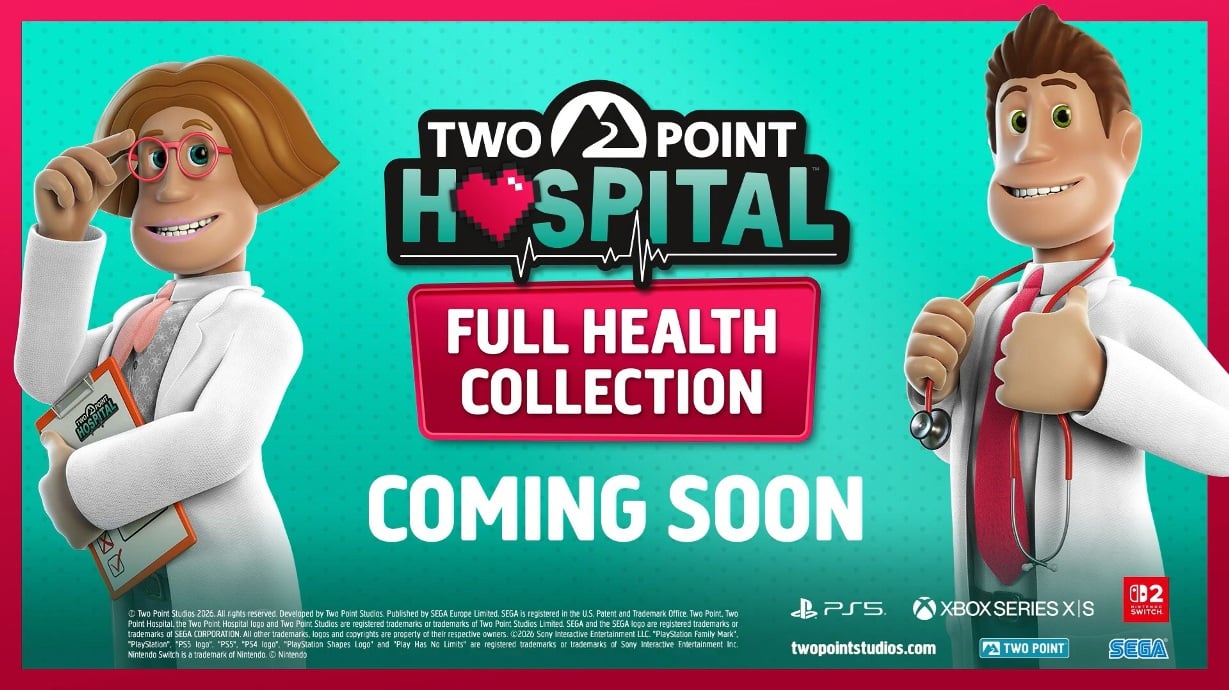
SEGA and Two Point Studios have announced Two Point Hospital: Full Health Collection for Nintendo Switch 2, giving players a new way to experience the wonderfully chaotic hospital management simulator. A specific release date has not been revealed, but the collection is described as coming soon, with further information planned for a later date.
Two Point Hospital: Full Health Collection combines the original game with every piece of downloadable and bonus material released for it. That means players can build medical facilities across a wide variety of locations, tackle unusual regional challenges and treat patients suffering from illnesses that would make a real doctor quietly reconsider their career. The package includes major expansions such as Culture Shock, A Stitch in Time, Close Encounters, Off the Grid and Speedy Recovery, alongside item packs, costumes and promotional bonuses.
The basic goal remains easy to understand but difficult to master. Players begin with an empty building and gradually turn it into a functioning hospital by constructing treatment rooms, hiring staff, researching equipment and keeping patients happy. Success unlocks additional locations, but each region introduces new problems that demand different layouts and management strategies.
Although technical details for the Nintendo Switch 2 edition have not been confirmed, the newer hardware creates an opportunity for improved image quality, smoother performance and better handling of large, busy hospitals. With all previously released extras included, Full Health Collection looks set to become the most complete console version of Two Point Hospital.
Two Point Hospital: Full Health Collection Is Coming to Nintendo Switch 2
SEGA and developer Two Point Studios are preparing to bring Two Point Hospital: Full Health Collection to Nintendo Switch 2. The newly announced edition combines the original hospital management simulator with every piece of downloadable material released during its lengthy life. It is essentially the whole medicine cabinet rather than a single packet of tablets, offering established fans and first-time administrators access to the broadest version of the game on a Nintendo system. A firm launch date has not been announced, although the publisher and developer have confirmed that additional information will be shared later. The collection is also heading to PlayStation 5 and Xbox Series X|S, marking a fresh console release for a game that originally arrived several years ago.
The announcement is particularly notable for Nintendo players because the original Switch version did not receive every expansion released for the PC edition. Full Health Collection addresses that gap by bringing the base experience and all additional material together. Instead of checking which hospital regions, costumes or gameplay systems are available on a particular platform, players will have one package containing the full assortment. That is a welcome prescription for anyone who enjoys management simulators but would rather not manage a spreadsheet of separate purchases before they can begin managing a hospital.

The Complete Two Point Hospital Experience in One Package
Two Point Hospital places you in charge of building and operating medical facilities throughout the fictional Two Point County. These are not grey, joyless buildings where everyone whispers in waiting rooms while staring at an outdated magazine. They are colourful, energetic workplaces filled with strange equipment, demanding patients and employees who occasionally need as much attention as the people they are treating. You begin with an empty hospital and gradually transform it into a busy healthcare operation, choosing where to place rooms, how to organise corridors and which members of staff should handle each responsibility.
The Full Health Collection preserves that familiar foundation while adding years of extra locations, challenges and decorative options. Each addition gives you another reason to rethink how a successful hospital should work. A layout that performs beautifully in one region may become an expensive disaster somewhere else, especially when environmental conditions or unusual objectives begin interfering with your plans. You might create an elegant medical centre with carefully arranged treatment wings, or you could end up with a maze of corridors and vending machines that somehow earns three stars. Both approaches are valid as long as the patients survive and the accountants stop sending worried emails.
Every Expansion, Item Pack and Bonus Included
Full Health Collection contains the base game and all of its downloadable extras. The announced package includes Culture Shock, Fancy Dress Pack, A Stitch in Time, Close Encounters, Retro Item Pack, Off the Grid and Speedy Recovery. It also incorporates bonus items connected to Two Point Campus, SEGA’s 60th anniversary and several promotional releases. These additions range from substantial gameplay expansions to costumes, furniture and decorative objects that let players give their hospitals a more individual identity. It is a broad selection rather than a handful of minor extras, adding locations, scenarios, mechanics and visual options to the original campaign.
The collection includes Two Point Hospital Bonus Campus Items, SEGA 60th Items, the Free Zombie Costume, the Hospital Pass with its Golden Toilet, Jingle Jam material and the Convention-al Rug in its Venus and Violet variants. A golden toilet may not improve anyone’s medical qualifications, but it certainly tells visitors that the hospital budget has taken an interesting turn. By combining these pieces with the larger expansions, Full Health Collection delivers both meaningful management challenges and plenty of opportunities to decorate facilities with objects that are charming, ridiculous or occasionally both.
The Full List of Confirmed Material
The collection reaches beyond the expansions previously available in some console editions. This matters because several later additions introduced mechanics and settings that meaningfully changed how hospitals were managed. Rather than treating the package as a simple rerelease of the original campaign, it is more accurate to view it as the completed version of Two Point Hospital, with its different eras, regions and experiments gathered under one roof. Players can progress through the core scenarios and then move into supernatural areas, environmentally focused hospitals, entertainment districts and even periods of history where modern healthcare becomes slightly more complicated.
- Two Point Hospital
- Culture Shock
- Fancy Dress Pack
- A Stitch in Time
- Close Encounters
- Retro Item Pack
- Off the Grid
- Speedy Recovery
- Two Point Hospital Bonus Campus Items
- Two Point Hospital: SEGA 60th Items
- Two Point Hospital: Free Zombie Costume
- Two Point Hospital: Hospital Pass with Golden Toilet
- Two Point Hospital: Jingle Jam material
- Two Point Hospital: Convention-al Rug in Venus and Violet variants
Building a Hospital from an Empty Plot
Every hospital begins as little more than an empty shell. The building may have walls and a front door, but it will not treat many illnesses until you start filling it with useful rooms and equipment. Reception desks usually come first because patients need somewhere to register. General Practitioner offices help diagnose illnesses, while wards, pharmacies and specialist treatment rooms allow the hospital to handle increasingly complicated cases. Toilets are also important. Ignore them and you will quickly discover that even the most advanced healthcare facility can be defeated by basic human biology.
Good construction is about more than squeezing as many rooms as possible into the available space. Corridors need enough room for patients and staff to move freely, while benches, food machines, drink machines and entertainment objects help people remain comfortable during long waits. Diagnostic and treatment areas should be arranged logically so that patients are not forced to cross the entire building repeatedly. A poorly planned hospital can resemble an airport during a cancelled flight, with crowds moving in every direction and nobody entirely sure where they are supposed to be.
Researching Treatments and Developing Equipment
As new illnesses appear, the hospital must develop better tools and treatment options. Research allows you to unlock rooms, improve medical technology and gain access to upgrades that make existing machines more effective. Investing in equipment can improve treatment results, but advanced machinery still needs qualified employees to operate it. Dropping an expensive device into a room and hoping for the best is rarely a sound healthcare policy, even in Two Point County.
Research also creates choices about where money and staff should be directed. A hospital experiencing immediate financial trouble may need to focus on profitable treatments, while a stable organisation can invest in longer projects that support future expansion. These decisions give the management systems their rhythm. You are constantly balancing what the hospital requires now against what it might need several months later. When that balance works, patients move efficiently through diagnosis and treatment. When it does not, queues grow, machines break and ghosts begin wandering around the corridors. At that point, hiring another janitor with ghost-capture training suddenly feels rather urgent.
Hiring and Supporting a Reliable Hospital Team
A hospital is only as effective as the people working inside it. Doctors, nurses, assistants and janitors each perform different tasks, and simply hiring the first available candidate is not always the wisest move. Employees have qualifications, personalities and individual strengths that affect their performance. A skilled doctor may diagnose patients quickly but become unhappy without regular breaks, while a less experienced employee might need training before handling specialist equipment. Choosing the right person for each position becomes increasingly important as hospitals expand.
Staff happiness also plays a major role. Employees require reasonable working conditions, access to food and drink, functioning toilets and comfortable staff rooms. They may become tired, frustrated or unhappy when their needs are neglected. Low morale can reduce efficiency and eventually encourage employees to quit. You can fire troublesome staff members yourself, of course, but replacing people repeatedly is expensive and disruptive. A carefully designed staff room can sometimes solve more problems than another stern meeting with human resources.
Training Staff for Specialist Responsibilities
Training helps employees develop new qualifications and improve their existing abilities. Doctors can specialise in areas such as psychiatry, surgery or research, while nurses can become better at treatment, diagnosis or ward management. Assistants benefit from customer service skills, and janitors can learn to repair machines, maintain the hospital or deal with the unfortunate spirits left behind by unsuccessful treatments. Matching qualifications with job assignments prevents trained specialists from wasting time on duties that someone else could perform.
As the hospital grows, staff management becomes a puzzle of its own. You may need enough employees to cover breaks without creating an enormous wage bill. Assigning staff to specific rooms can improve efficiency, but overly strict assignments may leave parts of the hospital unattended. The best approach often changes from one location to another. A small clinic can survive with a flexible team, while a sprawling facility needs clearly defined roles and enough backup staff to keep every department operating during busy periods.
Diagnosing the Strangest Illnesses in Two Point County
Two Point County is not populated by ordinary patients with ordinary medical concerns. Residents arrive with illnesses designed around elaborate jokes, visual transformations and absurd treatment procedures. Lightheadedness, for example, causes a patient’s head to become a light bulb. Treatment involves placing the patient in a specialised machine and carefully removing the bulb. It is ridiculous, instantly understandable and perfectly suited to the game’s cheerful approach to hospital management.
Other conditions require different diagnostic equipment, trained staff and dedicated treatment rooms. The challenge lies in recognising which facilities are needed before queues become unmanageable. Patients may pass through several diagnostic stages before doctors identify the problem, especially when staff members lack experience. Better training and upgraded equipment increase diagnostic certainty, allowing patients to receive treatment sooner. Every additional test costs time, and a patient who spends too long wandering between rooms may become hungry, bored or dangerously unwell.
Preparing for Emergencies and Disease Outbreaks
Routine healthcare is only part of the job. Hospitals may face emergencies in which several patients suffering from the same illness arrive within a limited period. Treating enough of them successfully can bring valuable rewards, but accepting an emergency without suitable rooms or qualified staff can create chaos. It is tempting to say yes to every opportunity, particularly when money is tight. Still, promising treatment for a busload of patients when the required machine is broken is a bold management strategy in all the wrong ways.
Disease outbreaks and other unexpected events test how well the hospital has been prepared. Spare treatment capacity, reliable maintenance and well-trained employees can turn a crisis into a profitable success. A facility operating at its absolute limit may struggle as soon as several new patients enter at once. These moments encourage you to think beyond immediate needs and create hospitals with enough flexibility to handle surprises. Preparation might not look exciting on a financial report, but it feels wonderful when an emergency arrives and every department is ready.
Earning Stars and Unlocking New Hospitals
The Two Point Health Ministry evaluates each hospital by setting objectives tied to the needs of its region. Completing these objectives awards stars, which unlock rewards, upgrades and additional hospitals. Earning the first star is often enough to continue progressing, but securing all three requires a more polished operation. Later targets may demand higher cure rates, greater hospital value, improved staff morale or the successful treatment of specific illnesses. These goals encourage players to keep refining facilities rather than abandoning them the moment a new location becomes available.
The star system creates a satisfying balance between freedom and direction. You are free to design the hospital according to your preferences, but regional goals provide a reason to improve weak areas. One hospital may require stronger training programmes, while another pushes you to increase financial performance or manage a particular crisis. The objectives act like a medical chart for the facility, highlighting the symptoms without dictating every step of the treatment. You decide whether to rebuild entire departments or make smaller adjustments until the hospital reaches the required standard.
Why Hospital Layouts Need to Evolve
A layout that worked during the opening hour may become inefficient once hundreds of patients are moving through the building. New plots provide more space, but expansion can stretch the distance between diagnosis and treatment. Moving rooms closer together, creating specialised wings and adding a second reception area can reduce congestion. It may feel painful to demolish a beautifully decorated room, but sometimes the potted plants must make way for progress.
Monitoring queues helps identify bottlenecks before they affect the entire hospital. A crowded General Practitioner office may indicate that more doctors are needed, but it can also reveal slow diagnostic processes elsewhere. Adding another room will not always solve the underlying problem. Improving staff skills, upgrading machines or changing patient routes may produce better results at a lower cost. Two Point Hospital rewards players who look beyond the most visible symptom and investigate how each part of the organisation connects to the next.
Expanding into Regions with New Challenges
Progress eventually opens new hospitals and regions across Two Point County. Each location introduces a different mixture of illnesses, environmental conditions and organisational goals. Some hospitals offer generous space but require careful financial control, while others force you to work around awkward buildings or unusual weather. These changes prevent the campaign from becoming a simple sequence of larger versions of the same facility.
Regional variety is one of the game’s greatest strengths. Moving into a new location often means leaving behind a hospital that has finally become efficient and beginning again with limited funds, basic equipment and a fresh collection of problems. That reset might sound cruel, yet it is where much of the appeal comes from. Building a stable organisation from nothing is more satisfying when the route to success changes each time. You carry forward your understanding of the systems, but the game keeps asking whether those lessons still apply under different conditions.
How the DLC Changes the Hospital Management Experience
The included expansions broaden the campaign with new settings and mechanics. Culture Shock focuses on the glamorous and unpredictable world of arts and entertainment, while Close Encounters introduces science-fiction themes and suspicious activity from beyond Two Point County. Off the Grid challenges players to operate environmentally conscious hospitals, encouraging the use of sustainable systems and thoughtful resource management. A Stitch in Time brings time travel into the equation, because apparently normal scheduling problems were not complicated enough.
Speedy Recovery adds a different kind of pressure by introducing ambulances and patient collection. Instead of waiting for everyone to arrive independently, players dispatch vehicles around the county and compete to transport patients back for treatment. This creates another strategic layer involving vehicle choice, coverage and the capacity of the hospital receiving those patients. Together, the expansions do more than add cosmetic themes. They change objectives, introduce systems and create new reasons to reconsider familiar management habits.
More Locations, Illnesses and Decorative Choices
New regions naturally bring new illnesses, rooms and visual themes. They also provide additional furniture and decorations that can be used to shape the atmosphere of each facility. Decorative objects are not merely there to fill empty corners. Attractive surroundings improve room prestige and can help patients and staff feel happier. A well-placed plant might not cure anyone directly, but it can make a cramped waiting area feel slightly less like a holding pen.
The item packs expand these possibilities further. Retro furniture can give a hospital a nostalgic appearance, while costumes and promotional objects add a playful touch. Players who enjoy creative construction can spend a surprising amount of time selecting wall colours, arranging seating and making sure every corridor has a coherent look. Others will place the cheapest benches available and return immediately to analysing cure rates. Full Health Collection supports both personalities, including those who insist they care only about efficiency but somehow spend twenty minutes choosing a rug.
What the Nintendo Switch 2 Version Could Improve
SEGA and Two Point Studios have not yet provided detailed technical specifications for the Nintendo Switch 2 version. Any particular resolution, frame rate or visual setting therefore remains unconfirmed. The stronger hardware should nevertheless give the developers more room to improve the experience compared with the original Nintendo Switch release. Large hospitals contain many patients, employees, rooms, animations and background calculations, making stable performance especially valuable during the later stages of a scenario.
A higher output resolution would help rooms, menus and smaller objects appear clearer, particularly when the console is connected to a television. More stable performance could also make busy hospitals feel smoother when players move the camera across crowded departments. Faster loading may improve transitions between locations and reduce interruptions while managing a campaign. These are logical opportunities rather than announced specifications, so players should wait for official confirmation before expecting a particular technical target.
Why Smooth Performance Matters in a Busy Hospital
Management simulators become more demanding as organisations grow. A small hospital with a few rooms is relatively easy to display and calculate, but a large facility can contain dozens of employees and long lines of patients, all following individual routines. The game must track needs, destinations, illnesses, skills, salaries, room assignments and treatment results at the same time. That is a great deal of activity beneath the cheerful animations.
Consistent performance makes it easier to respond when something goes wrong. Players frequently zoom out to inspect the entire building, then move quickly toward a queue, broken machine or emergency. Smooth camera movement and responsive menus matter because much of the experience involves making frequent small adjustments. Nobody wants to lose a patient because opening the staff menu felt like waiting for an actual hospital appointment. Nintendo Switch 2 has the potential to make these interactions more comfortable, although the final result will depend on how the edition is developed and optimised.
Portable Hospital Management Remains a Major Attraction
The ability to manage a complete campaign in handheld mode remains one of the biggest reasons to play on a Nintendo system. Two Point Hospital suits portable play because its scenarios can be approached in short sessions or enjoyed for hours. You can build a room, train a doctor and resolve a queue problem during a brief break, or spend an evening redesigning an entire medical campus. The pause function also makes it easy to stop the action while planning major changes.
Switch 2 can preserve that convenience while potentially offering clearer visuals and better performance than the original Switch edition. The Full Health Collection adds another benefit by keeping the complete experience together on one platform. Whether you are settling into a long campaign at home or checking an ambulance route while travelling, having every expansion available makes the portable version far more flexible. Just remember that shouting at an incompetent virtual doctor in public may attract concerned looks.
Release Timing and Further Details
Two Point Hospital: Full Health Collection does not currently have a specific release date. Two Point Studios has described the collection as coming soon and has asked players to stay tuned for more information. Pricing, physical edition plans, upgrade options and technical specifications have not been detailed. It is also unknown whether owners of the original Nintendo Switch edition will receive any purchasing option connected to their existing copy.
Until those details are announced, the confirmed information is straightforward: Full Health Collection is coming to Nintendo Switch 2, PlayStation 5 and Xbox Series X|S, and it contains the base game with every piece of downloadable material. That alone makes it a significant release for console players who previously lacked access to parts of the PC catalogue. More details should clarify exactly how the new edition takes advantage of Nintendo Switch 2 and whether existing owners have a path into the expanded package.
Conclusion
Two Point Hospital: Full Health Collection gives Nintendo Switch 2 players the chance to experience the complete hospital management simulator in one package. The original campaign already offered a lively mixture of construction, financial planning, staff management and delightfully strange medicine. Adding every expansion and bonus turns it into a much larger experience filled with additional regions, systems, illnesses and decorative choices.
The collection also corrects a long-standing gap between console and PC versions by bringing later material to current consoles. Expansions such as Speedy Recovery, Culture Shock and A Stitch in Time add substantial ideas rather than simply changing the scenery, while the smaller item packs provide extra freedom when designing each facility. Whether you prefer carefully organised treatment wings or hospitals held together by vending machines and optimism, there should be plenty to manage.
A release date and technical details are still missing, so questions remain about performance, visual improvements and possible upgrade options. Even without those answers, the confirmed package is an appealing prospect for management fans. Two Point Hospital has always made administrative chaos surprisingly cheerful, and Full Health Collection appears ready to deliver the entire dose on Nintendo Switch 2.
FAQs
- Is Two Point Hospital: Full Health Collection coming to Nintendo Switch 2?
- Yes. SEGA and Two Point Studios have confirmed the collection for Nintendo Switch 2, alongside PlayStation 5 and Xbox Series X|S.
- Does Full Health Collection include every Two Point Hospital DLC pack?
- Yes. The package contains the original game and all released downloadable material, including major expansions, item packs, costumes and promotional bonuses.
- When will Two Point Hospital: Full Health Collection be released?
- A specific release date has not been announced. Two Point Studios currently lists the collection as coming soon, with further details to follow.
- Will the Nintendo Switch 2 edition have better graphics and performance?
- Detailed technical specifications have not been confirmed. The hardware provides an opportunity for higher image quality, smoother performance and faster loading, but official targets have not been shared.
- Can owners of the original Nintendo Switch release upgrade?
- No upgrade programme has been announced. Pricing, upgrade options and physical release details are expected to become clearer when SEGA shares additional information.
Sources
- Two Point Hospital: Full Health Collection Console Announcement, Two Point Studios, June 19, 2026
- Two Point Hospital: Full Health Collection, SEGA Asia, June 19, 2026
- Two Point Hospital: Full Health Collection Coming Soon to Switch 2, Nintendo Life, June 19, 2026
- Two Point Hospital: Full Health Collection für die Nintendo Switch 2 angekündigt, ntower, June 19, 2026
- Two Point Hospital Healthy Collection Upgrade Pack, Two Point Studios, January 27, 2022