


Summary:
The Witcher 3 Remastered on Nintendo Switch 2 is a clear technical leap over the original Switch release, bringing improved textures, reworked lighting, DLSS-enabled upscaling and a choice between smoother or steadier performance. Digital Foundry’s analysis and developer details from CD Projekt Red show dynamic docked resolution that scales between roughly 540p and 1080p with DLSS reconstruction to target 1080p, while handheld output sits between about 360p and 720p with DLSS aiming for 720p. The port drops hardware ray tracing but adds more advanced physically based materials, dynamic local lighting and better LODs that reduce pop-in. Frame-rate behavior is nuanced: a 40 FPS cap is available when outputting to a 120 Hz display, but a 30 FPS cap applies otherwise and is the more stable option in demanding scenes. Storage needs rose compared to the first Switch version, and CD Projekt Red confirmed the remaster will be distributed on the Nintendo eShop. Whether you care most about visual fidelity or consistent frame pacing, the Switch 2 release gives you options and shows what the new hardware can deliver for big third-party remasters.
Quick overview of what Switch 2 Witcher 3 Remastered changes
The Switch 2 remaster refocuses The Witcher 3 on visual polish and more reliable performance without changing the core story or content players expect. Practically speaking, you should expect higher-resolution texture assets across characters and scenery, a new lighting model that changes how scenes feel, and improved foliage and geometry LODs that cut down on the visual pop you saw on the original Switch port. CD Projekt Red led the remaster effort with support from external studios, and the result is a version that aims to match modern console outputs more closely by using DLSS to reconstruct a final 1080p target in docked play and 720p in handheld. A number of quality-of-life upgrades – like reworked skill menus, combat tweaks and optional Joy-Con gyro and mouse modes – also landed in the Switch 2 release, so the overall package is both a technical upgrade and a usability improvement. If you played the original Switch release, expect the same game but sharper, less jittery and with a few modern conveniences that make long play sessions easier on both eyes and controls.
Resolution, DLSS and how image scaling behaves
The most obvious technical change is how the game handles resolution and image reconstruction. On docked Switch 2, the running resolution is dynamic and can range from roughly 540p up toward 1080p; that lower internal render is then fed into Nvidia-style upscaling – reported as DLSS in Digital Foundry’s breakdown – which reconstructs an output that targets 1080p. In handheld mode, internal resolution can drop to the 360p-720p range while DLSS aims for a 720p output. That approach cuts GPU load while preserving a cleaner final image than naive upscaling would, but it isn’t flawless – fast-moving scenes can look softer and some fine screen-space effects are reduced at lower internal resolutions. The remasterers also tuned ambient occlusion and post-processing so the visual profile changes compared to Switch 1 and other platforms, meaning the reconstructed picture can look different from a native 1080p render on higher-end consoles. In short, DLSS does a lot of heavy lifting here but you should expect occasional softness in dense, action-heavy frames, especially when the engine drops internal resolution to maintain performance.
Frame rate behavior – caps, VRR and real-world performance
Frame rate is one of the most-discussed elements of the Switch 2 release. The remaster exposes two practical regimes: a 40 FPS cap when the system outputs to a 120 Hz display, and a 30 FPS cap for 60 Hz outputs. This 40 FPS target is attractive on paper and works well in broad, open areas where the GPU load is lighter, but Digital Foundry notes that it struggles to remain consistent in high-density locations like Novigrad or during large battles. For many players, that means the more conservative 30 FPS lock will feel smoother overall because of its steadier pacing. Handheld mode benefits from VRR support which can help smooth frame pacing on compatible displays, but the remaster still trades resolution and some effects to hit higher frame targets. If you prize consistency over occasional higher frames, stick to 30 FPS; if you want the extra responsiveness and can tolerate occasional dips, experiment with the 40 FPS cap – particularly if you have a 120 Hz TV.
Visual upgrades beyond resolution and frame rate
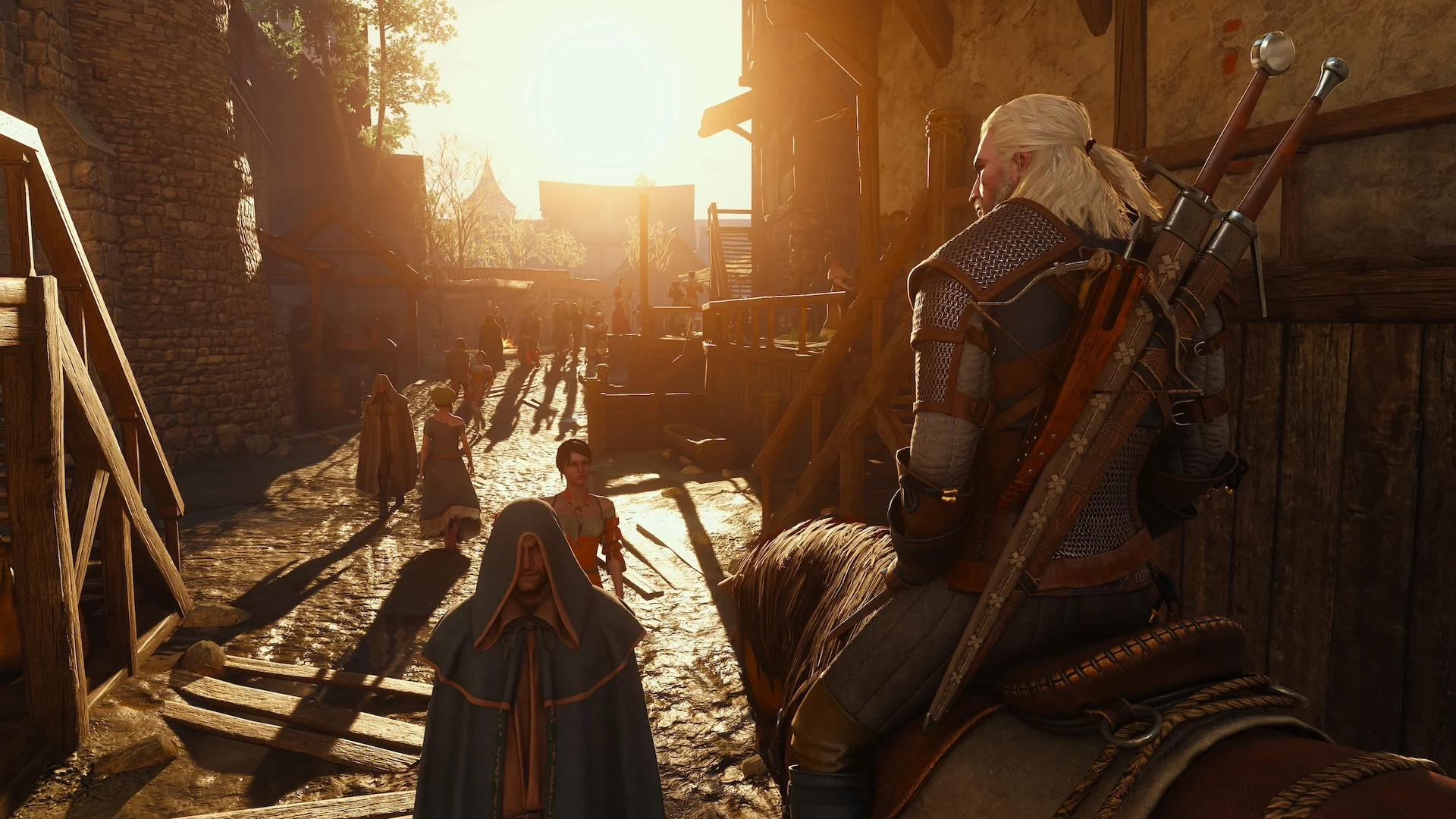
There are several non-resolution visual improvements that combine to make the Switch 2 remaster feel fresher than the original Switch port. Textures have been upgraded across the board – characters, environment maps and some pre-rendered cinematics now use higher bitrate encodes. Local lights cast dynamic shadows into the world and vegetation benefits from improved shading and new grass materials, which together give natural areas more depth and less of the flat, trimmed look the original port sometimes showed. The remaster also reworks color grading and atmosphere so scenes read differently; some users may prefer the richer palette, while others will notice differences in bloom and depth of field compared with previous versions. Ray tracing is not present on Switch 2, so these effects are achieved through classic rasterization techniques and smarter material setups. LOD improvements mean fewer sudden object pop-ins during exploration, although dense urban areas still present the biggest performance challenge due to the sheer volume of visible geometry and NPCs.
File size and storage – what to expect on your SD card
Storage demands are higher for the Switch 2 edition than for the Switch 1 release. Multiple sources note the install hovers around the 50-55 GB mark, which is a meaningful increase over the earlier 39.1 GB figure for the first Switch release. That growth reflects higher-resolution assets, upgraded textures and richer cutscene encodes – all the stuff that makes the game look closer to other modern platforms. If you plan to keep other Switch and Switch 2 titles on a single microSD card, consider a mid-to-large capacity card and, if you archive older games, be ready to free space. CD Projekt Red confirmed the remaster will ship digitally via the Nintendo eShop, so a physical release may come later if demand and logistics line up, but the current eShop-only approach means the download and patch sizes are worth planning for in advance. For players with limited space, offloading a few titles or choosing a high-capacity card will make the upgrade smoother and avoid juggling installs mid-playthrough.
Controls, quality-of-life improvements and new interface options
Alongside the graphical and performance work, the Switch 2 build adds several practical adjustments that make the game more comfortable to play on a handheld hybrid. There are updated skill-tree menus and UI tweaks to help with navigation, plus control refinements that include both gyro-assisted aiming and an optional Joy-Con mouse mode for players who prefer pointer-style input. These options can be toggled and combined so you can craft a control scheme that feels right for your playstyle, and they make the experience friendlier for players who primarily use handheld play sessions. Combat was also reworked in places with small tuning adjustments to offer a more modern feel, and the team polished background NPC animations to reduce the jittery motion seen in earlier ports. These tweaks are less flashy than a shiny new lighting model, but they matter a lot when you spend dozens of hours with Geralt on the road.
Performance advice – how to get the best experience on Switch 2
Choosing the right balance between visuals and performance depends on what you value as a player. If you want the highest visual fidelity and own a 120 Hz display, try the 40 FPS cap and DLSS upscaling in docked mode – you will see smoother camera response and a generally sharper final output in lighter scenes. However, be ready for dips in heavy areas; if those stutters bother you, flip to the 30 FPS lock for rock-solid pacing and fewer subjective hitching moments. In handheld mode, VRR can help, but the lower internal resolution in busy sequences may make motion feel softer; turning on gyro assists and adjusting sensitivity can improve targeting and immersion. Also keep an eye on storage: a 50-55 GB install means managing space ahead of time. Ultimately, the Switch 2 remaster offers the option to prioritize what matters to you – crisp visuals, faster frames or stable pacing – and you can adjust settings to suit your tastes.
Developer involvement and who handled the remaster
CD Projekt Red led the remaster and handled the majority of the work, with support from external teams during the porting process. Some collaborators contributed tools and optimisation pipelines to help bring the game to Nintendo’s hybrid hardware while keeping asset fidelity high. The decision to skip hardware ray tracing on Switch 2 was a pragmatic one, focusing effort on physically based textures, better lighting approximations and DLSS-based scaling that offer a greater net gain on this specific device. That collaborative approach allowed CD Projekt Red to upgrade many of the game’s visual systems while also adding the UX and control improvements that Switch players appreciate. It also meant the company could offer the remaster as a free upgrade in many cases for owners of the previous Switch release, a consumer-friendly move that keeps this edition appealing to both returning players and newcomers.
Conclusion
The Witcher 3 Remastered on Nintendo Switch 2 is a strong statement about what modern hybrid hardware can do for big third-party RPGs. It is not a miracle – it still makes compromises to hit targets – but those compromises are chosen more intelligently than they were on the original Switch release. You’ll find sharper textures, better lighting, DLSS-assisted reconstruction and meaningful quality-of-life work that make long sessions easier and more enjoyable. If you own a 120 Hz TV and like chasing higher frame targets, the 40 FPS cap rewards you in lighter scenes, though the stable 30 FPS lock is the smarter default for many players. Storage is larger than before, so plan accordingly, and take advantage of the control options to tune the game to your comfort. NintendoReporters will keep covering patches and post-launch fixes, but for now the Switch 2 remaster is a welcome upgrade for fans who want The Witcher 3 in a portable-friendly, modern package. For more Switch 2 news and technical coverage visit our Nintendo Switch 2 and Nintendo News pages.
FAQs
- Does the Switch 2 version use ray tracing?
- No – the remaster does not use hardware ray tracing on Switch 2; instead, it relies on reworked lighting, improved materials and DLSS-based upscaling to raise visual quality.
- What frame rates can I expect on Switch 2?
- There are two practical caps – a 40 FPS cap when using a 120 Hz display and a 30 FPS cap for 60 Hz output. 30 FPS is generally the more stable option in demanding areas.
- How big is the download on Switch 2?
- Install size has grown compared to the original Switch release – reports indicate around 50 GB to 55.5 GB depending on source, reflecting higher-resolution assets and cutscene encodes.
- Is the Switch 2 remaster a free upgrade?
- CD Projekt Red offered upgrade paths that make the remaster free for many owners of the original Switch release, including methods tied to carrying over a physical Switch cartridge in some cases.
- Are there control improvements for handheld players?
- Yes – the build adds gyro aiming, an optional Joy-Con mouse mode and UI improvements, giving handheld players more ways to tailor controls and improve precision.
Sources
- CD Projekt Red details technical information for The Witcher 3: Remastered on Switch 2, Nintendo Wire, August 28, 2026
- The Witcher 3 Remastered Nintendo Switch 2 frame rate and resolution, NintendoEverything, October 3, 2026
- “A Colossal Upgrade” – Digital Foundry Delivers Its Tech Verdict For The Witcher 3 Remastered On Switch 2, Nintendo Life, October 4, 2026
- The Witcher 3 Remastered is free for Switch 2 players with access to a Switch cartridge, GamesRadar, September 30, 2026