














Summary:
Digital Foundry has examined Xenoblade Chronicles 2 – Nintendo Switch 2 Edition, revealing a substantial collection of technical improvements over the original Nintendo Switch release. The updated edition offers cleaner edges, greater image stability, faster texture resolution and a presentation that appears much closer to 4K when played on a television. Interestingly, pixel counts suggest that the game may still render internally at approximately 720p in docked mode. Rather than relying on a straightforward native-resolution increase, it appears to use a sophisticated reconstruction or upscaling method to create its noticeably sharper final image.
Performance has also taken a significant step forward. The original Nintendo Switch version targeted 30 frames per second and occasionally dropped below that target while exploring demanding environments or watching busy cutscenes. On Nintendo Switch 2, the adventure now runs mostly at 60 frames per second in both TV and handheld modes. Some brief drops remain during effects-heavy scenes, traversal and certain cinematic sequences, but movement and combat generally feel far more responsive.
Portable play may be the biggest beneficiary. The original release could drop to roughly 360p and relied on an aggressive sharpening filter that often produced a coarse image. The Switch 2 edition instead delivers a stable, 1080p-like presentation with cleaner edges and improved treatment of fine details. Beyond the technical upgrades, the edition also introduces a welcome gameplay adjustment that allows Field Skills to be used without constantly equipping the required Blades, removing one of the original adventure’s most persistent frustrations.
Xenoblade Chronicles 2 receives a substantial Switch 2 upgrade
Xenoblade Chronicles 2 always felt as though its ambitions were wrestling with the limitations of the original Nintendo Switch. Monolith Soft created enormous Titans to explore, elaborate battle effects, dense settlements and some remarkably cinematic story sequences, but the hardware occasionally struggled to keep every part of that vision looking sharp and running smoothly. Nintendo Switch 2 gives the adventure considerably more room to breathe. Digital Foundry’s technical examination shows improvements across image quality, environmental detail, video presentation and performance. It isn’t simply a case of increasing a resolution number and calling the job finished. Many smaller adjustments work together to produce a cleaner and more polished result. Edges hold together more consistently, textures become readable sooner and movement feels noticeably more fluid. These changes are particularly meaningful in a role-playing game where players may spend dozens of hours travelling across vast environments. A slight improvement becomes far more valuable when you see it throughout an adventure of this size.
Switch 2 delivers sharper and more stable image quality
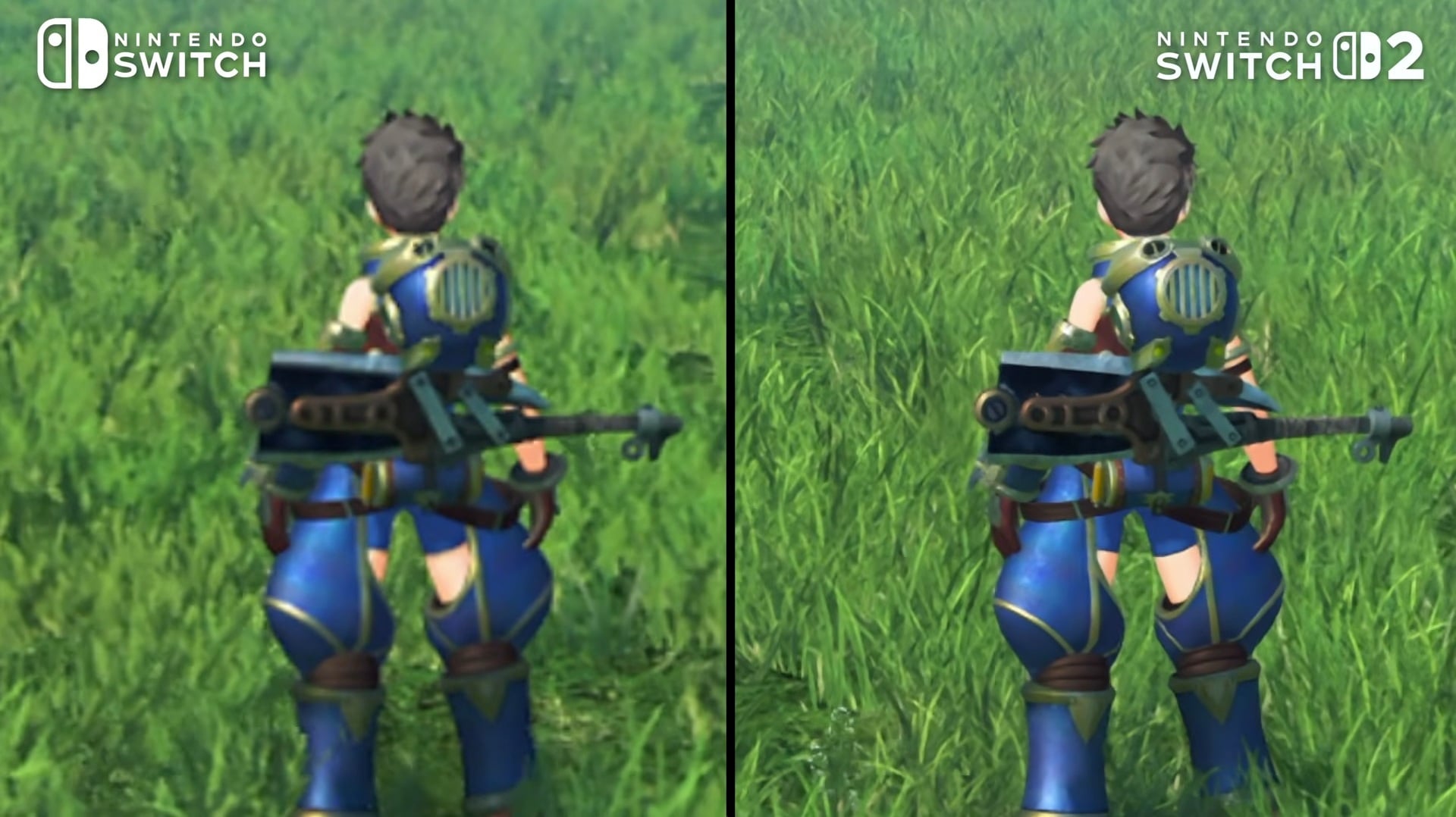
The most immediate difference is the quality of the final image. Xenoblade Chronicles 2 on the original Nintendo Switch could look soft, especially when its dynamic presentation was placed on a large television. Fine scenery, character outlines and distant objects could lose definition, while movement occasionally made the image appear unstable. The Nintendo Switch 2 edition improves edge detail and edge stability, giving characters and environmental features clearer silhouettes. Small texture details are easier to recognise, while foliage and distant geometry remain more coherent as the camera moves. The result matters because the world of Alrest is built around sweeping views. You regularly stand on high cliffs, look across enormous plains or watch cloud seas stretch toward the horizon. A cleaner presentation allows those scenes to retain more of their intended scale. It is a little like cleaning a window that you did not realise was dusty. The landscape was always there, but the improved clarity lets its details shine through.
The unusual rendering method produces a 4K-like result
Nintendo promotes a 4K output for the edition in TV mode, but Digital Foundry’s pixel analysis suggests that the underlying rendering resolution may still be approximately 720p. That sounds surprising at first. How can a game beginning with a 720p image produce something that looks substantially closer to 4K? The answer appears to lie in the reconstruction process applied before the final image reaches the screen. Instead of simply stretching each pixel, the system can combine information from multiple frames, study existing edges and estimate additional visual detail. This technique allows the output to appear much sharper than the internal pixel count would normally suggest. It does not turn the underlying image into native 4K, and very fine elements may still reveal the lower starting resolution. Nevertheless, the final presentation is dramatically cleaner than the original Nintendo Switch version. For most players, the practical difference will be immediately visible without pausing the game to count pixels.
Several possible upscaling techniques may be involved
The exact reconstruction method remains unclear. A 720p internal resolution would normally make Nvidia DLSS an obvious possibility because Nintendo Switch 2 contains the hardware needed to support that technology. However, Digital Foundry found visual characteristics that do not neatly match the expected DLSS presentation. The edition may instead use temporal upsampling, which gathers information from previous frames to improve the current one. Another possibility is a smart spatial upscaler that analyses the current frame and reconstructs edges without relying as heavily on historical information. A different proprietary solution could also be involved. What matters to players is that the technique generally succeeds. The image offers stronger detail and stability while avoiding the heavily sharpened appearance associated with the original release. There may still be small reconstruction quirks in motion, but the overall result demonstrates that internal resolution alone no longer tells the full story. Modern image reconstruction can squeeze surprisingly convincing results from a relatively modest starting point.
Environmental details and visual effects receive careful adjustments
The improvements extend beyond raw resolution. Grass appears to use greater detail and is distributed more generously across parts of the environment, helping open areas feel fuller. Depth of field has also been adjusted. Some scenes display a deeper focal range with less aggressive blur, allowing background objects to remain clearer without completely losing the cinematic separation between foreground and background. Bloom appears reduced as well, so bright lights and glowing effects are less likely to wash over nearby details. Ambient occlusion has become more localized, adding contact shadows in a way that better defines where objects meet surfaces. These may sound like small adjustments, but together they reshape the visual balance of a scene. The original could occasionally resemble a colourful painting viewed through a soft filter. The Switch 2 edition preserves the colour and spectacle while bringing more structure to individual surfaces, objects and character models. At least one comparison also appears to show noticeably revised lighting, although such differences can sometimes be affected by changing conditions within a scene.
Textures, cutscenes and scene lighting appear cleaner
Texture detail resolves more quickly on Nintendo Switch 2, reducing the time it takes for surfaces to reach their clearest appearance. This may partly result from the improved overall image and stronger texture filtering rather than entirely new texture assets, but the difference remains useful during normal play. When the party moves quickly through settlements or arrives after fast travel, surfaces appear more settled and readable. Pre-rendered cinematic sequences also seem to use a higher bitrate. These videos were often produced with elaborate direction and expressive character animation, yet compression could introduce softness or visible artifacts in the original release. A higher bitrate preserves more information, helping gradients, facial details and rapid motion look cleaner. It is not the flashiest upgrade on a specification sheet, but it supports the adventure’s storytelling. Xenoblade Chronicles 2 places enormous importance on its cinematics, so improving their clarity is not merely decorative. It helps emotional scenes retain the detail and visual impact their direction was designed to deliver.
Performance moves from 30 FPS to a mostly smooth 60 FPS
The original Nintendo Switch version targeted 30 frames per second. It generally remained playable, but traversal across demanding areas could produce dips, and complex cutscenes occasionally struggled to maintain consistent frame delivery. Nintendo Switch 2 doubles the target to 60 frames per second, transforming how movement and combat feel. Camera rotations become smoother, character animations appear more fluid and attack timing feels more immediate. Xenoblade Chronicles 2 uses an unusual combat system in which positioning, ability timing and chained actions all matter. The increased frame rate does not alter the underlying rules, but it makes each interaction feel more responsive. Exploring Alrest also becomes easier on the eyes because scenery moves across the screen with less judder. The edition is not locked perfectly to 60 FPS in every situation. Digital Foundry observed scattered dropped frames during traversal, effects-heavy moments and cutscenes. Even so, the overall leap is substantial and represents one of the most meaningful upgrades available in the new edition.
Double-buffered VSync causes noticeable drops under heavy load
The frame-rate dips are influenced by the edition’s use of double-buffered vertical synchronization. Under this approach, the game prepares frames in coordination with the display’s refresh cycle to prevent visible tearing. The downside is that missing the required frame-time window can cause delivery to fall abruptly rather than gradually. When a frame takes too long to complete, the game may temporarily present frames at approximately 33-millisecond intervals, which corresponds to around 30 FPS, until the extra processing load passes. That sudden change can be more noticeable than a small fluctuation from 60 to the mid-50s. Alpha-heavy effects, including smoke, particles and transparent layers, can place additional pressure on the renderer and trigger these moments. Busy cinematic sequences may do the same. Fortunately, the dips appear to be brief rather than constant. Most exploration and combat continue at or near 60 FPS, so the occasional hitch does not erase the broader improvement. Still, a future update could potentially refine these heavier scenes and make frame delivery even more consistent.
Handheld mode receives one of the edition’s largest improvements
Portable mode was one of the original release’s clearest compromises. Xenoblade Chronicles 2 could render at approximately 360p while undocked, and an aggressive sharpening filter attempted to restore lost definition. Instead of creating true detail, that filter could exaggerate edges and produce a rough, grainy appearance. Fine foliage, hair and distant scenery were especially vulnerable. Nintendo Switch 2 changes that experience dramatically. The new edition presents a 1080p-like output on the handheld screen with stable edges and far cleaner image treatment. Its internal resolution may be around 468p according to Digital Foundry’s estimates, meaning reconstruction once again performs a large amount of work. On the smaller display, however, the final result looks convincing. Character faces remain clearer, distant objects are easier to identify and the world no longer appears covered by an overzealous sharpening pass. For players who prefer exploring from the sofa, in bed or while travelling, this is not a minor bonus. It fundamentally changes the quality of the portable experience.
Portable image quality rises from 360p to a 1080p-like presentation
The leap from the original handheld presentation to the new 1080p-like image is striking because the Switch 2 display gives the reconstruction process a clear, high-resolution target. Stable edge treatment means character outlines no longer shimmer as aggressively when the camera moves, while the improved screen helps colours and fine details appear more defined. The game also maintains its 60 FPS target in handheld mode, providing the same basic responsiveness found when the system is docked. Similar drops can still occur during demanding traversal, particle-heavy effects and cutscenes, but handheld players are no longer receiving a substantially slower version of the experience. Digital Foundry did identify what may be a thin line artifact in parts of the portable presentation. Its precise cause is uncertain, and it does not appear to undermine the broader improvement. Even with that imperfection, the handheld edition is far easier to read and enjoy. The difference resembles moving from a compressed preview image to a carefully restored version of the same artwork.
Field Skills become considerably easier to manage
The technical upgrades may attract the most attention, but one gameplay adjustment could have an even greater effect during a full playthrough. Field Skills originally required players to equip Blades possessing the appropriate abilities before interacting with certain environmental obstacles or completing skill checks. You might reach a blocked path, open the Blade menu, reorganize the party, pass the check and then restore the preferred combat setup. Repeating that process made exploration feel more cumbersome than necessary, particularly once the party had collected a large roster of Blades. In the Nintendo Switch 2 edition, compatible Field Skills can be counted without requiring the relevant Blades to be actively equipped. That removes much of the menu juggling while preserving the underlying progression requirement. Players still need to own Blades with the necessary skills, but they no longer have to treat the party menu like a suitcase that must be repacked every few minutes. It is a sensible quality-of-life change that respects the player’s time.
The upgrade modernizes an ambitious Nintendo Switch RPG
Xenoblade Chronicles 2 was never lacking imagination. Its world, characters, music and battle systems helped it build a passionate audience despite visible technical compromises and a handful of frustrating design choices. Nintendo Switch 2 does not replace the adventure’s identity. Instead, it removes some of the friction that prevented its best qualities from appearing consistently. Sharper reconstruction makes Alrest easier to appreciate, improved texture treatment helps busy environments settle more quickly and upgraded cinematic videos give important scenes greater clarity. The mostly 60 FPS presentation makes exploration and combat feel more responsive, while the handheld improvements rescue a mode that previously demanded substantial visual sacrifices. The Field Skills adjustment completes the picture by addressing a problem that raw processing power could never solve. Some frame drops and potential reconstruction artifacts remain, so the edition is not technically flawless. Even so, it offers a far more comfortable way to experience one of Monolith Soft’s most ambitious role-playing adventures.
Conclusion
Digital Foundry’s findings show that Xenoblade Chronicles 2 – Nintendo Switch 2 Edition is much more than a simple resolution increase. Its internal rendering figures may remain surprisingly modest, but the reconstructed output delivers cleaner edges, stronger detail and a convincing 4K-like presentation in TV mode. The jump from 30 FPS to a mostly stable 60 FPS brings smoother exploration and more responsive battles, even though demanding scenes can briefly trigger larger drops because of double-buffered VSync. Handheld mode benefits even more dramatically, replacing the original 360p presentation and harsh sharpening with a stable, 1080p-like image. Add the faster texture resolution, improved cinematic quality, revised visual effects and more convenient Field Skills, and the result feels carefully modernized rather than carelessly stretched across newer hardware. It still carries a few technical quirks, but Alrest has rarely looked or felt this inviting.
FAQs
- What resolution does Xenoblade Chronicles 2 use on Nintendo Switch 2?
- Digital Foundry’s pixel counts suggest an internal resolution of approximately 720p in TV mode, although reconstruction produces a much sharper, 4K-like final output. Handheld mode may render internally at roughly 468p before being reconstructed to a 1080p-like presentation.
- Does Xenoblade Chronicles 2 run at 60 FPS on Nintendo Switch 2?
- Yes. The Nintendo Switch 2 edition targets 60 FPS in both TV and handheld modes. It generally reaches that target, although traversal, alpha-heavy effects and some cutscenes can cause brief drops.
- Does the Nintendo Switch 2 edition use DLSS?
- The precise upscaling method has not been confirmed. Digital Foundry found signs of temporal reconstruction or another smart upscaling technique, but the image does not clearly match the expected appearance of standard DLSS.
- How is handheld mode improved on Nintendo Switch 2?
- Handheld mode now produces a far cleaner 1080p-like image with stable edges and 60 FPS gameplay. The original Nintendo Switch version could drop to around 360p and used an aggressive sharpening filter that made the image appear coarse.
- What changed about Field Skills in the Switch 2 edition?
- Field Skill checks can now recognize suitable Blades without requiring players to equip them first. Players still need to own Blades with the relevant skills, but constant party rearrangement is no longer necessary.
Sources
- Xenoblade Chronicles 2 Nintendo Switch 2 Tech Analysis Including Frame Rate and Resolution, Nintendo Everything, August 1, 2026
- Digital Foundry Examines Xenoblade Chronicles 2 Nintendo Switch 2 Edition, My Nintendo News, August 1, 2026
- Xenoblade Chronicles 2 – Nintendo Switch 2 Edition, Nintendo, July 30, 2026
- Xenoblade Chronicles 2 Switch 2 Update Finally Makes a Huge Quality-of-Life Change, GamesRadar+, July 30, 2026
- Xenoblade Chronicles 2 Switch 2 Edition Overview Reveals New Pyra and Mythra Outfits, Merc Assault and Momo, Nintendo Life, July 24, 2026