














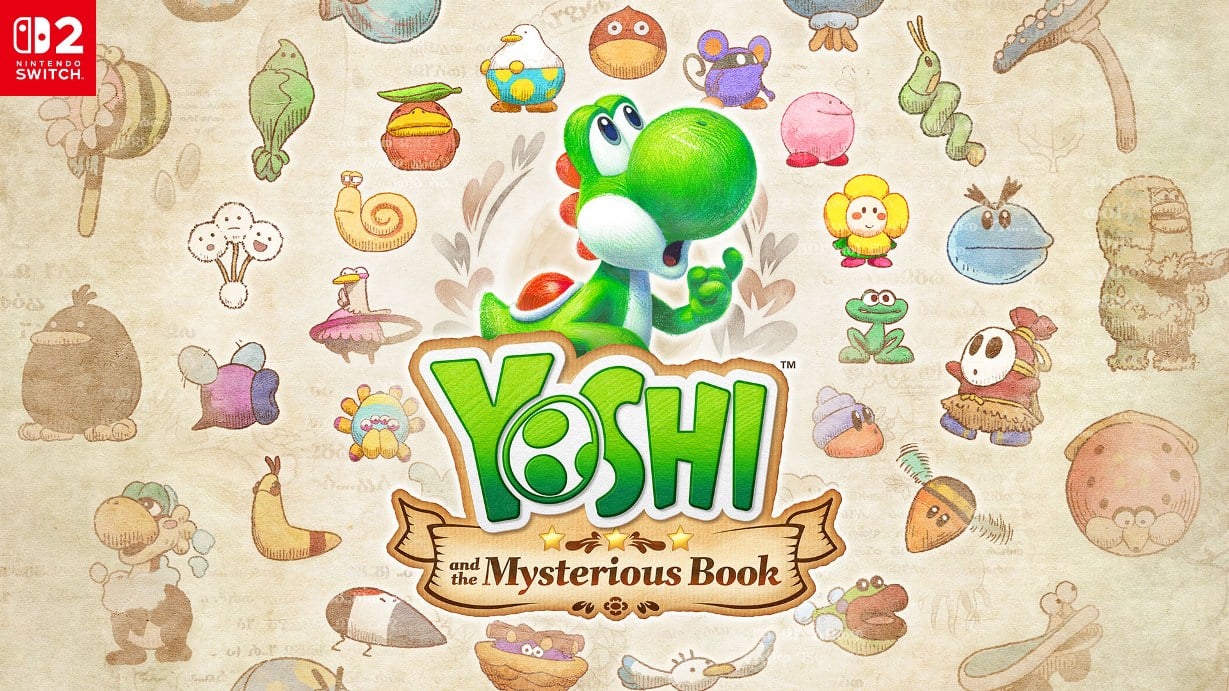
Summary:
Yoshi and the Mysterious Book may have arrived as a Nintendo Switch 2 exclusive, but the colorful adventure did not begin its life on Nintendo’s latest system. Members of the development team have revealed that production initially started with the original Nintendo Switch in mind. The project changed direction after the developers learned that Nintendo Switch 2 was on the way, leading them to target the newer hardware instead.
The development history also involved an important change behind the scenes. Longtime Nintendo developer Takashi Tezuka participated during the early planning stages, working with Nintendo and Good-Feel as they considered what the next Yoshi experience should become. However, Tezuka’s responsibilities on Super Mario Bros. Wonder eventually demanded his full attention. Hisashi Nogami subsequently took over the producer role and helped guide the project forward.
Perhaps most surprisingly, the mysterious encyclopedia at the heart of the finished adventure was not present when development began. The team first focused on Yoshi himself, examining his familiar actions, the relaxed pacing of the series and its emphasis on exploration. After creating Yoshi’s Woolly World and Yoshi’s Crafted World around strong visual themes, the developers wanted to approach the new project from a different angle. Instead of beginning with a particular material or artistic motif, they asked a more fundamental question: what makes Yoshi feel like Yoshi?
Yoshi and the Mysterious Book Originally Began on Nintendo Switch
From the outside, Yoshi and the Mysterious Book appears closely tied to Nintendo Switch 2. It was released exclusively for the system, takes advantage of Nintendo’s newer hardware and stands among the first major Yoshi experiences created for the platform. Behind the scenes, however, its journey began somewhere far more familiar. According to members of the development team, the project was originally being built for the first Nintendo Switch. That means the adventure was already taking shape before its creators committed to the newer console. The revelation offers a rare glimpse into the way Nintendo manages projects during a hardware transition. Games do not always begin with a new system neatly written at the top of a planning document. Sometimes development starts on established hardware, only for a new platform to arrive like an unexpected train pulling into the station.
The change also explains why the finished experience retains such a recognizable connection to earlier Yoshi games while still feeling designed for a different generation of hardware. Its foundation was formed using lessons learned throughout the original Switch era, yet the development team eventually had the chance to rethink how those ideas could work on Nintendo Switch 2. Rather than abandoning everything and beginning again, the developers changed course while preserving the concepts that had already proven valuable. That balance between continuity and reinvention has long been one of Nintendo’s strengths, particularly when familiar characters move from one console generation to another.
Nintendo Approached Good-Feel About Creating Another Yoshi Adventure
The collaboration began when Nintendo decided that the time was right for another Yoshi game. Associate producer Nobuo Matsumiya explained that Nintendo made the first move and contacted Good-Feel about working together again. The two companies already had a productive history through Yoshi’s Woolly World and Yoshi’s Crafted World, so returning to the same development partner made practical sense. They knew each other’s habits, understood the character and had already learned how to translate unusual artistic ideas into interactive environments. Starting another project together was less like an awkward first date and more like inviting an old friend back into the kitchen to try a new recipe.
Good-Feel president and senior producer Etsunobu Ebisu recalled that discussions followed with Matsumiya and Takashi Tezuka. Those early conversations did not immediately produce the encyclopedia concept seen in the finished release. Instead, Nintendo and Good-Feel spent time considering the broader identity of the series and the kind of experience they wanted to create. This is significant because Yoshi games are often remembered for their visual themes, but their appeal goes beyond yarn, cardboard or handcrafted scenery. Their pacing, movement and attitude toward exploration are just as important. By returning to Good-Feel, Nintendo could build on a shared understanding of those qualities without simply repeating the structure of the previous collaboration.
Takashi Tezuka Helped Shape the Project During Its Early Development
Takashi Tezuka was involved during the initial planning phase, contributing to discussions about the direction of the next Yoshi adventure. His participation carried considerable weight. Tezuka has been connected to many of Nintendo’s most recognisable platform games, and his history with both Mario and Yoshi made him a natural person to help define the project’s early goals. Together with Matsumiya and director Masahiro Yamamoto, he considered how the new experience should distinguish itself from earlier releases while preserving the qualities players associate with Yoshi.
Those discussions appear to have focused less on a marketable visual trick and more on the character’s underlying design language. What should Yoshi do repeatedly? How should players move through an environment? What makes exploration pleasant rather than stressful? These questions may sound simple, but they are the bolts holding the entire machine together. A beautiful visual concept can attract attention, yet movement and interaction determine whether an experience remains enjoyable after the initial charm wears off. Tezuka’s early involvement therefore helped establish a foundation that could survive later changes in platform, leadership and theme.
Super Mario Bros. Wonder Changed the Leadership Structure
Tezuka did not remain attached to the project throughout its full development. His work on Super Mario Bros. Wonder eventually required his complete attention, leaving little room for him to continue overseeing the Yoshi project. As a result, Hisashi Nogami took over as producer. This was not merely a name being swapped on a spreadsheet. A producer helps coordinate creative priorities, development schedules and communication between the teams involved, so a change in that position can influence the tone and direction of an entire production.
Nogami was hardly unfamiliar with Nintendo’s playful design philosophy. His career includes work across several major Nintendo properties, and his involvement offered the project a different perspective without severing its connection to the company’s broader development culture. The transition also appears to have happened naturally because the central ideas were still evolving. The encyclopedia had not yet become the defining concept, and the platform change was still ahead. Nogami therefore stepped into a project with a solid foundation but plenty of open space. Rather than simply guarding a finished blueprint, he could participate in shaping what the game would eventually become.
The Arrival of Nintendo Switch 2 Caused Development to Change Direction
Good-Feel initially developed the project for Nintendo Switch, but the situation changed when the team learned that Nintendo Switch 2 was approaching. Ebisu explained that development shifted midway because the creators wanted to release the game on the latest hardware. This decision transformed the project from another original Switch release into a Nintendo Switch 2 exclusive. Such a change sounds straightforward when reduced to one sentence, but changing target hardware during development can affect nearly every department. Programmers must reassess performance, artists may revise assets and designers can reconsider ideas that were previously limited by technical boundaries.
The move also reflects Nintendo’s need to prepare appealing software for a new platform without discarding projects that began during the previous generation. Hardware transitions create an unusual puzzle. Start too early, and the specifications or development tools may still change. Start too late, and the new system risks launching without enough games. Moving an existing Yoshi project to Nintendo Switch 2 gave Nintendo a familiar character for the newer platform while allowing Good-Feel to continue building on work already underway. The project became a bridge between two generations rather than a creation belonging exclusively to one development period.
Moving to New Hardware Offered More Than a Technical Upgrade
Targeting Nintendo Switch 2 was not simply about making the same game run at a higher resolution. New hardware can encourage developers to rethink visual density, animation, loading, environmental interactions and the number of objects operating at once. Yoshi games rely heavily on tactile presentation, with environments that invite players to stop and inspect tiny details. Extra technical room can make those spaces feel livelier, allowing creatures and scenery to behave more naturally without sacrificing performance.
The decision also changed how the project would be perceived. A game released late in the life of an older system can easily become overshadowed, even when the underlying work is strong. An exclusive on newer hardware carries a different level of attention and responsibility. Players expect it to demonstrate why the new platform matters. For Yoshi and the Mysterious Book, that did not require turning the series into a loud technical showcase filled with explosions and dramatic speeches. That would be rather un-Yoshi-like. Instead, the newer hardware could support richer environments and smoother interactions while allowing the relaxed personality of the series to remain intact.
The Encyclopedia Was Not Part of the Original Concept
Despite becoming the defining feature of the finished adventure, the encyclopedia was not included in the earliest plans. Nogami confirmed that development began with ideas surrounding the actions Yoshi would perform repeatedly. The team had not yet decided that players would enter the pages of a mysterious talking book, study unusual creatures and record discoveries. Those elements emerged later, after the developers had already spent time examining the basic rhythm of play.
This development process is revealing because it shows that the central theme grew from mechanics rather than being placed on top of them. The team did not begin with a book and then struggle to invent activities that fit inside it. Instead, it considered what players should do as Yoshi, then gradually found a concept capable of giving those actions meaning. The encyclopedia turned familiar abilities into tools for observation and experimentation. Swallowing, jumping, carrying creatures and throwing eggs were no longer useful only for defeating enemies or reaching collectibles. They became methods of research, allowing the player to learn how strange inhabitants behaved within each chapter.
Yoshi’s Familiar Abilities Became the Starting Point
Yoshi’s core move set has remained recognisable for decades. He can leap, briefly flutter through the air, grab objects with his tongue, swallow them and turn many of them into eggs. These actions give the character a playful physicality that differs from Mario’s more direct style of platforming. When planning the new project, the developers used these familiar actions as their starting point. They asked how often each ability should be used, what kinds of responses it should produce and how it could encourage players to experiment rather than rush forward.
That approach helped preserve the character’s identity even as other parts of the project changed. The target platform changed. The producer changed. The main theme emerged later. Yoshi’s movement remained the anchor holding everything together. This is an effective way to develop a game around an established character because players can accept bold structural changes when the character still feels right in their hands. A Yoshi game can take place in a world made from wool, cardboard or the pages of a magical encyclopedia, but the flutter jump and mischievous tongue need to feel as natural as slipping into a favourite pair of shoes.
Exploration Remained Central to the Series Identity
During planning, the developers compared Yoshi’s adventures with the Super Mario Bros. series. Matsumiya noted that Yoshi games do not typically use the same kind of time limit, allowing players to explore at their own pace. That difference shaped the new project’s identity. Rather than pushing players toward an exit before a clock reaches zero, the experience encourages them to linger, observe and test ideas. A curious creature in the corner is not merely decoration. It may react differently when swallowed, carried or placed near another inhabitant.
This slower rhythm supports players who enjoy searching every corner without feeling that the game is tapping its foot impatiently. Exploration becomes the goal rather than a distraction from it. That philosophy also suits the encyclopedia theme perfectly. Research cannot feel meaningful when the player is constantly being hurried along. By removing pressure and rewarding curiosity, the developers created space for discovery to become its own form of progress. You are not simply crossing a stage from left to right. You are poking at a small ecosystem to see what wiggles, squeaks or causes mild chaos when Yoshi gets involved.
The Developers Reconsidered What Makes a Yoshi Game Feel Distinct
One of the most important parts of the planning process involved defining what a Yoshi game should actually be. Matsumiya explained that the developers spent considerable time refining that question with Yamamoto and Tezuka. This was necessary because the series cannot rely solely on its lead character or a cute art style. A convincing Yoshi experience needs a particular balance of gentle platforming, playful experimentation, hidden details and approachable controls. Remove too many of those qualities and the result may still look like Yoshi without truly feeling like one.
The team’s willingness to question the formula helped prevent the project from becoming a simple continuation of Yoshi’s Crafted World. Rather than asking how to make another handcrafted environment, the developers examined the emotional response they wanted to create. Yoshi games invite players to relax and become curious. They offer secrets without making every missed collectible feel like a failure. They can appeal to younger players while still giving experienced fans reasons to inspect the environment carefully. That combination is difficult to achieve because accessibility can easily become emptiness if there is nothing interesting to discover. The mysterious book gave the developers a structure in which gentle play and meaningful experimentation could comfortably coexist.
Woolly World and Crafted World Influenced the Team’s Approach
Good-Feel’s previous Yoshi games began with strong material-based motifs. Yoshi’s Woolly World transformed characters and environments into yarn, fabric and knitted objects. Yoshi’s Crafted World followed with stages built from cardboard, paper, tape and household materials. Those themes did more than determine how the games looked. They influenced Yoshi’s actions, level design and the kinds of visual jokes that appeared throughout each environment. Pulling loose threads or interacting with handcrafted scenery felt natural because the mechanics grew from the chosen materials.
For Yoshi and the Mysterious Book, Yamamoto explained that the developers did not begin with another physical motif. Instead, they started by thinking about Yoshi as an entity. This subtle change opened a different creative path. The team was no longer asking which material could transform Yoshi’s world next. It was asking what players enjoy about being Yoshi. The answer led toward a more behaviour-driven experience in which creatures, movement and observation became central. Woolly World and Crafted World remained valuable reference points, but the new project used their lessons rather than copying their construction. It took the idea that theme and interaction should support each other, then applied it to an encyclopedia filled with living discoveries.
The Development Story Explains the Finished Game’s Unusual Identity
Knowing how Yoshi and the Mysterious Book evolved makes its final design easier to understand. The project began on Nintendo Switch, shifted to Nintendo Switch 2, changed producers and discovered its central encyclopedia concept after development was already underway. That is a remarkable number of major changes for one cheerful dinosaur to carry on his back. Yet the finished experience remained coherent because the team kept returning to the same foundation: Yoshi’s actions and the pleasure of unhurried exploration.
The development story also shows why the game feels familiar without behaving exactly like a traditional platform adventure. Its mechanics come from Yoshi’s established history, but its structure encourages players to observe creatures and create interactions rather than simply overcome obstacles. The mysterious book provides a reason for Yoshi to explore, while the lack of constant pressure gives players permission to experiment. Moving the project to Nintendo Switch 2 gave the developers newer hardware on which to present those ideas, but the character’s identity remained the most important ingredient. In the end, the technology changed and the concept changed, but Yoshi stayed Yoshi. That consistency is what allowed the rest of the project to evolve so dramatically.
Conclusion
Yoshi and the Mysterious Book followed a development path filled with unexpected turns. Nintendo originally commissioned the project for the first Nintendo Switch and once had Takashi Tezuka involved in its early planning. Tezuka later concentrated on Super Mario Bros. Wonder, allowing Hisashi Nogami to assume the producer role. The arrival of Nintendo Switch 2 then encouraged Nintendo and Good-Feel to move development to the newer platform.
Even the encyclopedia, now the heart of the finished adventure, appeared later in production. The earliest discussions instead focused on Yoshi’s recurring abilities, relaxed pacing and relationship with exploration. By examining those fundamentals, the developers found a concept that could make familiar actions feel fresh. The result demonstrates how a project can change hardware, leadership and creative direction without losing its central identity. Sometimes the road to a finished game resembles one of Yoshi’s own stages: colourful, slightly unpredictable and full of secrets that only become visible when you stop rushing toward the exit.
FAQs
- Was Yoshi and the Mysterious Book originally planned for Nintendo Switch?
- Yes. Good-Feel initially developed the project for the original Nintendo Switch before moving production to Nintendo Switch 2 midway through development.
- Why did development move to Nintendo Switch 2?
- The developers learned that Nintendo Switch 2 was on the way and decided that the latest Yoshi adventure should be created for Nintendo’s newest hardware.
- Why did Takashi Tezuka leave the Yoshi project?
- Tezuka became fully occupied with the development of Super Mario Bros. Wonder. Hisashi Nogami subsequently took over as producer of Yoshi and the Mysterious Book.
- Was the encyclopedia included from the beginning?
- No. The early plans focused on Yoshi’s recurring actions and the core qualities of the series. The encyclopedia concept emerged later in development.
- Who developed Yoshi and the Mysterious Book?
- Good-Feel developed the game in collaboration with Nintendo. The companies previously worked together on Yoshi’s Woolly World and Yoshi’s Crafted World.
Sources
- Yoshi and the Mysterious Book Team Details Game’s Development, Started Out on Nintendo Switch 1, Nintendo Everything, July 24, 2026
- Yoshi and the Mysterious Book, Nintendo, May 21, 2026
- Yoshi and the Mysterious Book – Creature Discovery, Nintendo of America, 2026
- Nintendo Keeps Finding New Ways to Reinvent Platformers, The Verge, May 20, 2026
- I Played Yoshi and the Mysterious Book and Haven’t Had This Much Fun Playing a Yoshi Game Since the Super Nintendo, Tom’s Guide, May 20, 2026