














Summary:
Nintendo is opening one of the most intriguing chapters in its archives by releasing Zero Racers and D-Hopper through Virtual Boy – Nintendo Classics on August 4, 2026. Both games were created for the original Virtual Boy but never reached players during the system’s commercial lifetime. Their arrival means two projects once considered lost pieces of Nintendo history will finally receive official releases roughly three decades after their development.
Zero Racers is a futuristic racing game in which humanity has retreated underground and lost many of the emotions that once defined it. Players enter a mysterious competition known as the “RACE,” piloting floating machines through enclosed courses formed from connected square ducts. Each event lasts five laps, and progression depends on maintaining the required position before ultimately finishing inside the top three. Rapid boosts collected around the course provide temporary bursts of speed and introduce another tactical element to every race.
D-Hopper follows Prince Dorin after the rebellious minister Rexxar drives him from the Sky Kingdom and into the depths below. With help from underground fairies, Dorin begins climbing back toward his home while searching for four missing spirits. Its stages combine jumping, aerial movement, floating platforms, and enemy encounters. Finding the spirits also allows Dorin to transform into dragons with special abilities.
The August 4 update will also introduce screen color customization. Players can change the visual palette during gameplay by holding the right control stick and selecting a color with the L and R buttons.
Nintendo Revives Two Unreleased Virtual Boy Games
Nintendo will add Zero Racers and D-Hopper to Virtual Boy – Nintendo Classics on August 4, 2026, giving both games their first official release. They will be available through the service on Nintendo Switch 2 and Nintendo Switch, provided players meet the relevant membership and hardware requirements. It is an unusual moment for Nintendo’s preservation efforts because these aren’t familiar games returning from an older system. They are finished or substantially developed projects that never had an opportunity to enter the market in their original era. Think of it as opening a sealed room in Nintendo’s archives and discovering that the lights still work. Rather than presenting these games only through screenshots, development documents, or museum material, Nintendo is making them playable. That distinction matters. Players will be able to experience their controls, level design, visual effects, music, and underlying ideas directly instead of relying on secondhand descriptions of what might have been.

Zero Racers Finally Leaves Nintendo’s Archives
Zero Racers is a racing game designed specifically around the Virtual Boy’s stereoscopic presentation. Its unusual world is set shortly before the beginning of the 30th century. Humanity has fallen far from its former prosperity, moved underground, and lost many of the emotions that once shaped everyday life. Against that bleak backdrop, people organize an event known simply as the “RACE.” It’s a wonderfully strange premise for a futuristic competition, mixing high-speed machinery with a society searching for something it no longer fully understands. Rather than racing on conventional roads, players pilot floating machines through tunnels built from connected square ducts. The enclosed design should make speed feel especially dramatic, with walls, corners, and obstacles rushing toward the player. Zero Racers may come from an earlier period of game development, but its setting still has the eccentric confidence associated with Nintendo’s more experimental projects.
A Futuristic Racing Tournament Inside Enclosed Courses
Each race in Zero Racers consists of five laps, but simply crossing the finish line is not enough. Players must remain within a specified position range during every lap, creating steady pressure throughout the event. A slow beginning can therefore become more than a temporary inconvenience. Fall too far behind, and the race may end before a last-minute comeback can save you. To advance to the next course, players must ultimately place inside the top three. This structure gives every lap a clear purpose while discouraging the familiar habit of cruising through the opening stages and attacking only near the end. The connected duct courses also distinguish Zero Racers from open-air racing games. Instead of staring across broad landscapes, players are surrounded by geometric passages that frame the action and amplify the illusion of depth. It’s racing inside a metallic maze, where every turn arrives quickly and every mistake threatens to echo through the remaining laps.
Rapid Boosts Add Speed and Strategy to Every Race
Speed is naturally at the heart of Zero Racers, but its Rapid mechanic gives players more to consider than holding the accelerator and hoping for the best. Rapid marks appear around each course, and passing through them allows the player to obtain a temporary high-speed ability. Once activated, Rapid sends the floating machine surging forward for a limited period. The obvious temptation will be to use it immediately, especially when another racer is hovering just ahead. However, saving the boost for a long section, a difficult recovery, or the final stretch could produce a much better result. That turns a straightforward speed increase into a small but meaningful strategic choice. Where did you collect it? How long can you afford to wait? Is the next corner too sharp for a safe activation? Those decisions can transform a five-lap event into a tense contest where timing matters as much as reflexes. One poorly placed burst could become a spectacularly fast trip into the wall.
D-Hopper Brings Prince Dorin’s Lost Adventure to Life
D-Hopper trades futuristic racing machines for a fairy-tale adventure starring Prince Dorin of the Sky Kingdom. His journey begins when the rebellious minister Rexxar pursues him and causes him to fall deep underground. Dorin survives thanks to fairies living beneath the surface, but getting home won’t be as simple as finding a staircase and climbing upward. Four spirits have disappeared from the fairy kingdom, and Dorin must search for them while making his way back toward the Sky Kingdom. The premise gives his adventure both a personal goal and a wider responsibility. He isn’t only trying to reclaim his home. He is also helping the inhabitants who rescued him when he was at his most vulnerable. That relationship gives the story a warmer heart than its opening conflict might suggest. The lost prince, hidden fairies, missing spirits, and treacherous minister create the ingredients of a classic Nintendo fantasy, complete with danger, charm, and a hero who can become something far more powerful.
Platforming, Flight, and Combat Shape the Journey
Dorin moves through the stages by jumping and flapping between platforms suspended in the air. That extra aerial movement appears to be a central part of D-Hopper’s identity, offering more control than a traditional jump while making the empty spaces between platforms feel less predictable. Players will need to judge distance, height, momentum, and enemy placement as they travel upward. Floating platforms can create a playful sense of freedom, but they also remove the comforting certainty of solid ground. One poor movement could send Dorin tumbling away from safety. Enemies positioned along the route add another layer of danger, forcing players to balance traversal with combat. Should you attack immediately, wait for a better angle, or flap past the threat altogether? The Virtual Boy’s depth effect should help separate platforms, characters, and environmental layers, allowing D-Hopper to build challenges around space rather than presenting every object on one flat plane.
Four Missing Spirits Unlock Powerful Dragon Forms
The four missing spirits are more than characters Dorin must rescue. Finding them gives him the ability to transform into dragons that possess special powers. These forms should change how players interact with stages, enemies, and obstacles, turning exploration into a growing toolkit of possibilities. A route that initially appears inaccessible may become manageable after the right spirit has been found, while an enemy that once felt intimidating could prove far less troublesome in dragon form. Transformations are an effective reward because they make progress visible and playable. Dorin doesn’t merely receive a line of dialogue confirming that he has become stronger. His abilities change in ways the player can immediately feel. The dragon mechanic also fits his identity as a prince from a fantastical kingdom, giving the story a satisfying link between character and gameplay. Who wouldn’t want to turn into a dragon when the path home is blocked by an army of enemies and floating hazards?
Screen Color Customization Expands the Virtual Boy Experience
The August 4 update is not limited to two additional games. Nintendo is also introducing screen color customization for Virtual Boy – Nintendo Classics. During gameplay, players can hold the right control stick and use the L and R buttons to cycle through the available display colors. The original Virtual Boy became famous for its red-and-black imagery, a visual identity that remains instantly recognizable decades later. That presentation is historically important, but it isn’t necessarily the palette every player will want to use for an entire session. Color customization offers a welcome degree of flexibility while keeping the underlying graphics intact. It can give familiar games a noticeably different atmosphere without altering their mechanics or structure. A cooler palette may make an eerie stage feel more distant, while a brighter option could improve the readability of certain objects for some players. It’s a small control adjustment with a surprisingly large visual impact, like changing the lighting in a room and suddenly noticing details that were always there.
How Players Can Access the New Virtual Boy Releases
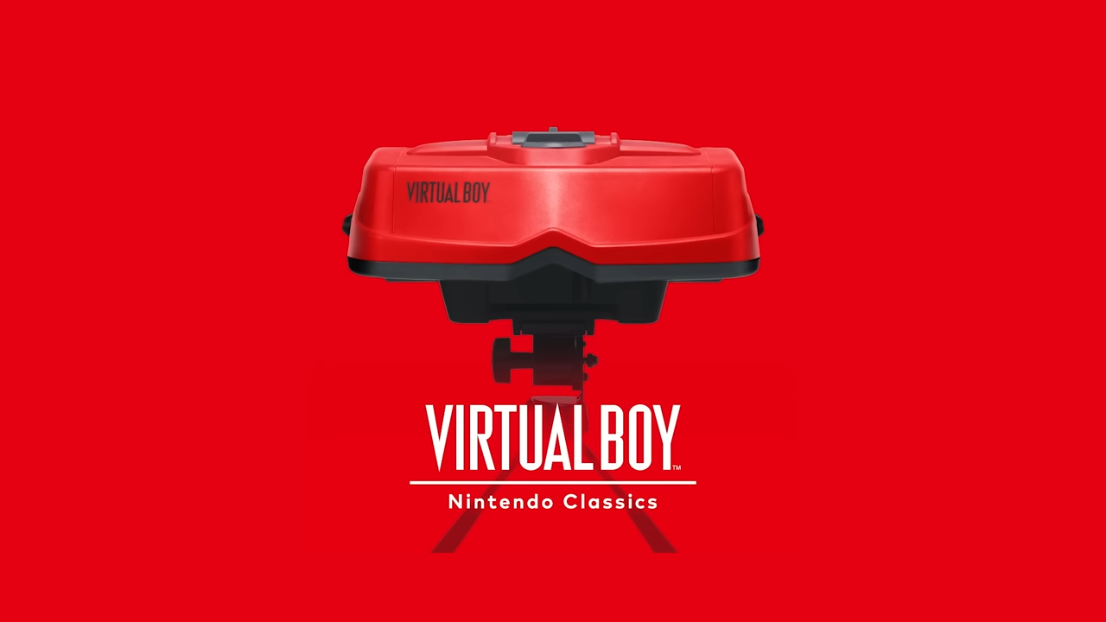
Zero Racers and D-Hopper will join the Virtual Boy – Nintendo Classics library on August 4 for Nintendo Switch 2 and Nintendo Switch users. Access to the library is tied to Nintendo Switch Online + Expansion Pack rather than the standard membership tier. Virtual Boy – Nintendo Classics is also designed around stereoscopic 3D and requires compatible dedicated hardware, such as Nintendo’s Virtual Boy accessory or its paper model alternative. Players should therefore check the service requirements before expecting the games to launch like conventional Nintendo Classics releases on a television or directly through ordinary handheld play. Once the necessary setup is in place, the two games will appear within the same application as the existing Virtual Boy selection. The screen color controls will arrive through the update as well, so users won’t need to locate a separate utility. Everything is being folded into the existing experience, keeping the newly released games and visual options together in one place.
Why These Lost Nintendo Games Matter
Zero Racers and D-Hopper matter because preservation becomes far more meaningful when people can actually play the work being preserved. Cancelled games are often reduced to blurry magazine scans, prototype photographs, scattered development stories, and endless speculation. Fans discuss them for years, but the projects themselves remain just out of reach. Officially releasing these two titles changes that relationship. Zero Racers can now be judged as a racing game rather than a mysterious footnote, while D-Hopper can be experienced as an adventure instead of an intriguing collection of unfinished memories. Their arrival may also encourage players to reconsider the Virtual Boy as more than an unsuccessful piece of hardware. The system’s limitations were real, yet developers still created unusual worlds and experimented with depth in ways that other platforms couldn’t easily reproduce. These releases won’t rewrite the Virtual Boy’s commercial history, but they will reveal more of its creative history, which is arguably the part worth saving.
Conclusion
Zero Racers and D-Hopper will finally become officially playable when they join Virtual Boy – Nintendo Classics on August 4, 2026. Zero Racers delivers enclosed futuristic racing built around position requirements, five-lap competitions, and carefully timed Rapid boosts. D-Hopper offers a fantasy adventure in which Prince Dorin jumps and flaps across floating platforms, fights enemies, searches for missing spirits, and unlocks dragon transformations. Both games represent pieces of Nintendo history that spent roughly three decades beyond the public’s reach. Their release turns old rumours and archival glimpses into experiences players can explore for themselves. The accompanying screen color customization feature makes the update even more notable, allowing users to alter the familiar Virtual Boy palette during play with a simple controller shortcut. It’s an unexpected return for two games that once appeared destined to remain lost, and a reminder that even an abandoned project can still find its moment to shine.
FAQs
- When will Zero Racers and D-Hopper be released?
- Both games will be added to Virtual Boy – Nintendo Classics on August 4, 2026.
- Are Zero Racers and D-Hopper completely new games?
- They were originally developed for the Virtual Boy but were never commercially released during the system’s original lifetime. Their Switch Online appearances will be their first official releases.
- What type of game is Zero Racers?
- Zero Racers is a futuristic racing game in which players pilot floating machines through connected square ducts. Races last five laps, and finishing inside the top three allows players to advance.
- What type of game is D-Hopper?
- D-Hopper is an action game featuring Prince Dorin. Players jump and flap across floating platforms, defeat enemies, search for four spirits, and gain dragon transformations with special abilities.
- How does Virtual Boy screen color customization work?
- Players can hold the right control stick during gameplay and use the L and R buttons to select their preferred screen color.
Sources
- Two Previously Unreleased Titles and a Screen Color Customization Feature Coming to Virtual Boy Nintendo Classics on August 4, Nintendo, July 31, 2026
- Virtual Boy Nintendo Classics Launches February 17, Nintendo, January 27, 2026
- Nintendo Switch Online Magazine: February Edition, Nintendo Australia, March 2, 2026
- Virtual Boy – Nintendo Classics, Nintendo UK, February 17, 2026
- You’ll Be Able to Change the Color of Virtual Boy Games on Nintendo Switch Online, The Verge, January 27, 2026