














Summary:
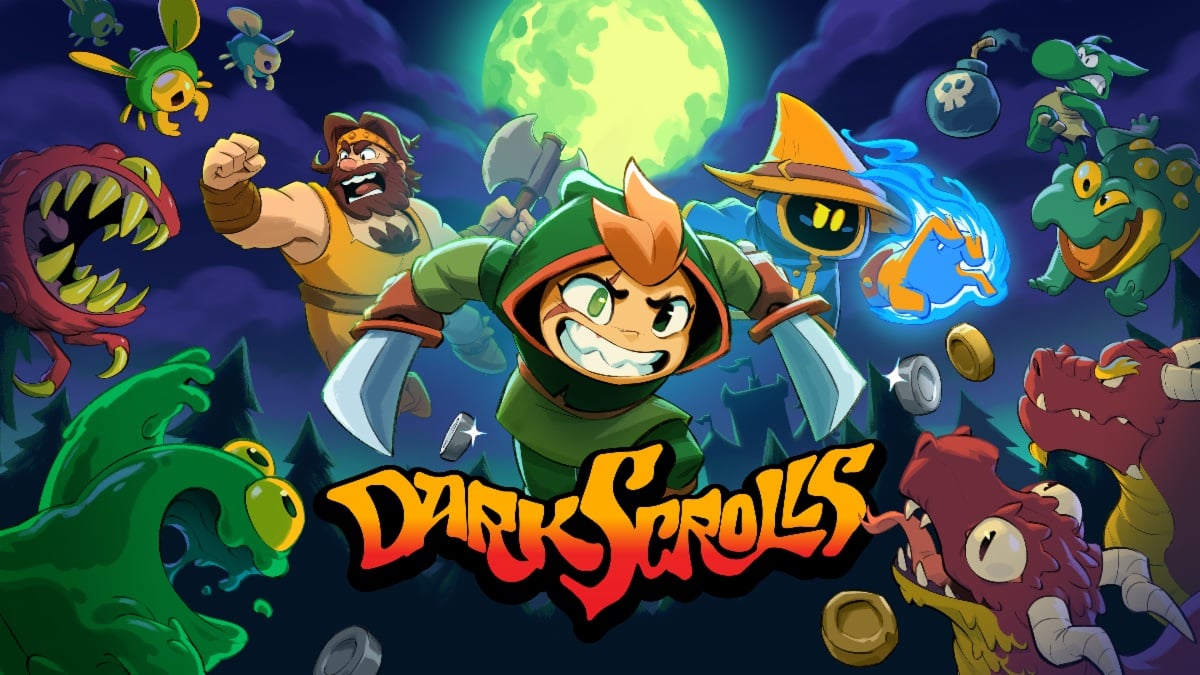
Dark Scrolls has officially arrived on Nintendo Switch, bringing Doinksoft’s unusual blend of fantasy platforming, shoot ’em up intensity and roguelite progression to Nintendo’s hybrid system. The launch trailer introduces a side-scrolling adventure that refuses to take the predictable route. Rather than limiting players to the usual warrior, thief and magician lineup, the playable cast also includes a lovable dog, an alien and a saxophone-playing rat. There are nine characters altogether, with each one offering different weapons, abilities, optional objectives and customizable trinkets.
Runs unfold across levels assembled from handcrafted rooms, allowing the game to rearrange familiar pieces into fresh combinations. Branching routes, strange enemies and demanding bosses ensure that players cannot simply memorize a single path and coast to victory. Coins collected during the action can be spent at Bruce and Goose’s Shoppe, where perks, attacks and summoned allies can turn a promising run into a screen-filling display of fantasy destruction.
The old-school pixel visuals, sound effects and music establish a strong arcade atmosphere, while responsive controls and modern progression systems keep the experience from feeling trapped in the past. Dark Scrolls can be played alone, through local cooperative play or online with another player. It is now available worldwide for Nintendo Switch, giving fans of fast platformers, scrolling shooters and unpredictable roguelites another wonderfully strange challenge to tackle.
Dark Scrolls launches its retro fantasy adventure on Nintendo Switch
Doinksoft has opened the gates to its latest wonderfully peculiar world with the release of Dark Scrolls on Nintendo Switch. The fantasy-themed action platformer is available worldwide, accompanied by a launch trailer that wastes little time showing players exactly what sort of mayhem awaits. Swords and solemn prophecies may be standard equipment in fantasy adventures, but Dark Scrolls clearly prefers axes, knives, arrows, magical projectiles and airborne steaks. It is the kind of game where an intimidating warrior can fight alongside a saxophone-playing rat without anyone stopping to question the logistics. That playful personality gives the adventure an immediate identity, while the rapidly scrolling stages and crowded encounters ensure there is far more happening beneath the joke-filled surface. Players must keep moving, react to incoming threats and find ways to survive as enemies, projectiles and environmental hazards steadily fill the screen. The result is a fantasy adventure built around speed, experimentation and the delightful knowledge that a perfectly sensible strategy can collapse within seconds.

Doinksoft combines platforming, shmup chaos and roguelite progression
Dark Scrolls sits at a busy crossroads between several familiar genres. Its movement and level layouts resemble a side-scrolling action platformer, but its crowded encounters frequently carry the frantic energy of a shoot ’em up. Enemies attack from different positions, projectiles demand immediate reactions and the constantly advancing action leaves little room for hesitation. Roguelite progression adds another layer by making each attempt feel like a fresh opportunity to discover new combinations rather than a simple repeat of the previous run. This mixture creates a rhythm that can change without warning. One moment you are carefully lining up an attack, and the next you are weaving through a storm of hazards while desperately trying not to tumble into danger. Sharp reflexes matter, but observation and quick decision-making are just as important. Charging forward without a plan may work for a few glorious seconds, although the game appears more than happy to remind reckless heroes that confidence and survival are not always close friends.
Nine playable characters turn every run into a different challenge
The cast is one of the clearest reasons that repeated runs should remain interesting. Dark Scrolls features nine playable characters, ranging from recognizable fantasy archetypes to heroes who appear to have wandered in from a much stranger adventure. Players can choose an axe-throwing warrior, a spellcasting magician or a knife-hurling thief when they want something relatively traditional. Those looking for a less conventional champion can instead play as a cute dog, an alien or the now-famous saxophone-playing rat. Another character can flip steaks at enemies, proving that cookware and fantasy warfare are apparently closer relatives than we once suspected. These heroes are not merely cosmetic alternatives. Their different weapons and abilities change how players approach enemies, obstacles and positioning. A character built around powerful close-range attacks may reward aggressive movement, while a hero with projectiles can create safer opportunities from a distance. Learning the strengths of each character should be a substantial part of the experience, especially when a reliable strategy with one hero becomes a terrible idea with another.
Unique skills and side objectives give each hero a distinct identity
Every playable hero comes with unique skills, side objectives and customizable trinkets, giving players several reasons to move beyond their first favourite. Distinct abilities affect the immediate action, but character-specific objectives encourage people to approach each run with additional goals in mind. Instead of focusing exclusively on reaching the next room, a player may be tempted to perform a particular action, defeat enemies in a certain way or pursue an optional challenge connected to the selected hero. These objectives create small stories within the larger run. You might begin with a careful plan, spot an opportunity to complete a side goal and then abandon all common sense in pursuit of it. Customizable trinkets add further room for experimentation by allowing character builds to shift according to the items and bonuses gathered along the way. A familiar hero can therefore feel noticeably different when paired with another collection of enhancements. This flexibility is particularly valuable in a roguelite, where discovering an unexpectedly powerful combination is often just as satisfying as defeating a difficult boss.
Procedurally assembled levels keep the scrolling adventure unpredictable
Dark Scrolls uses procedural generation, although its environments are not produced from a completely random collection of platforms and hazards. Instead, each level is assembled from an assortment of handcrafted rooms. This approach gives the developers direct control over the design of individual spaces while still allowing the order and overall route to change between attempts. Players can begin to recognize certain rooms, enemy arrangements or environmental tricks, but they cannot rely on encountering them in exactly the same sequence. It is a little like shuffling a deck of dangerous cards. You may recognize what has been dealt, yet the combination can still create a problem you have never faced before. Branching paths introduce further uncertainty and offer choices that may lead toward different challenges, discoveries or rewards. The scrolling structure prevents players from studying every situation forever, so knowledge must be paired with swift execution. Recognizing a dangerous room is useful. Remembering what to do before the advancing screen catches you is considerably more useful.
Relentless bosses test everything learned during a run
The escalating stages eventually bring players face to face with bosses designed to test movement, positioning and command of the chosen hero. These encounters arrive after players have spent time collecting upgrades and adjusting to the conditions of the current run, turning each boss into a measure of how well that improvised build actually works. A devastating combination may tear through ordinary opponents, only to reveal an awkward weakness against a larger enemy with restrictive attack patterns. Conversely, a run that initially feels underpowered can suddenly come alive when the right ability, summon or trinket creates an opening. Boss battles are especially suited to the game’s mixture of platforming and shmup mechanics because they can demand both precise movement and careful management of crowded projectiles. Panic is always available as an unofficial third strategy, although its success rate may vary. Since the route and collected upgrades can change, returning to a familiar boss does not necessarily mean repeating the same battle under identical circumstances.
Bruce and Goose offer upgrades that can transform an entire run
Coins gathered during the adventure can be spent at Bruce and Goose’s Shoppe, a welcome pause between bursts of scrolling chaos. The store allows players to purchase perks, powerful attacks and summoned allies that can reshape the remainder of a run. Choosing what to buy is likely to be as important as collecting the currency in the first place. A modest improvement that complements an existing skill may be more useful than a spectacular ability that does not fit the current character. Then again, resisting an upgrade capable of filling the screen with destruction is difficult when it looks as entertaining as the trailer suggests. The shop provides a moment to consider how the run has developed and decide which weaknesses need attention. Players can strengthen an effective strategy, cover a vulnerability or gamble on a new combination. When upgrades stack successfully, attacks can escalate into the sort of exaggerated visual spectacle associated with classic arcade games, where subtlety politely leaves the room and every available effect arrives at once.
Summoned allies and stacked perks reward experimentation
The ability to combine perks, attacks and summoned companions means that successful runs are built as much through experimentation as raw reflexes. Individual bonuses may appear simple when viewed alone, but their value can change dramatically when paired with another effect. An ally that adds extra damage could become far more useful alongside an upgrade that controls enemy movement, while a defensive perk may create enough breathing room for a slower character to use a powerful attack safely. These interactions encourage players to pay attention to how their collection works as a whole instead of automatically selecting the flashiest option. That does not mean restraint is mandatory. Dark Scrolls openly celebrates screen-filling excess, and finding a combination that turns a difficult encounter into an eruption of attacks is part of the appeal. The roguelite structure also reduces the pressure to discover a flawless build immediately. A strange experiment may end badly, but it can still reveal a useful interaction for the next attempt.
Retro presentation meets the convenience of modern game design
Dark Scrolls presents its fantasy world through pixel-based visuals, old-school sound effects and music inspired by earlier generations of arcade and console games. The presentation captures the direct readability and energetic personality associated with classic action releases, but the game is not simply attempting to reproduce every limitation of the past. Modern controls and progression systems sit beneath the retro exterior, helping the experience feel responsive rather than deliberately awkward. This balance matters because nostalgia works best when it recalls the excitement of older games without also resurrecting every frustration. Distinct character animations, vivid effects and crowded encounters give the screen plenty of movement, while the fantasy setting provides room for bizarre enemies and playful details. The result resembles a rediscovered game from an alternate version of the 1990s, one where alien heroes and musical rodents were completely normal. It looks familiar enough to spark recognition, yet unusual enough to avoid feeling like a straightforward imitation.
Readable action remains important when the screen becomes crowded
A visual style built around retro sprites may sound simple, but clarity becomes essential once enemies, attacks, summoned allies and environmental hazards begin competing for attention. Dark Scrolls uses its bold shapes and animated effects to communicate movement quickly, allowing players to identify threats while the stage continues to advance. That readability supports the fast decision-making at the heart of the experience. Players need to distinguish between an enemy projectile, a friendly attack and a collectible without pausing to study each object like a museum display. The audiovisual presentation also contributes to the pace by making attacks feel immediate and rewarding. Punchy effects can communicate impact before the player has consciously processed every detail, while music helps maintain momentum through repeated encounters. The retro design is therefore not only decorative. It supports the mechanical demands of the game by turning complicated situations into something players can read, react to and, with a little luck, survive.
Solo and cooperative play create two different kinds of chaos
Dark Scrolls supports both single-player and cooperative play, with Nintendo listing local play for up to two players and online support for two. Tackling the game alone places every decision, mistake and narrow escape on one pair of shoulders. Cooperative play changes that rhythm by adding another hero, another weapon set and another human being whose interpretation of a sensible plan may differ wildly from yours. Two characters can cover different parts of the screen, combine complementary abilities and rescue situations that would overwhelm a lone player. They can also produce twice as many questionable decisions, which is part of the charm. Character selection should become particularly interesting in co-op because certain pairings may offer better control, damage or defensive options. A ranged hero could support a more aggressive partner, while summoned allies and stacked effects may create even larger displays of destruction. Communication will help, but quick reactions remain crucial when the stage keeps moving and enemies refuse to wait for a team meeting.
The scrolling structure keeps both players moving together
Cooperative platformers often struggle when one player rushes ahead while the other stops to investigate every corner. Dark Scrolls addresses that tension through its continuously advancing structure, which keeps both heroes focused on forward movement. There may still be branching paths, secrets and optional objectives to pursue, but neither player can remain comfortably behind while the adventure waits. That pressure should produce lively moments of coordination as partners decide when to chase a reward and when to accept that survival is the wiser prize. Different character abilities may also affect how easily a pair can navigate particular rooms. One hero might remove enemies from a distance while the other handles threats closer to the ground. The shared pace encourages players to think as a team without slowing the game into a sequence of lengthy discussions. Sometimes the best cooperative plan is a carefully coordinated attack. Sometimes it is both players shouting, jumping and hoping the saxophone rat knows what he is doing.
Dark Scrolls is available worldwide on Nintendo Switch
Dark Scrolls launched on June 22, 2026, for Nintendo Switch and PC through Steam. On Nintendo’s system, the game supports TV, tabletop and handheld play, allowing its short bursts of frantic action to fit different play styles. A handheld run can offer a quick challenge away from the television, while local co-op makes tabletop or TV play an appealing choice when another player is available. The worldwide release gives Nintendo Switch owners immediate access to all nine heroes, the procedurally assembled stages, branching routes, bosses and unusual upgrades shown in the launch trailer. Doinksoft’s earlier work on Gato Roboto and Gunbrella established the studio’s talent for distinctive pixel adventures, and Dark Scrolls carries that recognizable taste for focused mechanics and eccentric ideas into a faster, more replayable format. Players searching for a fantasy platformer that values experimentation over solemn heroics can now discover whether an axe, spell, knife, steak or well-timed saxophone solo is the finest weapon against darkness.
Conclusion
Dark Scrolls brings together fast platforming, projectile-heavy combat and roguelite experimentation in a package that feels both nostalgic and cheerfully unpredictable. Its nine heroes provide far more than visual variety, with unique attacks, skills, side objectives and trinket combinations encouraging players to change their approach between runs. Handcrafted rooms are procedurally rearranged to create fresh routes, while branching paths and demanding bosses prevent the adventure from becoming routine. Bruce and Goose’s Shoppe adds meaningful decisions between encounters, allowing collected coins to become perks, summons and attacks capable of transforming the screen into a fantasy fireworks display. Solo play offers a focused reflex challenge, while local and online co-op introduce coordination, character combinations and the inevitable laughter that follows a perfectly avoidable disaster. Now that Dark Scrolls is available worldwide on Nintendo Switch, players can finally answer its most important question for themselves: can a saxophone-playing rat truly save the realm?
FAQs
- What is Dark Scrolls?
- Dark Scrolls is a fantasy-themed action platformer developed by Doinksoft and published by Devolver Digital. It combines side-scrolling platforming, shoot ’em up-style encounters and roguelite progression.
- How many playable characters are included in Dark Scrolls?
- Dark Scrolls features nine playable characters. The cast includes traditional fantasy heroes as well as unusual choices such as a dog, an alien and a saxophone-playing rat.
- Does Dark Scrolls support cooperative play?
- Yes. Dark Scrolls supports two-player local cooperative play on one system and online cooperative play for two players.
- Are the levels in Dark Scrolls completely random?
- The levels are procedurally assembled from handcrafted rooms. This allows individual areas to retain deliberate designs while their order, routes and surrounding challenges can vary between runs.
- When was Dark Scrolls released for Nintendo Switch?
- Dark Scrolls was released worldwide for Nintendo Switch and PC through Steam on June 22, 2026.
Sources
- Dark Scrolls, Devolver Digital, June 22, 2026
- Dark Scrolls is Out Now, Devolver Digital, June 22, 2026
- Dark Scrolls, Nintendo, June 22, 2026
- Dark Scrolls Launch Trailer – Fantasy-Themed Action Platformer on Nintendo Switch, Nintendo Everything, June 23, 2026
- Dark Scrolls Revealed! Old School Chaos, New School Problems, Devolver Digital, March 18, 2026