














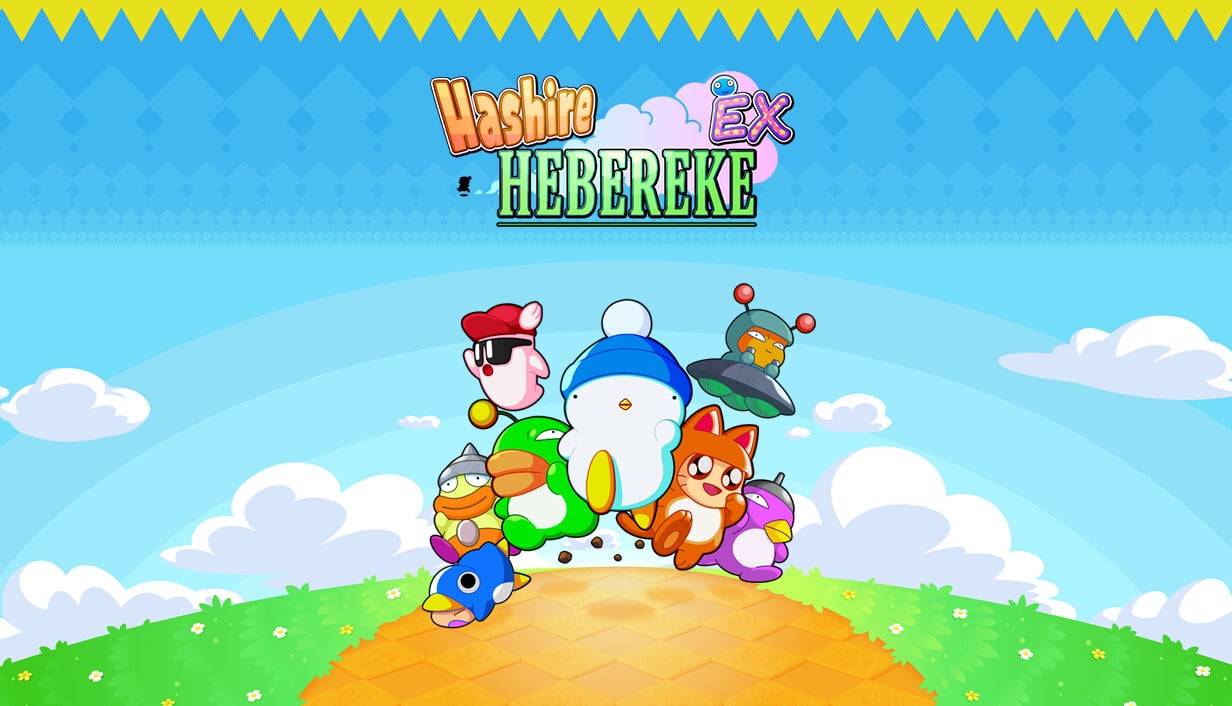
Summary:
Hashire Hebereke: EX has received a new overview trailer ahead of its planned Nintendo Switch and PC release on September 3, 2026. Developed by CRT Games and published by Gravity Game Arise, the game is a modern remake of Sunsoft’s 1994 Super Famicom racer. Rather than placing its characters behind steering wheels, Hashire Hebereke has its eccentric cast sprinting around colourful courses filled with obstacles, items, shortcuts, and opportunities to cause trouble for everyone nearby.
The remake retains that unusual identity while expanding the experience with updated presentation, additional modes, broader multiplayer support, and several modern convenience options. Story mode features different scenes depending on the selected character and challenges players to overcome opponents across ten stages. Time Attack focuses on personal records, while Battle Run provides split-screen racing for two to four local players. Engacho offers a deliberately silly form of tag, and the rhythm game swaps frantic racing for carefully timed button presses accompanied by colourful effects and character reactions.
Online Battle supports as many as eight participants, considerably increasing the potential chaos. Players can compete in Battle Run or Pofun Battle, with each online room accommodating up to eight people and stages selected randomly. Rankings, adjustable controls, vibration settings, screen options, and visibility aids round out the package. The newly released trailer gives players a closer look at how these different ingredients fit together, showing that this remake is interested in preserving the personality of the original while offering much more than a straightforward visual refresh.
Hashire Hebereke EX Returns With a New Overview Trailer
Gravity Game Arise has released a new overview trailer for Hashire Hebereke: EX, offering a clearer look at the remake’s unusual blend of racing, party-game chaos, and cartoon comedy. The footage introduces the main modes while showing the game’s cast sprinting around colourful courses instead of driving conventional vehicles. That one detail immediately separates it from the usual kart-racing crowd. Why worry about engines, tyres, and fuel when you can simply dash toward the finish line on your own two feet?
The trailer also highlights how much variety CRT Games has packed into the remake. Traditional races remain the central attraction, but they sit alongside character-based stories, split-screen contests, time trials, online matches, a tag-inspired party mode, direct battles, and a rhythm challenge. The result looks less like a single racing experience and more like a compact collection of competitive activities built around Sunsoft’s peculiar Hebereke characters. It is bright, energetic, and just strange enough to make an immediate impression.

A 1994 Super Famicom Racer Rebuilt for Modern Players
Hashire Hebereke: EX is based on Hashire Hebereke, a racing game originally released by Sunsoft for the Super Famicom in Japan in 1994. The original placed familiar characters from the wider Hebereke series into isometric races where they competed on foot. Items and hazards made every course unpredictable, while the cast’s exaggerated designs gave the game a playful personality that still stands out decades later.
CRT Games is rebuilding that foundation for modern platforms rather than merely placing the old release inside a basic retro wrapper. The remake features updated graphics, revised presentation, new activities, more substantial multiplayer options, and settings designed for current hardware. It also gives the game an opportunity to reach a broader international audience. Players who never encountered the Japanese Super Famicom release can therefore experience its core idea without needing to hunt down ageing hardware, specialist import equipment, or a cartridge that may have travelled through more homes than a well-loved board game.
Racing on Foot Gives Hashire Hebereke Its Distinct Identity
The most obvious feature separating Hashire Hebereke: EX from other colourful racers is the absence of vehicles. Its competitors run around the courses themselves, which gives each race a wonderfully scrappy appearance. Characters squeeze through narrow paths, dodge obstacles, collect useful items, and attempt to outmanoeuvre their rivals while moving through courses designed to interrupt any perfectly tidy plan.
This on-foot approach also fits the expressive cast. The characters are not hidden inside matching vehicles, so their animations and personalities remain visible throughout each event. Success is not simply about holding the accelerator and memorising a few corners. Players must watch the course, react to random items, understand their chosen character, and deal with opponents who may be far more interested in creating chaos than following proper racing etiquette. In other words, friendship might survive a close race, but the final few seconds could test it rather thoroughly.
Character Traits and Special Abilities Influence Each Race
The remake includes a collection of distinctive characters, with familiar names such as Hebe, O-Chan, Jennifer, Sukezaemon, Booboodori, Pen-Chan, Utsuzin, and Unyoon among the roster. Each racer has individual traits and special abilities, giving players a reason to experiment instead of selecting a character purely because they look cute. Admittedly, choosing the cutest competitor remains a perfectly understandable strategy in a game like this.
Learning how each character behaves should play an important role in competitive matches. A racer who suits one player’s aggressive approach may feel awkward in the hands of someone who prefers careful movement and defensive item use. Random pickups scattered around the courses add another tactical layer, since players must decide when to use an item and whether a risky manoeuvre is worth attempting. Those differences should help races retain their unpredictability even after players become familiar with the course layouts.
Story Mode Changes With the Selected Character
Story mode challenges a single player to defeat opponents across ten stages, but the journey is not presented identically for every member of the cast. Scenes and story developments change according to the selected character, giving players an incentive to return after completing the mode once. That structure suits a colourful ensemble particularly well, as each competitor can bring a different perspective and personality to the same broader competition.
Losing does not end the adventure permanently. Players can try again, learn from a failed attempt, and approach the next race with a better understanding of its hazards. This keeps Story mode approachable without removing the satisfaction of improvement. It should also serve as a useful introduction to the fundamental mechanics, allowing newcomers to become comfortable with movement, items, character abilities, and course layouts before challenging friends or entering larger online rooms.
Battle Run Brings Four-Player Split-Screen Competition
Battle Run is the game’s traditional local racing mode, supporting between two and four players. The screen is divided into two or four sections so that every participant can follow their own character independently. The objective is refreshingly direct: reach the finish line before everyone else. Naturally, the route between the starting point and that finish line is where things become messy.
Split-screen support makes Battle Run particularly well suited to Nintendo Switch gatherings. Players can compete in the same room, react to sudden reversals, and immediately identify the person responsible for launching an especially irritating item. Local competition has a social energy that online matchmaking cannot always reproduce. A narrow victory feels more dramatic when the defeated players are sitting within glaring distance, while an embarrassing mistake tends to become funnier when everyone witnesses it together.
Local Multiplayer Keeps the Party Focus Intact
Local play supports up to four participants, making it possible to experience several of the competitive modes without relying on an internet connection. That accessibility matters for a remake built around quick rounds and unpredictable interactions. It allows the game to work during family gatherings, relaxed evenings with friends, or those dangerous moments when someone confidently claims they are unbeatable after watching only a few seconds of gameplay.
The compact format of the individual activities should also make it easy to rotate players between rounds. Someone can join a race, step away, or hand over a controller without disrupting a lengthy campaign. This flexible structure reflects the spirit of classic multiplayer releases while benefiting from modern presentation and control options. It is the sort of setup where understanding the rules takes very little time, but earning consistent victories may take considerably longer.
Time Attack Encourages Players to Chase Their Own Ghost
Time Attack removes rival players and focuses entirely on speed. The objective is to reach the finish line as quickly as possible, record a strong time, and then return to improve it. Courses that initially seem simple can become far more demanding once every turn, shortcut, obstacle, and item decision affects the final result. A few wasted movements may separate a respectable attempt from a personal best.
Players can race against a ghost representing a previous record. This creates an immediate visual reference for improvement, showing exactly where time is being gained or lost. Chasing a ghost is often more motivating than staring at numbers alone because every small mistake becomes visible. When the ghost slips ahead at a corner, there is no need for a complicated explanation. The game has already shown precisely where the run started to fall apart.
Engacho Turns a Ridiculous Idea Into a Party Mode
Engacho is a tag-style activity for two to four players, although its visual premise is considerably stranger than an ordinary playground chase. One participant has a poop symbol placed on their head and becomes the tagger. That player must catch somebody else and transfer the unwanted burden before the round concludes. It is childish, absurd, and perfectly suited to the Hebereke series’ sense of humour.
The mode changes the usual racing priorities. Reaching a finish line is no longer the main concern, and players must instead pay close attention to positioning, escape routes, and the movements of everyone nearby. The tagger has to close the distance without being avoided, while the remaining players must resist the temptation to trap themselves while laughing at the person currently wearing the unfortunate head decoration. Simple rules should make Engacho easy to understand, but the shifting roles can still create tense last-second reversals.
Online Battle Expands the Competition to Eight Players
Hashire Hebereke: EX supports online rooms containing up to eight players. This doubles the maximum number supported in local play and gives races a busier, more unpredictable rhythm. More competitors mean more character abilities, more item interactions, and a greater chance that an apparently secure lead will disappear after one badly timed collision.
Online participants can play Battle Run or Pofun Battle, with stages chosen randomly for each match. Random selection reduces the likelihood of one player repeatedly choosing a favourite course and encourages everyone to adapt. It also fits the game’s party-oriented personality, where responding to unexpected situations is part of the entertainment. Online support should be especially valuable for a historically Japan-exclusive game, as the remake can connect its newly expanded audience instead of limiting multiplayer to people who happen to be sitting in the same room.
Pofun Battle Adds Direct Character-to-Character Combat
Pofun Battle shifts attention away from racing and asks players to attack their opponents with throwable Pofuns. Hitting an opponent three times secures a round, and the first player to win two rounds claims the match. This creates a more direct competitive format in which movement is used to dodge incoming attacks, create better throwing angles, and pressure rivals into vulnerable positions.
Because Pofun Battle can be selected during online play, it offers a useful alternative when players want confrontation without a finish line. The round-based structure should keep matches focused while giving someone who loses the opening exchange an opportunity to recover. It also broadens the value of the roster’s expressive movement and animations. These characters are not merely colourful runners. They are equally prepared to pelt one another with strange objects when the occasion demands it.
Rhythm Game Offers a Musical Change of Pace
The rhythm game provides one of the most unexpected departures from the main racing action. Coloured Pofuns travel toward a judgement line, and players must press the corresponding inputs at the correct moment. Accuracy affects the words, effects, and character reactions displayed on the screen, while successful sequences build combos and improve the player’s performance.
Fever Mode introduces additional visual effects when certain conditions are met, making a strong run feel increasingly energetic. This mode should appeal to players who enjoy the game’s characters and music but want a break from competitive races. It also demonstrates that the remake is willing to play with the wider Hebereke identity rather than forcing every activity into the same format. A racing remake did not strictly need a rhythm game, of course, but unnecessary oddities are often where party games discover their most memorable moments.
Rankings and Settings Add Useful Modern Features
A high-score board allows players to view leading results in ranking order, giving score-focused modes a stronger sense of competition. Rankings provide another reason to revisit familiar activities, especially for players who enjoy refining their performance after learning the basic mechanics. Instead of treating completion as the final goal, they can continue reducing times, improving accuracy, or pushing scores higher.
The settings menu includes language selection, screen options, volume controls, and alternative control styles. Players can also activate vibration feedback and enable shadow silhouettes that help identify characters when scenery or objects obscure them. That visibility option may sound modest, but it could prevent considerable frustration on crowded courses. When several colourful competitors are colliding behind an environmental object, knowing which moving silhouette belongs to you becomes rather important.
Multiple Languages Open the Remake to More Players
The remake supports several subtitle languages, including English, Japanese, Korean, Simplified Chinese, Traditional Chinese, French, German, Spanish, and Italian. This represents a significant change for a game based on a release that originally remained exclusive to Japan. Players across more regions can follow its character-based stories, understand its settings, and learn the rules without relying on fan translations or external explanations.
Broader language support also complements the expanded online multiplayer. A worldwide audience makes eight-player rooms more meaningful, particularly for a revival that may attract both longtime Sunsoft followers and people discovering Hebereke for the first time. The characters may be eccentric, and some of the jokes are deliberately silly, but the practical side of the remake appears far more welcoming than the original game’s limited availability.
Nintendo Switch Release Details
Hashire Hebereke: EX is scheduled to launch for Nintendo Switch and PC via Steam on September 3, 2026. The Switch version is planned for distribution through the Nintendo eShop, placing the remake on a platform naturally suited to its mixture of solo challenges, local multiplayer, and online competition. Its short-form modes should work well for handheld sessions, while split-screen races are likely to feel more at home on a television.
The new overview trailer gives prospective players a useful introduction before launch. Rather than concentrating on a single race, it presents the remake as a varied package filled with character stories, competitive running, time trials, unusual battles, musical challenges, and online rooms for up to eight players. Hashire Hebereke has always been an unconventional racer, and EX appears determined to preserve that peculiar spirit rather than sanding away its personality.
Conclusion
Hashire Hebereke: EX is shaping up to be far more than a visual update of a 1994 Super Famicom release. CRT Games is retaining the original’s charming on-foot racing while surrounding it with new modes, larger online matches, character-based stories, modern settings, and broader language support. The overview trailer makes its priorities clear: quick competition, expressive characters, and cheerful disorder are at the heart of the experience.
With local play for four participants and online rooms supporting up to eight, the remake has several ways to turn a quiet evening into a noisy contest. Story mode and Time Attack provide options for solo players, while Engacho, Pofun Battle, and the rhythm game ensure that racing is not the only activity available. Hashire Hebereke: EX is scheduled to arrive on Nintendo Switch and PC on September 3, 2026.
FAQs
- When will Hashire Hebereke: EX be released?
- Hashire Hebereke: EX is scheduled to launch for Nintendo Switch and PC on September 3, 2026.
- Is Hashire Hebereke: EX a remake?
- Yes. It is a modern remake of Sunsoft’s Hashire Hebereke, which originally launched for the Super Famicom in Japan in 1994.
- How many players does Hashire Hebereke: EX support?
- Local multiplayer supports up to four players, while online rooms can accommodate up to eight participants.
- Which modes are included in Hashire Hebereke: EX?
- The game includes Story, Battle Run, Time Attack, Engacho, Pofun Battle, Online Battle, a rhythm game, and score-ranking features.
- Will Hashire Hebereke: EX support English?
- Yes. English is among the supported subtitle languages, alongside Japanese, Korean, Chinese, French, German, Spanish, and Italian.
Sources
- Hashire HEBEREKE: EX Official Website, Gravity Game Arise, June 12, 2026
- Hashire HEBEREKE: EX Joins Steam Next Fest, Gravity Game Arise, June 16, 2026
- Overview Trailer Released for Hashire Hebereke: EX, Nintendo Everything, July 1, 2026
- Hashire HEBEREKE: EX, Gematsu, July 18, 2024
- Hashire HEBEREKE: EX Free Demo Available June 12, Steam, June 12, 2026