














Summary:
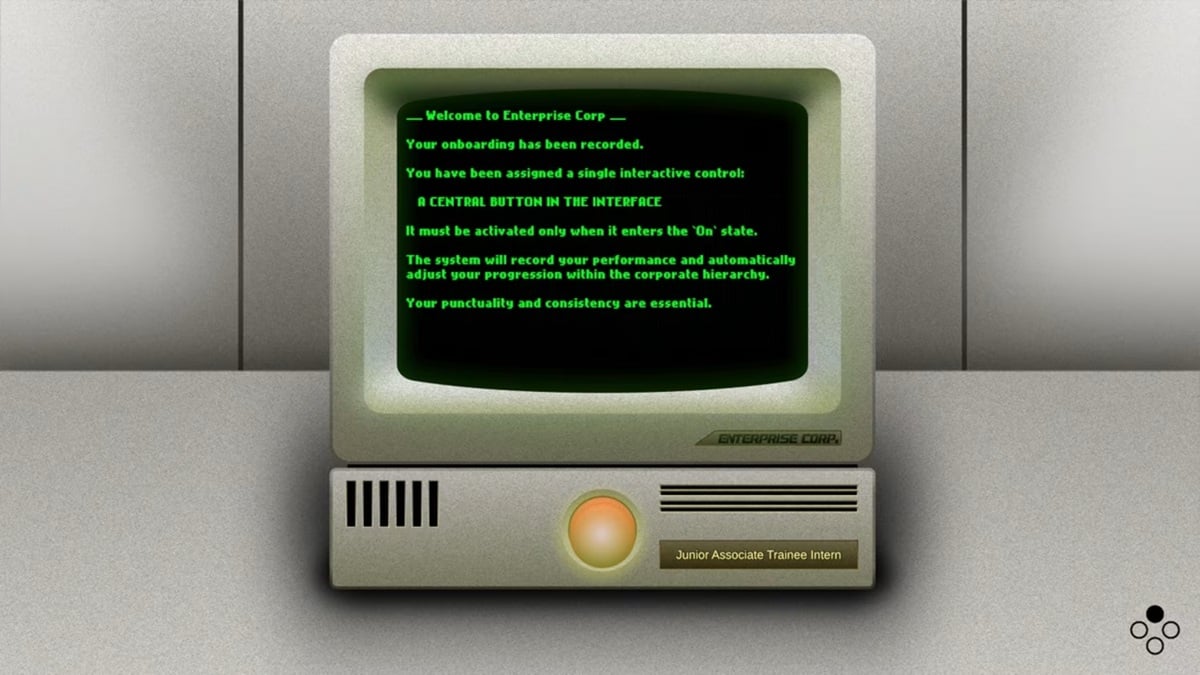
Just Press the Button is now available for Nintendo Switch, offering a deliberately simple job with increasingly uncomfortable implications. Developed and published by Sonomio Games, the dystopian narrative experience places you inside Enterprise Corp, an organisation that claims to value punctuality, consistency, and unquestioning obedience. Your responsibility appears harmless enough: press a button whenever the system tells you to do so. Follow every instruction and you may earn promotions, praise, and a higher position within the corporate hierarchy. Fail to meet expectations, however, and the consequences can be immediate.
That basic interaction supports a story about ambition, conformity, workplace pressure, and the price people may be willing to pay for success. Enterprise Corp insists that employees do not need to understand how its internal processes work. The system provides information only when it considers that information relevant, records every action, and presents itself as incapable of making mistakes. It is the kind of company handbook that makes you want to inspect the emergency exits before signing anything.
The experience uses repetition and corporate routine to create tension rather than relying on a complicated set of mechanics. As promotions bring greater expectations, the apparently innocent button becomes connected to questions the company would prefer you not to ask. Just Press the Button is available as a digital Nintendo Switch release for $2.99. The Nintendo eShop listing also identifies it as a single-player title with English and Spanish language support and a compact download size of approximately 69 MB.
Just Press the Button turns one simple task into a Nintendo Switch exclusive
Most games spend their opening moments teaching you how to run, jump, fight, craft, or survive. Just Press the Button takes a much less complicated approach. It places a button in front of you and asks you to press it when instructed. That is the job. There are no dragons circling the office building, no sprawling equipment menu to organise, and apparently no need to submit a timesheet at the end of the day. Yet the simplicity is precisely what gives the premise its strength. By stripping the interaction back to a single repeated action, Sonomio Games can focus attention on why the player is following each command and what may be happening beyond the limits of their workstation.
The Nintendo Switch exclusive is presented as a dystopian narrative experience rather than a traditional action game. Its central themes include obedience, ambition, monotony, authority, and the hidden cost of professional advancement. Every correct response helps the employee climb higher within Enterprise Corp, but the company offers very little explanation about what the button actually controls. The player is expected to trust the system because the system says it deserves to be trusted. That circular reasoning should sound familiar to anyone who has ever received an office email explaining that a confusing new procedure will make everything less confusing.
Welcome to Enterprise Corp, where following orders is your only job
Enterprise Corp greets new employees with the polished language of a company that wants everything to appear calm, efficient, and completely under control. The organisation explains that the role is simple, the instructions will be clear, and strong performance will be recognised. It sounds reassuring at first. Who would not appreciate a position with straightforward responsibilities and an obvious route towards promotion? The discomfort begins when Enterprise Corp makes it equally clear that understanding the internal process is unnecessary. Employees are there to act, not to question, investigate, or form independent conclusions.
The system evaluates punctuality, consistency, and the ability to follow instructions. Those qualities are not unusual in a workplace, but their presentation here feels cold and absolute. Every action is recorded, every delay matters, and poor performance carries immediate consequences. There is no suggestion that the system may consider personal circumstances, honest mistakes, or moral objections. Enterprise Corp has transformed employment into an ongoing examination in which obedience is both the question and the expected answer. The company also insists that its system does not make mistakes, which may be the most suspicious sentence in the entire employee orientation package.
Promotions transform obedience into a path through the corporate hierarchy
Enterprise Corp does not rely on threats alone. It also offers one of the most effective tools available to any rigid organisation: the promise of advancement. Press the button at the correct moment, satisfy the evaluation criteria, and you can move higher within the hierarchy. Promotions provide recognition and suggest that loyalty will eventually lead to influence, security, or answers. The player is therefore encouraged to view obedience as an investment. Every successful response feels like another rung on a ladder, even when nobody has explained where that ladder ends or what is waiting at the top.
This structure gives the repeated action a personal dimension. The button is not merely a switch that needs to be activated. It becomes a test of ambition. How much are you prepared to overlook when the next promotion appears to be within reach? Would you ask questions if doing so could erase your progress? The premise reflects the uncomfortable way rewards can make questionable systems feel acceptable. A small achievement can distract from a large concern, especially when the organisation has trained everyone to concentrate on their individual position. Enterprise Corp understands that employees may tolerate an alarming amount of uncertainty when a better title is dangling just above their heads.
Every press may carry a hidden cost that employees cannot see
The most unsettling part of Just Press the Button is not the physical action itself but the absence of context surrounding it. Enterprise Corp gives instructions without explaining what the button controls. The system declares that all necessary information will be supplied at the appropriate moment, quietly reserving the right to decide what employees are allowed to know. That creates an immediate moral problem. A person can follow an order with perfect accuracy while remaining completely unaware of the consequences. Efficiency becomes a blindfold, and punctuality may simply mean completing a harmful action before doubt has time to interfere.
The promise that those who reach the top may discover what really happens introduces a powerful reason to continue. Knowledge becomes another reward controlled by the company. The player cannot fully understand the task without advancing, but advancement requires continued cooperation with the task. It is a neat trap. Each button press may bring the employee closer to the truth while also making them more responsible for whatever that truth reveals. By the time answers become available, walking away may feel much harder. After all, people rarely enjoy admitting that the ladder they climbed was leaning against the wrong building.
Routine and pressure shape the game’s dystopian atmosphere
Just Press the Button builds its atmosphere around routine rather than spectacle. The tension comes from waiting for instructions, reacting at the correct moment, and knowing that the system is constantly observing the result. A repeated office task can become surprisingly oppressive when every movement is measured and every pause may be interpreted as failure. The button itself may remain simple, but the meaning attached to it grows heavier as expectations increase. What begins as an ordinary instruction can slowly feel like a demand for total submission.
This approach suits the corporate setting because workplace pressure is often expressed through small, repetitive requirements rather than dramatic confrontations. A notification appears. A deadline moves closer. A performance score changes. Another instruction arrives before there has been time to consider the previous one. The system does not need to shout when it controls the employee’s future. Its calm language can feel more disturbing than an obvious threat because it treats every demand as normal. Enterprise Corp does not describe itself as cruel. It presents itself as efficient, and it expects employees to treat that efficiency as a virtue regardless of what it may produce.
A focused design gives the central idea room to breathe
The game’s narrow mechanical focus appears designed to keep attention on its central questions. Rather than surrounding the player with dozens of systems, Just Press the Button repeatedly returns to the same interaction and allows its meaning to change through context. A button press made during the opening minutes may feel harmless. The same action can feel very different after the player begins to suspect that Enterprise Corp is hiding something important. The controls have not necessarily changed, but the person using them has gained doubt, fear, or ambition.
This is where minimalist design can be especially effective. A limited range of actions does not automatically mean a limited experience. Repetition can create rhythm, expectation, and discomfort when it is tied closely to the story. The player knows what the system wants, but that does not mean complying will always feel easy. There is also something fitting about a corporate environment reducing an employee’s role to one measurable action. Enterprise Corp does not appear interested in creativity or personal judgement. It wants a reliable human component that reacts on command, ideally without asking why the machinery needs a human component in the first place.
A low price and compact download make experimentation easy
Just Press the Button is sold digitally for $2.99, placing it among the lower-priced releases on Nintendo eShop. That price may make it appealing to players who enjoy trying unusual concepts without committing to a larger purchase. The official store information lists a download size of approximately 69 MB, so the installation should require very little storage compared with most modern releases. Even an overworked microSD card should be able to find a quiet corner for Enterprise Corp.
The Nintendo eShop categorises the game under simulation, arcade, and lifestyle, while its description places the strongest emphasis on narrative tension and corporate pressure. It supports a single player and can be played in handheld, tabletop, or television mode. The listed language options are English and Spanish, and Nintendo Switch Pro Controller compatibility is also included. Save Data Cloud support through Nintendo Switch Online is not available according to the European listing, which is worth remembering before moving data between systems. These practical details reinforce the impression of a small, focused release built around one central idea rather than a long list of modes or additional features.
Players who enjoy unusual narrative experiences may feel at home
Just Press the Button is likely to appeal most strongly to people who enjoy experimental storytelling, unsettling workplace satire, and games that ask players to think about the meaning of simple actions. The central interaction is intentionally repetitive, so anyone looking for fast combat, large environments, or a complicated progression system should approach it with the correct expectations. This is a concept-driven experience in which tension comes from participation, observation, and the gradual suspicion that following instructions may not be as harmless as it first appeared.
The corporate setting may also connect with players who appreciate stories about bureaucracy and institutional power. Enterprise Corp turns familiar workplace ideas such as evaluations, promotions, productivity, and recognition into mechanisms of control. That exaggeration works because the foundation is recognisable. Most people have encountered a rule that nobody can properly explain, a process that exists because it has always existed, or a system that measures performance while ignoring common sense. Just Press the Button takes those frustrations and places them inside a darker framework where every instruction may have consequences far beyond an employee’s desk.
Conclusion
Just Press the Button uses an intentionally basic task to explore much larger questions about obedience, ambition, responsibility, and corporate power. Enterprise Corp rewards employees who respond quickly and consistently, but it withholds the information they would need to judge whether following those instructions is right. Promotions offer a reason to continue, while the promise of eventual answers encourages the player to climb deeper into the system. The result is a dystopian setup in which success and complicity may be separated by little more than a performance review.
Sonomio Games has framed the release around repetition, observation, and growing uncertainty rather than mechanical complexity. That focused approach could make the experience particularly interesting for players who enjoy narrative experiments and workplace satire. Available digitally for $2.99, Just Press the Button presents a low-cost invitation to join Enterprise Corp, meet every expectation, and discover what may be happening on the other side of the button. Just remember to read the employment contract. Preferably before pressing anything.
FAQs
- What is Just Press the Button about?
- Just Press the Button is a dystopian narrative experience about an employee working for Enterprise Corp. The player must press a button whenever instructed while being evaluated on punctuality, consistency, and obedience. Successful performance can lead to promotions, but the company refuses to explain what the button actually controls until the employee advances far enough through the hierarchy.
- Is Just Press the Button exclusive to Nintendo Switch?
- The release has been presented as a Nintendo Switch console exclusive. It is available digitally through Nintendo eShop and supports handheld, tabletop, and television play on compatible Nintendo Switch systems.
- How much does Just Press the Button cost?
- Just Press the Button is priced at $2.99 through the North American Nintendo eShop. Prices may differ between countries and regions because Nintendo eShop displays local currencies and regional pricing.
- What is the download size of Just Press the Button?
- The Nintendo eShop lists a download size of approximately 69 MB. It is therefore a relatively small installation compared with many other Nintendo Switch releases.
- Which languages and features does the game support?
- The official Nintendo listing includes English and Spanish language support. It is a single-player game compatible with handheld, tabletop, and television modes, and it supports the Nintendo Switch Pro Controller. The European listing states that Nintendo Switch Online Save Data Cloud backup is not supported.
Sources
- Just. Press. The Button. for Nintendo Switch, Nintendo, June 18, 2026
- Just. Press. The Button. Nintendo Switch Download Software, Nintendo UK, June 17, 2026
- Just Press the Button, a Dystopian Narrative Game, Incoming for Nintendo Switch, Nintendo Everything, June 16, 2026
- Just Press the Button Arrives on Nintendo Switch June 18, Softonic, June 16, 2026