














Summary:
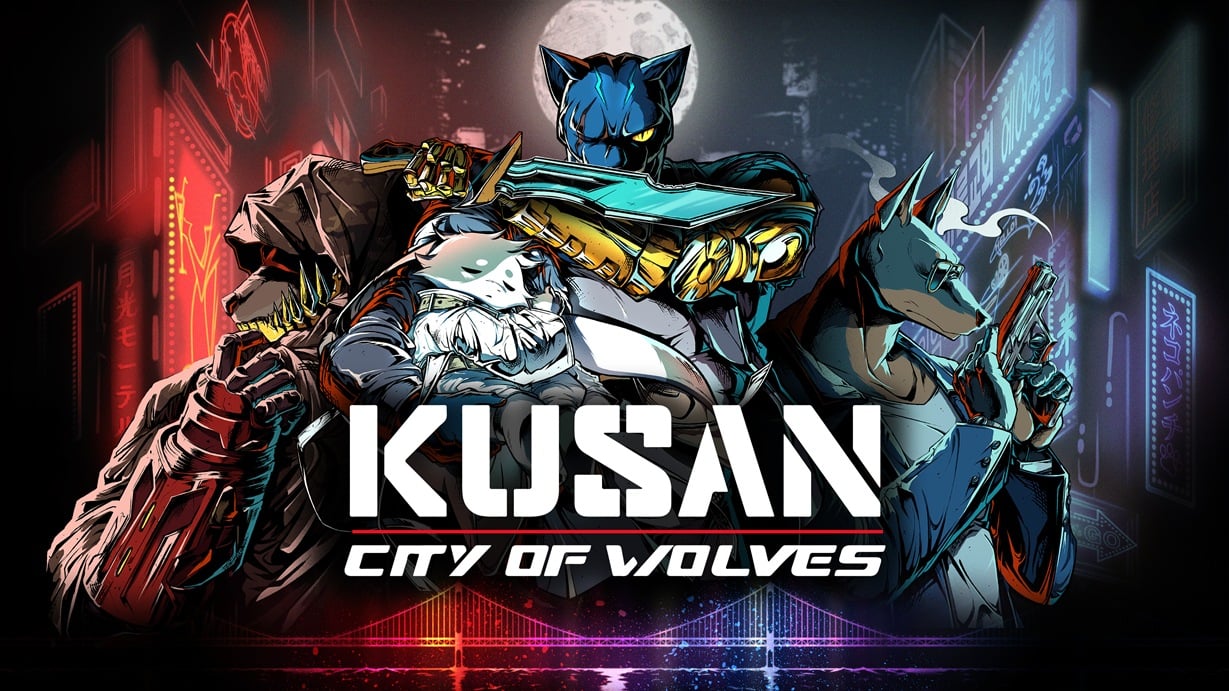
Kusan: City of Wolves has received an action-packed launch trailer following its release for Nintendo Switch. Developed by CIRCLEfromDOT and published by PQube, the hardcore top-down shooter drops players into a rain-soaked metropolis where corruption, violence and neon signs seem to occupy every street corner. Players control Jin, a former soldier who now works as a gun-for-hire and becomes caught in a dangerous conspiracy that could end in atomic destruction.
The adventure features more than 54 handcrafted stages spread across multiple chapters, combining rapid gunfights with environmental challenges, skill-based puzzles and demanding boss encounters. Jin can rely on conventional firearms as well as his signature War Hand and Quantum Knife, giving players several ways to tear through tightly designed combat arenas. Success depends on movement, accuracy and the ability to react before an enemy turns Jin into another stain on the pavement.
Players can also expand Jin’s abilities through the Techtrix system, arranging skills and upgrades to create a loadout that complements their preferred approach. Comic-panel cutscenes tell the story between missions, while detailed pixel art and a hip-hop soundtrack by Loptimist give the city its distinctive identity. Kusan: City of Wolves is available for Nintendo Switch in both physical and digital formats, giving action fans a new opportunity to chase higher ranks, master its combat systems and survive one of gaming’s most dangerous neon playgrounds.
Kusan: City of Wolves celebrates its Nintendo Switch release with a launch trailer
Kusan: City of Wolves has marked its arrival on Nintendo Switch with a launch trailer filled with gunfire, flashing blades and enough neon lighting to make the average city electricity bill look terrifying. The footage provides a final overview of the fast-paced action awaiting players, introducing its central characters while demonstrating the speed and precision required to survive. Rather than offering a slow tour through its rain-covered streets, the trailer throws viewers directly into combat, where enemies attack from multiple directions and hesitation can be fatal. It also highlights the upgrade system, comic-inspired storytelling and stylized pixel-art presentation that help separate the experience from more traditional shooters.
The game was released for Nintendo Switch on July 30, 2026, alongside versions for PlayStation 5, Xbox Series X|S and PC. Its portable version gives players access to the complete adventure, including its demanding stages, cinematic boss battles and progression systems. Whether played on a television or carried around in handheld mode, it has been designed as a focused test of reflexes and decision-making. The launch trailer captures that identity clearly. This is a city where doors are kicked open, ammunition disappears quickly and every room looks as though it was built specifically to ruin Jin’s evening.

Jin enters a violent city threatened by corruption and atomic destruction
At the centre of the story is Jin, a former soldier who has traded military service for life as a gun-for-hire. He is not presented as a spotless hero who always chooses the moral path. Instead, he is a hardened survivor prepared to cross dangerous lines when the situation demands it. His latest mission drags him into a conspiracy involving Haru, a girl fitted with a city-grade atomic weapon. Saving her means confronting the criminal forces, corrupt figures and heavily armed opponents who control Kusan from the shadows.
This setup gives the relentless action a clear purpose. Jin is not simply clearing rooms because someone placed a score counter in the corner of the screen. Every mission pushes him closer to the people responsible for the crisis, while the threat hanging over Haru adds urgency to his choices. The city itself feels inseparable from that conflict. Its streets are crowded with danger, its institutions appear rotten and its most powerful residents have little interest in letting Jin expose their plans. Kusan may glow beautifully beneath its signs and streetlights, but behind that colourful surface sits a place ready to collapse under the weight of its own corruption.
Precise top-down combat rewards speed, timing and constant movement
Combat in Kusan: City of Wolves is viewed from a top-down perspective, giving players a clear look at each arena and the threats moving through it. That visibility does not make survival easy. Enemies can attack quickly, bullets cover open spaces and a poorly timed movement may end a promising run before it properly begins. Players must read the room, identify immediate threats and decide whether to shoot, slash, reposition or use the environment to create an opening.
The controls are built around precision rather than prolonged exchanges of damage. Every movement matters, and stylish play emerges naturally from learning how weapons and mobility work together. A successful encounter might begin with Jin rushing through a doorway, eliminating one enemy at range and immediately closing the distance on another before additional reinforcements can react. When everything flows properly, the result resembles a carefully rehearsed action sequence. Of course, reaching that point may require several failed attempts, a little frustration and the quiet realisation that standing in the middle of an exposed room was never a brilliant tactical plan.
The War Hand and Quantum Knife give Jin a deadly personal arsenal
Jin’s signature equipment adds a distinctive layer to the gunplay. The War Hand and Quantum Knife give him close-range options that can be combined with firearms, allowing combat to move rapidly between shooting and direct physical attacks. These tools are not decorative additions designed to look impressive in screenshots. They are central parts of Jin’s fighting style, encouraging players to remain aggressive and use the right weapon for each situation.
The War Hand gives Jin a powerful means of confronting enemies at close range, while the Quantum Knife provides a sharp answer when bullets alone are not enough. Conventional guns remain essential, particularly when opponents are positioned across an arena or controlling narrow paths. However, relying on a single weapon is rarely the safest approach. Switching between abilities creates opportunities to manage groups, interrupt attacks and maintain momentum. The strongest runs are likely to come from understanding how every part of the arsenal fits together, much like selecting the correct tools from a very violent toolbox.
More than 54 handcrafted stages challenge players across several chapters
The main campaign includes more than 54 handcrafted stages divided across multiple chapters. Each location has been deliberately arranged rather than assembled through random generation, giving encounters their own enemy placements, environmental layouts and tactical demands. This structure lets players learn from failure because the challenges remain consistent. A dangerous corner, awkward doorway or concealed attacker can be remembered and approached differently during the next attempt.
The stages are not limited to straightforward combat rooms. Skill-based puzzles and other challenges interrupt the gunfights, requiring players to use movement and observation as well as raw firepower. The changing objectives help keep the campaign from becoming a long sequence of similar encounters. One stage might demand cautious positioning, while another rewards immediate aggression before enemies have time to control the arena. By spreading these ideas across several chapters, the game can steadily increase the pressure and introduce more elaborate combinations of hazards. Players are not merely asked to finish each mission either. The promise of an S-rank gives perfectionists a reason to return and turn messy victories into clean, controlled performances.
Higher ranks encourage players to master every dangerous encounter
The ranking system adds an additional goal for anyone who enjoys replaying stages and improving small details. Completing a mission is an achievement, especially when its enemies or hazards have already sent Jin back to the starting point several times. Earning the highest possible rank demands something more. Players must understand the stage well enough to act decisively, avoid unnecessary mistakes and maintain an effective rhythm from the opening seconds to the final encounter.
This pursuit can change the way each level is approached. During an initial run, survival may be the only concern. Later attempts can focus on reducing wasted movement, choosing better upgrades or eliminating enemies in a more efficient order. A room that once felt chaotic gradually becomes predictable as its patterns are learned. That process creates the satisfying sense of growth that challenging action games rely on. Jin’s abilities improve through progression, but the player’s own knowledge becomes equally valuable. Eventually, a stage that seemed impossible can feel like a dance whose steps have finally been memorised.
Boss battles turn timing and pattern recognition into a fight for survival
The major bosses are designed as towering opponents with distinct mechanics and high-risk attack patterns. These encounters move beyond the usual groups of armed enemies, forcing players to study a specific opponent and recognise the signals that appear before each attack. Charging forward without understanding those patterns is unlikely to end well. Bosses punish impatience, and their cinematic presentation makes each confrontation feel like an important obstacle rather than an oversized enemy placed at the end of a chapter.
Timing plays a central role in these duels. Players must know when to attack, when to move and when to abandon an aggressive plan before it becomes a spectacular mistake. As new phases or mechanics appear, the strategy may need to change immediately. That combination of observation and execution turns each battle into a tense test of memory and reflexes. The challenge is not simply discovering what to do. It is performing the correct action while the screen is filled with danger and the boss seems determined to demonstrate exactly how fragile Jin can be.
Learning from defeat is part of defeating Kusan’s strongest enemies
Failure is an expected part of mastering the boss battles. Each defeat reveals something useful, whether it is the reach of an attack, the timing of a safe opening or the moment when a new phase begins. The game’s demanding approach means that progress often comes through small improvements. Surviving a few seconds longer or reaching a later phase with more resources can show that the strategy is beginning to work.
This design asks players to remain patient without making the action feel slow. Attempts are intense, and lessons can be applied immediately during the next confrontation. Over time, attacks that initially appeared overwhelming become readable. The boss has not become weaker, but the player has learned its language. It is a familiar pleasure for fans of skill-based action: the moment when panic disappears, confidence takes its place and a seemingly unstoppable opponent suddenly looks vulnerable.
The Techtrix system lets players create and improve custom loadouts
Jin’s abilities can be customised through the Techtrix system, which allows players to arrange skills and upgrades according to their preferred playstyle. Rather than forcing everyone into a fixed progression path, the system encourages experimentation. A player who values aggressive close-range attacks may favour a different setup from someone who prefers controlling distance and relying heavily on firearms. These choices influence how Jin handles the challenges waiting in each stage.
Stronger builds can help players earn additional resources, creating a progression loop in which effective planning supports further upgrades. The placement of abilities matters, so building the ideal loadout involves more than selecting whichever option has the largest number attached to it. Players must consider how individual upgrades interact and whether the complete setup supports the way they actually fight. A theoretically powerful build is not particularly useful when it encourages a style that feels uncomfortable. The best arrangement is the one that helps Jin move through combat naturally while giving the player reliable answers to the game’s increasingly dangerous situations.
Experimentation gives repeat missions a different tactical rhythm
The ability to alter Jin’s loadout also supports replayability. Returning to an earlier mission with a new combination of upgrades can change its rhythm, even when the enemy positions and environmental layout remain familiar. A setup focused on speed may encourage rapid attacks and close-range movement, while another combination might favour greater control and calculated use of ammunition. These differences allow players to revisit challenging stages without repeating the exact same strategy.
Experimentation is especially valuable when a particular encounter becomes a roadblock. Instead of repeatedly attempting the same unsuccessful approach, players can reconsider their Techtrix arrangement and look for abilities that address the problem. Perhaps a different upgrade provides better control against groups, or a revised weapon focus creates safer opportunities during a boss fight. Adjusting a build can feel like changing the pieces of a puzzle. The solution still requires skill, but the right tools can make that solution much easier to see.
Graphic-novel storytelling presents a tale of loyalty, violence and betrayal
The story is delivered through dynamic comic-panel cutscenes that use sharp framing and cinematic pacing. This presentation complements the pixel-art gameplay while giving conversations and dramatic moments their own visual identity. Panels can focus attention on a character’s expression, a sudden act of violence or a detail that might be lost during active play. The result resembles a graphic novel brought to life between missions.
The narrative explores corruption, fractured loyalties and the consequences of Jin’s violent work. His mission to protect Haru places him against powerful enemies, but the greater conflict is not divided neatly between perfect heroes and obvious villains. Kusan is a city shaped by compromised people and dangerous relationships. That atmosphere gives the story a harder edge and suits Jin’s role as a former soldier who has already seen what institutions and individuals are capable of doing. The comic-panel format keeps the storytelling direct, allowing the adventure to move quickly without treating its characters as an excuse to connect one firefight to the next.
Jin’s mission gives the relentless action a personal cost
Haru’s situation turns the wider threat into something personal. The possibility of atomic destruction raises the stakes for the entire city, but Jin’s determination to save her gives the crisis an emotional centre. His willingness to cross every line suggests that this is more than another paid assignment. It is a mission that tests what remains of his loyalty, morality and ability to care in a place that has taught people to value survival above almost everything else.
That personal connection prevents the plot from becoming an abstract battle against corruption. The consequences are attached to someone Jin wants to protect, and every powerful enemy standing in his way becomes part of that immediate danger. Players may come for the fast combat and demanding rankings, but the relationship at the centre of the story gives each chapter greater weight. Beneath the weapons, upgrades and neon spectacle sits a simple motivation that is easy to understand: Jin refuses to abandon someone who needs him.
Neon-soaked pixel art transforms Kusan into a dangerous urban playground
Kusan’s visual design combines detailed pixel art with a neo-noir atmosphere. Rain falls across city streets illuminated by glowing signs, while dark interiors create sharp contrasts between shadow and colour. The metropolis looks energetic and hostile at the same time. It is the kind of place that might seem beautiful from a distant rooftop, provided nobody notices the armed criminals in the alley below.
The top-down perspective allows the environments to function as both scenery and tactical spaces. Furniture, walls, corridors and open areas shape the flow of each encounter, while lighting and visual details reinforce the city’s oppressive mood. The environments are not clean futuristic showcases. They feel worn, crowded and shaped by years of corruption. This gives Kusan a distinct personality, turning the setting into more than a backdrop. Jin is fighting through a place with its own rhythm, history and scars, and the pixel-art direction makes those qualities visible even during the fastest battles.
The city’s atmosphere supports both the gameplay and its darker story
The neo-noir presentation works because it is closely tied to the narrative themes. Rain, darkness and artificial light reflect a city where the truth is difficult to see and corruption hides behind attractive surfaces. The visual contrast also supports the action by making attacks, weapons and movement stand out against the environment. Even when the screen becomes busy, the effects help communicate the speed and impact of combat.
This balance between mood and clarity is important in a game where a moment of confusion can end a run. The world needs to appear dangerous without making threats impossible to identify. Kusan’s artists have used colour, animation and environmental detail to create a location that feels alive while preserving the readability required by its demanding mechanics. The result is a metropolis that can look stylish, miserable and strangely inviting all at once.
Loptimist’s hip-hop soundtrack keeps every mission moving
The action is accompanied by an original hip-hop soundtrack from artist Loptimist. Its energetic beats support the rapid pace of combat, helping each encounter feel like a carefully edited action sequence even when the player is making decisions in real time. Music can dramatically change the character of a shooter, and here it reinforces Jin’s confidence, the city’s attitude and the forward momentum of each mission.
The soundtrack also helps establish an identity that extends beyond the visuals. Neon streets and pixel art immediately communicate the neo-noir setting, while the heavy hip-hop influence gives Kusan a pulse of its own. During difficult stages, that energy can make repeated attempts feel less mechanical. Players are not simply restarting a challenge. They are dropping back into the rhythm, looking for a cleaner performance and trying to make their next run match the confidence of the music. The complete soundtrack has also been made available separately for anyone who wants to keep listening after putting down the controller.
Music and movement combine to make successful runs feel cinematic
The relationship between sound and action becomes especially noticeable when a stage begins to flow. Shots land on enemies, Jin crosses an arena without losing momentum and the soundtrack continues driving the sequence forward. These moments can make an ordinary attempt feel cinematic, even though the player is responsible for every successful movement. It is a powerful reward because it is created by performance rather than triggered automatically.
A failed attempt can break that rhythm instantly, but that only makes a smooth run more satisfying. The music invites players to try again and recover the sense of control they briefly achieved. In that way, the soundtrack is more than background decoration. It acts as a companion to the combat system, encouraging confident play and making the city’s most violent encounters feel strangely musical.
Physical and digital editions are available for Nintendo Switch
Kusan: City of Wolves can be purchased for Nintendo Switch in both physical and digital formats. The digital version is available through the Nintendo eShop, allowing players to download the game directly to their system. Nintendo’s European listing gives the Switch version a download size of approximately 2.8 GB, making it relatively manageable for players keeping a close eye on their remaining storage space.
A physical edition is also available for collectors and players who prefer keeping their games on cartridges. The availability of both formats gives buyers flexibility, whether they value the convenience of immediate digital access or enjoy adding another boxed release to the shelf. Regardless of the chosen format, Nintendo Switch players receive the same neon-noir adventure, including its full campaign, customisation systems and collection of handcrafted challenges. The city is ready, Jin is armed and the bosses are waiting. The only remaining question is how many attempts it will take to earn that first perfect rank.
Conclusion
Kusan: City of Wolves brings a focused combination of precise top-down shooting, close-range weapons, demanding stages and flexible character progression to Nintendo Switch. Its launch trailer captures the speed of its combat while introducing the dark story surrounding Jin, Haru and the atomic threat hanging over the city. More than 54 handcrafted stages provide plenty of opportunities to refine strategies, experiment with Techtrix builds and chase higher mission rankings.
The neo-noir pixel art and comic-panel storytelling give the adventure a strong visual personality, while Loptimist’s soundtrack pushes each violent encounter forward. Players who enjoy learning enemy patterns, improving through repeated attempts and turning chaotic rooms into controlled action sequences should find plenty to test their skills. With physical and digital versions available, Kusan’s rain-covered streets are now open to Nintendo Switch owners brave enough to enter them.
FAQs
- When was Kusan: City of Wolves released for Nintendo Switch?
- Kusan: City of Wolves was released for Nintendo Switch on July 30, 2026.
- How many stages are included in Kusan: City of Wolves?
- The campaign features more than 54 handcrafted stages spread across multiple chapters, including combat encounters, puzzles and ranking challenges.
- What weapons can Jin use?
- Jin can use conventional firearms alongside his signature War Hand and Quantum Knife, allowing players to combine ranged and close-range attacks.
- Does Kusan: City of Wolves include character upgrades?
- Yes. Players can use the Techtrix system to arrange skills, improve abilities and create customised loadouts that suit different playstyles.
- Is Kusan: City of Wolves available physically on Nintendo Switch?
- Yes. The Nintendo Switch version can be purchased physically or downloaded digitally through the Nintendo eShop.
Sources
- Kusan: City of Wolves Is Out Now on PC and Consoles!, PQube, July 30, 2026
- Kusan: City of Wolves, Nintendo UK, July 30, 2026
- Kusan: City of Wolves Launch Trailer, Nintendo Everything, July 31, 2026
- Kusan: City of Wolves im Launch-Trailer, Games.ch, July 30, 2026
- Kusan: City of Wolves – Official Launch Trailer | Out Now, PQube, July 30, 2026