














Summary:
Pikmin 4 places players unusually close to its miniature explorers, and Nintendo wanted its soundscape to support that dramatic change in perspective. Sound design lead Taiyo Furukawa has explained how the development team approached the challenge, revealing that believable audio could not simply mean recording tiny objects and turning down the volume. Every movement still needed to feel clear, responsive and satisfying, even when the characters performing it were only a few centimetres tall.
That balance influenced everything from the sound of footsteps to the impact of breaking a dirt wall. Small, realistic noises sometimes lacked the force needed to make an action feel rewarding, while heavier sounds risked making the protagonist and Pikmin seem human-sized. Nintendo therefore prioritised tactile feedback before carefully adding details that restored the intended sense of scale.
One particularly clever solution involved combining a small portion of a human footstep with the sound of fingers pressing into gravel. Other materials, including cardboard and aluminium foil, were recorded and adjusted so players could almost feel each surface beneath the character’s feet. The team also changed the way sounds were presented as the camera moved closer, imitating how an object resonates differently when your ear is near it. Furukawa’s reflections show how close observation, experimentation and collaboration helped Nintendo turn ordinary noises into an unusually convincing miniature world.
Pikmin 4 Sound Designer Reveals How Its Miniature World Was Heard
Pikmin 4 may be filled with colourful creatures, oversized household objects and dangerous wildlife, but its sense of scale does not come from the visuals alone. Nintendo sound design lead Taiyo Furukawa has explained how the team used carefully constructed sound effects to place players at ground level alongside the Pikmin. It was not enough for the world to look enormous. It also needed to sound as though every pebble, cardboard sheet and patch of dirt towered over the tiny explorers moving through it. That meant reconsidering familiar noises and asking an unusual question: what would an ordinary object sound like if your ears were only a few centimetres from the ground?
Furukawa worked on the overall sound design concept for Pikmin 4 and supervised whether sounds created by other team members matched that direction. His responsibilities went beyond collecting amusing noises in a recording booth. He helped establish the rules governing how the whole adventure should sound, ensuring that movement, environmental details and interactive objects belonged to the same miniature world.
Sound Effects Play a Larger Role Than Players May Realise
Graphics usually receive most of the attention when players discuss a game’s atmosphere, but sound effects quietly perform an enormous amount of work. They tell us whether an object is heavy, whether a surface is soft and whether an action has succeeded. Even when we are not consciously listening, our ears are constantly interpreting these signals. Remove them, and the world can suddenly feel strangely hollow, rather like watching someone enthusiastically pop bubble wrap with the sound switched off. The action is still visible, yet much of the satisfaction has vanished.
Furukawa described environmental sounds and effects as essential parts of helping players understand what is happening. They also contribute to memories and impressions formed while playing. The whistle that gathers Pikmin, the patter of tiny feet and the impact of an object landing all help define how the adventure feels. These sounds need to communicate information immediately, but they must also support the charming and sometimes slightly unsettling personality of the Pikmin universe.
A Closer Camera Created an Entirely Different Audio Challenge
Pikmin 4 introduced a more flexible camera that can move much closer to the playable character than in earlier entries. This lower viewpoint lets players inspect the environment from roughly the same level as the Pikmin, transforming familiar locations into enormous landscapes. A tabletop can resemble a plateau, a garden becomes a wilderness and a cardboard box suddenly has the architectural presence of a small apartment building. Once the camera moved that close, however, sounds designed for a distant overhead perspective no longer felt entirely convincing.
The team wanted the audio to change alongside the viewpoint. When the player brings the camera closer to the protagonist, nearby sounds are presented as though the listener’s ear has also moved towards the ground. This creates a subtle sense of intimacy. Tiny movements become clearer, footsteps gain definition and surrounding materials feel more immediate. The camera therefore does more than change what players see. It influences the apparent position from which they hear the world as well.
Nintendo Had to Balance Miniature Scale With Satisfying Feedback
Making everything sound small might appear to be the obvious solution, but Furukawa discovered that realism could work against the controls. A tiny noise may accurately represent a tiny character, yet it can feel weak when attached to an important action. Players expect a clear response when they strike an obstacle, throw a Pikmin or break through a barrier. Without enough impact, pressing a button can feel disconnected from the result on screen, almost like tapping a table while wearing three pairs of oven gloves.
Nintendo’s challenge was therefore to preserve two ideas at once. The characters needed to feel miniature, while their actions still needed enough weight to be enjoyable. Furukawa initially considered whether the team should favour scale or responsiveness, but the eventual approach was not to sacrifice either. The sound designers first made each interaction feel pleasant and understandable, then searched for ways to introduce smaller textures that restored the sense of scale.
Dirt Walls Revealed a Fundamental Sound Design Problem
One early example involved the dirt walls that players can destroy while exploring. Using the natural sound of a small clump of earth breaking apart might have been physically believable, but it lacked satisfying force. The wall appeared to crumble, yet the audio did not provide the strong confirmation players expected from clearing an obstacle. Increasing the impact too much created the opposite problem. The protagonist and Pikmin began to sound as though they possessed the weight and strength of full-sized humans.
This experiment helped Furukawa establish a broader production method. The team would begin by making an action feel good, then introduce finer sounds and textures that suggested a tiny viewpoint. It was a practical compromise, but not a careless one. Strong feedback formed the foundation, while carefully selected details kept the effect rooted in Pikmin’s miniature proportions. The final result could therefore be satisfying without turning every broken dirt wall into the audio equivalent of a collapsing skyscraper.
Human Footsteps and Crushed Gravel Created Believable Movement
The protagonist’s footsteps demonstrate this layered method particularly well. Through repeated testing, the team discovered that including a small amount of a real human footstep made walking feel more convincing. A footstep is not a single sound. It contains the initial moment of contact followed by a brief scrape or shift across the surface. Nintendo recreated that sequence by combining different sources rather than relying on one recording.
The first portion used part of a human footstep to provide immediate contact and responsiveness. The second used the sound of fingers pressing or crushing gravel, introducing a smaller and more delicate texture. Together, those elements created a step that felt firm while still belonging to a tiny explorer. The human component gave the movement enough body to register, while the gravel added the close-up detail needed to keep the character’s scale believable.
Cardboard and Aluminium Foil Helped Surfaces Feel Physical
Different surfaces required their own carefully considered responses. Walking over cardboard should not sound identical to crossing aluminium foil, soil or another material. More importantly, each surface needed to communicate how the protagonist’s feet interacted with it. The team incorporated noises that suggested the foot was pressing firmly into the material, allowing the player to hear a small resonance around each step.
These distinctions help Pikmin 4’s environments feel tangible. Cardboard has a dry, hollow quality, while aluminium foil creates a thinner and more metallic reaction. Such details might pass unnoticed during a busy encounter, but they shape how players imagine the ground beneath the character. The effect is almost tactile. You may be holding a controller, yet the audio encourages your brain to picture creases, vibrations and slight movements within the material. Good sound design can be sneaky like that. It convinces one sense that another sense is doing the work.
Camera Distance Changes How the World Reaches the Player’s Ears
Furukawa drew inspiration from a simple real-world observation: tapping a desk sounds different depending on where your ear is positioned. From a short distance, you hear the general impact and resonance. Place your ear close to the surface, and smaller vibrations become much more noticeable. Pikmin 4 applies a similar principle when the camera approaches the protagonist.
This change supports the feeling that the camera represents more than a floating observer. As it drops closer to the ground, the listening perspective follows. Nearby details become more present, helping the player inhabit the same space as the tiny characters. The effect also strengthens the relationship between movement and scale. A sound that might disappear from a distant viewpoint can become a meaningful part of the experience when heard from just above the soil.
Everyday Listening Became an Essential Development Tool
Creating unusual game audio does not always require unusual objects. Furukawa explained that useful sounds are hidden throughout everyday life, provided the designer remains alert enough to notice them. A desk, handful of gravel, sheet of foil or discarded cardboard box can become part of an alien planet when recorded and combined in the right way. The creativity lies not only in finding a sound, but in recognising what else it could represent.
This habit of active listening became important throughout Pikmin 4’s development. Rather than treating ordinary noise as background clutter, Furukawa observed how objects resonated, how distance changed their character and how several recordings could work together. That approach resembles building a creature from spare parts. Each piece may be familiar on its own, but the finished combination can feel entirely new. Players hear a convincing step on a mysterious planet without necessarily realising that part of it began with fingers pushing into gravel.
Clear Explanations Helped the Sound Team Improve Its Ideas
Instinct plays an important role in creative work, but Furukawa also stressed the value of explaining decisions in clear language. Different listeners can interpret the same sound in different ways. One person may hear something delicate, while another hears something weak. One designer may find an effect satisfyingly heavy, while someone else thinks it makes a Pikmin sound as though it has been secretly lifting weights between missions.
Being able to explain why a particular effect was chosen helps a team discuss those differences productively. It gives colleagues a way to assess the intention rather than merely reacting to the sound in isolation. Logical explanations also make it easier to identify what is not working. When a designer can describe the desired scale, texture and response, other team members can offer suggestions that address the actual problem instead of simply proposing louder or quieter alternatives.
Childhood Curiosity Helped Shape Pikmin 4’s Tiny Perspective
Furukawa’s interest in insects during childhood helped him remain enthusiastic about the question at the heart of the project: how does the world sound to a small creature? That curiosity suited Pikmin 4 perfectly. The series has always encouraged players to reconsider ordinary spaces by shrinking their perspective. Fruit, toys and household objects become valuable treasures, while small animals become intimidating predators.
Thinking like an insect provided a useful imaginative starting point, even though the final sounds still needed to support clear gameplay. It encouraged Furukawa to pay attention to vibrations, close surfaces and details that a human listener might normally ignore. The objective was not to reproduce scientifically exact insect hearing. Instead, it was to create an understandable audio interpretation of smallness that players could instantly recognise and enjoy.
Collaboration Broadened the Final Soundscape
Furukawa also credited discussions with other Nintendo employees for broadening his perspective. Difficult sounds can leave a designer stuck between several imperfect solutions, particularly when realism and responsiveness are pulling in opposite directions. Hearing how other people interpret an effect can reveal why it feels wrong, suggest an unexpected recording source or help the team find a more balanced result.
Nintendo’s developers bring different interests, strengths and ways of thinking to a project, giving sound designers access to viewpoints they may not have considered alone. This collaborative process was especially important for Pikmin 4 because its audio direction depended on subtle judgement rather than a simple rule. There is no universal setting labelled “make this sound 40 percent smaller.” Each effect had to be tested, discussed and adjusted until it supported both the controls and the miniature atmosphere.
Pikmin 4 Remains Available on Nintendo Switch
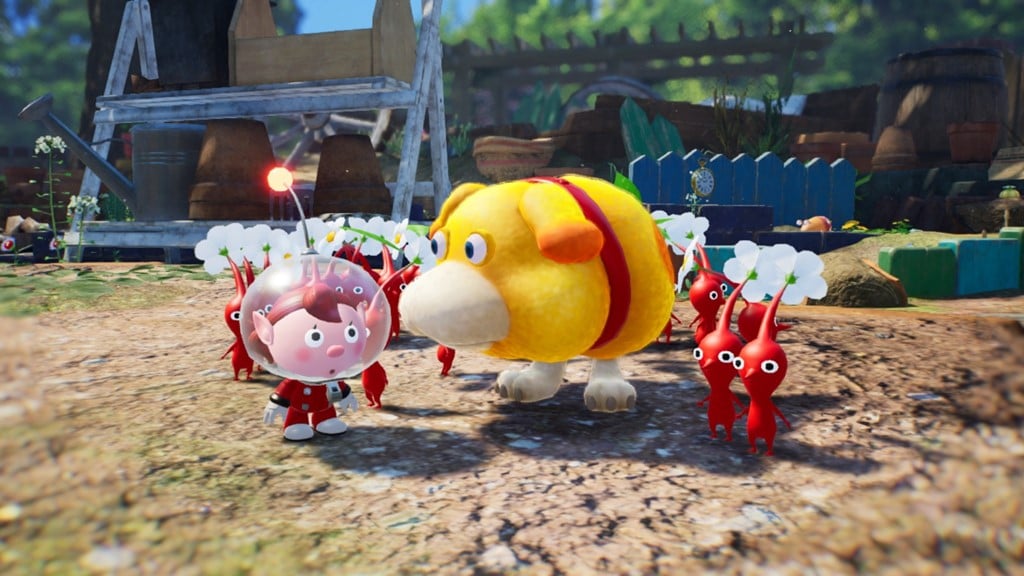
Pikmin 4 originally launched worldwide for Nintendo Switch on July 21, 2023. The adventure follows a newly recruited Rescue Corps member exploring a mysterious planet with Pikmin and the rescue pup Oatchi. Its lower camera perspective, detailed environments and close-up character interactions gave the sound team opportunities that were less prominent in earlier entries.
The game can also be played on Nintendo Switch 2 through backward compatibility, but Nintendo has not officially announced a dedicated Pikmin 4 Nintendo Switch 2 Edition. Rumours about a possible enhanced release should therefore be treated separately from confirmed information. Regardless of platform speculation, Furukawa’s explanation provides a fascinating look at the original game’s production and the thoughtful work hidden inside sounds players may hear hundreds of times without stopping to examine them.
Conclusion
Pikmin 4’s soundscape succeeds because it does more than imitate the noises made by tiny objects. Nintendo’s team carefully balanced scale, responsiveness and material detail so every movement could feel both miniature and satisfying. Human footsteps supplied weight, crushed gravel introduced smaller textures and familiar materials such as cardboard and aluminium foil helped each surface develop its own physical character. Camera distance further changed the listening perspective, bringing players closer to the world whenever they lowered their viewpoint. Furukawa’s reflections show that memorable sound design often begins with ordinary observations. A tap on a desk or a handful of gravel may not seem remarkable, but in the right hands, those sounds can help an entire alien planet feel alive beneath your feet.
FAQs
- Who led the sound design work on Pikmin 4?
- Taiyo Furukawa served as sound design lead on Pikmin 4. He helped establish the game’s overall audio concept and supervised whether sounds created by other staff matched that direction.
- Why was Pikmin 4’s closer camera important for its sound effects?
- The lower and more flexible camera placed players closer to the protagonist and Pikmin. Nintendo adjusted nearby sounds to resemble what someone might hear with their ear positioned close to the ground or another surface.
- How were the protagonist’s footsteps in Pikmin 4 created?
- The footsteps combined part of a human footstep with a smaller texture created by fingers pressing into gravel. This mixture provided satisfying contact while preserving the character’s miniature scale.
- What everyday materials were used for Pikmin 4’s sounds?
- Furukawa mentioned materials including gravel, cardboard and aluminium foil. Their distinctive textures and resonances helped Nintendo make different surfaces feel physical beneath the protagonist’s feet.
- Has Nintendo announced a Pikmin 4 Nintendo Switch 2 Edition?
- No dedicated Pikmin 4 Nintendo Switch 2 Edition has been officially announced. The original Nintendo Switch release can be played on Nintendo Switch 2 through backward compatibility.
Sources
- 仕事を読み解くキーワード:小さな生き物が聞いている音を作る, Nintendo, June 2026
- Pikmin 4 Sound Design Lead Talks About Working on the Game’s Sound Effects, Nintendo Everything, June 27, 2026
- Pikmin 4, Nintendo, July 21, 2023
- Ask the Developer Vol. 10, Pikmin 4 – Part 1, Nintendo, July 18, 2023
- Ask the Developer Vol. 10, Pikmin 4 – Part 2, Nintendo, July 18, 2023