














Summary:
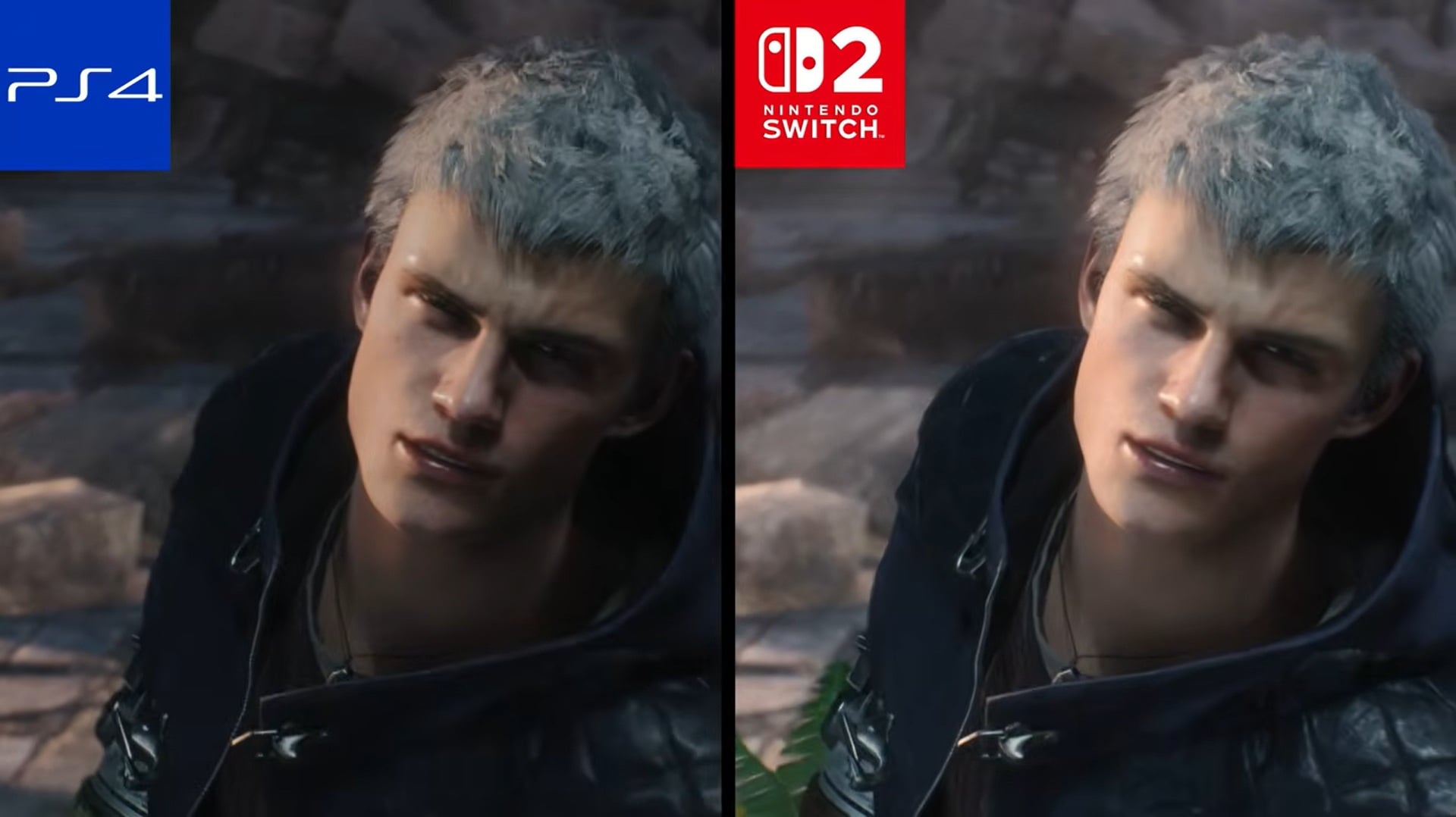
Devil May Cry 5: Devil Hunter Edition has arrived on Nintendo Switch 2 with an unexpectedly strong technical showing. A comparison produced by GVG places the new release alongside the original PlayStation 4 version, revealing that Capcom has preserved the visual identity of its stylish action game while delivering noticeably smoother performance. The two editions look remarkably similar during normal gameplay, although the Switch 2 image appears slightly brighter in several scenes. More importantly, the Nintendo release manages to maintain a mostly stable 60 frames per second, avoiding many of the drops that could affect the PS4 version during demanding battles and cinematic sequences.
The biggest surprise is the discovery that Devil May Cry 5 can run above 60 FPS on Nintendo Switch 2 and may reach up to 120 FPS. Players must enable the console’s 120 Hz Output option before the game can attempt these higher frame rates. A compatible television or monitor is required to display the full result while playing in docked mode, but the option still gives owners more flexibility than many expected from this version. The frame rate will not remain fixed at 120 FPS in every scene, yet measurements regularly rise well above 60 FPS. Combined with its portable support and remarkably faithful presentation, Devil May Cry 5: Devil Hunter Edition stands as an impressive demonstration of what Capcom can achieve on Nintendo’s newer hardware.
Devil May Cry 5 looks remarkably familiar on Nintendo Switch 2
Devil May Cry 5 has never been a quiet or visually restrained game. It throws demonic creatures, glowing attacks, collapsing scenery, flying debris, and enough dramatic poses to fill an entire heavy-metal album cover onto the screen. Bringing all of that to a portable console without losing the game’s identity was never going to be a small task. Yet the Nintendo Switch 2 edition remains impressively close to the PlayStation 4 release in GVG’s direct comparison. Character models retain their detailed clothing, hair, weapons, and facial features, while environments continue to present the crumbling streets, grotesque organic structures, and elaborate effects that define the adventure.
That similarity matters because Devil May Cry 5 relies on presentation as much as mechanical precision. Its battles are supposed to look theatrical. Dante doesn’t merely defeat an enemy when he can humiliate it with a motorcycle, a sword, several firearms, and a perfectly timed one-liner. The Switch 2 version preserves that energy rather than making the game feel like a heavily reduced substitute. Small compromises may become visible when individual frames are enlarged or placed side by side, but the overall impression remains remarkably faithful. During ordinary play, most people will probably be far more focused on maintaining a stylish combo than examining a distant wall texture.

Visual differences between the Switch 2 and PS4 releases
The most immediately noticeable visual difference is the brightness of the Nintendo Switch 2 image. In matching scenes, the newer release can look slightly brighter than the PS4 edition, making shadowed areas and darker surfaces a little easier to distinguish. This does not completely change the atmosphere or transform the game’s artistic direction. Devil May Cry 5 still uses heavy shadows, rich reds, muted city streets, and eerie organic environments to create its demonic tone. The difference is closer to adjusting a display setting by a small amount than switching on the lights in a dark room.
Whether the brighter presentation is preferable will depend on personal taste and the screen being used. Some players may appreciate the added visibility, especially during frantic encounters where enemies, particle effects, and environmental details can overlap. Others may prefer the slightly darker contrast of the PS4 release. Display calibration may also influence how obvious the difference appears. A television with aggressive brightness settings could exaggerate it, while a well-calibrated monitor may make it less pronounced. What matters most is that the Switch 2 edition does not appear dramatically compromised. It remains recognisably Devil May Cry 5, with its effects, character detail, animation, and exaggerated visual style intact.
A mostly locked 60 FPS transforms the portable experience
The strongest part of the Nintendo Switch 2 conversion is its frame rate. GVG’s analysis indicates that the game runs at a mostly locked 60 frames per second during standard play. That target is especially valuable for Devil May Cry 5 because combat depends on quick reactions, precise inputs, animation timing, and the ability to read several threats at once. A steadier frame rate does more than make the image look smoother. It helps attacks feel more responsive and makes rapid combinations easier to follow, particularly when Nero, Dante, V, or Vergil begins filling the screen with increasingly elaborate moves.
Fast action games can feel awkward when performance rises and falls unpredictably. It is a little like trying to dance while someone keeps changing the speed of the music. You may still know every step, but maintaining the rhythm becomes more difficult. A stable 60 FPS creates a more consistent connection between the player’s input and the resulting action. It also strengthens the visual impact of enemy animations, weapon effects, camera movement, and rapid dodges. Having that experience available on a Nintendo handheld is particularly notable. Players can now carry one of Capcom’s most mechanically demanding action games with them without accepting the 30 FPS target commonly associated with ambitious portable conversions.
How Nintendo Switch 2 improves upon the PS4 frame rate
The PlayStation 4 version generally aimed for 60 FPS, but it could fall below that target when the action became demanding. Cutscenes were particularly prone to larger drops, with some sequences descending into the 30 or 40 FPS range. Gameplay could also fluctuate depending on the scene, number of enemies, effects, and environmental complexity. The experience remained playable and was widely praised when it originally launched, but the performance was not completely locked. Those variations become easier to notice when the PS4 release is placed directly beside the Switch 2 conversion.
On Nintendo Switch 2, the frame rate appears steadier across comparable material. The improvement does not mean every moment is guaranteed to remain perfectly fixed at 60 FPS, but consistency is clearly stronger in the footage examined by GVG. This creates an unusual situation in which a portable-capable Nintendo system can provide smoother performance than the original home-console release. Hardware has naturally moved forward since the PS4 version appeared, yet the result remains striking. Nintendo systems have often received action-game conversions with obvious frame-rate compromises. Here, the opposite is true. The Switch 2 version can outperform the older console edition while retaining a very similar visual presentation.
Devil May Cry 5 can reach up to 120 FPS on Switch 2
The comparison uncovered an option that was not widely discussed before release: Devil May Cry 5 can attempt to run at up to 120 FPS on Nintendo Switch 2. When the console’s 120 Hz output is enabled, the frame rate is no longer restricted to the standard 60 FPS presentation. Measurements can climb significantly higher, sometimes approaching the upper 120 FPS limit. It does not remain at 120 FPS throughout every battle, cinematic, and environment, so this should be viewed as a variable high-frame-rate mode rather than a perfectly locked performance setting.
Even with those fluctuations, spending much of the game above 60 FPS can make motion look clearer and controls feel more immediate on a suitable display. The benefit is most noticeable during rapid camera turns, enemy attacks, evasive movements, and complex combos. Devil May Cry 5 is an ideal candidate for this kind of option because its combat encourages players to react quickly while chaining several actions together. It is also a welcome choice rather than a requirement. Players who value predictability can remain with the regular 60 FPS presentation, while owners of compatible equipment can experiment with the higher output and decide which experience feels best.
How to activate 120 Hz Output on Nintendo Switch 2
Enabling the higher frame-rate output requires a change within the Nintendo Switch 2 system settings. From the HOME Menu, open System Settings and navigate to the Display options. Find the setting labelled 120 Hz Output and enable it. Once active, Devil May Cry 5 can attempt to render above 60 FPS when the hardware and connected display allow it. Players using the console in docked mode will need a television or monitor that supports a 120 Hz signal. The display, cable, dock connection, and selected input must all support the required output for the full effect to appear correctly.
Some televisions only permit 120 Hz through specific HDMI ports, so it may be necessary to consult the display’s settings or manual. Game Mode is also worth enabling because it usually reduces input latency and disables unnecessary image processing. Players should remember that selecting 120 Hz Output does not guarantee a constant 120 FPS. The game uses the additional headroom when possible, which means performance may fluctuate according to the complexity of the scene. Think of 120 FPS as the ceiling rather than the floor. Even so, frame rates that regularly rise beyond 60 FPS can provide a meaningful improvement for players with compatible displays.
What players should expect in handheld and docked modes
In handheld mode, the key attraction is having a responsive 60 FPS version of Devil May Cry 5 available without a television. That is no small achievement. The game was built around detailed environments, realistic characters, dramatic lighting, and combat sequences filled with layered visual effects. Playing it on a portable screen may naturally make minor differences in resolution or fine detail harder to notice. What remains obvious is the fluidity of the action, which is arguably more important for this particular game than inspecting every brick, demon tooth, or strand of Dante’s magnificently rebellious hair.
Docked play introduces the possibility of using the 120 Hz output on compatible equipment. It also presents the image on a larger screen, where smaller visual differences between versions may become easier to identify. Players who prioritise stable performance may prefer the regular 60 FPS mode, while those who own a 120 Hz television or monitor can take advantage of the unlocked frame rate. The important point is that both styles of play receive a strong experience. Handheld users gain portability without sacrificing the standard 60 FPS target, and docked users receive an optional route to even smoother performance.
Why this port is an encouraging sign for Nintendo Switch 2
Devil May Cry 5: Devil Hunter Edition demonstrates that technically ambitious games from the previous console generation can translate well to Nintendo Switch 2. It does not merely run on the system. It preserves the visual character of the PS4 edition, improves frame-rate consistency, and includes an option that lets performance rise beyond 60 FPS. That combination is more meaningful than a simple resolution comparison because it affects how the game feels in the player’s hands. Devil May Cry 5 lives and dies by responsiveness, and the Nintendo version appears to understand that priority.
The conversion also provides an encouraging example of Capcom’s support for Nintendo’s hardware. A strong release can make other demanding games feel more plausible, particularly when studios are willing to balance image quality, resolution, effects, and frame rate carefully. Not every title will achieve the same result, of course. Different engines and game designs bring different challenges. Still, this is the sort of release that makes players look at the console with fresh curiosity. When a portable system can offer a mostly locked 60 FPS experience and venture into 120 FPS territory, the familiar question of whether a game can run on Nintendo hardware starts to feel a little outdated.
Conclusion
Devil May Cry 5: Devil Hunter Edition is shaping up as a remarkably capable Nintendo Switch 2 conversion. The visual comparison with PS4 shows two releases that remain closely matched, aside from a slightly brighter image on Nintendo’s system and the usual smaller differences that become visible under close inspection. The more important advantage is performance. Switch 2 maintains a mostly stable 60 FPS, avoiding many of the dips seen in the original PS4 version, including the more noticeable drops that occurred during certain cinematic sequences.
The optional 120 Hz output makes the package even more interesting. It cannot promise a permanently locked 120 FPS, but it allows compatible displays to show frame rates well above 60 FPS when conditions permit. For a game built around speed, timing, and theatrical combat, that additional responsiveness is a valuable extra rather than an empty specification. Whether played on the portable screen or connected to a modern television, Devil May Cry 5 gives Switch 2 owners a smooth and visually faithful way to hunt demons, chase higher style ranks, and watch Dante treat an apocalyptic crisis like another excuse to show off.
FAQs
- Does Devil May Cry 5 run at 60 FPS on Nintendo Switch 2?
- Yes. Devil May Cry 5: Devil Hunter Edition targets 60 FPS on Nintendo Switch 2 and appears to maintain that target during most of the tested gameplay. Its performance is generally steadier than the original PS4 release, which could experience drops during demanding scenes and cutscenes.
- Can Devil May Cry 5 reach 120 FPS on Nintendo Switch 2?
- Yes. The game can run above 60 FPS and may reach up to 120 FPS after the console’s 120 Hz Output option is enabled. Performance is variable, so it should not be interpreted as a locked 120 FPS mode in every scene.
- How do you enable 120 FPS in Devil May Cry 5?
- Open System Settings from the Nintendo Switch 2 HOME Menu, enter the Display options, and enable 120 Hz Output. A compatible 120 Hz television or monitor is required to see the full benefit when the console is docked.
- Does the Switch 2 version look different from the PS4 release?
- The two versions look very similar in direct comparisons. The Nintendo Switch 2 presentation appears slightly brighter in some scenes, but character models, environments, effects, and the overall artistic style remain close to the PS4 edition.
- When was Devil May Cry 5: Devil Hunter Edition released for Switch 2?
- Devil May Cry 5: Devil Hunter Edition was released digitally for Nintendo Switch 2 on June 23, 2026. The edition includes the main adventure, Vergil, and a selection of previously released additional material.
Sources
- Devil May Cry 5 on Switch 2 Can Hit 120fps, GVG, June 24, 2026
- Video: Devil May Cry 5 Nintendo Switch 2 vs. PS4 Comparison, Can Hit 120 FPS on Nintendo’s Console, Nintendo Everything, June 25, 2026
- Devil May Cry 5 Devil Hunter Edition to Launch on Nintendo Switch 2, Capcom, June 10, 2026
- Devil May Cry 5 Devil Hunter Edition, Nintendo, June 23, 2026
- Devil May Cry 5 Devil Hunter Edition Switch 2 Review: Still Schooling Modern Action Games, Creative Bloq, June 22, 2026