














Summary:
SEGA is bringing Shinobi: Art of Vengeance to Nintendo Switch 2 on September 24, 2026, giving Joe Musashi another opportunity to draw his blade on Nintendo hardware. Developed by Lizardcube, the studio known for Streets of Rage 4, the stylish 2D action platformer first appeared on the original Nintendo Switch and other platforms in August 2025. Its dedicated Nintendo Switch 2 edition will improve the resolution, allowing the hand-drawn environments, energetic animations and rapid combat effects to appear sharper on the newer system.
The adventure follows Joe Musashi after his village is destroyed and the members of his clan are mysteriously turned to stone. That tragedy sends the legendary ninja on a relentless mission against a powerful evil. Along the way, players use the Katana Oborozuki, kunai, Ninjutsu techniques, Ninpo attacks, Amulets and specialised Ningi tools. These abilities support both fast-paced battles and exploration across more than a dozen stages, including military compounds, laboratories, urban environments and scorching deserts.
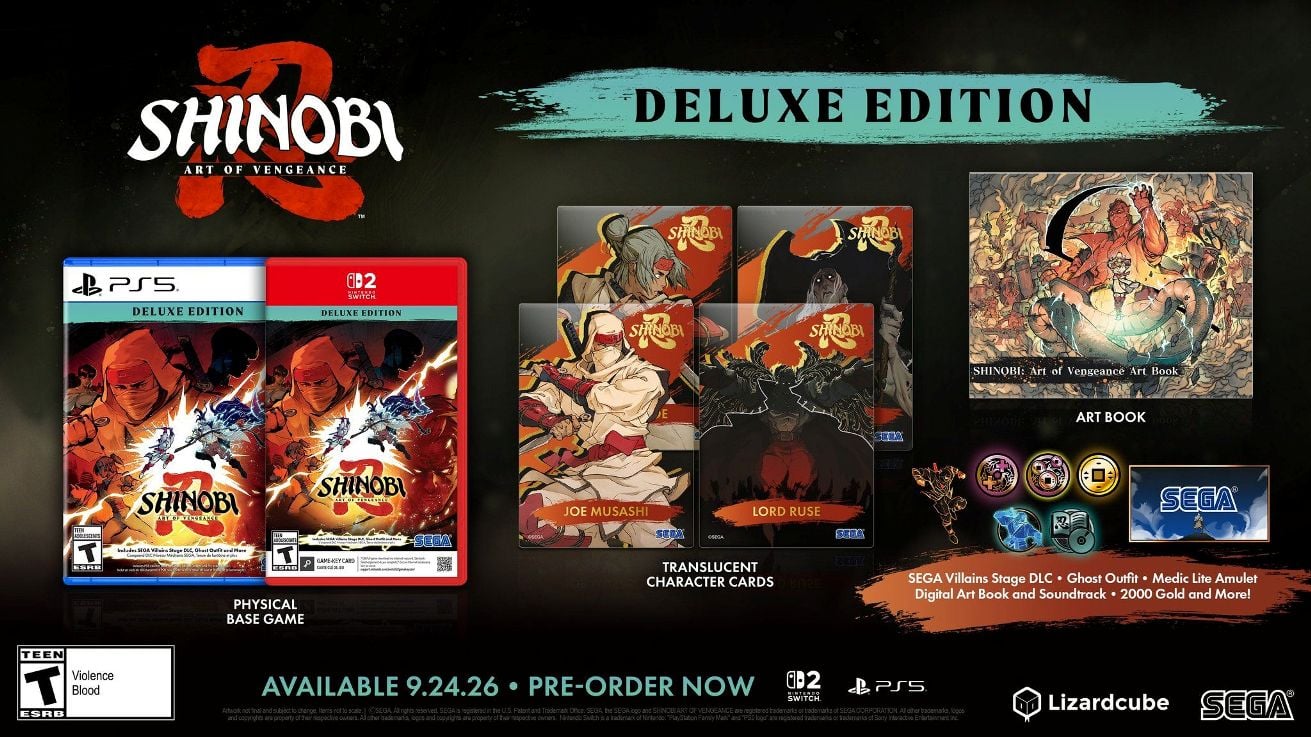
SEGA plans to offer the Nintendo Switch 2 edition digitally and physically. However, collectors should know that the boxed release uses a game-key card rather than storing the complete software on the card. The physical package does offer additional appeal through included downloadable material and collectible bonuses. With its expressive artwork, responsive combat and mixture of platforming and exploration, Shinobi: Art of Vengeance looks ready to make a cleaner and sharper impression on Nintendo Switch 2.
Shinobi: Art of Vengeance is coming to Nintendo Switch 2
Joe Musashi is preparing to strike again, as SEGA has confirmed that Shinobi: Art of Vengeance will launch for Nintendo Switch 2 on September 24, 2026. This is a dedicated version for Nintendo’s newer hardware rather than a simple backward-compatible listing of the existing Nintendo Switch release. The announcement gives players who skipped the original edition a fresh entry point, while longtime Shinobi followers get another reason to revisit one of SEGA’s most recognisable action heroes. It also feels like a natural fit for a hybrid console. Shinobi has always worked best when movement, timing and immediate controls take centre stage, and those qualities translate neatly to both handheld and television play. You can picture it already: one more attempt at a difficult platforming sequence becomes five, and suddenly the battery warning appears. Ninja discipline clearly has its limits.
The Nintendo Switch 2 edition arrives more than a year after the game’s original August 2025 debut. That gap gives this version an unusual position. It isn’t launching alongside the other editions, but it also isn’t being presented as a remake or major reworking. Instead, SEGA is highlighting an improved technical presentation while retaining the underlying adventure developed by Lizardcube. For newcomers, that means the complete journey is waiting from day one. Returning players, meanwhile, will need to decide whether the visual improvement and available edition bonuses make another purchase worthwhile.

Improved resolution gives the hand-drawn world a sharper presentation
The main technical enhancement confirmed for Nintendo Switch 2 is improved resolution. SEGA has not provided a precise pixel count or detailed comparison between handheld and docked play, so it would be premature to attach specific numbers to the release. Still, resolution matters more than you might expect in a game built around detailed hand-drawn artwork. Fine outlines, background scenery, particle effects and rapid character animations can lose some of their clarity when the image is rendered at a lower resolution. A sharper output should help the environments look cleaner and make Joe Musashi’s movements easier to follow during busy encounters.
That improvement is especially relevant because Shinobi: Art of Vengeance rarely sits still. Enemies rush in from multiple directions, blades flash across the screen and special abilities fill the battlefield with vivid effects. It is less like admiring a framed painting and more like watching the painting leap from the wall and challenge you to a duel. Better image clarity can therefore support both presentation and playability. Hazards may be easier to identify, distant platforms should appear more defined and the game’s expressive animation can retain more of its original detail. SEGA has not confirmed additional performance upgrades, so improved resolution remains the clearest distinction currently attached to the Nintendo Switch 2 edition.
Joe Musashi returns for a personal mission of vengeance
Shinobi: Art of Vengeance places players in control of Joe Musashi, the legendary ninja who has represented the series across several generations of SEGA hardware. His latest mission begins with a devastating discovery. Joe returns to find his village burned and the members of his clan transformed into stone. The destruction turns the adventure into something more personal than a routine battle between a hero and another ambitious villain. Joe isn’t chasing glory or treasure. He is pursuing the force responsible for taking away his home, his people and the life he once knew.
The straightforward setup suits the fast pace of the experience. There is no need for an hour of political debate before the first blade leaves its sheath. The motivation is immediate, understandable and powerful enough to carry Joe across a long chain of hostile locations. That simplicity also echoes the arcade roots of Shinobi, where a clear objective pushed players forward while the action supplied most of the drama. Lizardcube builds on that foundation with animated scenes, expressive environments and a visual style that gives Joe’s anger a tangible weight. Every attack feels like another step towards settling a very large and extremely sharp-edged score.
Precision combat combines steel, kunai and ninja techniques
Joe enters battle with a varied arsenal designed to handle enemies at close range, from a distance and everywhere in between. His central weapon is the Katana Oborozuki, a powerful blade used to carve through opponents with quick strings of attacks. Kunai let him target distant threats, interrupt enemy movements and maintain pressure while navigating platforms. Ninjutsu techniques and Ninpo abilities add another layer, giving players powerful options when ordinary swordplay is not enough. Together, these tools make Joe feel adaptable rather than locked into one repetitive attack pattern.
Precision sits at the heart of the system. Hammering the same button may deal with a weak opponent, but tougher encounters encourage careful positioning, intelligent use of abilities and an awareness of what every enemy is doing. A well-timed attack can keep a combo alive, while a poorly judged leap may send Joe directly into a hazard. The rhythm resembles a choreographed martial arts scene in which the player controls every cut, dodge and sudden burst of movement. When everything flows correctly, Joe seems untouchable. When it falls apart, the screen can become a crowded reminder that even legendary ninjas benefit from practice.
Combos and custom abilities reward experimentation
Combat becomes more flexible as players learn new moves and begin connecting attacks into increasingly elaborate combinations. Joe can move between grounded strikes, aerial techniques, kunai throws and special abilities without forcing every battle into the same pattern. This freedom encourages experimentation. One player may focus on aggressive close-range pressure, while another might prefer to control space with ranged attacks before closing the distance. The system rewards creativity, but it also asks players to understand timing. A long combination is satisfying only when the next attack lands before the enemy escapes or retaliates.
Amulets provide another route for customisation by enhancing particular abilities or supporting different approaches. They allow players to shape Joe around preferred tactics instead of accepting one fixed setup throughout the entire adventure. That flexibility can also make difficult encounters feel less rigid. When a strategy fails repeatedly, changing an Amulet or adjusting the balance between melee and ranged attacks may reveal a better solution. It is the ninja equivalent of checking the toolbox rather than repeatedly hitting the same locked door with your forehead. The game wants players to improve their execution, but it also gives them meaningful equipment choices that can support that improvement.
Ningi tools open routes through varied stages
Joe’s abilities are not limited to combat. Special Ningi tools help him overcome obstacles, interact with the environment and reach paths that were previously inaccessible. These tools give the stages a stronger sense of progression because new abilities can change how players view familiar areas. A suspicious wall, unreachable ledge or blocked passage may become important later, encouraging players to remember locations and return when Joe has the right equipment. Exploration therefore works alongside the main action instead of feeling like a completely separate activity.
The game includes more than a dozen stages, and the environments cover a broad range of themes. Joe moves through fortified military areas, dangerous industrial facilities, harsh desert landscapes and other visually distinctive locations. Each setting introduces its own mixture of enemy formations, platforming challenges and hidden routes. The changes in scenery help the journey maintain momentum, but they also influence how players move. A tightly guarded base creates a different rhythm from an open desert filled with environmental hazards. The result is an adventure that regularly asks you to reassess the space around Joe rather than sprinting from left to right with all the caution of a runaway shopping trolley.
Secrets and platforming make exploration worthwhile
Hidden areas and optional discoveries provide a reason to look beyond the most obvious path. Players who rush towards the exit can still enjoy the central action, but those who inspect unusual corners and experiment with Joe’s mobility may uncover additional rewards. These secrets turn each stage into more than a corridor filled with enemies. Walls, platforms and environmental objects can all hint at something concealed nearby, giving observant players a reason to slow down between battles.
Platforming challenges also test a different side of Joe’s skill set. Combat asks players to read enemies, while traversal demands control over momentum, jumping and the timing of special movements. Switching between those demands keeps the experience lively. One moment may involve a crowded arena, while the next asks for a precise sequence across moving platforms and lethal hazards. The hand-drawn animation helps these transitions feel smooth because Joe’s movements remain expressive whether he is attacking an opponent or navigating the environment. It is a demanding life, but at least he never has to stop and search for a bus timetable.
Lizardcube gives Shinobi a striking hand-drawn identity
Lizardcube’s visual direction is one of the defining qualities of Shinobi: Art of Vengeance. The Paris-based studio previously worked on Wonder Boy: The Dragon’s Trap and Streets of Rage 4, establishing a reputation for reviving classic properties without stripping away their personality. Its approach to Shinobi follows a similar philosophy. The game respects the fast, direct action associated with the older releases while presenting Joe’s world through fluid hand-drawn characters and richly illustrated environments.
This visual identity helps the revival stand apart from both pixel-art throwbacks and fully three-dimensional action games. Joe’s silhouette remains immediately recognisable, but his movements carry a level of detail that makes every slash and landing feel animated rather than mechanically assembled. Enemies react with exaggerated force, scenery stretches into layered backgrounds and special attacks erupt with the energy of an animated feature. Improved resolution on Nintendo Switch 2 should complement that work by preserving more of its fine detail. For a game called Art of Vengeance, looking like a moving piece of artwork isn’t merely a pleasant bonus. It is woven directly into the name and personality of the experience.
Physical and digital editions offer different buying options
SEGA plans to release Shinobi: Art of Vengeance for Nintendo Switch 2 through both digital and physical channels. The digital edition offers the most straightforward route, allowing players to download the game directly from the Nintendo eShop. Nintendo’s official listing estimates a file size of 12 GB, although platform holders note that such details can change before release. The game supports television, tabletop and handheld play, making it possible to continue Joe’s journey in whichever Nintendo Switch 2 configuration suits the moment.
The physical option is aimed at players who prefer a boxed edition or want the extra items associated with the retail package. However, the box does not contain a conventional cartridge holding the complete game. That distinction will be important for collectors, preservation-minded buyers and anyone with limited internet access. A physical case may look handsome on a shelf, but the way the included card works determines how independent the purchase is from Nintendo’s download infrastructure. Buyers should therefore examine the packaging and edition details rather than assuming every red box functions in exactly the same way.
The physical release uses a Nintendo Switch 2 game-key card
The boxed Nintendo Switch 2 edition uses a game-key card. This type of card acts as a key for downloading and launching the software rather than containing the full game data. Players will need an internet connection to download the game before playing it for the first time. After installation, the game-key card must remain inserted when the software is launched, much like a standard cartridge is required for a traditional physical release.
That format is likely to divide the audience. Some players will appreciate having a resellable card, a display case and physical bonuses, while others may feel that a retail release should contain the complete game. Both reactions are understandable. The important point is that prospective buyers know what they are purchasing before reaching the checkout. Calling it physical without explaining the download requirement would be like handing someone a treasure map while quietly forgetting to mention that the treasure is stored online. The package has physical value, but it does not provide the same self-contained experience as a complete cartridge.
Deluxe Edition extras expand Joe Musashi’s adventure
The Deluxe Edition bundles the main adventure with additional digital material. Its extras include the SEGA Villains Stage downloadable expansion, the Ghost Outfit, the Medic Lite Amulet, 2,000 units of in-game gold, a digital art book and a digital soundtrack. The package also includes promotional equipment such as the Original Arcade Outfit and Fortune Hunter Amulet. These additions provide a mixture of cosmetic items, useful equipment and extra playable material rather than relying on a single bonus.
The SEGA Villains Stage is the most substantial component because it adds crossover encounters involving familiar figures from other SEGA properties. The downloadable expansion includes additional stages, music, bosses, Ninpo abilities, outfits and challenge modes. Players who primarily want Joe’s core mission can choose the standard edition, while those interested in the crossover material may find the Deluxe Edition more convenient. As always, it is worth separating playable additions from digital collectibles. A soundtrack and art book can be enjoyable, but they do not alter the campaign in the same way as new stages and bosses. Even a master ninja should inspect the inventory before spending extra gold.
The Switch 2 release introduces Shinobi to another audience
Although Shinobi: Art of Vengeance is already available on the original Nintendo Switch, a dedicated Nintendo Switch 2 edition gives the game another moment in the spotlight. That matters for a series returning after a long absence from major releases. Many younger players may recognise SEGA through Sonic the Hedgehog, Like a Dragon or Persona without having much experience with Joe Musashi. A sharper edition on current hardware can help introduce his style of action to an audience that never encountered the arcade games or classic console entries.
The timing also benefits players who prefer to wait for later editions. By September 2026, the game will have an established history, downloadable additions and plenty of information available about how its systems work. Newcomers will not have to make a decision based solely on a reveal trailer. They can see how the combat, exploration and artwork have been received before choosing an edition. At the same time, the release demonstrates that SEGA still sees value in supporting Shinobi beyond its initial launch window. Joe Musashi has spent enough years in the shadows. Giving him another platform is a welcome way to keep the blade moving.
What remains unconfirmed ahead of launch
Several technical and purchasing details have not yet been clearly confirmed. SEGA has announced improved resolution, but it has not specified the exact rendering resolution, frame rate targets or differences between handheld and docked play. There is also no confirmed upgrade route for owners of the original Nintendo Switch edition. Existing players should therefore avoid assuming that their current purchase automatically grants access to the Nintendo Switch 2 version or that a discounted upgrade will become available.
Save-data transfer details also remain unclear. Because the Nintendo Switch 2 edition is listed as a separate release, players who completed part of the original version should wait for an official explanation before expecting their progress to carry over. These unanswered questions do not change the confirmed release date or core features, but they may influence whether returning players buy the game again. SEGA has several months to clarify the remaining points before September 24, 2026. Until then, the safest approach is simple: enjoy the confirmed trailer and features, but keep speculative numbers sheathed until official information appears.
Conclusion
Shinobi: Art of Vengeance will arrive on Nintendo Switch 2 on September 24, 2026, bringing Joe Musashi’s hand-drawn mission of revenge to the newer system with improved resolution. The game combines precise sword combat, kunai, Ninjutsu, Ninpo abilities, customisable Amulets and exploration tools across more than a dozen varied stages. Lizardcube’s expressive visual direction gives the classic SEGA series a modern identity without abandoning the fast action that made Shinobi memorable. Digital and boxed editions will be available, although physical buyers should remember that the retail version uses a game-key card and requires a download. Deluxe Edition bonuses add costumes, equipment, music, artwork and the SEGA Villains Stage expansion. Questions remain about frame rate, exact resolution, save transfers and a possible upgrade route, but the confirmed package already offers a sharp opportunity for new players to discover why Joe Musashi remains one of SEGA’s most enduring heroes.
FAQs
- When will Shinobi: Art of Vengeance launch on Nintendo Switch 2?
- SEGA will release the Nintendo Switch 2 edition on September 24, 2026.
- What is improved in the Nintendo Switch 2 version?
- SEGA has confirmed improved resolution for the Nintendo Switch 2 edition. Exact resolution and frame rate specifications have not yet been announced.
- Will Shinobi: Art of Vengeance receive a physical release?
- Yes. A boxed edition is planned, but it uses a Nintendo Switch 2 game-key card and requires the game data to be downloaded.
- Who developed Shinobi: Art of Vengeance?
- The game was developed by Lizardcube, the studio known for Wonder Boy: The Dragon’s Trap and Streets of Rage 4, and published by SEGA.
- Can Nintendo Switch owners upgrade to the Switch 2 edition?
- SEGA has not confirmed a free or paid upgrade route for owners of the original Nintendo Switch version.
Sources
- SHINOBI: Art of Vengeance, SEGA, June 18, 2026
- SHINOBI: Art of Vengeance for Nintendo Switch 2, Nintendo, June 18, 2026
- Shinobi: Art of Vengeance coming to Nintendo Switch 2, Nintendo Everything, June 18, 2026
- Shinobi: Art of Vengeance Is Getting A Switch 2 Release This September, Nintendo Life, June 19, 2026
- Shinobi: Art of Vengeance, Lizardcube, February 12, 2025