














Summary:
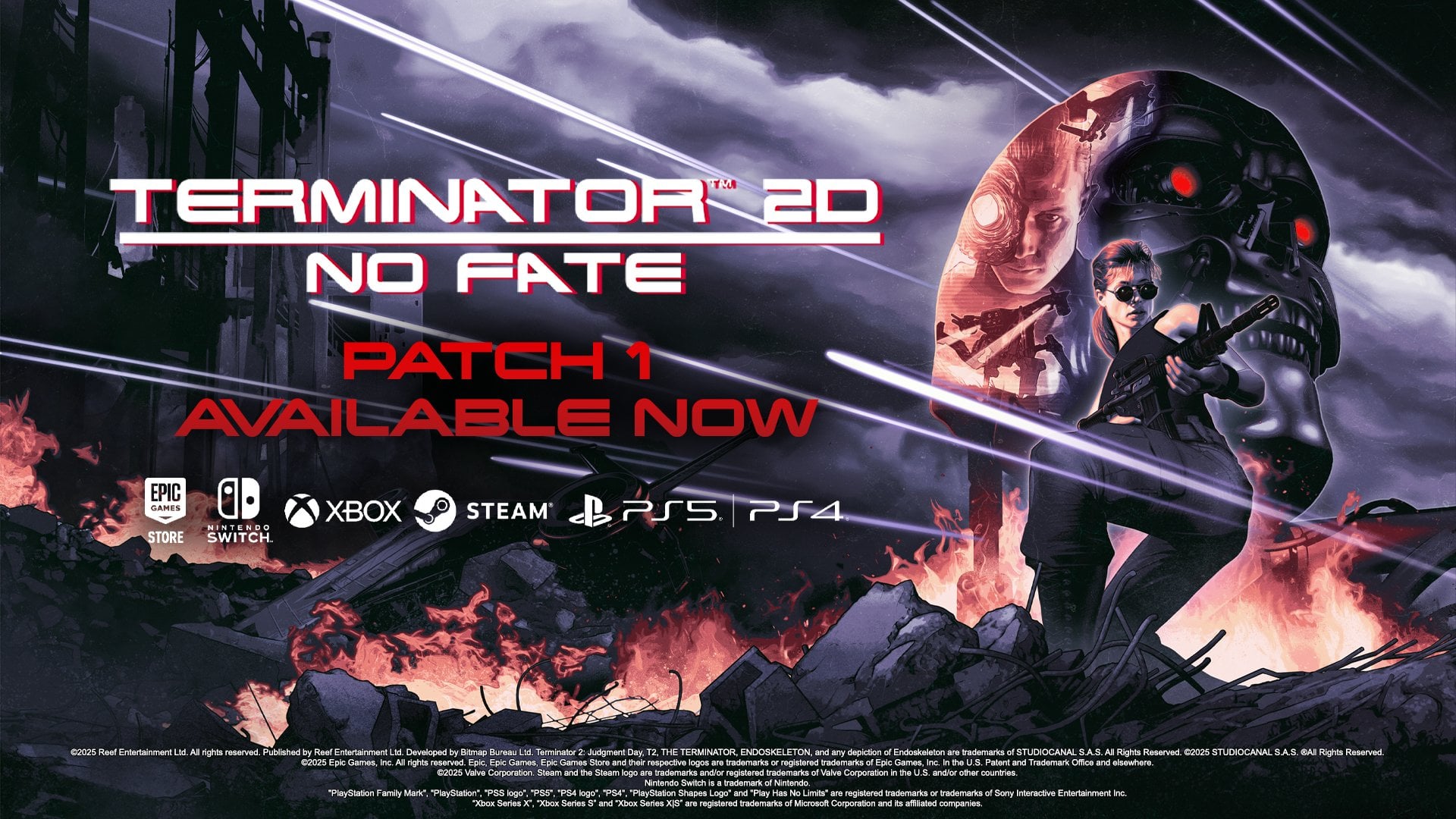
Terminator 2D: No Fate has received a substantial update on Nintendo Switch, bringing a mixture of new features, progression improvements, achievement fixes, balance adjustments and presentation upgrades. One of the most immediately useful additions is a completion percentage displayed through the title screen menus. It gives players a clearer sense of how much remains by considering unlocked paths, difficulty progress, achievements, secrets and level ranks. Story Mode has also become more convenient, as saved progress can now return players to their most recent checkpoint in many levels instead of forcing them to restart the entire stage.
The update also introduces a streamer music mode designed to bypass licensed tracks, a toggle for hiding control tutorials and easier access to Level Training. Players can now unlock training stages simply by reaching them, rather than having to finish them first. Elsewhere, the primary Story Mode path and Arcade Mode gain a new T-800 bonus section inside Cyberdyne HQ: Infiltration, while the HK-BOMBER encounter receives plasma turrets and revised balancing.
Numerous achievements have been adjusted to make their conditions more reliable or easier to understand. Artwork, animation frames, hitboxes, sound effects, enemy behaviour and boss encounters have also been refined. Alongside fixes for score farming, inaccessible collectibles and incorrect music, these changes make the Nintendo Switch version smoother, fairer and more informative for both first-time players and returning resistance fighters.
Terminator 2D: No Fate Receives a Substantial Nintendo Switch Update
Skynet may be stubborn, but the developers behind Terminator 2D: No Fate are proving equally unwilling to stop improving their arcade-inspired adventure. A sizeable update is now available for the Nintendo Switch version, covering almost every corner of the experience. New menu options sit alongside progression improvements, revised checkpoints, achievement adjustments, redrawn artwork, corrected sound effects and a long list of fixes for individual stages. This is not simply a case of moving a few pixels and calling it a day. The update takes aim at several frustrations that could interrupt repeat playthroughs, particularly when players were chasing secrets, higher ranks or specific achievements. Terminator 2D: No Fate was built around branching paths and repeated runs, so clearer progression and fairer restarts can make a meaningful difference. Nobody wants to replay a lengthy sequence because real life suddenly summoned them away from the Switch. Even Sarah Connor probably has errands.
Completion Tracking Makes Every Remaining Objective Easier to Understand
A new completion percentage has been added to the title screen menus, giving players a much clearer picture of their overall progress. The percentage can be viewed by selecting Start or Options, where it appears in the upper-right area of the screen. Rather than measuring only the number of finished stages, the tracker considers several parts of the game. These include unlocked story paths, completed difficulties, achievements, discovered secrets and ranks earned across individual levels. That broader calculation fits the structure of Terminator 2D: No Fate, where completing the story once does not necessarily mean you have seen everything. Different decisions can lead towards alternate scenarios, while stronger ranks and hidden discoveries encourage further runs. The new percentage effectively acts like a dashboard for dedicated players. It may not reveal exactly where every missing objective is hiding, but it does answer the nagging question that often follows the credits: how much is actually left?
Story Mode Checkpoint Saves Reduce the Pain of Interrupted Runs
The Save Progress feature in Story Mode has also received an important improvement. When players continue a saved run, the game can now return them to the most recent checkpoint they reached instead of restarting the whole level. This applies where suitable checkpoints are available and should make longer or more demanding stages less punishing when a session has to end early. Several levels use specialised restart rules because their structures do not follow the standard medkit-based checkpoint system. Reaching The Corral in Biker Bar allows the player to resume inside it, while Truck Chase can restart at the T-1000 bridge sequence. Cyberdyne Annihilation with the T-800 can resume at its boss battle, and Cyberdyne Infiltration or Assault returns players to the latest elevator floor they reached. Freeway Chase and Steel Mill still restart from the beginning, while Desert Town remains excluded. Even with those exceptions, this is a welcome quality-of-life change for a game built around precision, momentum and repeated attempts.
Level Training and Hidden Continue Tracking Support Completionists
Level Training has become more accessible through a small but sensible change to its unlock requirements. Previously, a stage needed to be completed before it appeared in the training menu. Players now only need to reach a level for it to become available. That means a difficult encounter can be practised without first overcoming the very obstacle that made practice necessary. It is the gaming equivalent of being handed the training manual before the machine explodes, rather than afterwards. Story Mode’s ending screen has also been updated to show whether a hidden Continue was collected in each applicable level. This information is particularly useful when working towards the SKYNET SECRET FINDER achievement, since players can identify stages where an important pickup may still be missing. Together, these changes reduce unnecessary guesswork. Terminator 2D: No Fate still expects players to learn its stages and improve their performance, but it now provides better tools for doing so.
Streamer Music Mode and Tutorial Controls Provide Useful New Options
Players who broadcast or record their gameplay can now activate a dedicated streamer music mode through the Audio menu. The toggle bypasses potential problems involving licensed tracks, allowing footage to be shared without relying on quick muting, awkward editing or the streamer’s finest improvised humming. It is a practical addition that recognises how games are experienced beyond the television screen. A separate Show Tutorials option has also been placed in the Accessibility menu. Long-time players can disable control reminders for a quicker and less interrupted Story Mode run, while newcomers can leave them enabled until the mechanics feel familiar. Neither option transforms the underlying action, but both allow players to shape the experience around their needs. The Options screen now includes a View Credits selection as well, providing direct access to the credits and an opportunity to listen to one of Featurecast’s music tracks without first reaching an ending.
Cyberdyne HQ and Future War Encounters Receive Fresh Gameplay Additions
The update introduces more than menu refinements and technical corrections. A T-800 bonus section has been added to Cyberdyne HQ: Infiltration on the primary Story Mode route, expanding that path with another playable sequence. The same section is also available in Arcade Mode, giving score-focused players another encounter to master. Meanwhile, the HK-BOMBER boss found in Future War: Resistance has gained plasma turrets. Their inclusion required the fight to be rebalanced, so returning players should not assume their old strategy will work without adjustment. Freeway Chase now communicates weapon changes more clearly too. When John gives Sarah a different firearm, the exchange is accompanied by a weapon-upgrade sound and text identifying what she has received. In the middle of a frantic chase, that extra feedback matters. Players can immediately understand how their equipment has changed instead of discovering it by firing and hoping for the best.
Achievement Requirements and Troublesome Unlocks Become Clearer
Several achievements have been reviewed following reports that their conditions were confusing, unusually demanding or unreliable. The requirement to earn an S Rank on every level now has stronger support through the Story Mode end screen, which displays all 19 relevant levels. This should help players identify unfinished stages rather than assuming the achievement has failed after completing the more obvious routes. The Stealth Ninja achievement has also been made more manageable by adjusting the position and movement of the male security guard near the end of the Hospital level. Previously, his behaviour could make the required stealth sequence more difficult than intended. Additional improvements target the PARKOUR, MAN’S BEST FRIEND, HUNTER KILLER, FIND ASSAULT RIFLES and COMPLETE STORY HARD S achievements. The patch notes do not detail every internal adjustment, but the overall objective is clear: successful attempts should be recognised more consistently, and players should have a better understanding of what remains.
Secret Collectibles Are Less Likely to Block Progress
Collectible behaviour has been revised in several places, particularly where bonus skulls could interfere with the SKYNET SECRET FINDER achievement. Two additional skulls from the Future War: Resistance and Hospital stages have been removed from their normal Story Mode placements because they could occasionally prevent the achievement from unlocking. They still appear under specific conditions, including when the player already holds nine Continues and discovers a secret Skynet pickup. They also remain in Arcade Mode, where they replace the secret pickups. Another bonus skull in the first Future War stage of Arcade Mode had been positioned inside a hidden area where it could not be collected, but it is now accessible. These are easy details to underestimate until you are searching every corner of a stage and wondering whether a tiny skull has decided to join Skynet. The adjustments should make secret hunting more predictable without removing the incentive to explore.
Gameplay Balancing Removes Frustrating Attacks and Unfair Damage
Sarah Connor’s automatic melee attack has been removed because it could expose her to damage at inconvenient moments. An automatic move may sound helpful, but control is vital in an arcade-style action game where spacing and timing decide whether Sarah escapes or gets flattened by the next threat. Triggering a close-range attack unexpectedly could leave players locked into an animation or pushed towards danger. The Cyberdyne Factory’s jet flames have also received a smaller hitbox, reducing cases where Sarah appeared to clear a hazard but still took damage while jumping nearby. The Cyberdyne Research lab boss has been made slightly easier on Hard difficulty, while the green bandit positioned before Bandit Bob in Desert Town has received a behavioural adjustment. These changes do not remove the challenge. Instead, they aim to ensure that failure feels connected to the player’s decisions rather than an attack activating unexpectedly or a hazard reaching farther than its appearance suggests.
Boss Encounters Receive Targeted Fixes and Exploit Prevention
Several boss battles have been adjusted to improve fairness, presentation and scoring integrity. Hazmat enemies during the Cyberdyne Factory boss encounter can no longer be used for unintended point farming. Projectiles in the Desert Town and Future War: Redemption boss fights now travel farther into the corners, closing off positions where players could avoid danger too safely. The Centurion’s missile attack in Future War and Future War Redemption has received a visual correction on Easy Money difficulty. The animation previously displayed two missiles launching even though only one would actually attack, creating misleading visual information. The Centurion’s bullet-spray sound on that difficulty was also too short and has been fixed. During the T-808s fight in Boss Rush, one of the enemies could take too long to begin attacking, so its opening behaviour has been improved. Each fix is relatively focused, but together they make boss fights feel more deliberate and less vulnerable to odd behaviour.
Visual, Animation and Layering Improvements Strengthen Presentation
The pixel artwork has received numerous refinements across characters, objects and environments. Sarah’s quick ladder-descent animation has been adjusted, while her crouching frame in Pescadero Hospital has been redrawn. Her portrait during Future War: Resistance now better matches her appearance within the level. John Connor’s jogging animation in Desert Town has gained revised frames, and the Police Station bonus item has been visually updated to better suit its surroundings. A shadow has also been added beneath the truck at the end of Freeway Chase, helping it sit more naturally within the scene. None of these changes is likely to stop players in their tracks, but pixel art depends on precise silhouettes and carefully chosen frames. A single awkward pose can stand out when every movement is intentionally constructed. These adjustments preserve the retro appearance while improving the clarity and consistency expected from a modern release.
Corrected Sprite Layers Keep Explosions and Characters in Place
Layering errors can make a polished scene look strangely assembled, as though its characters and explosions were pasted onto transparent sheets in the wrong order. Several such problems have been corrected. When an HK-Aerial was destroyed, its explosion appeared on an incorrect layer and could overlap the sprite improperly. The explosion now displays behind the appropriate artwork. A barrel blast in Desert Town also used the wrong layer when covering an enemy positioned above it. During Truck Chase, John Connor could appear on an incorrect layer after being knocked from his bike. These problems did not necessarily alter the outcome of a level, but they could break the illusion of depth created by the backgrounds, character sprites and effects. Correcting them gives action scenes a cleaner visual hierarchy, making it immediately obvious which objects are in front, which are behind and where the impact is supposed to occur.
Level Design Changes Improve Hazards and Environmental Reactions
Cyberdyne Research and Cyberdyne Factory now make destroyed ceiling turrets more physically satisfying. When these turrets are eliminated, they can be knocked into nearby enemies, allowing a defeated hazard to become an improvised weapon. It is a fitting touch for an action game where machinery is constantly exploding and anything not bolted down may soon be flying across the room. The Steel Mill finale has also gained an extra animation for certain outcomes. When Sarah is terminated, the T-1000 may now walk towards John Connor to finish its mission, provided the level’s positioning allows the sequence to play correctly. Elsewhere in Steel Mill, Sarah will no longer continue jumping after firing the final shot at the T-1000. That behaviour could leave her appearing to float during the scene, which slightly weakened what should be one of the most dramatic moments in the game.
Individual Levels Benefit From More Consistent Setup and Behaviour
Several stages have received fixes tailored to their unique layouts. In Mother of the Future mode, Sarah previously began Freeway Chase with a pistol even though the intended version of the level called for an assault rifle. Her starting weapon now matches the run. Pescadero Hospital’s first armed male guard could continue firing in Sarah’s direction after she escaped to either of the two floors below him. His behaviour has been corrected so he no longer shoots endlessly through the level’s logic. The new T-800 sequence in Cyberdyne Infiltration required the top-floor medkit to be moved to a more suitable location. Police Station cover animations have also been improved. When Sarah rises from a crouched cover position, she now moves directly to the end of the standing cover animation rather than replaying the entire transition. These refinements help each stage respond more naturally to player movement.
Music and Sound Corrections Make Major Scenes More Convincing
The T-800’s shoulder-charge attack now uses a revised sound effect that better matches the force of the movement. Steel Mill’s ending sequence also gains a new effect when the T-800 fires a grenade at the T-1000, adding extra impact to an already memorable confrontation. Music errors affecting two Future War boss fights have been corrected as well. If the player died and used a Continue during the first form of the T-999999 battle in Future War: Retaliation, regular level music could play instead of the intended boss theme. A similar problem affected the T-808s fight in Future War: Redemption, where the HK-Tank mid-boss music could mistakenly resume. The T-808 death sound has been revised, and the Pull Trigger ending branch in Future War: Redemption now features improved effects. Pescadero Hospital’s female security guard also produces an appropriate landing sound after Sarah drops onto her from above.
Exploit Prevention and Smaller Fixes Polish the Overall Experience
The remaining changes cover localisation, cutscenes and several unusual situations that players might encounter during repeated runs. Ukrainian and Dutch text issues have been corrected, while Spanish dialogue and terminology have received multiple spelling fixes. Future War: Retaliation now properly fades its interface to white alongside the background during the transition between stages of the final boss. These are not headline additions, yet they matter because Terminator 2D: No Fate encourages replaying its branching routes across multiple modes and difficulty settings. The more often a game is revisited, the more noticeable a mistimed sound, inaccessible collectible or repeated animation becomes. This update addresses many of those rough edges while also adding genuinely useful features such as completion tracking, checkpoint recovery and streamer-friendly music settings. The result should feel less like a replacement and more like a carefully tuned version of the same arcade experience.
Conclusion
The latest Terminator 2D: No Fate update delivers the kind of improvements that can make repeat playthroughs much more inviting. The completion percentage provides a clearer sense of direction, checkpoint-based Story Mode saves respect the player’s time and Level Training is easier to access when practice is needed most. Achievement fixes and collectible adjustments should reduce situations where progress feels unclear or fails to register correctly. At the same time, revised hitboxes, enemy behaviour, boss balancing, animation frames and sound effects polish the moment-to-moment action. The addition of streamer music mode is another smart decision, especially for players sharing their runs online. Terminator 2D: No Fate remains available on Nintendo Switch, and this update gives both new recruits and experienced resistance fighters several good reasons to return. Skynet may insist that fate is inevitable, but thankfully patch notes can still change it.
FAQs
- What does the new completion percentage measure?
- The percentage considers unlocked story paths, completed difficulties, achievements, discovered secrets and ranks earned across the game’s levels.
- Does Story Mode now save progress at checkpoints?
- Yes. Continuing a saved Story Mode run now returns players to the latest applicable checkpoint in many levels, although some stages use specialised restart points or still begin from the start.
- What is streamer music mode?
- Streamer music mode bypasses potential issues involving licensed tracks, making it easier to broadcast or record gameplay. It can be enabled through the Audio menu.
- How are levels unlocked in Level Training?
- A level now becomes available for training as soon as the player reaches it. Completing the entire stage is no longer required.
- Is Terminator 2D: No Fate available on Nintendo Switch?
- Yes. Terminator 2D: No Fate is available for Nintendo Switch alongside PlayStation, Xbox and PC versions.
Sources
- Terminator 2D: No Fate Update Out Now, Patch Notes – New Features, Improvements, More, Nintendo Everything, June 26, 2026
- Reef Entertainment Announces Terminator 2D: No Fate, Reef Entertainment, February 27, 2025
- Terminator 2D: No Fate Release Date Moved to December 12, 2025, Reef Entertainment, November 5, 2025
- Terminator 2D: No Fate Releases on PlayStation, Nintendo Switch, Xbox and PC, Reef Creative Group, December 12, 2025
- Terminator 2D: No Fate Review – The Least Bad Terminator Game in a Long While, The Guardian, December 23, 2025